TL;DR: Bonfire costs nothing to use, pays you the gap between your price and the base cost, and takes a fee only on donations and tips. If you are leaving, choose by goal: Custom Ink Fundraising for a school or charity drive, a Printify Pop-Up Store or Printful Quick Store for a free shop with a big catalog, Fourthwall or Spreadshop for a creator shop, and Etsy, Amazon Merch, TeePublic or Redbubble when you want shoppers you did not bring. Every fee here was read on the platform's own site on November 25, 2026.
Bonfire made one job easy: put a shirt online, share the link, and let someone else print and post it. Schools, teams, causes and small brands have used it that way for years. So when people search for Bonfire alternatives, the plan has usually changed more than the platform: they want shoppers who find them, a payout that is not PayPal, more products, or a shop outside the US.
The wrong replacement can cost you a season. A fundraiser that misses its print minimum ships nothing, and a creator shop with no audience sits empty.
So first, what Bonfire charges, then eight Bonfire alternatives with every fee taken from the platform's own pages. Trendlytic is my company. It researches niches and prints nothing, so it is not one of the eight. Spring (formerly Teespring) is missing too: it closed on September 15, 2026, and Printful vs Spring explains what happened.
How Bonfire works and what it costs (November 2026)
You design a product, set a price, and sell in batches or on demand. What you earn is the selling price minus the base cost, and that cost moves with the product, the ink colors, one or two print sides, and how many items sell (help.bonfire.com, November 2026).
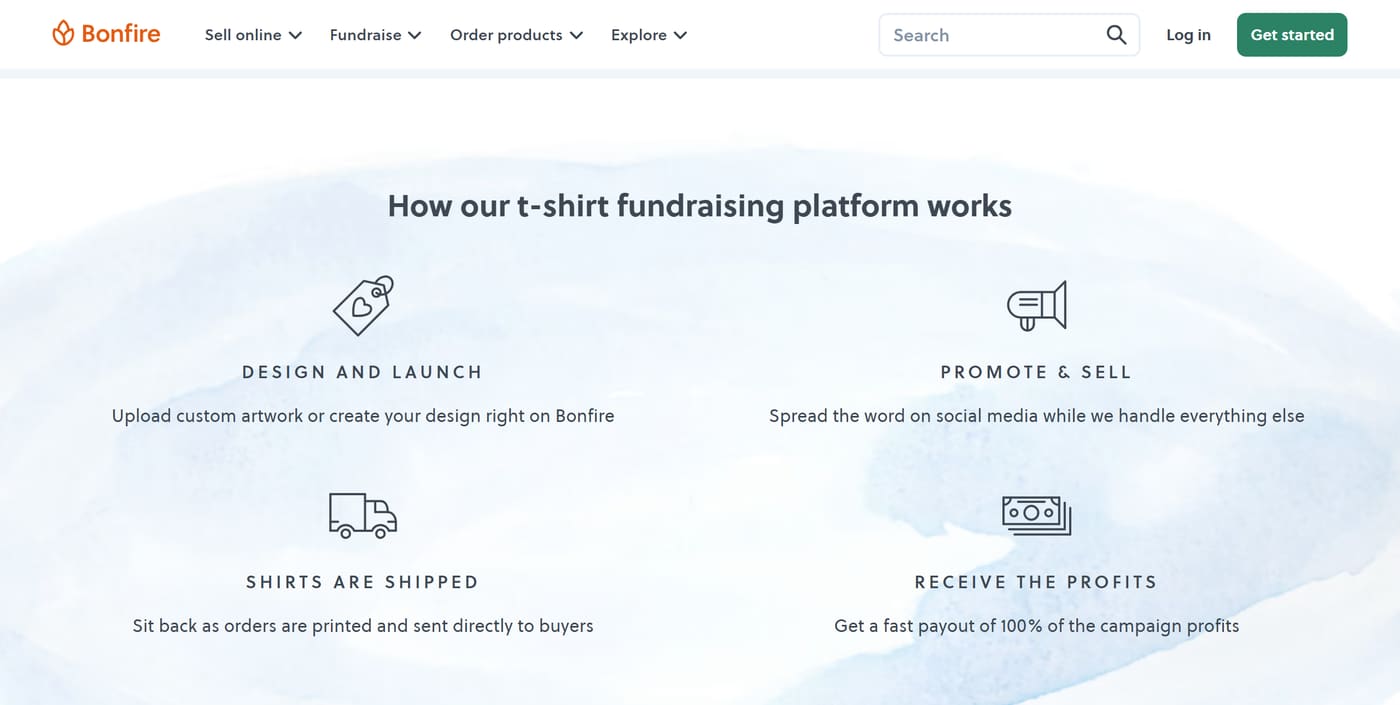
- Batches or on demand. A batch stays open 2 to 21 days, prints when it closes, and lowers each item's base cost as it sells more. On demand, an order prints the next business day, but the base cost resets to its maximum daily, so margins are thinner.
- Fees. Bonfire's single fee is a processing fee on donations or tips: 8%, or 3.5% for verified nonprofits (bonfire.com/fundraising, November 2026). It covers payout fees itself.
- Payouts. By PayPal from a $5 minimum, usually ready 1 to 3 business days after orders go to print. Checks need $100 and ACH $1,000, for accounts Bonfire accepts. Eligible nonprofits are paid through its partner Change.
- Shipping. Buyers pay from $5.99 in the US and $11.99 abroad for most non-fleece apparel. Group shipping sends a whole campaign to one address in the continental US.
- Bonfire Pro. A separate paid platform with a custom domain and Stripe payouts: Essentials at $9.99 a month or $99 a year, Super at $299 a year, US sellers only (help.bonfire.com, November 2026).
What Bonfire does well: a fundraiser goes live in an afternoon with no money up front, a batch prints even from one sale in most cases, and nonprofits get paid directly. What it leaves to you is promotion. That, plus an apparel-focused catalog and PayPal as the usual payout, is why people compare.
Bonfire alternatives at a glance (November 2026)
Picked for the two things Bonfire does: campaigns and no-inventory apparel stores. Bonfire is the baseline row.
| Platform | Best for | How you earn | Fees to know | Who brings buyers |
|---|---|---|---|---|
| Bonfire (baseline) | Campaigns and fundraisers | Price minus a base cost that falls with volume | 8% on donations and tips | You |
| Custom Ink Fundraising | School, team and charity drives | Funds past a print minimum | 2.9% on donations | You |
| Printify / Printful stores | A free store, large catalog | Price minus base cost and shipping | None to run the store | You |
| Fourthwall | Creators with an audience | Price minus a flat product cost | 2.9% + 30¢ on US cards | You |
| Spreadshop | A free shop, quick US shipping | Margin over a fixed base price | None to open or run | You |
| Etsy + a POD partner | Being found in search | Price minus Etsy fees and print cost | $0.20 a listing, 6.5% a sale | Etsy and you |
| Amazon Merch on Demand | Reach, once accepted | Royalty by price and group | No upfront costs | Amazon |
| TeePublic | A browsing apparel crowd | Fixed amount per item | None to join | TeePublic |
| Redbubble | One design, many products | Markup on a base price | Platform fee below Pro | Redbubble |
1. Custom Ink Fundraising: best for school, team and charity drives
What it is: the fundraising arm of the printer Custom Ink. It used to be called Booster, and old Booster links redirect to it. How you earn: launching is free. Each page has a print minimum, the number of items that must sell to cover the order cost; past it, every sale raises money, and the cost per item drops as more sell. A donation added by a supporter carries a 2.9% card processing fee. Funds go out by PayPal within two weeks of the close, or to a charity online or by check (a check takes about four weeks) (customink.com help center, November 2026).
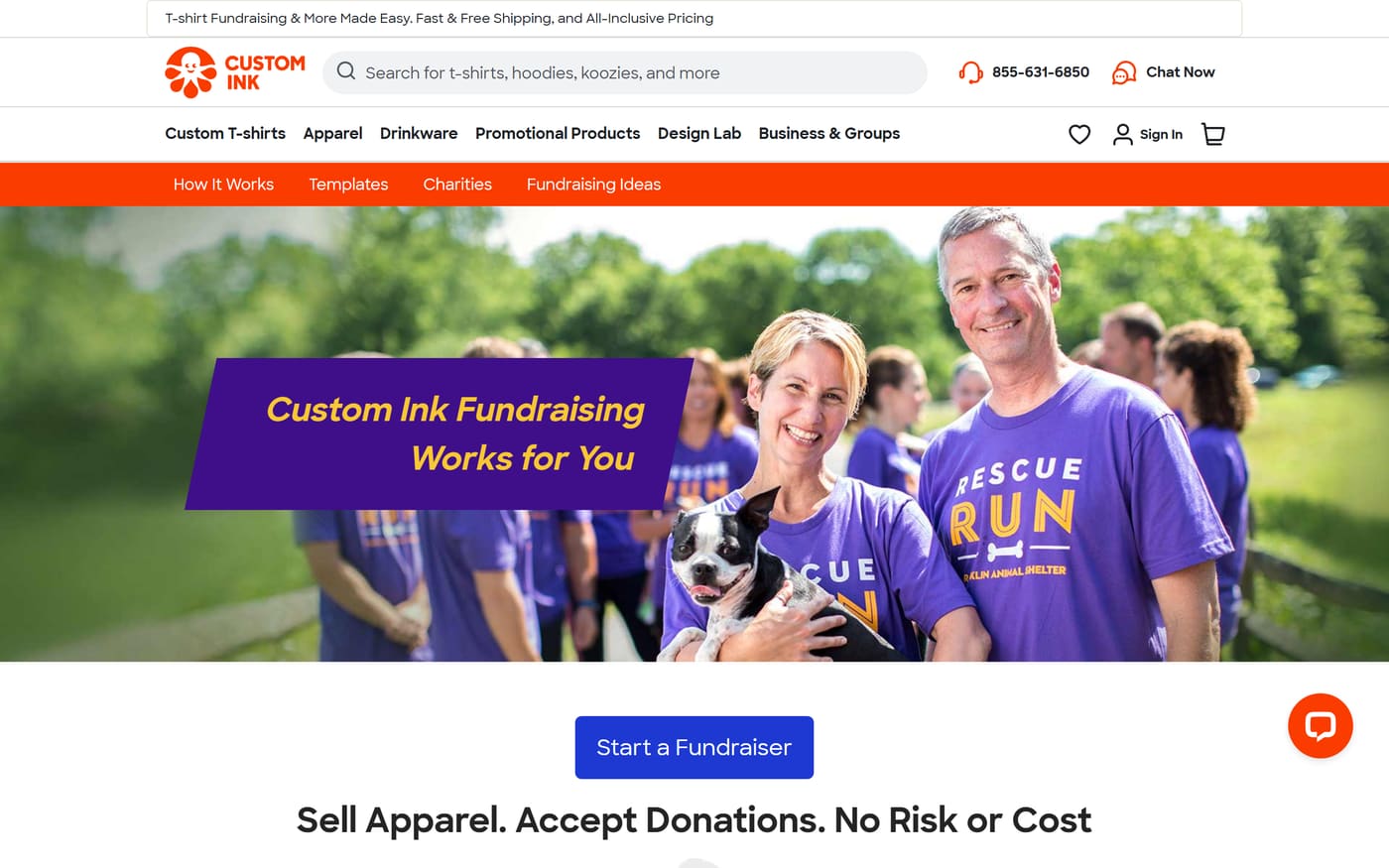
This is the nearest thing here to a Bonfire batch, with one difference that decides a lot: the minimum. Miss it, and Custom Ink refunds every buyer and prints nothing, though donations of $20 or more still reach your cause. In return, donations cost less to process (2.9% against Bonfire's 8%), orders can ship to the organizer free for hand-out, and individual delivery is a flat $9.95 in the US. Shirts arrive about 12 working days after a page closes.
Best for: a PTA, club or charity run with a fixed date and a crowd that will buy before it.
2. Printify Pop-Up Store or Printful Quick Stores: best for a free store with a large catalog
What it is: free storefronts hosted by two print-on-demand suppliers, so you skip Shopify and Etsy. How you earn: the retail price is yours to set and the supplier keeps its cost. Printify lists no fees for setup, listings, subscriptions or commissions on a Pop-Up Store; base cost and shipping come out of each sale, and Stripe payouts land on the 15th of the next month. Its example: a $25 t-shirt on an $8.80 base earns $16.20 before shipping (printify.com Pop-Up Store page, November 2026). Printful's Quick Stores are free too, with the customer paying your price plus Printful's standard shipping (printful.com/quick-stores, November 2026).
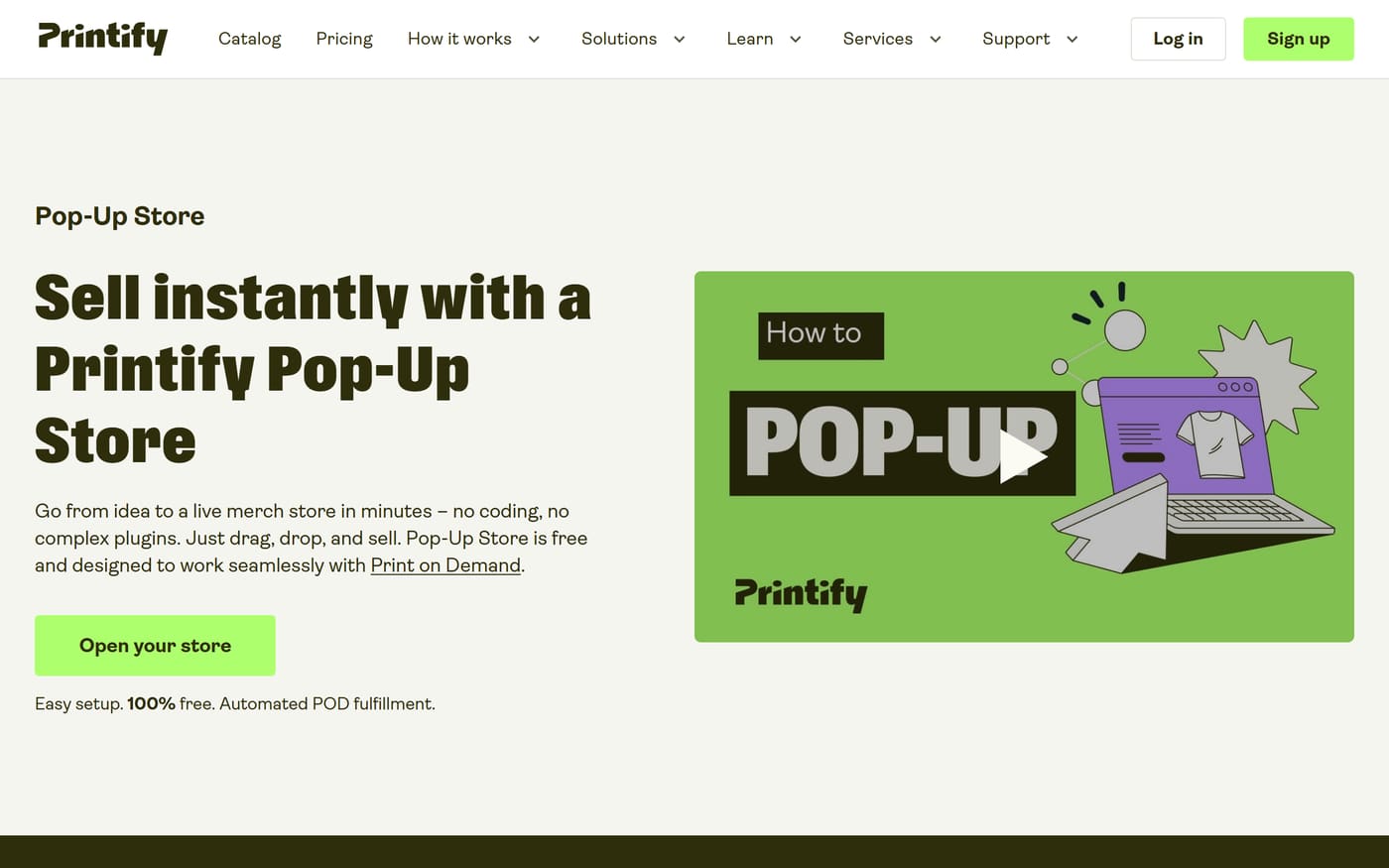
These behave like Bonfire's on-demand mode with no batches at all. Printify counts over 2,000 products, and both suppliers pitch their stores for school spirit wear, team gear and company swag. Quick Stores serve US sellers and US shoppers only, live on a Printful address with no custom domain, and do not yet support Google Analytics or a Meta Pixel; a Pop-Up Store can use your own domain. Neither brings visitors: Printify says plainly that you supply the traffic.
Best for: organizers and small brands who want a shop that stays open, with far more than shirts.
3. Fourthwall: best for creators whose followers already want merch
What it is: a creator storefront selling catalog merch, self-sourced products, digital products and memberships. How you earn: your price, less a publicly listed flat cost per catalog product, with no extra percentage. US card payments carry 2.9% + 30¢. Digital products pay 5% on the free plan, memberships 5% on both plans. Pro is optional, $19 monthly or $15 per month on yearly billing, and earnings reach your bank account each month (fourthwall.com/pricing, November 2026).
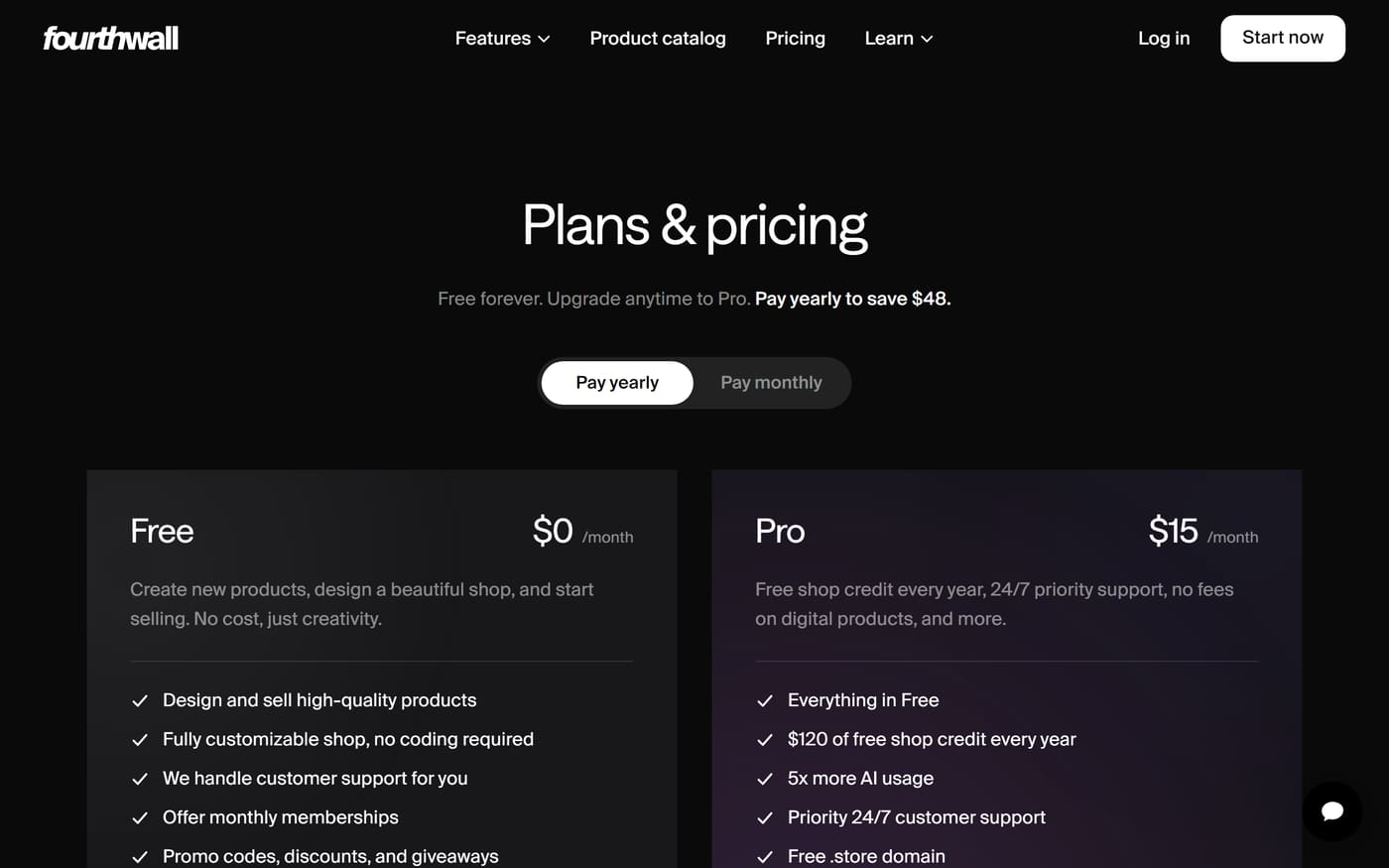
Fourthwall fits a shop that is a brand rather than a one-off drive. Donations and tips carry no fee beyond card processing, which matters if your Bonfire campaigns leaned on extra contributions. It sells through YouTube, Instagram and TikTok and handles customer support for catalog products. No marketplace sends strangers to your page, though, so it pays off when people already ask where to buy your merch.
Best for: YouTubers, streamers, podcasters and artists who want merch and memberships in one place.
4. Spreadshop: best for a free shop with quick US shipping
What it is: the shop builder from Spreadshirt, a print-on-demand company that prints in its own facilities. How you earn: you choose a margin above each product's fixed base price, and the shop costs nothing to open or run, with no minimum order. Its calculator showed a hoodie with a $27.99 base sold at $43.99, leaving $16 per item. Earnings are paid monthly to a US bank account or PayPal once you pass a minimum balance set by your currency, and a performance bonus grows with monthly sales (spreadshop.com, November 2026).
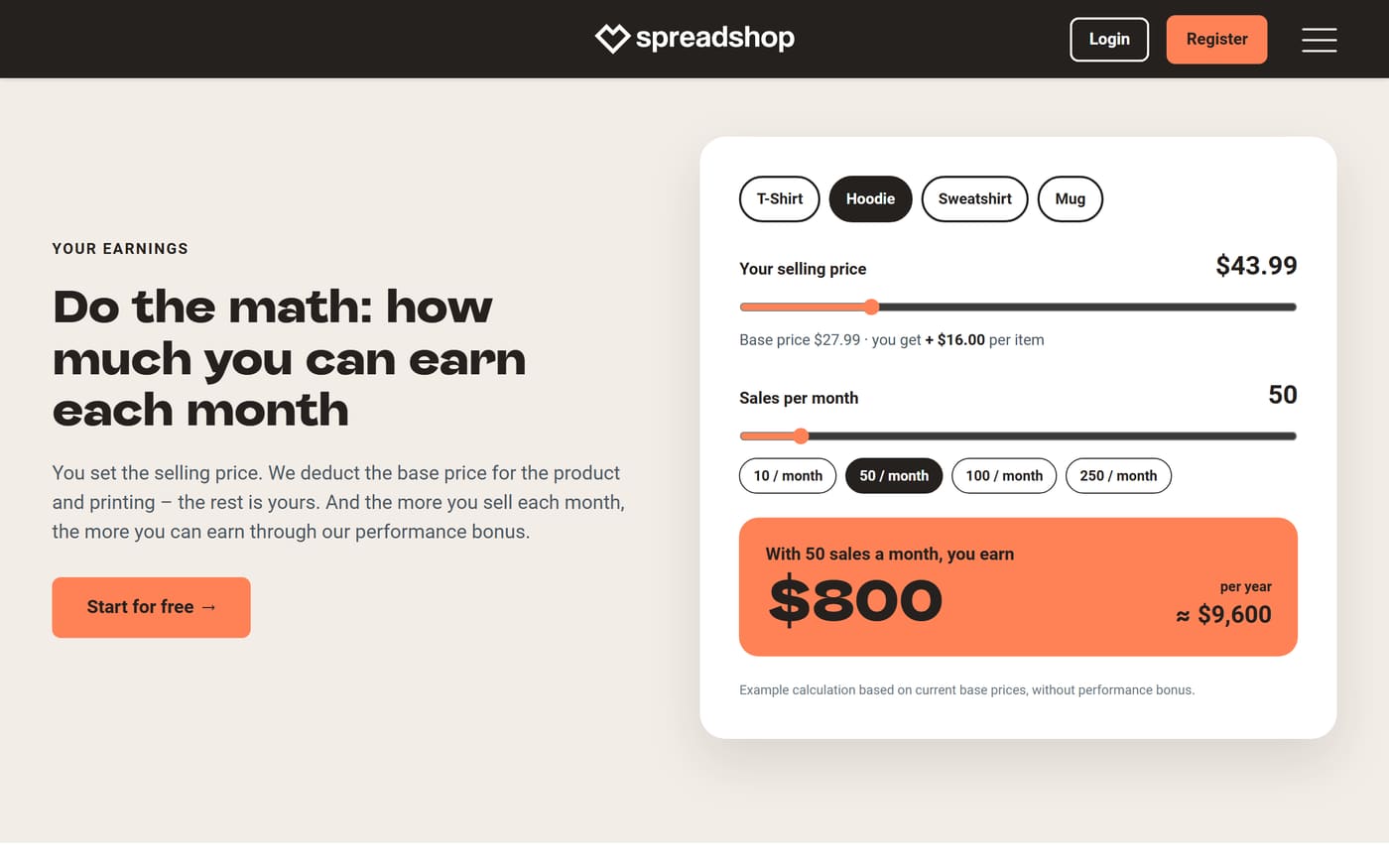
Spreadshop runs four production facilities in Europe and the US. US orders print in Las Vegas and typically ship within 48 hours, so nobody waits for a batch to close. It names schools, teams, podcasts and family reunions among its users. The trade-off against Bonfire is volume pricing: with a fixed base price, a big class order does not get cheaper per shirt.
Best for: clubs and creators who want a permanent shop that ships fast, with buyers in the US or Europe.
Four marketplaces with shoppers built in
Everything above leaves the selling to you. The next four work the other way round: shoppers arrive by searching or browsing, and your design competes with many others. On a campaign page, supporters buy because they know you. On a marketplace, a stranger buys because the design fits a niche with real demand that is not already crowded.
So before you design for one of them, look at what already sells there, not only at what people search for. Checking that by hand on four marketplaces is slow work. Trendlytic covers Redbubble, Amazon US, Etsy and TeePublic in one search, where Rising marks new designs already selling. Any phrase you choose can go through a USPTO lookup first.
5. Etsy plus a print partner: best for being found by people who search
What it is: your own Etsy shop, with Printify, Printful or another supplier connected to print and ship each order. How you earn: your price minus Etsy's fees and the supplier's cost. Etsy charges $0.20 per listing, renewed every four months, a transaction fee of 6.5% on the item price plus shipping and gift wrap, and payment processing that depends on your country. A new shop may also owe a one-off fee to set up, and an order from Etsy's Offsite Ads carries a 15% fee, or 12% for shops past $10,000 in yearly sales (etsy.com/legal/fees, November 2026).
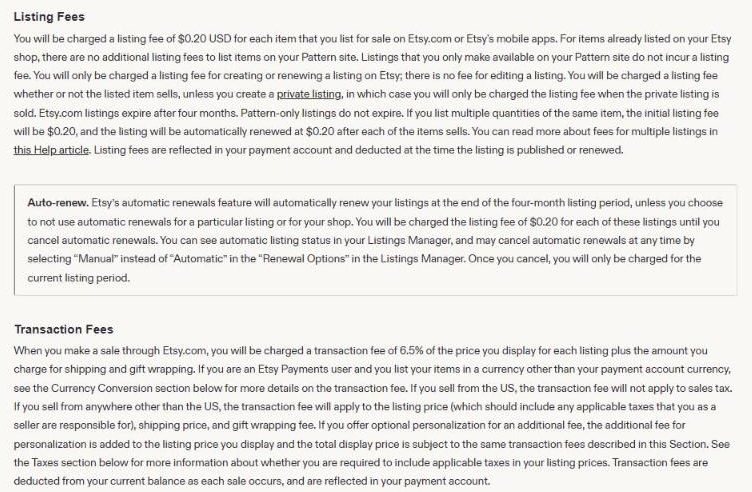
Etsy shoppers arrive with a search in mind, which suits personalized shirts, family reunion sets and gifts. The work moves to you: titles and tags decide whether you are found, and buyers' questions land in your inbox. Price with every fee included. Connecting a supplier is covered in selling print on demand on Etsy.
Best for: sellers who want steady search traffic and will put real time into their listings.
6. Amazon Merch on Demand: best for reach, once you are accepted
What it is: the print-on-demand program run by Amazon. You upload artwork and suggest a list price; Amazon prints, ships with Prime and answers customers, with no upfront costs. How you earn: a royalty. Amazon takes tax and its own costs off the offer price, then applies a rate set by your royalty group. In the US, a standard t-shirt at $19.99 pays $2.44 in the Creator group. Creators who drive at least 15% or 35% of unit sales from outside traffic, and sell 10 units a month, move to Plus or Premium at 2x or 2.16x that rate (merch.amazon.com, November 2026).
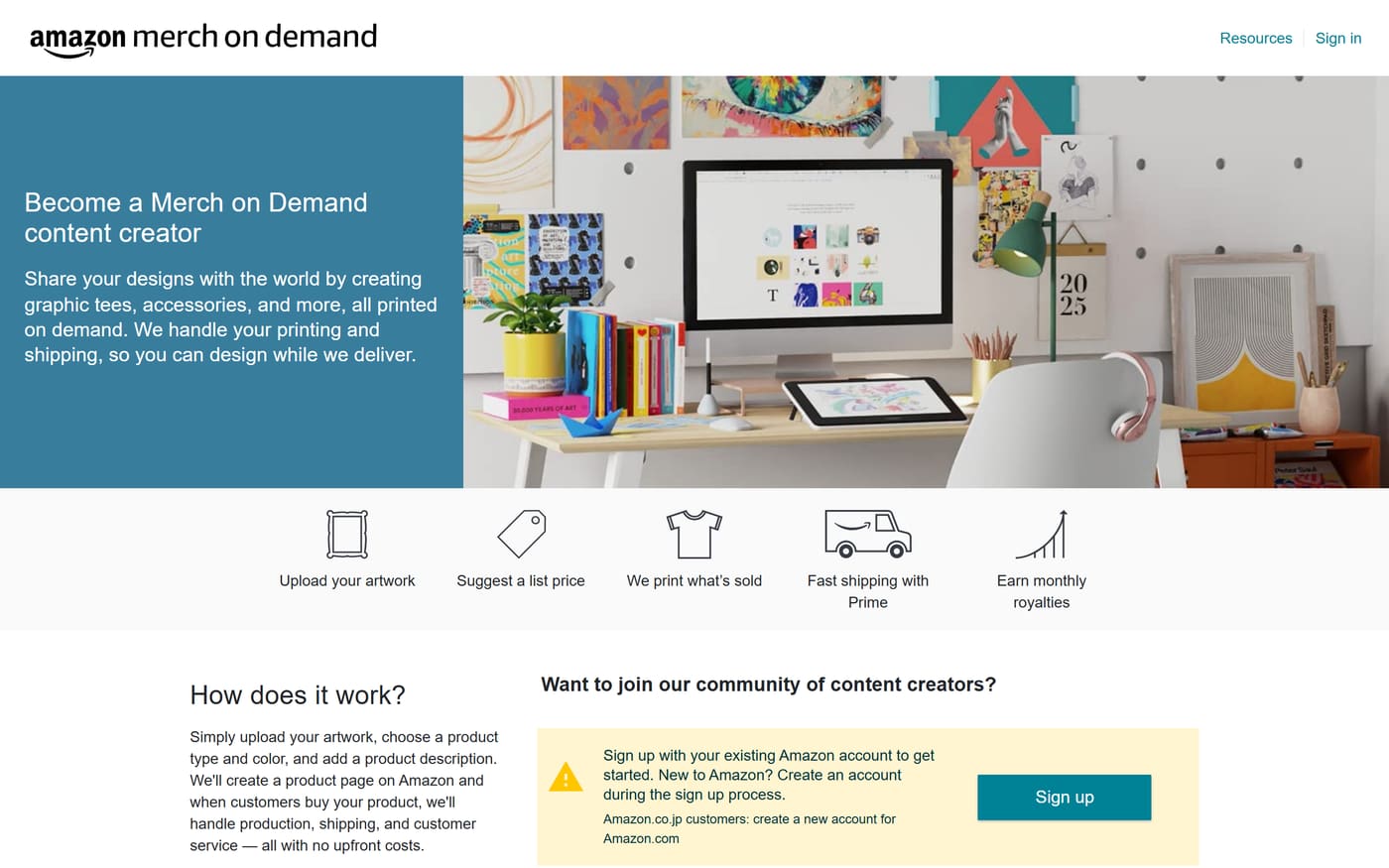
You trade control for reach: Amazon's costs and your royalty group decide what you keep, and after signing up you wait for a decision by email. In return, the shirt sits in a store Amazon says reaches hundreds of millions of customers. A design that breaks Amazon's content policy can be removed and can lead to suspension, so check every phrase before upload.
Best for: designers selling to strangers rather than supporters, who can wait out the sign-up.
7. TeePublic: best for a browsing crowd that buys apparel
What it is: an artist marketplace: you upload designs for shirts, hoodies, stickers, mugs and more, and TeePublic prints and ships them. How you earn: a fixed amount per item rather than a margin you choose. For Artisan accounts, a t-shirt or hoodie pays $4 at full price and $2 on sale, a sticker $0.75 or $0.50 (teepublic.com/earnings, November 2026).
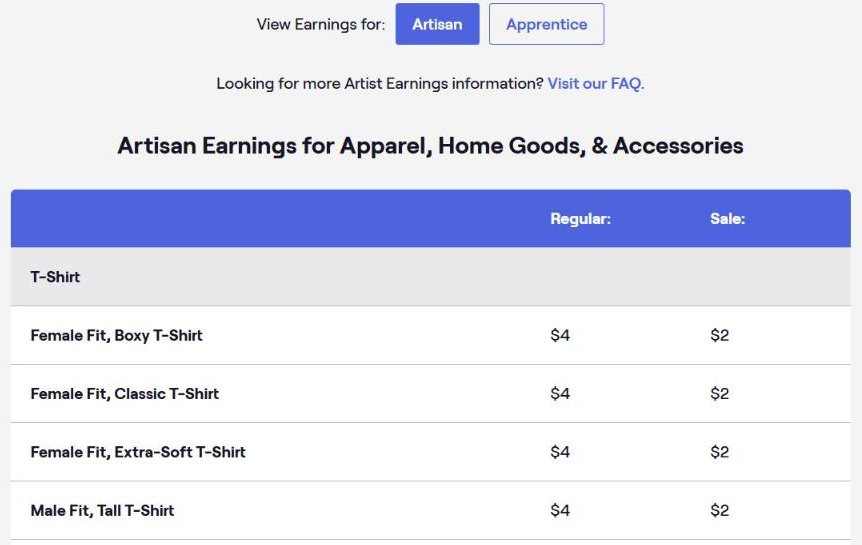
There is no campaign to run and nothing to promote before the first sale; people browse and buy. The cost is margin. On Bonfire you can price a fundraiser shirt well above its base, while on TeePublic a shirt earns a set $4, or $2 in a sale. It rewards many designs in clear niches. Is TeePublic legit covers payouts and trust.
Best for: artists with a large catalog who would rather upload than promote.
8. Redbubble: best for one design on many products
What it is: a marketplace that prints artists' designs on a long range of products, from Classic T-Shirts to stickers. How you earn: a markup you set on Redbubble's base price, 10% by default. Its own example: a Classic T-Shirt shipped to the US with a $20 base and a 20% markup earns $4 before fees. Standard accounts then pay a 50% platform fee on monthly earnings, Premium 20%, Pro nothing. Markups above 20% add an excess markup fee on Standard and Premium, and account fees top out at $150 for any payment period (help.redbubble.com, November 2026).
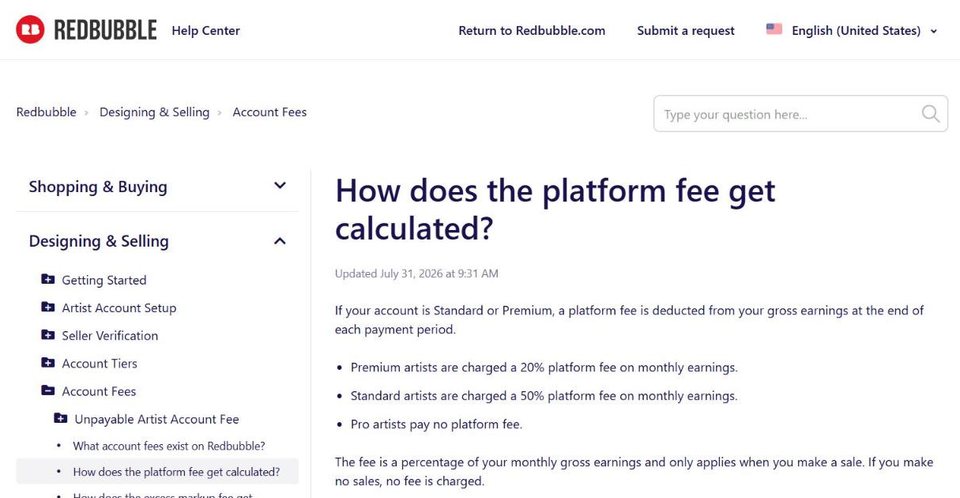
You choose a margin, as on Bonfire, but the tier Redbubble classifies your account into can halve what you keep. In exchange, one upload reaches Redbubble's shoppers across many product types. My Redbubble selling guide covers setup, and Redbubble alternatives covers where sellers go next.
Best for: artists whose designs sell on stickers as well as shirts.
Which Bonfire alternative fits you
You are raising money for a school, team or cause
Custom Ink Fundraising, if your crowd will clearly pass a print minimum and you like a fixed end date. Stay on Bonfire if you might sell only a handful, since a batch prints from one sale in most cases, though its donation fee is higher. For spirit wear sold all year, a Printify Pop-Up Store or Spreadshop.
You are a creator with followers
Fourthwall for memberships and digital products beside merch, Spreadshop for fast US printing with production in Europe too, and Printify for a catalog of over 2,000 products at no monthly cost.
You want buyers you did not bring
Etsy for searchable, personal and gift designs. TeePublic and Redbubble to upload once and let browsers find you. Amazon Merch for reach once accepted. Many sellers run two, and the niche weighs more than the platform: a crowded niche stays crowded wherever you upload.
You need a payout that is not PayPal
Fourthwall deposits to a bank account, Spreadshop pays a US bank or PayPal, Printify pays through Stripe, and Custom Ink sends PayPal, an online payment or a check.
FAQ
What is the best alternative to Bonfire? It depends on why you sell. For a fundraiser, Custom Ink Fundraising has the closest model; for a free store, Printify or Printful; for a creator brand, Fourthwall or Spreadshop; for shoppers you do not have to find, Etsy, TeePublic, Redbubble or Amazon Merch.
Is Bonfire really free? For selling, yes: no subscription, no upfront cost, and Bonfire covers payout fees. Its one fee is the processing fee on donations and tips, 8%, or 3.5% for verified nonprofits. Bonfire Pro is the paid version, from $9.99 a month.
What happened to Teespring and Booster? Spring, formerly Teespring, closed on September 15, 2026. Booster was renamed Custom Ink Fundraising, and old Booster links redirect there.
Which Bonfire alternative pays the most per shirt? The ones where you set the price: a store on Printify, Printful, Fourthwall or Spreadshop, or Etsy after its fees. Printify's example keeps $16.20 of a $25 shirt before shipping. Marketplaces pay less per sale, $4 per full-price shirt on TeePublic or $2.44 on a $19.99 Amazon tee in the Creator group, but they bring the buyers.
Do I need an audience to use these Bonfire alternatives? For the stores, yes. Printify says a Pop-Up Store brings no buyers, and Printful tells Quick Stores sellers to bring traffic by sharing their link. For the marketplaces, no, but you compete with every other design in your niche, so pick niches that sell and are not crowded.
Conclusion
Bonfire is still a sound choice for a quick drive: free, simple and cheap to try. The alternatives earn their place when your needs change: Custom Ink Fundraising for a cause with a deadline, Printify, Printful, Fourthwall or Spreadshop for a shop you keep, and the four marketplaces when you want strangers to find the shirt.
On a marketplace, the design decides more than the platform. Trendlytic reads the designs already selling on Etsy, TeePublic, Redbubble and Amazon US, so the niche gets tested before the design work starts. It runs from $19.99/mo, a 3-day trial that takes a card. The entry plan brings 100 credits, which read up to 12,000 designs on the marketplaces with a verdict on every niche, plus the 1,000 top designs in Best Design Instant, re-ranked every hour. Trending Now shows up to 50 niches per marketplace, refreshed every hour, and a USPTO lookup runs on any phrase you choose. Start your 3-day trial.
Where are you taking your shirts after Bonfire, and what made you look?
Try Trendlytic
Find your next winning POD niche in 40 seconds
Live data from TeePublic, Amazon Merch, Redbubble, and Etsy, and a one-click USPTO lookup on any phrase. Then turn any winner into a listing for a design of your own in that niche. Plans from $19.99/month.
Start researchingLiked this? Learn niche research in 5 short emails.
One email a day for 5 days: how sellers pick niches, why designs fail, and how to check yours. Unsubscribe in one click.
Keep reading
- Trendlyticprintify mockup generator
Printify and Printful Mockup Generator Guide (2026)
The JournalPrintify and Printful Mockup Generator Guide (2026)
November 24, 2026 · 16 min read
- Trendlyticsmartmockups alternatives
Smartmockups Alternatives: 8 Mockup Tools for 2026
The JournalSmartmockups Alternatives: 8 Mockup Tools for 2026
November 23, 2026 · 20 min read
- Trendlyticetsy black friday
How to Run an Etsy Black Friday Sale in 2026
The JournalHow to Run an Etsy Black Friday Sale in 2026
November 22, 2026 · 18 min read