TL;DR: Printful and Spring solve different problems, so this is not really a "which is better" question. Spring, formerly Teespring, closed on 15 September 2026, and Amaze now points creators to Amaze Commerce; it was a free creator storefront with social integrations, built for people who already had an audience to sell to. Printful plugs into a store you already run and prints most things in-house, so it fits sellers who want consistent quality and real branding and can drive their own traffic. Pick by whether you have an audience or a store. Neither one sends you customers for free.
If you're comparing Printful and Spring, you're probably a creator or a seller trying to figure out where to actually put your designs, and the two names keep showing up side by side. The honest answer up front: they aren't competitors doing the same job slightly differently. They sit in different parts of the process and assume different things about you.
Spring gives you a place to sell and some tools to sell it. Printful gives you production and branding for a store you already have. One assumes you bring an audience. The other assumes you bring a shop and the traffic to fill it. That single split decides almost everything below, and it's why "which is better" is the wrong question. The right one is "which job am I trying to do."
I've spent the last couple of years watching print-on-demand sellers work across Etsy, Redbubble, Amazon Merch, and TeePublic, and I see people pick the wrong tool for their situation constantly. So I'll be plain about the trade-offs on both sides, including the parts each platform is quietly weak at.
First, the name confusion: Teespring is now Spring
Before anything else, let's clear up the name, because it trips people up. Teespring rebranded to "Spring," and Spring then operated as "Spring by Amaze," with Amaze as the parent commerce platform behind it. So "Teespring," "Spring," and "Spring by Amaze" all point at the same lineage. If you searched "printful vs teespring," you're in the right place.
Update, October 2026: Spring closed on 15 September 2026. Its stores take no more orders, the dashboard stays open only to collect payouts until 15 October 2026, and Amaze is pointing creators at Amaze Commerce as the replacement storefront. The comparison below describes how Spring worked, and the same trade-offs apply to Amaze Commerce as its successor. For the current picture, see Printify vs Teespring.
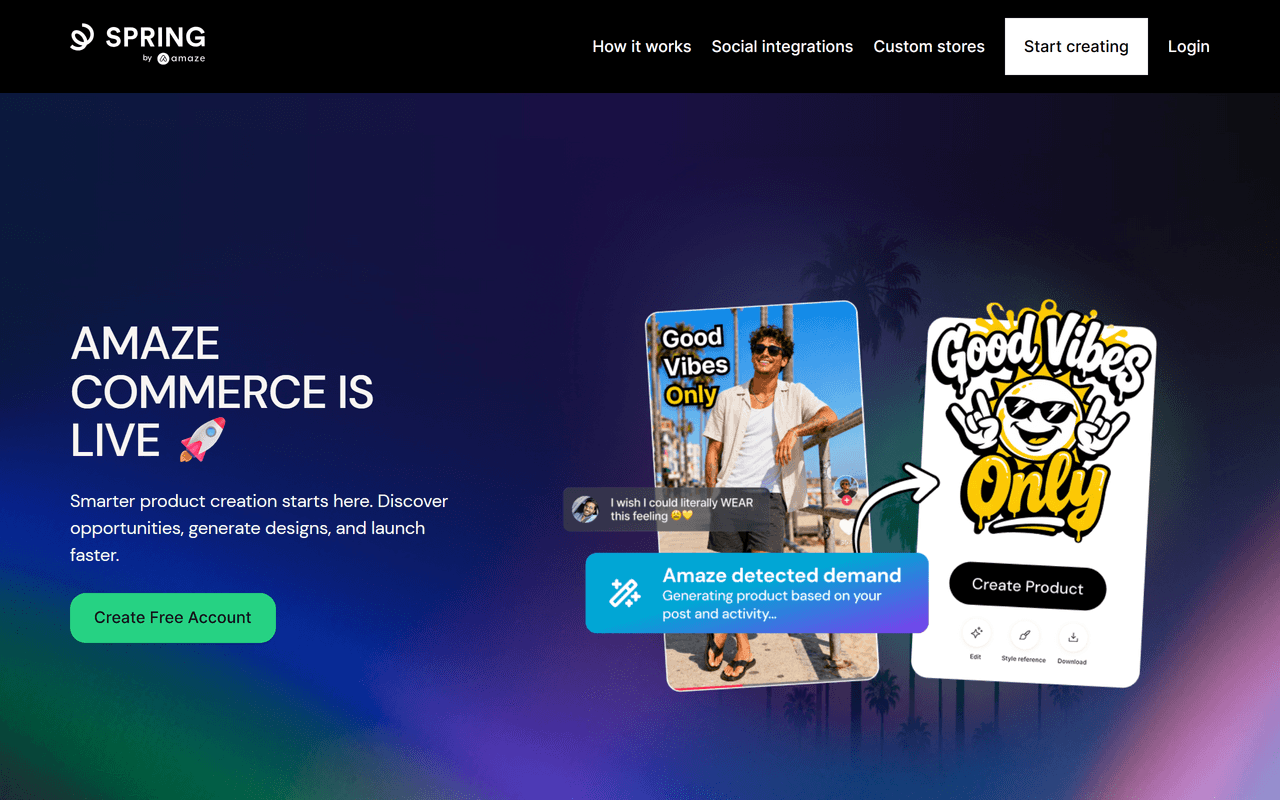
A lot of readers still type "teespring.com" out of habit and land somewhere that talks about "Amaze commerce," AI-assisted product creation, and social integrations, and they wonder if they've hit the wrong site. They haven't. The current homepage leans into AI-assisted product creation (the pitch is roughly "discover opportunities, generate designs, launch faster") with navigation for how it works, social integrations, and custom stores. Same platform, new name, new direction. Throughout this article I'll mostly say Spring, and I mean the thing you may still know as Teespring.
Don't miss the next one.
New POD niche analysis every Wednesday.
Printful vs Spring at a glance
Here's the whole comparison in one table. Read the "What it is" and "Who it's for" rows first, because they explain every other row.
| Dimension | Printful | Spring (formerly Teespring) |
|---|---|---|
| What it is | Fulfillment for a store you already run | A free creator storefront and social selling platform |
| Who it's for | Store owners who can drive their own traffic | Creators who already have an audience |
| Storefront | No, you supply the store | Yes, a free creator page is built in |
| Traffic | None, it's on you | None, it's on your audience |
| Print quality | Much of the catalog printed in-house, consistent | Handled for you, built for speed over premium |
| Branding options | Strong (custom labels, packaging inserts) | Minimal, not the focus |
| Integrations | Shopify, Etsy, WooCommerce, and more | Social platforms (TikTok, YouTube, Instagram, and similar) |
| Cost to start | Free to start, base cost per item | Free to start, base cost per item |
| Best for | Brand-focused sellers with their own shop | Creators monetizing an existing following |
Everything below unpacks that fairly, because each side genuinely wins for a different person.
Printful: fulfillment for a store you already run
Printful is a fulfillment service. It doesn't sell your products for you and it isn't a place customers browse. Instead, it connects to a store you already operate (Shopify, Etsy, WooCommerce, and others), and when someone buys, Printful prints the item and ships it to them on your behalf. You run the shop and the marketing; Printful runs production.
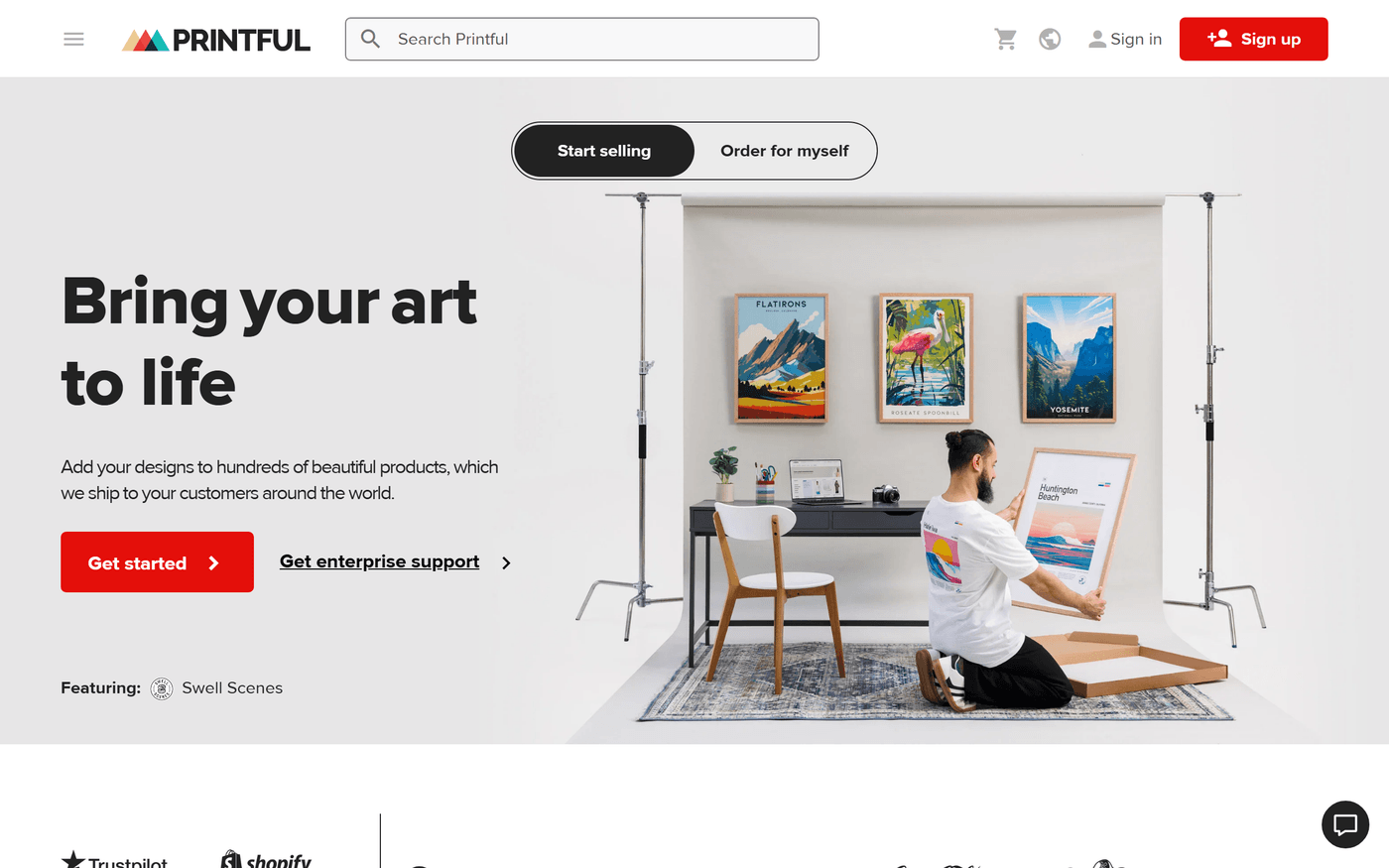
What sets Printful apart is that it prints a large part of its catalog in its own facilities rather than routing everything to outside factories. That in-house control is why its output tends to be consistent from one order to the next. The sample you approve is likely close to what a customer receives months later, on the same equipment to the same standard. For anyone building a real product line, that predictability is worth a lot.
Printful also gives you actual branding. Custom inside labels, packaging inserts, and other touches let the parcel feel like it came from your company rather than a generic dropshipper. If part of what you're selling is the sense that this is a legitimate brand, those details matter.
The trade-off is blunt: Printful sends you zero traffic. None. It assumes you already have a store and a way to get people to it, whether that's Etsy search, ads, an email list, or social. If you don't have that yet, Printful is production waiting for a business that doesn't exist. It's a great engine, but you have to supply the car. For how it stacks up against another supplier, see Printful vs Printify.
Printful suits you if you run (or are ready to run) your own store, you care about consistent quality and a branded unboxing, and you already have a plan for getting traffic.
Spring (formerly Teespring): a storefront for creators
Spring comes at this from the opposite direction. It gives you a free creator storefront, prints and ships your products for you, and plugs into the social platforms where creators already live. You don't need your own website or a Shopify subscription. You set up a creator page, add products, and point your followers at it. Recent direction leans into AI-assisted product creation and tighter social integrations, all under the Amaze umbrella.
The pricing model is creator-friendly. You set a retail price above a base cost, and you keep the difference as your margin. There's nothing to pay to open a storefront, which is a big part of the appeal for someone testing whether their audience will buy at all.
The social integrations are the real point. Spring is built to connect with platforms like TikTok, YouTube, and Instagram so your merch surfaces where your audience already watches you. For a creator with even a modest following, that removes a lot of friction. You don't have to teach people to visit a separate shop; the shop comes to where they already are.
Here's the honest catch, and it's the mirror image of Printful's. Spring gives you a storefront, but it does not give you an audience. A creator page with no followers pointed at it is just as empty as a Shopify store with no traffic. Spring is built for people who already have attention and want to convert it into sales quickly, not for people hoping the platform will find buyers for them. And because it's built for speed and creator convenience, it isn't the place to go if premium branding and a custom unboxing are central to your plan.
The Spring model (now Amaze Commerce) suits you if you already have an audience (YouTube, TikTok, Instagram, a community), you want to launch merch fast without running your own store, and convenience matters more to you than premium branding.
Print quality and consistency
Printful has the edge here, and the reason is structural. Because it prints much of its catalog in-house, it controls the equipment and the standard, so orders tend to come out uniform over time. That consistency reduces surprises and refunds, which quietly protects a brand.
Spring handles fulfillment for you competently, but it's built around creator speed and convenience rather than chasing a premium, tightly controlled standard. For selling merch to fans, that's usually fine. For building a product line where every unit needs to match, Printful's in-house consistency is the safer bet.
Verdict: Printful, on in-house consistency.
Branding and the unboxing
This one isn't close. Printful offers real branding: custom labels, packaging inserts, and a white-label feel so the parcel reads as your company. If the unboxing is part of the experience you're selling, that's a genuine advantage.
Spring simply isn't built for that. It's built to get a creator's merch live and selling to an audience quickly, not to craft a bespoke unboxing. That's a reasonable choice for its user, but if branded packaging is central to your plan, Spring will feel thin.
Verdict: Printful, clearly.
Storefront and traffic
Spring wins on storefront. It hands you a free creator page out of the box, no separate store to build or pay for. With Printful, the storefront is your responsibility; Printful only handles what happens after a sale.
But notice the thing both share: neither one brings you customers. Spring gives you a page and Printful gives you fulfillment, and in both cases the traffic is on you (or, for Spring, on the audience you already command). This is the single most misunderstood point in the whole comparison. A storefront is not an audience, and fulfillment is not marketing.
Verdict: Spring gives you the page; neither gives you buyers.
Integrations
The two integrate with completely different worlds, which tells you exactly who each is for. Printful connects to store platforms: Shopify, Etsy, WooCommerce, and more. You build products in Printful, push listings to your shop, and orders sync back for fulfillment.
Spring connects to social platforms instead (TikTok, YouTube, Instagram, and similar), so your products surface where your audience already is. That's the creator-first bet made concrete.
Verdict: A tie that depends on you. Printful if you sell through a store; a creator storefront (Spring until September 2026, Amaze Commerce now) if you sell through an audience.
Costs and margins
Both are free to start, so cost isn't a barrier to trying either. In both cases you set a retail price above a base cost and keep the difference as your margin. I'm not going to quote exact base costs or margin percentages, because they drift and vary by product, and a number I print today could be wrong next month.
The qualitative truth is this: Printful's premium quality and branding generally cost more per unit, which means either a slimmer margin at the same price or a higher retail price. Spring's model is built to keep things simple and fast for creators. Whichever you use, price the specific product you plan to sell, including shipping to your main market, before you assume one is "cheaper." Base cost is one input, not the whole equation.
Verdict: Both free to start; Printful's quality costs more per unit, which is fair for what it is.
Which should you choose?
Here's the framework, and it comes down to one honest question about your own situation.
- You already have an audience (you're a creator with a YouTube channel, a TikTok following, an engaged community): look at Amaze Commerce, Spring's successor, and read its current terms before you move in. The creator-storefront model assumes you can bring attention, and it removes the friction of running your own store.
- You run or want your own store and care about quality and branding: go with Printful. You get in-house consistency and real branding, and you're the type who can drive traffic to a shop.
- You want a marketplace that brings buyers to you: honestly, neither of these does that. Spring and Printful both assume the demand is yours to generate. If you want built-in browse traffic, look at marketplaces like Redbubble, TeePublic, and Amazon Merch instead. See the best print-on-demand companies for the full landscape, and Printful alternatives if Printful's fit but you want to weigh options.
Be honest with yourself about which line you're actually in. Most people who pick wrong do it by wishing they were in a different one.
Whichever you pick, validate the design first
Here's the part the platform choice quietly hides. Spring versus Printful is the smaller half of the decision. Whichever one you use, a design nobody wants sells nothing. An empty niche or a hopelessly saturated one loses on either platform, and a trademarked phrase gets your product pulled down no matter who printed it or where it was listed.
That research step comes before you ever pick a platform, and it's the same regardless of which one you land on. The principle is simple to say and slow to do by hand: check whether there's real demand and whether the niche is already flooded before you commit, and confirm you're not printing something that's trademarked. Doing that properly means digging through several marketplaces to see what's genuinely selling versus what just looks busy, plus a separate trademark check. By hand that's hours.
That's the boring, decisive step I built Trendlytic to handle. One search shows what's actually selling across Etsy, Redbubble, TeePublic, and Amazon Merch at once, and before you commit to a phrase, a quick lookup shows whether it is already registered with the USPTO. It's $19.99/month for 100 searches, with a free trial. It isn't a supplier and it doesn't compete with Spring or Printful. It sits one step earlier, so you're validating the idea instead of guessing. If you want a starting point, here's how to find trending POD niches.
FAQ
Is Spring the same as Teespring? Yes. Teespring rebranded to Spring, which then ran as Spring by Amaze until it closed on 15 September 2026; Amaze now sends creators to Amaze Commerce. The old teespring.com name still gets searched, but it's the same lineage. If you knew it as Teespring, Spring is what it became.
Is Printful better than Spring? It depends on what you have. Printful is better if you run your own store and want consistent, in-house print quality and real branding. Spring's model, which Amaze Commerce now carries on, suited creators who already had an audience and wanted a free storefront with social integrations. It's a store-versus-audience question, not a "which is better" one.
Does Spring cost anything to start? Spring was free to start, and it closed on 15 September 2026, so nobody can open a Spring storefront now. Check Amaze Commerce's current terms before you plan around it. The model was simple: you set a retail price above a base cost and kept the difference as your margin, so you only made money once your products sold, which is why an existing audience mattered so much.
Can I use Printful with Spring? They're built on different models, so this isn't the setup to plan around. Printful connects to stores you run (Shopify, Etsy, WooCommerce), not to Spring's creator platform. Think of them as two separate paths, and pick the one that matches whether you have a store or an audience.
Which has better print quality? Printful, generally, because it prints much of its catalog in-house to one standard, which keeps orders consistent over time. Spring handles fulfillment for you but is built more for creator speed and convenience than for a premium, tightly controlled standard.
Do Printful or Spring bring me customers? No. Neither is a marketplace, so neither sends you buyers for free. Printful assumes you drive traffic to your store; Spring assumes you bring an audience to your creator page. If you want built-in browse traffic, a marketplace like Redbubble, TeePublic, or Amazon Merch is a different route.
The bottom line
Printful and Spring aren't rivals so much as answers to different questions. Spring, formerly Teespring, gave creators a free storefront and social tools until it closed in September 2026 (Amaze Commerce is its successor), and that model assumes you bring the audience. Printful gives store owners in-house quality and real branding but assumes you bring the store and its traffic. Audience-first or store-first, that's the whole decision, and neither one hands you customers for free.
Whichever side you land on, validate the design before you print it, because that's the half that actually decides whether you make money. Start a Trendlytic trial to see what's really selling across Etsy, Redbubble, TeePublic, and Amazon Merch, and look up any phrase in the USPTO register while it is still just an idea, not a shirt.
If you've sold through both Spring and Printful, which one earned its place for you, and did the audience-versus-store split play out the way you expected? I'd genuinely like to hear what's working out there.
Like this? Get one like it every Wednesday.
Niche data, trademark alerts, one tactic per week.
Try Trendlytic
Find your next winning POD niche in 40 seconds
Live data from TeePublic, Amazon Merch, Redbubble, and Etsy, with a trademark check built in. Then turn any winner into a listing for a design of your own in that niche. Plans from $19.99/month.
Start researchingKeep reading
- Trendlyticprintful vs gelato
Printful vs Gelato: In-House vs Local Printing
The JournalPrintful vs Gelato: In-House vs Local Printing
August 18, 2026 · 15 min read
- Trendlyticprintify alternatives
8 Best Printify Alternatives in 2026 (Faster & More Reliable)
The Journal8 Best Printify Alternatives in 2026 (Faster & More Reliable)
July 6, 2026 · 14 min read
- Trendlyticbest print on demand companies
The 10 Best Print-on-Demand Companies of 2026
The JournalThe 10 Best Print-on-Demand Companies of 2026
July 1, 2026 · 20 min read