TL;DR: Yes, Printify is legit. It is a real print-on-demand company, founded in 2015 and based in Riga, Latvia, that merged with Printful in 2024; both now run as separate brands under a parent company called FYUL. You pay it per order, after your customer has paid you, and it reprints or refunds misprints reported within 30 days with a photo. The real risks are fit, not fraud: thin margins, quality that shifts between providers, and a claim window shorter than Etsy's.
If you typed "is Printify legit" into Google, you are probably not a shopper. Printify works behind your store, so shoppers rarely deal with it directly. You are about to connect your store to it and save a card in it, and you want to know that is safe first.
I run Trendlytic, a niche research tool for print-on-demand sellers, and I have no deal with Printify. For this post I read Printify's own pages on 27 November 2026: the pricing page, the About page and nineteen help-center articles on billing, order holds, claims, IP blocks and account security. Every Printify rule below comes from those pages, so you can check it yourself.
For features, catalog and plan details, see my Printify review. This post is about trust: who you are dealing with, where your money goes, and what happens on the day something breaks.
Is Printify legit? The short answer
Yes. Printify is a legitimate company, not a scam, and the evidence is the kind a scam cannot fake for long:
- Named founders and leadership. Printify was founded in 2015 by James Berdigans, Artis Kehris and Gatis Dukurs (Latvian Investment and Development Agency, LIAA, 2021). Its About page lists the current executives by name.
- Real outside money. It raised a $45 million Series A in 2021 (LIAA, 2021), and its About page lists investors including Index Ventures, H&M Group and Virgin Group.
- A pay-per-order model. The Free plan costs $0 a month (printify.com/pricing, November 2026). You pay for each order as it comes in, plus any samples you choose to buy.
- Written rules for bad days. Its help center spells out claim windows, photo requirements and even measurement tolerances for misprints.
So "is Printify a scam?" has a plain answer: no. The useful questions are narrower. Will the money flow work for your store? Will the print quality hold up? What happens when a parcel vanishes or a charge fails?
Who runs Printify
Printify started in 2015 and is based in Riga, Latvia (printify.com/about, November 2026). In November 2024, Printify and Printful announced they would merge as equal partners, and Printful's announcement said both platforms would keep running as separate brands (printful.com/news/merger, November 2024). Alex Saltonstall, who led Printful, became CEO of the merged company, and Printify's About page lists him as chief executive today. In late 2025 the group took a new name, FYUL, and fyul.com lists Printify, Printful and Snow Commerce as its brands, each on its own site (fyul.com, November 2026).
For a seller, little changes: you still sign up, pay and file claims on printify.com, under the policies quoted here. If you are choosing between the two sister platforms, Printful vs Printify compares how each one prints and charges.
Printify's About page counts more than 10 million merchants and 100+ printing locations, and its pricing page says more than 70 print providers (printify.com, November 2026). Those are its own numbers, not audited ones. But a scam does not publish its executives and a refund policy with half-inch tolerances.
How the money moves: you pay Printify, your store pays you
This is the part that confuses new sellers, so here it is in one line: Printify does not pay you. Your store does.
Every sale creates two transactions. Your customer pays your sales channel (Etsy, Shopify and so on), which takes its fees and pays you on its own schedule. Separately, Printify charges you for making and shipping the item. What is left between the two is your profit. Printify cannot pull money out of your Etsy or Shopify account, which is why it needs a card or a prepaid balance from you (help.printify.com, "How will Printify charge me?", November 2026).
| Money | Who pays | Who receives it | When |
|---|---|---|---|
| Retail price and shipping your buyer chose | Your customer | Your store (Etsy, Shopify...) | At checkout, then paid out to you on the channel's schedule |
| Production, shipping and any tax on them | You | Printify | Before production starts (by default 24 hours after the order arrives) |
| Premium membership (optional) | You | Printify | Monthly or yearly, charged up front |
| Your profit | Your customer, through your store | You | What is left after Printify's charge and your channel's fees |
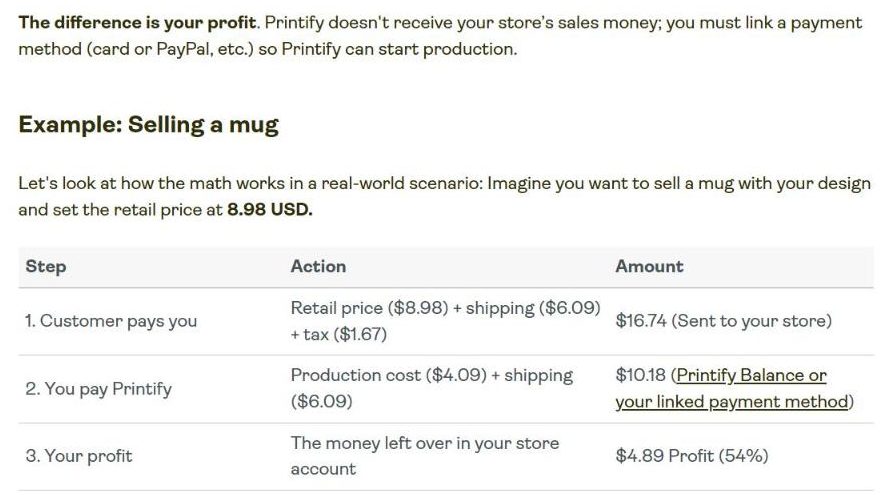
Printify's own example is a mug sold at $8.98: the customer pays $16.74 with shipping and tax, you pay Printify $10.18, and $4.89 is left (help.printify.com, "How does the payment process work?", November 2026). That example leaves out your channel's fees. On Etsy, the listing, transaction and payment processing fees still come out of that $4.89.
There is also a timing gap: you pay Printify when the order comes in, and your store pays you later. In a busy December, your card carries that gap.
Premium cuts most catalog prices by up to 20% and costs $39 monthly or $299 yearly (printify.com/pricing, November 2026). Its fee renews automatically and is non-refundable, so cancel before the renewal date if you are stopping. One trap: uninstalling the Printify app from Shopify cancels Premium automatically, but uninstalling it from other channels does not.
Printify Balance, cards, and what happens when a charge fails
You can pay Printify in two ways (help.printify.com, "How do I set up payments in Printify?", November 2026):
- A saved credit or debit card. The only way to get automatic payments. You can save up to 5, and if the default is declined or expired, Printify tries the next valid one.
- Printify Balance, a prepaid wallet you top up with PayPal, Payoneer, Google Pay, Apple Pay, Venmo or a saved card, from 10 USD or 10 AUD. It only works in USD and AUD. When an order comes in, the Balance is used first and any shortfall goes to your card.
Balance money is not locked in, but withdrawals only go back to the original payment source, the minimum is $5, approval takes up to 2 business days, and a card top-up can take up to 10 more business days at your bank. Payoneer top-ups cannot be withdrawn at all (help.printify.com, "How do I withdraw funds from my Printify Balance?", November 2026). Your profits never land there: it holds top-ups and refunds only.
When a charge fails, the order does not go to production. It shows "On hold: Action required" with the substatus "Payment not received". You fix the card or top up the Balance, then click Update payment and Retry payment on the Orders page.
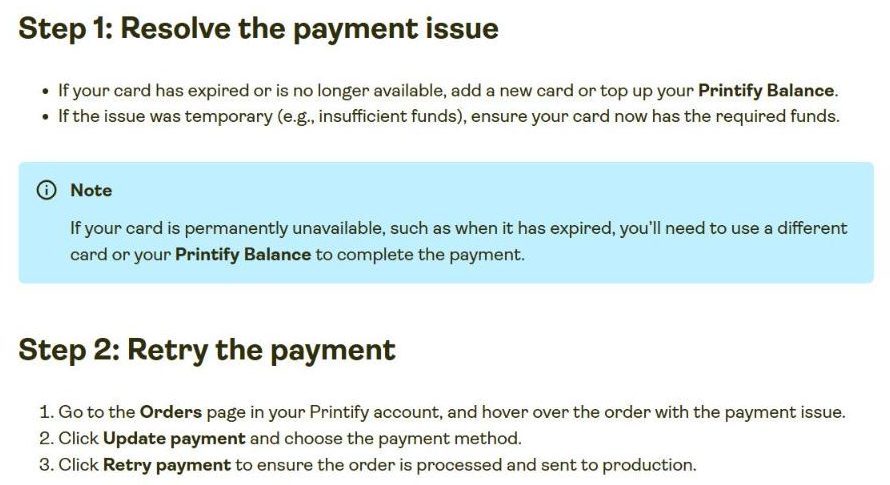
If Printify needs to review your payment method, the order waits and you get an email within 24 to 72 hours; meanwhile you can pay from your Balance (help.printify.com, "What should I do if my order payment fails?", November 2026). An order showing plain "On hold", with no button to edit or submit, is under review for payment verification, intellectual property or embroidery digitizing, and needs nothing from you (help.printify.com, "What does the status of my order mean?", November 2026).
So, can Printify hold your money? Not your profits, because it never touches them. It can hold an order while your customer waits. A small Balance as a buffer, plus a second saved card, removes most of that risk.
The print-provider network: why quality varies
Printify does not own the presses. It routes each order to a print provider, an outside print business in its network, and those providers are not interchangeable. They differ in location, prices, shipping rates, garments, print areas, equipment and a Performance Score, and Printify says that even on the same garment with the same technology, each provider runs its own color tests (help.printify.com, "What are Print Provider differences?", November 2026).
So the same tee with the same file can come out a little different from two providers, and the policy does not call that a defect. Printify gives you some tools to choose well:
- Average fulfillment time. Each provider shows its average for a product over the last 30 days. Most orders ship within 2 to 7 business days (help.printify.com, "What are Printify's production times like?", November 2026).
- Printify Choice. Printify picks a provider per order from a vetted group, at a fixed price with no extra fee, on 100+ best-selling products. The trade is control: you will not see which provider made an order, designs can shrink by up to 7% in rare cases with unusual colors, and auto-routing to Choice is on by default when an exact match saves time and cost, though you can opt out (help.printify.com, "What is Printify Choice, and how does it work?", November 2026).
- Samples. There are no free samples. They cost the regular price, with your Premium discount if you have one (help.printify.com, "How does sample ordering work?", November 2026).
Pay for one anyway: order your main product from the provider you plan to use, wash it once and look at it in daylight. That tells you more than any score.
When an order goes wrong: reprints, refunds and claims
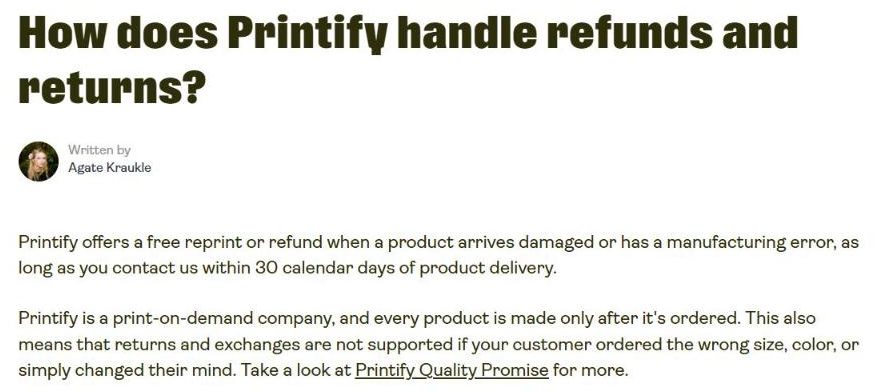
Printify's promise is short: a free reprint or refund when a product arrives damaged or has a manufacturing error, as long as you report it within 30 calendar days of delivery with a clear photo. You do not have to send the item back (help.printify.com, "How does Printify handle refunds and returns?", November 2026).
| What can go wrong | What Printify does | What you should do |
|---|---|---|
| Faded, smudged or flawed print | Free reprint or refund | Photo of the product flat, in natural light, whole design in frame |
| Print placed more than 0.5 inch off | Free reprint or refund | Photo with a ruler or tape measure showing the gap |
| Wrong product, size, color or brand | Free reprint or refund | Photo with the size tag visible |
| Damaged in transit | Free reprint or refund | Photo or video showing the package, the design and the damage |
| Parcel never arrives | Free reprint once it finds no error on your side | Wait 30 days (US or regional EU) or 45 days (international), check the address and the post office, then report within one week |
| Returned for a wrong or incomplete address | Support may offer a partial refund or a reprint, case by case | Check addresses before orders go to production |
| Buyer ordered the wrong size or changed their mind | Nothing, not covered | Write your shop policy to match |
| Blurry print from a low-resolution file | Nothing, not covered | Upload print-ready, high-resolution files |
Sources: help.printify.com, "How does Printify handle refunds and returns?", "When is a product eligible for a reprint?" and "How can I report an issue with my order?", November 2026.
The details that matter in practice:
- How to file. Open the order, click Submit issue under the product, choose reprint or refund, and attach up to 5 photos and one video. A reprint gets a new order ID and tracking number.
- The window is strict. Reports must come within 30 days of the delivery date or the estimated delivery date; Printify says it cannot accept them later.
- Some things are not defects. Slight variation in embroidery stitching, a faint smell on new DTG shirts and visible pre-treatment residue are normal. Sizing counts as a defect only beyond ±1 inch on most adult garments and ±0.5 inch on baby clothing.
- Refunds go to you, not your buyer. A Printify refund lands in your Printify Balance (or on your original payment source if you bill in a currency other than USD or AUD). You still refund your customer yourself, through Etsy or Shopify.
Printify pays when the fault was in production or fulfillment; you pay when the address was wrong or the customer changed their mind.
Content rules: IP blocks and takedowns
Printify prints your products, so it filters what it accepts. A product can be blocked when a rights holder complains, in which case Printify says it is legally required to restrict it, or when Printify's own review flags it as high risk (help.printify.com, "Why is my product blocked for Intellectual Property infringement?", November 2026).
What surprises sellers is how wide that net is:
- The trigger can be the design, the product title or the description. An original drawing with a brand name in the title can still be blocked.
- Common causes include trademarked names, phrases or slogans, fan art, AI designs that closely resemble existing work, fonts or stock graphics without commercial rights, and parody claims.
- A blocked product cannot be published, ordered or duplicated, and if it was live, it is hidden from your store. You can appeal from the product page with proof such as a license, but Printify says an appeal does not guarantee the product comes back.
One sentence from that article is worth reading twice: "Creating the design yourself does not automatically mean you have the right to use it commercially." Slogans are where this bites, because a phrase can be registered for shirts even when it sounds generic. Check every phrase in the USPTO database before you design around it. Our guide to print-on-demand trademarks walks through the check.
Keeping your Printify account secure
Your Printify account can hold up to five saved cards and a Balance, and anyone who gets in can place orders charged to you. Two things to set up on day one:
- Two-factor authentication. Printify supports 2FA with an authenticator app such as Google Authenticator, Authy or 1Password, plus one-time recovery codes. SMS codes are not supported, and 2FA only covers email-and-password logins; Google or Apple sign-ins rely on those providers. It is optional, each team member turns it on individually, and admins cannot yet require it (help.printify.com, "What is Two-Factor Authentication (2FA) on Printify?", November 2026).
- The real support channels. Support runs 24/7 through live chat, which opens with a virtual agent called Richie and lets you ask for a human, or through a contact form; order problems go through Submit issue on the order (help.printify.com, "How can I contact the Printify Support Team?", November 2026).
The usual advice for any account that holds a card applies too: type printify.com yourself rather than clicking a login link in an email.
Where sellers get burned (fit, not fraud)
Some sellers leave unhappy anyway, usually for one of these reasons:
- Margins thinner than expected. When I priced a SwiftPOD-made Gildan 18500 hoodie for the hoodie guide on this blog, an Etsy listing at $44.99 with free shipping kept $9.61 once the blank, the postage and every Etsy fee were paid, and at $39.99 it kept $5.08 (Printify prices read in November 2026). Run your own numbers in the free POD profit calculator and read how to price print-on-demand products before you list.
- Provider roulette. Switching to the cheapest provider, or letting Choice route orders, can change how a design looks, and a product praised from one provider can draw complaints from another.
- The return-window gap. Etsy gives buyers 180 days to report a defective product and TikTok Shop US gives 90; Printify gives you 30 from delivery. Printify's help center says that when your store's policy is more generous than its own, the difference comes out of your margin (help.printify.com, "How does Printify handle refunds and returns?" and "How should I set my store's return policy?", November 2026).
- Paying before you are paid. A failed card stalls orders while your buyer waits, and a payment review means 24 to 72 hours before an email with next steps.
- Rules with clocks in them. A lost parcel cannot be claimed until 30 or 45 days have passed, and an IP appeal has no guaranteed outcome. None of it is hidden, but it is easy to miss.
Printify fits sellers who will pay for samples, price for every fee, keep a card or a small Balance ready, and stick with a provider once one works. If you would rather have one company print everything in-house to a single standard, look at Printful vs Printify, or the wider field in Printify alternatives.
FAQ
Is Printify legit? Yes. It is a legitimate print-on-demand company founded in 2015 and based in Riga, Latvia, which merged with Printful in 2024; both run as separate brands under the parent company FYUL. It charges you per order and publishes written rules for reprints and refunds.
Is Printify a scam? No. Printify does not ask you to buy stock, its Free plan costs $0 a month, and you pay for production and shipping when an order comes in. Most bad experiences come from thin margins, provider differences or missed claim deadlines, not from fraud.
Is Printify safe to use? Yes, with normal care. Turn on two-factor authentication, keep a valid card or a small Printify Balance so orders are not held for payment, and order a sample before you sell a new product.
Does Printify pay you? No. Your customer pays Etsy, Shopify or your own site, that channel pays out to you on its schedule, and you pay Printify separately for production and shipping. The difference is your profit, and Printify never holds it.
What happens if a Printify order is misprinted? Report it from the order page within 30 calendar days of delivery, with a clear photo of the problem. If the fault was in production or delivery, Printify offers a free reprint or a refund, and the item does not need to come back. Refunds go to your Printify Balance, and you refund your customer yourself.
Can Printify hold my orders or my money? It can hold orders: when a payment fails, while it reviews your payment method, or while it reviews a design for IP. It cannot hold your sales money, because that goes to your store. Money you put in your Printify Balance can be withdrawn to its original source, except Payoneer top-ups.
What happens if a Printify parcel gets lost? Wait until it is 30 days undelivered (US or regional EU) or 45 days (international), then report it within one week. If Printify finds no error on your or your customer's side, it sends a free reprint.
Is Printify the same company as Printful now? They share an owner but run as separate platforms. The two announced a merger in November 2024, and in late 2025 the group took the name FYUL. Each still runs its own website, catalog and help center.
So, can you trust Printify with your store?
Yes. Printify is a real company with named owners, a written claims process and per-order payment. Trust it like any supplier: test the product, read the rules, keep your own records. What it cannot do is make a design sell. It prints whatever you send it, crowded niche or not.
Choosing what to send it is the part I work on. Trendlytic is my own tool, and it costs from $19.99/mo, for 100 credits, which read up to 12,000 designs on the marketplaces with a verdict on every niche, plus the 1,000 top designs in Best Design Instant, re-ranked every hour. Rising flags new designs that are already selling, so you can spot a niche with real buyers before you pay for a sample. You also get a one-click USPTO lookup on a phrase you choose before it goes on a product, and plans start with a 3-day trial that takes a card.
What brought you here today: a bad order story you heard, the money flow, or something in Printify's rules that did not add up? Tell me, and I will tell you what I would check first.
Try Trendlytic
Find your next winning POD niche in 40 seconds
Live data from TeePublic, Amazon Merch, Redbubble, and Etsy, and a one-click USPTO lookup on any phrase. Then turn any winner into a listing for a design of your own in that niche. Plans from $19.99/month.
Start researchingLiked this? Learn niche research in 5 short emails.
One email a day for 5 days: how sellers pick niches, why designs fail, and how to check yours. Unsubscribe in one click.
Keep reading
- Trendlyticprintify review
Printify Review: Is It Worth It for Print-on-Demand Sellers?
The JournalPrintify Review: Is It Worth It for Print-on-Demand Sellers?
August 19, 2026 · 15 min read
- Trendlyticprintify vs teespring
Printify vs Teespring in 2026: Which Should You Use?
The JournalPrintify vs Teespring in 2026: Which Should You Use?
September 14, 2026 · 15 min read
- Trendlyticprintful alternatives
8 Best Printful Alternatives in 2026 (Cheaper & Faster POD)
The Journal8 Best Printful Alternatives in 2026 (Cheaper & Faster POD)
July 5, 2026 · 13 min read