TL;DR: Print on demand pricing works differently on every platform. On Redbubble you set a markup percentage (default 20%, and going much higher is penalized). On TeePublic you get a fixed royalty you barely control. On Amazon Merch you choose a list price that sets a tiered royalty. On Etsy with Printful you set retail fully and pay base cost plus fees. The core trade-off is always the same: a higher price earns more per sale but converts fewer buyers. The practical rule is to stay inside each platform's competitive band — don't undercut to nothing, and don't overprice yourself into invisibility.
If you've ever stared at the price field on a new POD listing and just guessed, this is the page I'd want you to read. Pricing is the step most beginners hand-wave through, and it quietly decides whether your work earns $4 a sale or $1.
I've spent the last two years tracking print-on-demand sellers across Redbubble, TeePublic, and Amazon Merch. One thing I've seen over and over: people obsess over the design and then set the price in three careless seconds — either copying a guru's flat "always charge X," or maxing the markup because more money per sale sounds smart. Both leave money on the table in different directions.
So this is the honest version of how POD pricing actually works in 2026 — the real markup, royalty, and margin mechanics on each platform, a simple framework you can apply today, and the mistakes that cost people sales. No magic number, because there isn't one.
Why pricing matters more than beginners think
Here's the thing nobody tells you up front: in print on demand, price isn't just "how much you make per sale." It's also a lever on how many sales you make. And those two move in opposite directions.
Raise your price and you earn more on every shirt that sells — but fewer shirts sell, because buyers comparison-shop and the algorithm tends to favor listings that convert. Drop your price and more people buy, but each sale is worth less. Somewhere in the middle is the band where you make the most total money, and that band is set by the platform and your competitors, not by what you wish you could charge.
Beginners get this wrong in both directions. Underpricing is the more common one — racing to the bottom because you assume "cheaper sells more," when in reality you've just handed away margin you didn't need to. A buyer searching a specific niche rarely picks the listing that's $2 cheaper; they pick the design that speaks to them. Overpricing is the quieter killer — you set a number that feels fair for your art, but it sits well above the comparable listings, so it never converts and you blame the design.
The fix is not a secret price. It's understanding the pricing model of whatever platform you're on, then pricing inside the competitive band on purpose instead of by accident. That starts with knowing how each one actually works — because they're genuinely different.
How pricing works on each platform
This is the meat of the article. The single biggest source of pricing confusion is assuming every marketplace works the same way. They don't. On some you set a percentage, on some you barely control the price at all, and on one you set the whole retail number yourself. Here are the verified 2026 mechanics.
Redbubble — you set a markup percentage
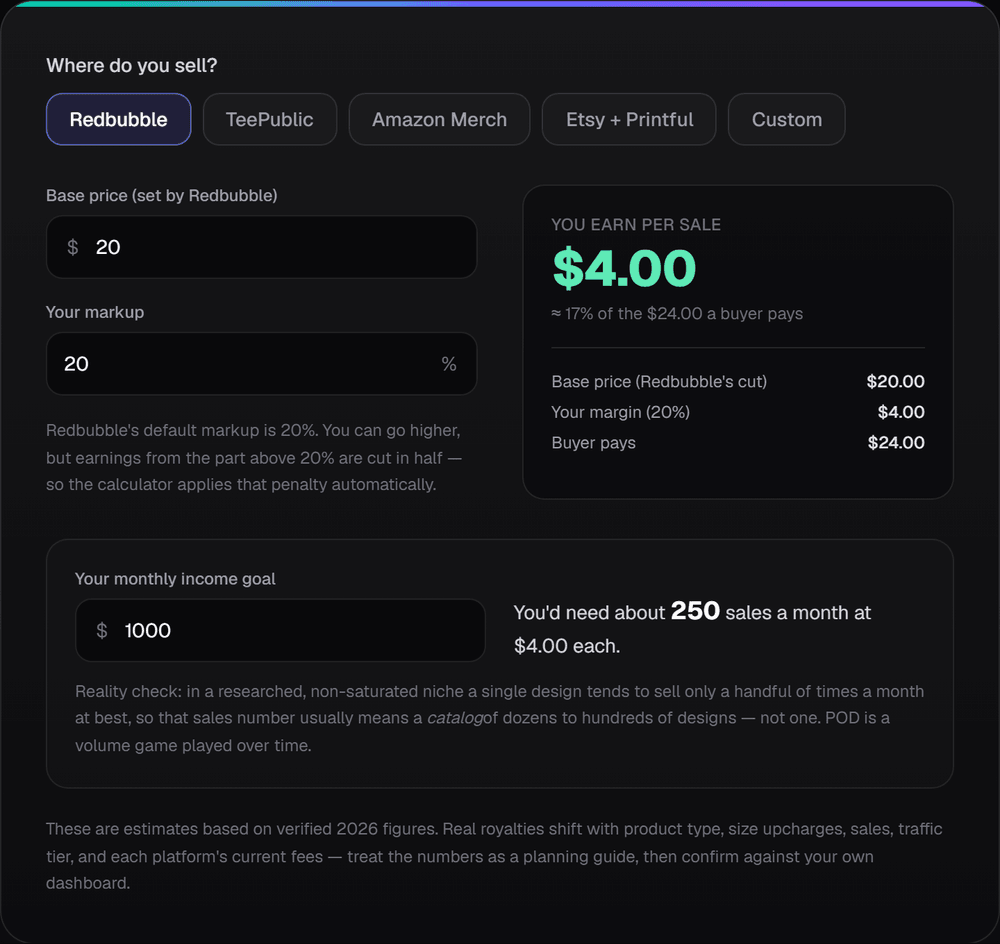
On Redbubble you don't set a retail price directly. You set a markup percentage on top of a base price the platform controls, and your earnings are base × markup. The default markup is 20%.
So on a standard tee with a base price of around $20, a 20% markup earns you about $4, and the shirt retails at roughly $24. Simple enough.
Here's the catch most beginners miss: markup above 20% is penalized. Redbubble effectively halves your earnings on the portion of markup above the 20% default. So cranking your markup to 40% does not double your profit — the extra is discounted, and meanwhile your retail price climbs and your conversion drops. For most sellers the practical lever is to stay at or near 20% unless you have a specific reason (original art, a low-competition niche) to go higher. Redbubble pricing is mostly a "leave it near default and compete on design and tags" game.
TeePublic — a fixed royalty you don't really control
TeePublic gives you the least price control of the marketplaces. You earn a fixed royalty per item — roughly $4 on a tee when it sells off-sale. The complication is that TeePublic runs sitewide sales constantly, and during those your royalty is roughly halved to around $2.
Because a large share of TeePublic sales happen during a sale, the honest move is to plan for the on-sale number (~$2), not the sticker number. You can't price your way out of this — it's baked into the platform — so TeePublic is best thought of as a volume add-on rather than a place where pricing skill earns you more.
Amazon Merch — you set the list price, royalty is tiered
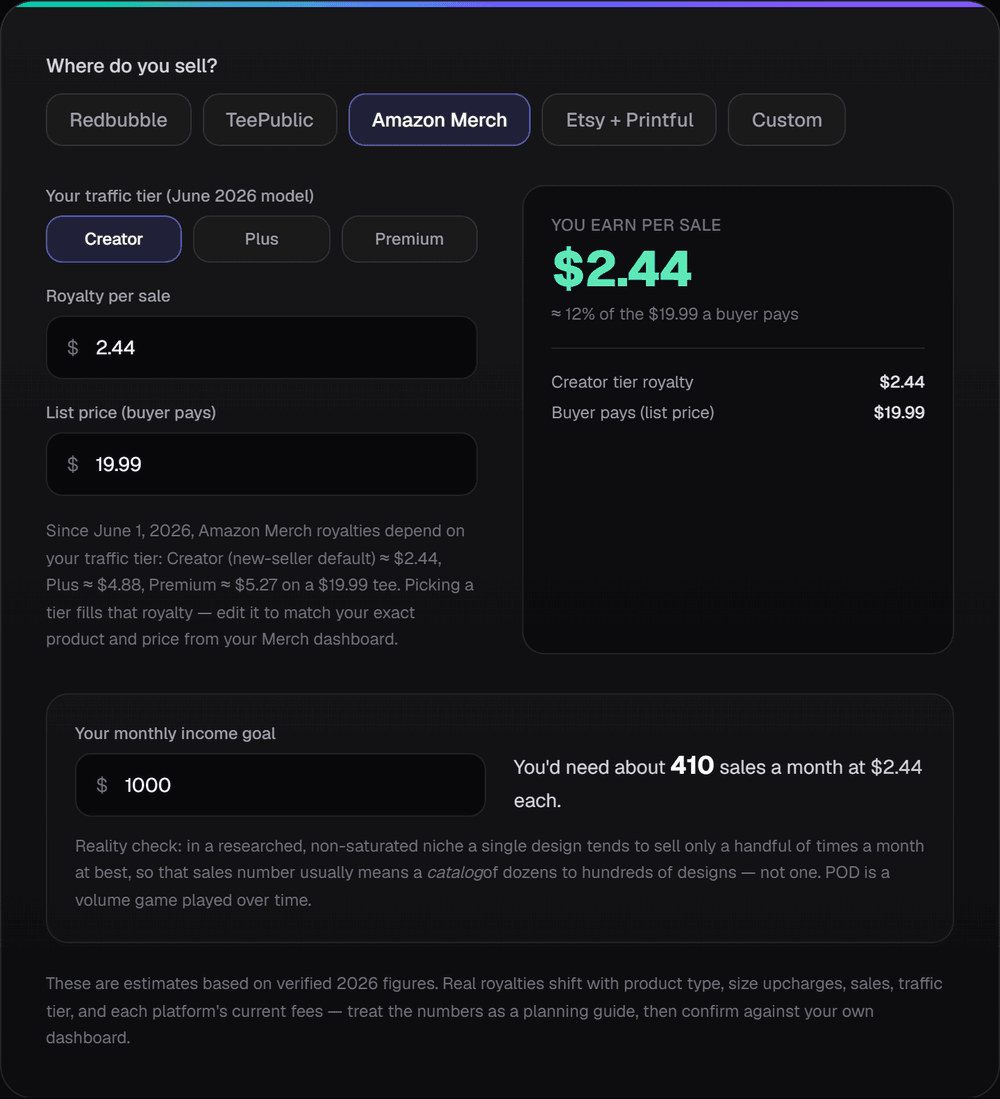
Amazon Merch is where list-price choice becomes a real lever again. You set the list price within an allowed range, and your royalty is tiered under the June 2026 model based on the tier you're in. On a $19.99 tee, the numbers look roughly like this: Creator tier (the new-seller default) earns about $2.44; Plus earns about $4.88; Premium earns about $5.27.
Two levers stack here. First is the tier, which you climb by driving external traffic. Second is the list price itself: a higher list price raises your royalty per sale, but on Amazon — where buyers absolutely comparison-shop — a higher price also lowers conversion. So the trade-off is live and real. Most beginners start at Creator on a ~$19.99 list price, which is why ~$2.44 is the realistic starting number. I covered the new tiered model in depth in the honest take on Amazon print on demand.
Etsy + Printful — you set retail fully (where pricing actually matters)
On Etsy with a partner like Printful, you control everything — which is exactly why pricing skill matters most here. Your profit is simply:
retail − base cost − Etsy fees
A Printful tee base costs around $11.69, and Etsy takes roughly 9.5% + $0.45 per order (about 6.5% transaction + ~3% + $0.25 payment processing + a $0.20 listing fee). Here's the same tee at three different retail prices so you can see how much the number you choose matters:
| Retail price | Base cost | Etsy fees (~9.5% + $0.45) | Your profit |
|---|---|---|---|
| $16.99 | ~$11.69 | ~$2.06 | ~$3.24 |
| $24.99 | ~$11.69 | ~$2.82 | ~$10.48 |
| $29.99 | ~$11.69 | ~$3.30 | ~$15.00 |
At $24.99 you keep around $10.48 — far more than a marketplace royalty, but only because you drove the traffic and set the price deliberately. Price it carelessly at $16.99 and your margin nearly evaporates after base cost and fees. This is the one place where getting the number right (or wrong) changes your business.
The per-platform summary
| Platform | Pricing model | Your lever | Realistic profit (standard tee) |
|---|---|---|---|
| Redbubble | Markup % on platform base (default 20%) | Markup %, but >20% is penalized | ~$4 at 20% on a ~$20 base |
| TeePublic | Fixed royalty per item | Almost none | ~$4 off-sale, ~$2 on-sale |
| Amazon Merch | You set list price; tiered royalty | List price + tier (driven by traffic) | ~$2.44 Creator → ~$4.88 Plus → ~$5.27 Premium ($19.99 tee) |
| Etsy + Printful | You set retail fully | Full price control | retail − ~$11.69 base − ~9.5% + $0.45 fees |
If you want to plug in your own platform and price instead of reading off a table, the free POD Profit Calculator does this exact math — it shows your real per-sale take-home after base cost and fees, so you're not guessing.
A simple pricing framework
Once you understand the models, the actual decision is straightforward. Here's the step-by-step I'd use on any new listing.
1. Know your floor. Your floor is the lowest price that still leaves you something worth keeping. On a marketplace this is mostly handled for you (the base price is fixed), but on Etsy/Printful you must add it up: base cost (~$11.69 for a tee) plus fees (~9.5% + $0.45) is your hard floor. Sell below that and you lose money on every order. Run it through the POD Profit Calculator once so you actually see the floor instead of guessing at it.
2. Check what comparable listings actually charge. Open the marketplace, search your exact niche keyword, and look at what the selling listings in that niche are priced at — not one outlier, the cluster. That cluster is the competitive band. This is the single most useful five minutes in the whole process, and almost nobody does it.
3. Price inside the band, not above or below it. On Redbubble that usually means leaving markup at or near 20%. On Amazon it means picking a list price near where comparable tees sit. The goal is to be a normal, credible price in your niche — not the suspiciously cheap one and not the inexplicably expensive one.
4. On Etsy or your own store, price for a target margin and perceived value. Because you control the full retail number here, work backwards from a margin you'd be happy with, then sanity-check it against what the design's perceived value supports. Original art in a specific niche can carry a higher price than a plain text tee. Don't only price off cost — price off what the buyer feels it's worth, within reason.
5. Test and adjust. Pricing isn't permanent. If a design gets views but no sales, your price (or your design's perceived value) may be above the band — nudge it down. If it sells briskly from day one, you may have room to nudge up. Treat it as a dial, not a one-time decision.
That's the whole framework: floor, band, position, perceived value, adjust. No magic number — just knowing your costs and your market.
Should you ever raise your price?
Yes — but only when something justifies it, not as a default.
Raise it when you have genuine pricing power:
- Original, distinctive art that buyers can't easily find elsewhere. If your design is the only good one for a specific identity, you're not competing on price.
- A specific, low-competition niche. When there are few credible alternatives, the buyer who wants that design isn't comparison-shopping — they're buying yours.
- Premium products. Hoodies, canvas prints, and the like carry higher base prices and higher perceived value, so a higher absolute markup reads as normal, not greedy.
Don't raise it when you're selling a commodity:
- Plain text tees in saturated niches. If a hundred near-identical designs exist, a higher price just sends the buyer to the cheaper near-identical one. Here you stay in the band and win on tags and niche fit, not price.
The honest test: would you still buy this at the higher price if you were the target customer, with all the alternatives a search away? If yes, raise it. If you're only raising it because more-per-sale sounds nice, you're about to trade a lot of conversions for a little extra margin — usually a bad deal.
Common pricing mistakes
After watching a lot of accounts, the same pricing errors show up again and again:
- Racing to the bottom. Undercutting everyone to "guarantee" sales. Buyers in a specific niche rarely pick the cheapest listing — they pick the design that fits. You usually give away margin for nothing.
- Blindly maxing the markup. On Redbubble, markup above 20% is penalized and tanks conversion, so you often earn less, not more. On Amazon, a too-high list price quietly kills your conversion. More-per-sale is not the same as more-total.
- Ignoring fees on Etsy. Forgetting the ~$11.69 base and ~9.5% + $0.45 in fees and pricing like the whole retail number is profit. Then wondering why the "sales" didn't translate to money.
- Pricing every product the same. A sticker, a tee, and a hoodie have completely different bases and buyer expectations. One flat markup across all of them leaves money on some and overprices others.
- Copying a guru's flat "always charge X." There is no universal POD price. A number that works for one person's niche, platform, and art is meaningless for yours. Price off your costs and your market, not a YouTube screenshot.
Avoid those five and you're already pricing more deliberately than most sellers on the platform.
FAQ
How much should I charge for a print-on-demand t-shirt?
On marketplaces you mostly don't fully choose — Redbubble lands around $24 retail ($4 profit) at the default 20% markup, TeePublic sets a fixed royalty ($4 off-sale, ~$2 on-sale), and Amazon Merch tees commonly list around $19.99. On Etsy with Printful, a common retail is roughly $22–$28, which after the ~$11.69 base and ~9.5% + $0.45 fees leaves a healthier margin. The right number is whatever sits inside the competitive band for your specific niche.
What's the best markup on Redbubble? For most sellers, near the default 20%. Redbubble penalizes markup above 20% by roughly halving your earnings on the portion over the default, and a higher price also lowers conversion. Going above 20% only makes sense when you have genuine pricing power — original art or a low-competition niche. Otherwise the 20% default is the practical sweet spot.
How do I price to make a profit on Etsy POD? Start from your floor: base cost (~$11.69 for a Printful tee) plus Etsy fees (~9.5% + $0.45 per order). Anything below that loses money. Then price above the floor toward a target margin, and check it against what comparable listings in your niche actually charge. Because you control retail fully on Etsy, this is where careful pricing pays off most — use the POD Profit Calculator to see your real take-home before you list.
Should I price higher or lower than my competitors? Usually neither — price inside their band. Undercutting rarely wins the sale (buyers pick fit, not the lowest price) and overpricing kills conversion. The exception is when you have real pricing power (distinctive art, a low-competition niche, a premium product), in which case a price at the higher edge of the band, or slightly above it, can hold.
What profit margin should I aim for in print on demand? On marketplaces, "margin" is mostly fixed for you — expect roughly $2–$5 per tee depending on platform and tier. On Etsy/your own store where you set retail, a common target is keeping clearly more than half the retail price after base cost and fees (e.g. ~$10+ on a ~$25 tee). But chase total profit, not a margin percentage: a thinner margin that converts well can out-earn a fat margin that never sells.
Does raising my price increase my total earnings? Not automatically. A higher price earns more per sale but converts fewer buyers, and on Redbubble and Amazon it can be actively penalized. It increases total earnings only when you have pricing power — distinctive art or a low-competition niche where buyers aren't comparison-shopping. In a saturated, commodity niche, raising the price usually lowers your total take.
Where to go from here
Pricing in print on demand isn't a magic number — it's understanding your platform's model, knowing your floor, and pricing inside the competitive band on purpose. Stay near Redbubble's 20% default, plan for TeePublic's on-sale royalty, choose your Amazon list price knowing it's a real lever, and on Etsy price deliberately off cost and perceived value. Then test and adjust. That's the entire game.
But here's the honest catch I always come back to: pricing only matters if people actually find and want your design. A perfectly priced shirt in a flooded, no-demand niche still earns $0. The lever with far more leverage than price is picking a researched, non-saturated niche in the first place — which is exactly what I built Trendlytic for. One search shows what's actually selling across Redbubble, TeePublic, Amazon Merch, and Etsy, with a live USPTO lookup on the phrases you decide to keep. $19.99/month, 100 searches, free trial. It does the boring research step so you don't dig through marketplaces by hand. It is not a money printer, and you don't need it to succeed — it just makes the research faster.
For the practical next steps: run your real numbers with the free POD Profit Calculator, read the honest math in is print on demand profitable, and if you're just getting set up, how to start a print on demand business walks the whole thing step by step. To price well you first need the right niche, so dig into print on demand niches and how to find trending POD niches — and when it's time to list, grab phrase tags fast with the free Redbubble tag generator. For the big-picture map of how pricing fits with everything else, the complete guide to print on demand pulls the whole thing together.
One question before you set your next price: which platform are you pricing for right now — and are you tempted to go above the competitive band, or undercut it? Tell me which way you're leaning, and I'll tell you whether it's the right call for your niche.
Try Trendlytic
Find your next winning POD niche in 40 seconds
Live data from TeePublic, Amazon Merch, Redbubble, and Etsy, and a one-click USPTO lookup on any phrase. Then turn any winner into a listing for a design of your own in that niche. Plans from $19.99/month.
Start researchingLiked this? Learn niche research in 5 short emails.
One email a day for 5 days: how sellers pick niches, why designs fail, and how to check yours. Unsubscribe in one click.
Keep reading
- Trendlyticprint on demand
Print on Demand: The Complete Guide for 2026
The JournalPrint on Demand: The Complete Guide for 2026
June 13, 2026 · 14 min read
- Trendlyticprint on demand
Is Print on Demand Profitable in 2026? An Honest Breakdown
The JournalIs Print on Demand Profitable in 2026? An Honest Breakdown
June 8, 2026 · 14 min read
- Trendlyticprint on demand
How to Start a Print on Demand Business in 2026: A Step-by-Step Guide
The JournalHow to Start a Print on Demand Business in 2026: A Step-by-Step Guide
June 5, 2026 · 17 min read