TL;DR: Printful prints most orders inside facilities it owns and staffs, which buys you one standard and serious branding options at a higher unit cost. Printify brokers your orders to a network of independent factories that you pick between, which buys you a much larger catalog and more room on price, provided you vet the factory. Both now sell a paid tier that tops out at a third off product prices, so the old line about Printify simply being the cheap one is weaker than it was. Choose Printful when the product itself is the pitch. Choose Printify when range and unit cost are.
Anyone typing this comparison into Google is at the same point in the process: the designs are coming along, the shop is nearly ready, and now somebody has to actually make the shirts. Good news first. Neither of these two is a wrong answer, and the difference between them is structural rather than a matter of one being better run than the other.
Worth clearing up before anything else, because beginners trip on it weekly: neither company is a shop window. No buyer browses Printful hoping to stumble across your work. You bolt the supplier onto a storefront you already control, whether that is Etsy, Shopify, WooCommerce or your own site, and when an order lands the supplier makes the item and posts it with your name on the parcel. Getting people to the listing stays your job. Manufacturing stops being your job.
My own work is a research tool for sellers, so I have no stake in which of these two prints your order. I did go and check the claims, though, because supplier comparisons age badly and plenty of the ones ranking today were written against 2024 pricing. Every figure below came off Printful's or Printify's own site in September 2026, and the text says which page each one came from, so you can re-read it yourself in six months when it has moved again.
Gelato stays out of this page on purpose, so if it is also on your shortlist, read Printful vs Gelato, Gelato vs Printify or the three-way comparison rather than asking this one to stretch.
Don't miss the next one.
New POD niche analysis every Wednesday.
Two companies, two very different org charts
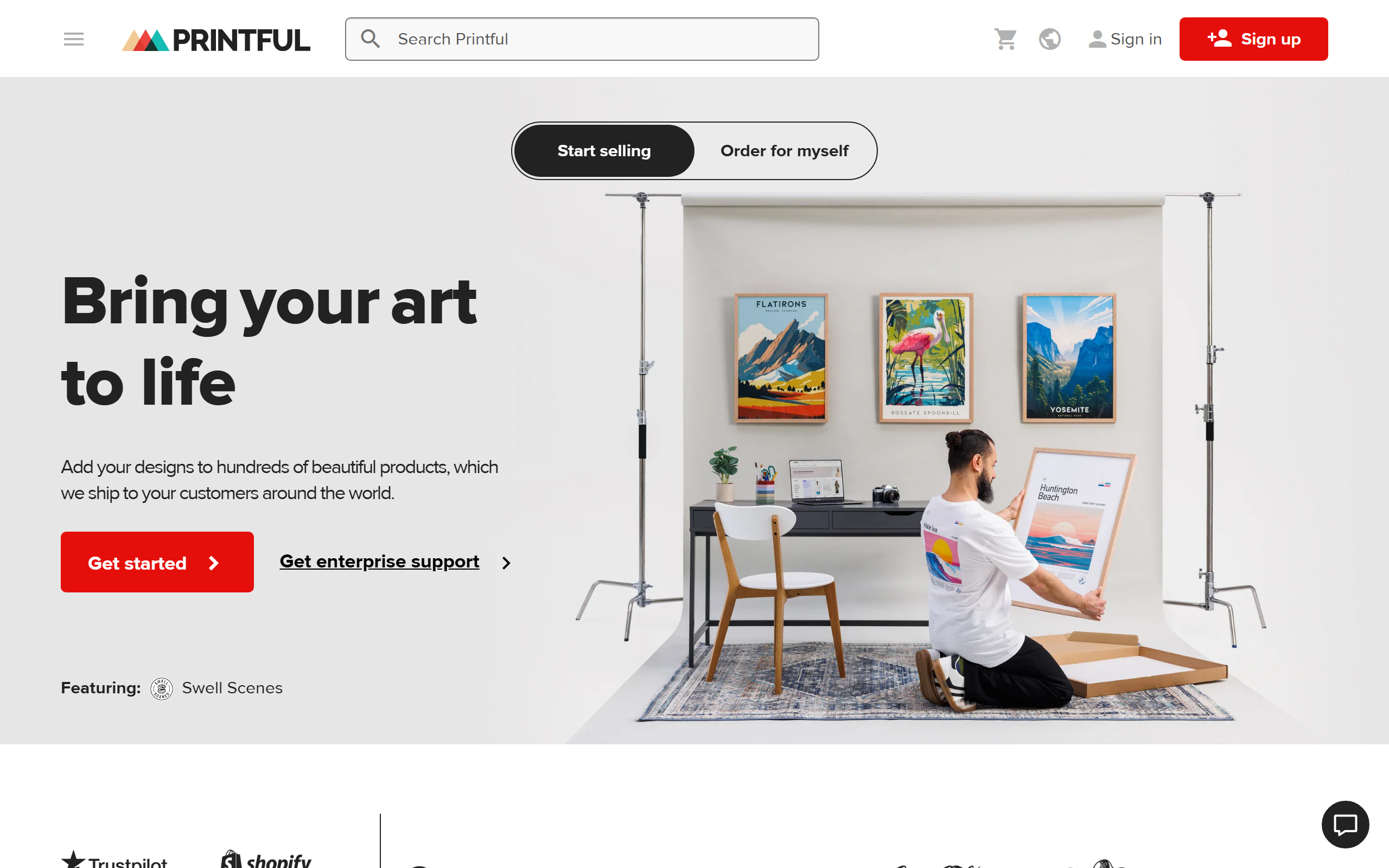
Printful owns its production. Orders run through facilities the company operates itself, with its own staff, its own machines and its own quality checks, which is the single fact that explains most of what follows. One operation means one standard. The hoodie you approved in spring is made the same way in autumn, on the same kit, by people answering to the same quality manager. Nothing about that is glamorous, but for a brand it removes a whole category of problem: you are never wondering which subcontractor caught this week's batch.
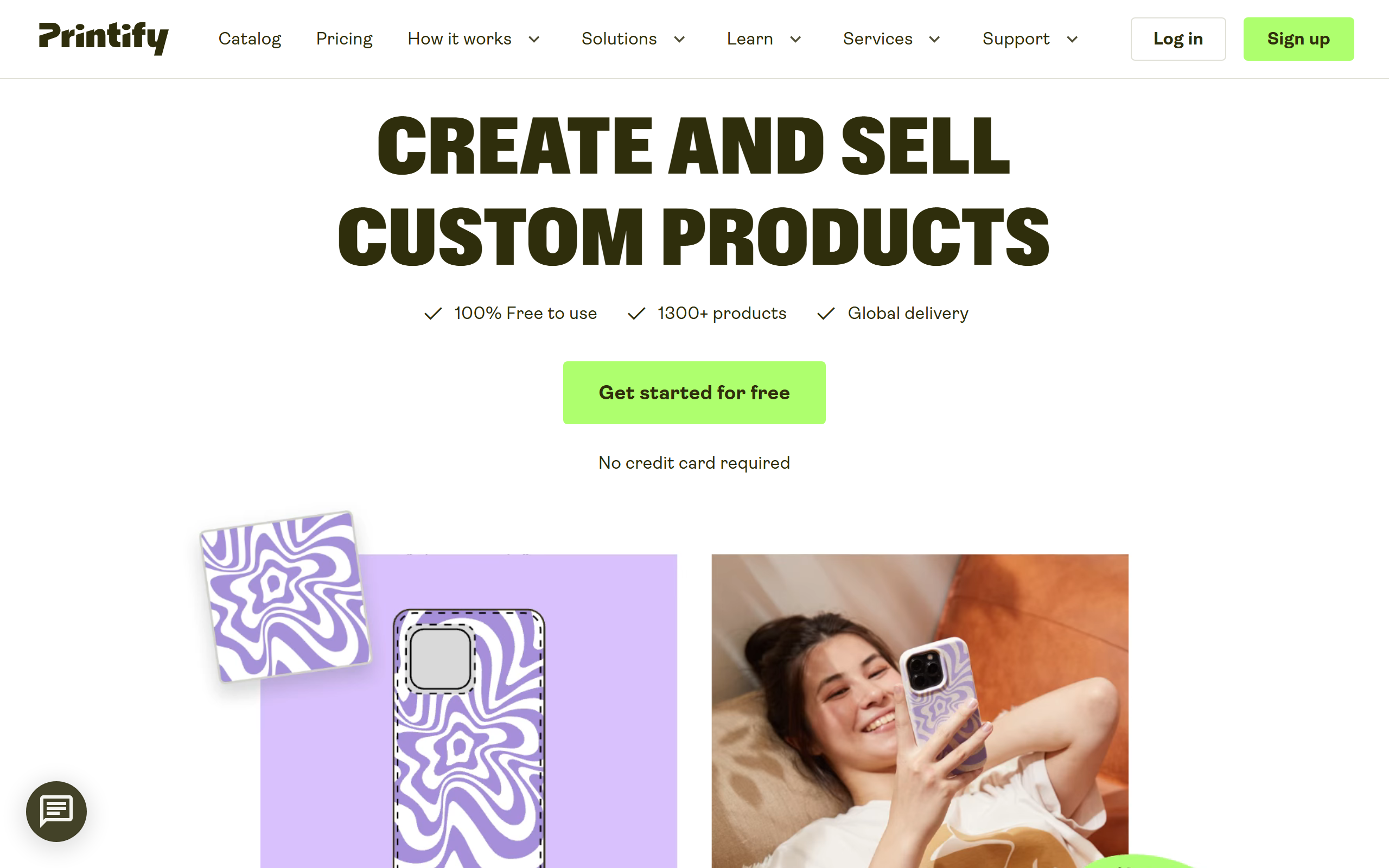
Printify does not own production at all. It is a layer between you and a lot of independent factories, and its print-on-demand page states the size of that layer plainly: more than 140 printing facilities across the US, Canada, the EU, the UK, Australia and China. For most items you choose which of those facilities gets your orders, and that choice sets your unit cost, your dispatch point and your quality. The company is, in effect, a marketplace of manufacturers with a shared design tool bolted on top.
Read those two paragraphs again if you are in a hurry, because the rest is consequences. Owning the factory buys uniformity and costs money. Brokering factories buys choice and range and hands you the vetting work.
Plans and prices, as listed in September 2026
Here is what each company publishes on its own pricing page right now. I have kept the exact tier names rather than translating them, because both companies renamed things in the last couple of years and half the advice online still uses the old labels.
| Printful | Printify | |
|---|---|---|
| Entry tier | Free | Free |
| What the free tier lists | Access to 561 custom products, unlimited stores and 10 Quick Stores, free Design Maker and Mockup Generator, 20+ platforms, 24/7 support | Unlimited product designs, 5 stores, the product creator, the major sales channels, 24/7 merchant support |
| Paid tier | Growth, $24.99/month, and free once you pass $12K/year in sales | Premium, from $39/month, or from $24.99/month billed annually |
| Paid tier discount | Up to 33% off product pricing, 9% off product branding, 25% off sample orders | Up to 33% off new products, 20% off all products, 33% off custom branding, AI Mockups |
| Stores on the paid tier | Unlimited | 10 |
| Top tier | Enterprise, custom pricing | Enterprise, custom pricing |
Two things in that table deserve to be said out loud, because they cut against the received wisdom.
First, the headline discount is the same ceiling on both. Printful advertises up to 33% off product pricing on Growth. Printify advertises up to 33% off new products on Premium, alongside 20% off the rest of the catalog. Whatever the old blog posts say about one company being categorically cheaper, at the subscription level the two are now aiming at the same number.
Second, Printful's paid tier has an exit. Growth is listed at $24.99 a month and becomes free once you are doing $12K a year in sales, which is a threshold a modest but real shop clears. Printify's pricing page lists nothing equivalent, though Premium does drop to roughly the same monthly figure if you pay for a year up front instead of month to month. So the sensible reading is that both charge about the same for their discount tier, and Printful is the one that eventually stops charging.
None of which tells you the actual cost of a shirt. Subscription tiers move the discount, not the base price, and base prices differ product by product and factory by factory. Price the specific garment you plan to sell, in the colors you plan to sell it in, with delivery to the country most of your buyers live in, and compare the margin you would keep at a retail price real people will pay. If the retail side is the part you are unsure about, this walkthrough of POD pricing does the arithmetic with you.
Catalog: curated versus sprawling
The gap here is large, though pinning it to one exact figure is harder than it ought to be.
| Printful | Printify | |
|---|---|---|
| Products listed | 561 custom products | 2,000+ products on the home page, 1,300+ on the print-on-demand page |
| Where the range comes from | One in-house catalog | Many facilities, often offering overlapping items |
| Practical effect | Fewer choices, fewer decisions | More choices, including several versions of the same blank |
| Duplicate listings | Rare | Common, since providers compete on the same base product |
A quick note on that second column, since I would rather show you the mess than tidy it away. Printify's home page counts 2,000+ products and 141 facilities, while its own print-on-demand page still says 1,300+. Two pages, one company, two answers, which is a fair reminder that supplier marketing numbers are approximate by nature.
That size gap sounds decisive until you use both. Printify's count is partly a side effect of its structure: several factories offer the same blank tee at different prices with different print methods, and each of those is an entry. That is genuinely useful once you know what you are looking for, because you can shop the same product on price and location. On day one it is a lot of near-identical rows to sift.
Printful's smaller catalog is the other side of the same coin. Everything in it goes through one operation, which is why the number is smaller and why the range feels coherent. If your shop is apparel and accessories with some home goods, you will not run out of products. If your plan depends on an unusual item, check whether it exists before you commit, because 561 is a decent catalog and not an infinite one.
The question is never which catalog is bigger in the abstract. It is whether the eight or ten products you actually intend to list are on the platform, made well, at a price that leaves you something.
Speed: what each one publishes about production
Both companies document production time, and they document it differently, which itself tells you something.
Printful publishes an average across its facilities: fulfillment takes 2 to 5 business days for most production techniques, more than half of orders ship within 3 business days, and over 97% ship within 5. Some categories run longer, with all-over prints listed at up to 7 business days and knitwear at up to 12. Those are company-wide figures because there is one company doing the work.
Printify cannot publish a single average in the same way, so it publishes a range and a per-factory number: most orders ship within 2 to 7 business days, and when you pick a provider for a product you can see that provider's average fulfillment time for that product over the previous 30 days. Printify also runs an Express Delivery option for US orders that aims to get the parcel there within two business days.
That per-provider average is the most underused number on the platform. It is recent data about the factory you are about to trust, sitting right next to the price, and plenty of sellers scroll past it to look at the price alone. If two providers are twenty cents apart and one of them is two days faster, the twenty cents is not the story.
Quality, and the habit that protects you on either platform
Printful's consistency argument is real, and it is a consequence of the org chart rather than of marketing. When one company runs the presses, output drifts less between orders.
Printify's quality is not worse. It is variable, which is a different problem and one you have some control over. A strong factory in that network produces work that stands up to anything. A weak one produces the horror stories you read in seller groups. The difference between those two outcomes is usually whether you chose deliberately or accepted whatever was set as the default.
So the habit that matters is the same on both, and it is dull enough that plenty of people skip it: order the sample before you scale the product. On Printful you are sampling to confirm a standard you can then expect to hold. On Printify you are sampling a specific factory, which means a sample from one provider tells you nothing about another, and switching providers later means sampling again. Dark garments and artwork with fine detail are where prints go wrong most often, so test those first rather than testing your safest design. One sample costs less than a week of refund emails. If the printing methods themselves are new to you, DTG vs DTF explains what you are actually looking at when a sample arrives.
Branding and integrations
Integrations are close to a tie, which is the boring but useful conclusion. Printful lists selling on 20+ ecommerce platforms and marketplaces on its free tier. Printify names Shopify, WooCommerce, Etsy, eBay, Wix, PrestaShop and BigCommerce among its connections. Either way, the storefront you are likely to be running is supported, orders flow back without you forwarding anything by hand, and the connection is not going to be the thing that decides this.
Branding is where they separate, and the pricing pages show it in the discounts each one offers. Printful sells branding as a category of its own, with 9% off product branding on the Growth tier and a set of options built around making the box look like it belongs to your label instead of to a print shop. Printify offers custom branding too, discounted 33% on Premium, though what is available depends on the factory you picked, since not every provider in a network of 140-plus supports every branding feature.
The practical rule: if a branded unboxing is part of what you are selling, confirm your chosen Printify provider supports the specific branding you have planned before you design around it. On Printful you are asking one company, and the answer applies everywhere.
So which one fits you
Be honest about which of these lists you are actually in, because both are correct answers for the right shop.
Printful fits you if you sell at a price point that carries a higher unit cost, the product in the customer's hands is the argument for your brand, you want branded packaging without auditing factories, you would rather remove variables than optimize them, and you expect to pass $12K a year in sales and stop paying for the subscription.
Printify fits you if unit cost drives your margin, you want the widest possible range of products to test with, you are willing to read provider stats and order samples before scaling, you want to choose where each product ships from, and you would rather have five versions of a blank to pick from than one decided for you.
Both fits you if your flagship line needs to be identical every time and your experimental line needs to be cheap, and you have enough order volume that running two supplier accounts is worth the admin. Plenty of established shops do exactly this, with the brand-defining products on the in-house operation and the long tail on the network. The two companies are not enemies, and nothing about connecting one stops you connecting the other.
If you want a wider field before you commit, there is a broader supplier roundup, plus dedicated breakdowns of Printful alternatives and Printify alternatives.
The half of the decision this page cannot settle
Here is the part supplier comparisons quietly skip. Choosing between these two is the easy half. Whichever one ends up printing your orders, you still have to decide what to put on the product, and that decision is where shops actually live or die. A beautifully made, perfectly branded shirt in a niche nobody is buying earns nothing, and a phrase somebody else registered gets the listing pulled regardless of who made the garment. That work sits before the supplier and is unaffected by which one you picked.
Declaring the obvious conflict: Trendlytic is my own company, so the following paragraph is a founder describing his product rather than a neutral tip. It prints nothing. It sits one step earlier than Printful and Printify rather than competing with them. A single search puts Etsy, Redbubble, TeePublic and Amazon Merch side by side and shows which designs are moving, so you work from evidence instead of a hunch, and you can click a phrase to send it to the live USPTO register and see what is already registered before you build a design around it. That lookup takes one click, it is on every plan, and it is a first filter rather than legal advice. The subscription begins at $9 a month, with a free trial ahead of the first charge. If you want somewhere to start, we have written up which niches actually make money and how to spot a trend while it is still early.
One thing worth saying because it gets misread constantly: when you find a design selling well, the move is not to copy it. The move is to serve that same buyer with a design of your own, in the look they are clearly responding to. Different artwork, different hand, same proven appetite.
FAQ
Which is better, Printful or Printify? Neither, universally. Printful is better when you want one production standard and strong branding and can carry a higher unit cost. Printify is better when you want the widest catalog and the lowest unit cost and are willing to pick and vet a factory. The deciding question is whether you would rather remove variables or optimize them.
Is Printify cheaper than Printful? Usually on base cost, but the gap at the subscription level has narrowed. Printful's Growth tier lists up to 33% off product pricing at $24.99 a month, and it becomes free past $12K a year in sales. Printify's Premium lists up to 33% off new products and 20% off everything else, priced from $39 monthly, or from $24.99 a month if you commit to a year. Compare the exact items you sell, with shipping to your main market, instead of trusting a general answer.
How fast does each one ship? Printful states 2 to 5 business days for most fulfillment, with over 97% of orders shipping within 5 and more than half within 3. Printify states most orders ship in 2 to 7 business days and shows each provider's 30-day average fulfillment time next to that provider, with an Express option aiming at two business days for US orders.
How many products does each one offer? Printful's free tier lists access to 561 custom products. Printify's own pages give two different counts, 2,000+ on the home page and 1,300+ on the print-on-demand page, drawn from a network of more than 140 printing facilities, which is why the same blank often appears several times at different prices.
Can I use Printful and Printify together? Yes, and it is a common setup once a shop has traction. Both connect to the same major storefronts, so you can route your flagship branded products to one and your cheaper or experimental products to the other from a single shop. The cost is two accounts to manage rather than one.
Do I still need to worry about trademarks if my supplier prints it? Yes. A supplier prints what you upload and takes no view on whether the phrase belongs to someone else, and the takedown lands on your listing rather than on them. Check a phrase against the register before you design around it, and read our guide to print-on-demand trademarks if you are unsure what counts.
Conclusion
Printful and Printify are both solid, and the choice is a question about your shop rather than about the companies. Printful owns its production, which buys consistency and branding depth at a higher unit cost, and its subscription stops costing you anything once sales pass $12K a year. Printify brokers a network of more than 140 factories, which buys a catalog several times the size and room on unit cost, in exchange for you doing the vetting. Both cap their paid-tier discount at the same 33%, so pick on model and product rather than on a price myth.
And whichever one you connect, the supplier is the easy half. What you put on the product is the half that decides whether any of it sells.
If you have run orders through both, which one earned its place in your shop, and did the consistency-versus-cost trade play out the way you expected?
Like this? Get one like it every Wednesday.
Niche data, trademark alerts, one tactic per week.
Try Trendlytic
Find your next winning POD niche in 40 seconds
Live data from TeePublic, Amazon Merch, Redbubble, and Etsy, with a trademark check built in. Then turn any winner into a listing for a design of your own in that niche. Plans from $9/month.
Start researchingKeep reading
- Trendlyticbest print on demand companies
The 10 Best Print-on-Demand Companies of 2026
The JournalThe 10 Best Print-on-Demand Companies of 2026
July 1, 2026 · 20 min read
- Trendlyticetsy
Etsy Print on Demand: The Complete 2026 Beginner's Guide
The JournalEtsy Print on Demand: The Complete 2026 Beginner's Guide
May 23, 2026 · 17 min read
- Trendlyticprint on demand automation
Print on Demand Automation: What Actually Runs Itself
The JournalPrint on Demand Automation: What Actually Runs Itself
September 15, 2026 · 15 min read