TL;DR: Screen printing gets cheap per shirt once one design runs into the dozens or hundreds. DTF has no minimum, costs the same for any number of colors, and wins on small runs and shops with many designs. On prices I read on 26 November 2026, ooShirts charged $9.13 a shirt for 12 one-color screen prints on white tees and $4.45 for 288, setup and shipping included, while a DTF shirt pressed at home came to $4.90 to $5.89 for transfer and blank, before the press and your time. For a one-color design the crossover sat between 96 and 288 shirts, and each extra ink color pushes it higher. Screen prints carry the stronger wash claims; DTF goes on almost any fabric but leaves a film you can feel. Print-on-demand sellers rarely get to choose: the provider prints with DTG or DTF.
Most people who type this question are about to spend real money on shirts for the first time: a first drop for a small brand, a run for a local event, stock for a market table. The choices look like three doors. Press DTF transfers yourself, pay a screen printer for a run, or let a print-on-demand company print each shirt after it sells.
In our DTG and DTF comparison I wrote that screen printing isn't really a print-on-demand method, and I still think so. This post is about the moment you order shirts as a batch, and whether that batch should be screen printed or pressed with DTF.
Every price, minimum and press setting below comes from the company's own page, read on 26 November 2026. Where two companies disagree, you get both numbers. Where I found no published figure, I say so.
How each method works, in plain words
Screen printing
Custom Ink's help center has a clear description. The printer makes a stencil, which printers call a screen, and a squeegee pushes ink through the open parts of it onto the shirt. "Each color is applied using a different stencil, one at a time" (customink.com, November 2026). A three-color design means three screens, each one made, mounted and lined up before a single shirt is printed.
That setup is the whole economics of the method. Once the screens sit on the press, each extra shirt costs little.
The ink is then cured with heat. Lawson, which sells screen printing equipment, says most plastisol inks cure at 320°F, or 160°C (lawsonsp.com, November 2026). Plastisol is the everyday ink. RushOrderTees explains the difference between ink types: "Plastisol ink bonds to the surface of the fibers, while water-based and discharge inks soak into them" (rushordertees.com, November 2026).
DTF (direct to film)
DTF prints the entire design, every color plus a layer of white behind it, onto clear PET film. Adhesive powder goes on, the film is cured, and the transfer is then pressed onto the shirt. In Custom Ink's words, the design on the film "is heat-transferred to the fabric using a heat press machine."
There are two ways in. You can buy a printer: Epson's SureColor F1070 Standard Edition, which does both DTG and DTF, lists at $4,995 MSRP, and its box list includes no heat press (epson.com, November 2026). Or you can order printed transfers and press them yourself, with no printer to buy. DTF Transfers Now sells them on 22-inch-wide gang sheets, advertises no minimums and no setup fees, and says standard DTF "prints in 24 hours" (dtftransfersnow.com, November 2026).
Pressing takes seconds. These are DTF Transfers Now's published settings:
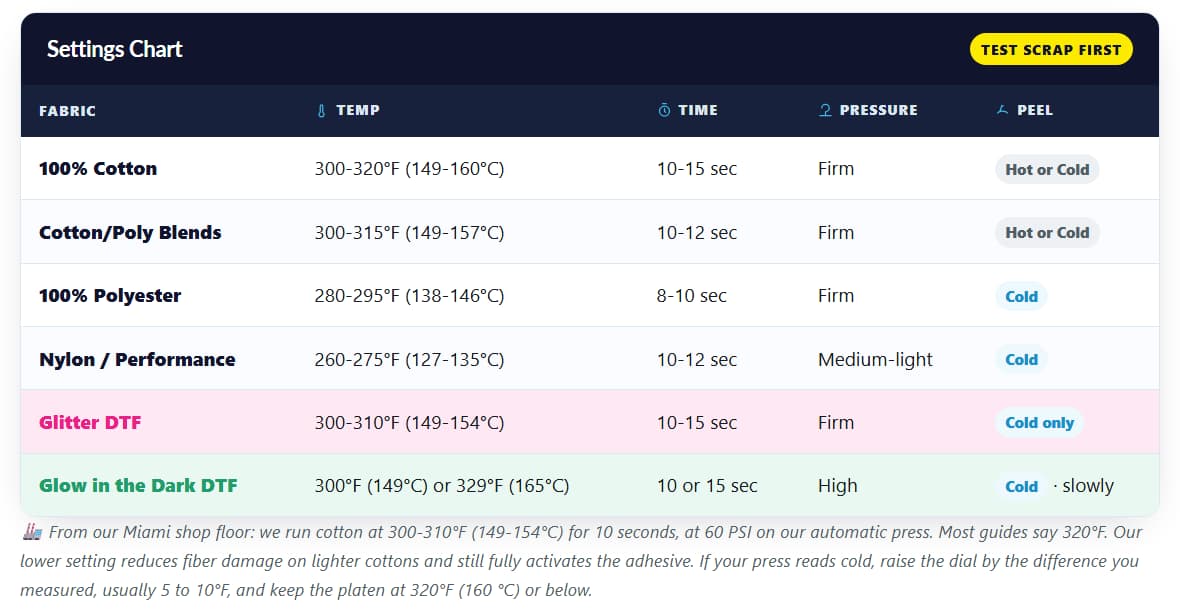
Pressure is firm, and a final 10-second press goes on with a Teflon sheet or a linen cloth over the bare design. Under the chart, the same supplier says its own Miami shop runs cotton a little cooler, at 300 to 310°F for 10 seconds, while "Most guides say 320°F." Test on a scrap of the same fabric before you trust any number, theirs included.
Transfers are ordered by width, and the right width changes with the shirt size. Our free chart of DTF transfer sizes gives the widths suppliers publish for each size and placement, from toddler tees to 4XL and hoodies.
Feel, durability and wash care
How each print feels
A plastisol screen print is a layer of ink on top of the fabric; ooShirts describes "thick, vibrant ink layers" (ooshirts.com, November 2026). Water-based and discharge inks soak into the fibers instead. Ask your printer which ink the quote uses, because the feel follows the ink more than the name of the method.
DTF is a film. Printful says a DTF garment "feels slightly stiff when new and wears in after a few washes," and that "A layer of full-coverage print makes the garment feel heavier and less breathable" (printful.com, November 2026). A small chest logo barely registers. A large solid block across the front does.
How long each print lasts
This is what each company claims, under its own conditions:
| Method | What the company claims | Source |
|---|---|---|
| Screen printing | Ink layers "that hold up through hundreds of washes" | ooshirts.com, November 2026 |
| Screen printing | A properly cured print "can last for many washes, often as long as the garment itself" | rushordertees.com, November 2026 |
| DTF | A properly pressed transfer "lasts 50 to 100 washes under normal washing conditions" | dtftransfersnow.com, November 2026 |
| DTF | "Certified for 100+ Washes" in its own test: 100 cycles at 80°F, normal cycle, line dried, on a 100% cotton shirt | ninjatransfers.com, November 2026 |
| DTG | Held color "through 100 wash cycles" in a 2026 Kornit test that Printful cites | printful.com, November 2026 |
Read these as seller figures, not independent lab results. I found no neutral test that put both methods on one shirt, and DTF Transfers Now says as much: screen print durability "depends on its own ink, curing, and fabric, so we don't put a side-by-side number on it." The two DTF numbers disagree too, 50 to 100 against 100 plus, and the 100-plus test was line dried, which is gentler than most buyers will be.
The sources do agree on how each print fails. A screen print fails when it wasn't cured properly, which is why both screen printers above say "properly cured." A DTF transfer fails at the press. DTF Transfers Now writes that "Peeling is almost always a pressing issue: temperature too low, insufficient pressure, or a skipped second press." So a screen print's life depends on your printer, and a DTF shirt you pressed yourself depends on you.
My read on DTF vs screen printing durability: a well-cured plastisol print has the stronger claim on paper, hundreds of washes against 50 to 100. If a shirt has to survive years of weekly washing, like a work uniform, I would lean toward screen printing. For an ordinary graphic tee, both hold up when the press or the cure is done right.
Wash care
| Screen printing | DTF | DTG | |
|---|---|---|---|
| Before the first wash | Not stated | Wait 24 hours after pressing | Not stated |
| Washing | Inside out, cold water | Inside out, cold water only | Inside out, cold water |
| Detergent | Avoid bleach | Mild detergent, no bleach, no fabric softener | Mild detergent |
| Drying | Tumble dry low or hang dry | Tumble dry low, or air dry (preferred) | Not stated on the page I read |
| Ironing | No direct high-heat ironing on the print | Never iron directly on the design | Never iron the print |
| Source | ooshirts.com | dtftransfersnow.com | printful.com |
Printful adds one DTF warning that belongs on your care card: "the design may develop small cracks if the garment is washed in hot water."
Colors, gradients and detail
Screen printing charges by the color. Custom Ink says "Most screen-printed designs use between one and six ink colors," calls the method "ideal for bold designs with solid colors," and adds that "For designs with many colors or photographic images, digital printing may be a better option" (customink.com, November 2026). ooShirts says most shops can handle six to eight colors, but that one to three is where screen printing costs least. Lost Woods, a smaller screen print shop, says "We can print up to 10 colors" (Lost Woods' help center, November 2026).
Photos are possible but awkward. ooShirts says screen printing "is not the ideal method for reproducing full-color photographs on t-shirts," and that printers imitate them with six to eight halftone inks.
Dark shirts add a color. To keep ink bright on black, the printer puts down white first, and Custom Ink's blog notes that "An underbase adds one color to your ink count, which increases cost on screen-printed orders." Its example: a two-color design on a black shirt needs three screens.
DTF doesn't count colors. The same Custom Ink article says digital printing charges the same for a 12-color gradient as for a two-color graphic, with the white base applied automatically at no extra cost. DTF Transfers Now prices its standard sheets by length. Printful calls its own DTF method, DTFlex, "Our most colorful production method."
So the design decides a good part of the bill. A one-color logo is the screen printer's best case. A sunset in eleven shades is DTF's.
Cost per shirt as the quantity grows
A screen print order carries a fixed cost before the first shirt is printed. DTF mostly doesn't.
ooShirts puts a number on that fixed part: "The industry-standard setup fee is typically $20 per color, per print location," and it builds the fee into its quotes instead of listing it (ooshirts.com, November 2026). RushOrderTees lists no screen fee either: "Screen setup is shared across every piece, so the price per piece usually drops as your order grows." You may never see a "screen fee" line on an online quote, but it sits inside the per-shirt price.
ooShirts publishes reference prices by quantity:
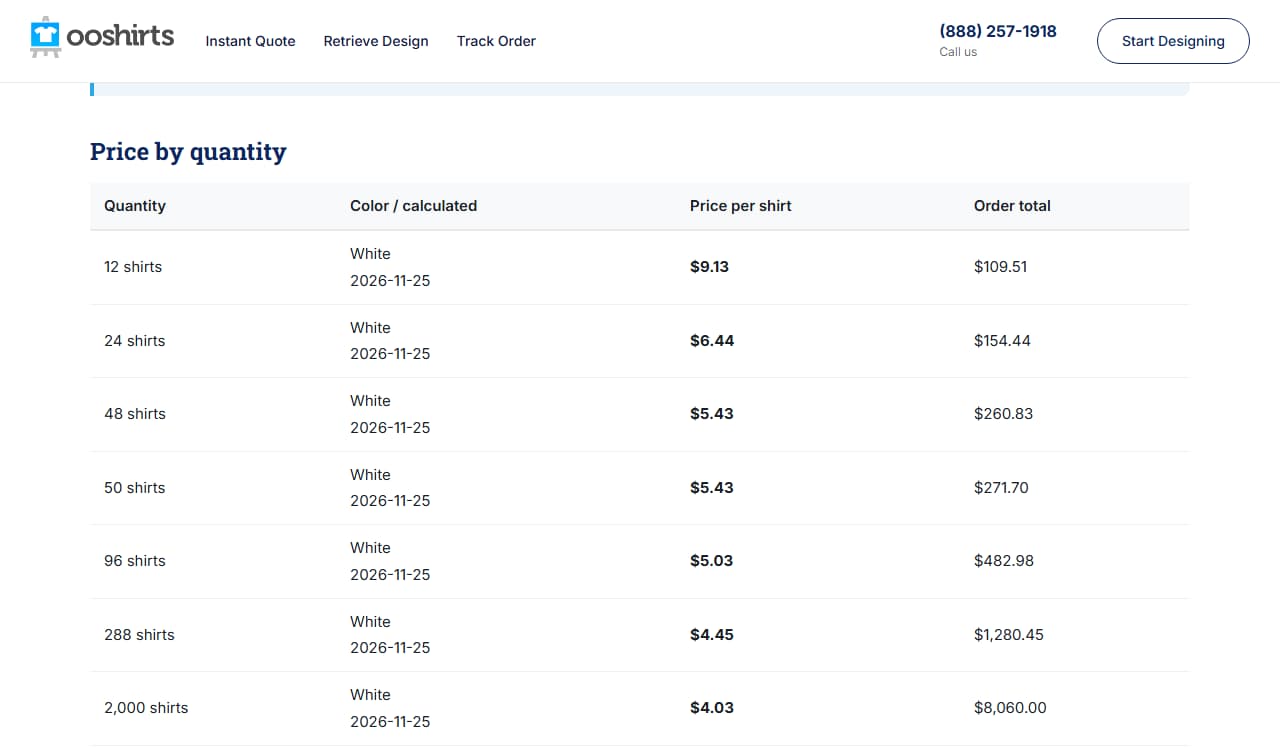
They cover setup and standard shipping within the contiguous US, for one ink color on the front of a white shirt, size medium. Extra colors, darker shirts and more print locations raise the total, and ooShirts doesn't publish those prices. Here they are next to the other two routes:
| Shirts of one design | Screen print, 1 color on white (ooShirts) | DTF pressed at home: transfer plus blank | DTG through Printful, Bella+Canvas 3001 |
|---|---|---|---|
| 1 | Not offered (12 minimum) | $5.89 | $11.92 |
| 12 | $9.13 | $5.89 | $11.92 |
| 24 (Printful: 25) | $6.44 | $5.89 | $10.40 |
| 48 (Printful: 50) | $5.43 | $4.90 | $9.44 |
| 96 (Printful: 100) | $5.03 | $4.90 | $8.72 |
| 288 (Printful: 200 and 500) | $4.45 | $4.90 | $8.37 and $8.13 |
| 2,000 | $4.03 | $4.90 | Not listed |
Read 26 November 2026. Screen: ooshirts.com/prices (calculated 25 November). DTF: dtftransfersnow.com charges $27 for a 22 x 60 inch sheet, which it says holds eight designs of 10 x 12 inches ($3.38 each), and $114.75 for 22 x 300 inches, which holds 48 by my count ($2.39 each); a white Gildan G500 blank is $2.51 at shirtspace.com. That column leaves out the press, your time and shipping (free over $79 at Shirtspace, over $75 at DTF Transfers Now), and below 48 it assumes you fill each sheet, with other designs if needed. DTG: printful.com product and bulk pages, one DTG print included, shipping extra.
Two caveats sit under the DTF column.
The transfer seller matters as much as the method. Ninja Transfers listed its 22 x 60 inch sheet at $49.99 on sale, down from $84.95 (ninjatransfers.com, November 2026). If the same eight designs fit, that's $6.25 a transfer and about $8.76 a shirt with the blank, and screen printing wins from 24 shirts. Price your own supplier before you rely on my numbers.
The press is a real cost. Heat Press Nation listed its HPN Black Series 15 x 15 inch clamshell at $419.95 (heatpressnation.com, November 2026). Spread over your first 100 shirts, that's $4.20 a shirt. And every shirt takes a 10 to 15 second press on cotton plus the 10-second finishing press, plus loading and peeling.
Where the break-even sits
For a one-color design on white shirts, with a press you already own and your time left out, home-pressed DTF was cheaper than ooShirts through 96 shirts and more expensive at 288. The crossover sat somewhere between those two. Count your pressing time and it moves lower. Buy the press for this one order and screen printing comes out ahead at every quantity in the table.
Extra colors move it the other way. Take ooShirts' industry figure of $20 per color per location. A four-color design on a black shirt needs five screens, four colors plus the white underbase, so about $100 of setup before a drop of ink, by my arithmetic. That's $4.17 a shirt across 24 shirts and $1.04 across 96, on top of the ink. The DTF transfer for the same design costs exactly what the one-color version did.
Against print-on-demand DTG, 12 shirts is close. ooShirts' $9.13 sits between Printify's $8.39 for a Gildan 5000 (printify.com, November 2026) and Printful's $11.92 for a Bella+Canvas 3001. From 24 shirts on, screen printing is clearly cheaper, and Printful's best bulk price in the table, $8.13 at 500, is still well above ooShirts' $4.45 at 288. Print on demand earns its higher price differently: no stock, no minimum, and nothing paid until a buyer pays you. For shirts you mail one at a time, postage changes the math, and I priced that in my guide to starting a t-shirt business.
Minimums and turnaround
| Company | Method | Minimum | Turnaround |
|---|---|---|---|
| ooShirts | Screen printing | 12 pieces per design | Produced and shipped within 7 business days, free shipping |
| Custom Ink | Screen printing | Set per product; it recommends 24 or more and sends smaller orders to digital printing | Orders typically arrive within 2 weeks with free standard shipping |
| RushOrderTees | Screen printing | Usually used from 15 pieces of the same design; smaller orders go digital | Free standard shipping takes 9 to 12 business days |
| Lost Woods | Screen printing | 24 | 10 to 15 business days of processing, plus shipping |
| Printful | DTG and DTFlex; screen printing only from 500 units on select apparel | None; bulk pricing from 25 | Typically fulfills orders within 2 to 5 business days |
| Printify | DTG and DTF | None | Production usually takes 2 to 7 business days |
| DTF Transfers Now | DTF transfers you press | None, no setup fees | Standard DTF prints in 24 hours, then shipping |
Each company's own pages, read 26 November 2026: ooshirts.com, customink.com, rushordertees.com, Lost Woods' help center, printful.com, printify.com, dtftransfersnow.com.
Screen print minimums are low at these shops, 12 to 24, but 12 is where screen printing looks worst on price. And of the options above, DTF transfers get a finished shirt into your hands quickest: a sheet printed in a day, shipping, then your press.
Which fabrics each method works on
DTF is the most flexible. Printful says "Direct-to-film printing covers polyester, cotton, fleece, nylon, and blends," and DTF Transfers Now publishes a separate temperature for each.
Screen printing covers a wide range too; RushOrderTees says "Screen printing provides better results on a wider range of fabrics" than DTG. Polyester is the tricky one. Avient, which makes Wilflex inks, says 100% polyester garments need "ink with bleed resistance," because dye in the fabric can move into the ink under heat (avient.com, November 2026), and Lawson advises no more heat than the cure needs. On a polyester performance tee, ask the printer how they handle it before you pay.
DTG wants cotton. Printful says it works best on materials with at least 50% cotton, that 100% cotton gives the most opaque result, and that dark garments "get a white ink layer first" (printful.com, November 2026).
Sublimation only works on polyester. Printful calls it "Only compatible with white or light-colored polyester" and "Not suitable for cotton or dark garments."
DTG vs DTF vs screen printing vs sublimation
DTG and sublimation are the other two methods you'll meet, mostly in print-on-demand catalogs. For how they compare with DTF directly, see DTF vs sublimation and the DTG comparison linked at the top.
DTG vs screen printing. ooShirts sums up the trade: "DTG printing has no minimum order, no setup fees, and no extra charge for additional colors," and it recommends DTG for orders under 12. RushOrderTees adds that "Complicated designs or those with photorealism are best printed using DTG," while screen printing covers more fabrics. For small orders DTG wins easily. For one design in volume, screen printing wins on price. Printful, which prints most of its catalog with DTG, offers screen printing only from 500 units on select apparel.
Sublimation vs screen printing. They barely compete. Sublimation leaves no layer at all; Printful says the print "feels entirely like a part of the garment and not a sticker on top of it," and it allows edge-to-edge all-over designs. But it needs light polyester. Screen printing goes on dark cotton with an underbase and suits a few flat colors in bulk. My guide to sublimation printing covers that method from the ground up.
| DTF | Screen printing | DTG | Sublimation | |
|---|---|---|---|---|
| How it works | Printed on film, then pressed on with heat | Ink pushed through one stencil per color | Inkjet printing straight onto a pretreated shirt | Heat turns dye to gas that bonds with polyester |
| Feel | A thin film, stiff when new | Plastisol sits on top; water-based soaks in | Soft, breathable | Nothing to feel |
| Fabrics | Cotton, polyester, fleece, nylon, blends | Most fabrics; polyester needs bleed-resistant ink | At least 50% cotton | White or light polyester only |
| Many colors, gradients | Same price for any color count | Each color adds a screen | Same price for any color count | Same price for any color count |
| Dark shirts | Yes, white layer built in | Yes, the underbase counts as a color | Yes, white layer printed first | No |
| Minimum | None at DTF Transfers Now | 12 to 24 at the shops I read | None at Printful and Printify | None at Printful |
| Cost pattern | Paid by sheet size | Setup per color, then cheap per shirt | Flat per shirt, bulk pricing from 25 at Printful | Flat per item |
| Best for | Many designs, small runs, mixed fabrics | One design in bulk, few colors | One-offs and print on demand on cotton | All-over print on light polyester |
When each one makes sense for a seller
You have many designs and don't know which will sell. Skip screen printing. Sell through print on demand, or press DTF transfers if you sell in person; one gang sheet can carry eight different designs, so testing ten ideas doesn't mean ten setups.
You need one design in bulk for an event, a team or a shop order. This is screen printing's job, especially with one to three colors. Get quotes at 24, 48 and 96, because the per-shirt price falls hard across that range.
Your art is a photo, a gradient or lots of colors. DTF if you're pressing, DTG through print on demand. A screen printer can approximate it, but you pay for every color.
Your blank is polyester or a blend. DTF handles it without fuss. Screen printing can, with the right ink, so ask first.
A design has proven itself. Now a screen run starts to pay. When one design keeps selling and you can count on a few hundred sales, a one-color run at ooShirts' 288-shirt price undercuts both DTF and print on demand.
Before you pay for screens
Every route above assumes the design will sell, and that's the expensive assumption. Screen printing raises the stakes, because the cheap price only arrives once you've committed to dozens or hundreds of one shirt.
That check is the reason I built Trendlytic, so weigh this part knowing it's my own product. Trendlytic starts from $19.99/mo for 100 credits, which read up to 12,000 designs on the marketplaces with a verdict on every niche, plus the 1,000 top designs in Best Design Instant, re-ranked every hour. Rising marks new designs already selling, the signal I'd want before ordering a run of anything. Any phrase you plan to print can be looked up against the USPTO register in one click, and the 3-day trial takes a card.
FAQ
Is DTF better than screen printing?
Neither wins everywhere. DTF suits small runs, many designs, art with lots of colors, and mixed fabrics, since it has no minimum and no per-color cost. Screen printing suits one design in volume with few colors, where it becomes cheaper per shirt and carries stronger wash claims.
Does DTF last as long as screen printing?
On paper, not quite. ooShirts says its screen prints hold up through hundreds of washes, while DTF sellers claim 50 to 100 washes (DTF Transfers Now) or 100-plus in their own test (Ninja Transfers). Both depend on the work: a screen print has to be fully cured, and a DTF transfer has to be pressed with enough heat and pressure.
Is DTG or screen printing better for small orders?
DTG. It has no minimum, no setup and no charge for extra colors, which is why ooShirts recommends DTG for orders under 12 and Custom Ink routes orders under 24 to digital printing. Screen printing pays off once one design runs into the dozens.
How many shirts make screen printing cheaper than DTF?
It depends on colors, your transfer supplier and whether you own a press. On 26 November 2026 prices, a one-color print on white from ooShirts was cheaper than home-pressed DTF at 288 shirts but not at 96, with a press you already own. With more colors or a dark shirt the crossover moves higher; with a pricier transfer seller it moves lower.
Can you screen print on polyester?
Yes, with care. Ink maker Avient says 100% polyester needs ink with bleed resistance, because dye in the fabric can migrate into the print under heat. DTF is the simpler option on polyester and blends.
Is sublimation or screen printing better?
They suit different products. Sublimation suits light-colored polyester and all-over prints, and leaves nothing to feel. Screen printing suits bulk runs of a few colors and works on dark cotton, where sublimation can't go.
Wrapping up
DTF vs screen printing comes down to how many shirts share one design and how many colors it has. Few shirts, many designs, many colors: DTF. Many shirts, one design, few colors: screen printing. Print on demand sits beside both for anything you'd rather not stock.
How many shirts of your best design could you honestly sell this season, and has that number ever been high enough to make screens worth it?
Try Trendlytic
Find your next winning POD niche in 40 seconds
Live data from TeePublic, Amazon Merch, Redbubble, and Etsy, and a one-click USPTO lookup on any phrase. Then turn any winner into a listing for a design of your own in that niche. Plans from $19.99/month.
Start researchingLiked this? Learn niche research in 5 short emails.
One email a day for 5 days: how sellers pick niches, why designs fail, and how to check yours. Unsubscribe in one click.
Keep reading
- Trendlyticdtf vs sublimation
DTF vs Sublimation in 2026: Which One Fits Your Product?
The JournalDTF vs Sublimation in 2026: Which One Fits Your Product?
October 6, 2026 · 18 min read
- Trendlyticdtg vs dtf
DTG vs DTF vs Sublimation: Which to Use?
The JournalDTG vs DTF vs Sublimation: Which to Use?
August 30, 2026 · 13 min read
- Trendlyticbest sublimation printer
8 Best Sublimation Printers for Small Business (2026)
The Journal8 Best Sublimation Printers for Small Business (2026)
November 26, 2026 · 16 min read