TL;DR: By the time a product is famous enough to appear on a "what's trending on Etsy" list, the results pages for it are usually already full. You are better off finding trends yourself, and Etsy hands you the tools free: search autocomplete, the related-searches row, category browsing, Etsy's own gift guides, and the search-terms report in your Shop Manager. The categories that trend consistently rather than briefly are personalized and custom items, gift and occasion products, seasonal goods, home and wall decor, digital downloads, pet items, hobby and identity niches, and aesthetic-driven styles. Judge a trend by its direction, rising or fading, and by whether real sales sit behind the searches. And check any trend phrase for trademarks before you build on it, because trend-driven designs are where sellers step on registered marks most often.
Every few weeks someone asks me what's trending on Etsy right now. It is a fair question, and I understand wanting a straight answer. The trouble is that a straight answer has a shelf life of about a month, and that month disappears while you design, list, and wait for Etsy to give the listing a chance.
There is a bigger problem. A trend list is a public document. If a product is popular enough to be named in one, thousands of sellers already know and plenty of them uploaded last week. You are not early. You are the crowd.
So this post does something less satisfying and more useful. I will show you how to read what is trending on Etsy yourself, then walk through the categories that trend reliably rather than briefly. The hot product changes. The method and the patterns do not.
Don't miss the next one.
New POD niche analysis every Wednesday.
Why a trend on a "what's trending" list is usually already over
Think about how a trend reaches a list. Something starts selling quietly. A few sellers who watch closely notice buyers asking for it, they list, they sell, and almost nobody else is in the space. Then the sales get big enough to be visible from outside, someone writes it up, and the article circulates.
That write-up is the signal the quiet phase has ended. Interest in the term spikes, but supply spikes faster, because making a listing is cheaper than making a buyer. Within weeks the first pages fill with near-identical takes, prices slide, and the shops that got there first keep most of the sales because they have review history behind them.
None of this makes trends useless. It moves the useful work earlier. The sellers I see doing well on Etsy either catch a rise while it is still awkward and unnamed, or they take an evergreen category and enter with an angle nobody has covered. Both need you to read the market directly rather than read someone's summary of it. For the print-on-demand-wide version of the same idea, see print on demand trends.
How to find what's trending on Etsy yourself
Etsy publishes no trending dashboard and no search volume. What it does leak, in a dozen places, is behavioural exhaust: what buyers type, what Etsy suggests back, what it chooses to feature, and what people typed to reach your shop. Read those together and you get a decent live picture.
1. Mine autocomplete for direction, not just phrases
Most sellers use Etsy's autocomplete to collect tags. Use it to watch movement instead. Type a seed phrase and note what Etsy suggests, then return to the same seed a few weeks later and note it again. Suggestions are ordered by how commonly buyers enter them, so a phrase that climbs, or appears where it was not before, is telling you demand for it is growing.
Keep a plain document of seeds with dated snapshots. Ten minutes a week, and it is the cheapest trend tracker on Etsy. For the tag-collecting side of autocomplete rather than the trend-watching side, best keywords for Etsy covers it properly.
2. Read the related-searches row
Run a search and look at the related searches Etsy suggests near the top of results. These are adjacent queries from buyers who searched what you searched, which makes them a map of how a niche is branching. New branches are where new demand shows up first, usually as an unfamiliar modifier bolted onto a familiar product.
When a modifier you do not recognise appears, chase it. Search it alone and see whether the listings that exist look like they are selling. An unfamiliar modifier with thin, recent listings behind it is close to the ideal shape of an early trend.
3. Browse categories the way a buyer would
Walk down through Etsy's subcategory filters instead of searching. Categories show how Etsy itself organises demand, and a subcategory exists because it carries enough volume to justify a filter. It surfaces angles a keyword-first approach never shows you, because you are reading structure rather than phrases. Read the filters too: colour, occasion, material, and recipient options are Etsy telling you which attributes buyers sort by, which doubles as a list of angles.
4. Watch Etsy's editorial surfaces
Etsy runs editor picks, gift guides, and curated seasonal collections. These are not neutral reflections of demand, they are Etsy deciding what to push, which is arguably better information, since a curated placement gets real traffic. Skim them for formats and styles that keep reappearing, and treat them as pattern sources rather than shopping lists. If a guide leans on one aesthetic across several unrelated products, that aesthetic is the signal.
5. Use your own Shop Manager search terms
If you already have listings, the most honest trend data available is your own. Etsy's search analytics show the exact phrases people typed to reach your shop and which listings they landed on. Nothing public comes close, because these are real buyers finding real products.
Look especially for phrases bringing views that you never deliberately targeted. When one keeps reappearing, build listings for it.
6. Think in calendar, not in "right now"
This is the correction that changes the most for new sellers. Etsy demand ramps well before the date it belongs to, because buyers shop early for anything with a deadline and because ranking rewards listings with some history. A holiday listing published during the holiday competes against listings that have been gathering signals for months.
Practically: work backwards from each occasion and list weeks ahead. Christmas work belongs in late summer, Valentine's before the new year settles, and Mother's Day, graduation, and back to school follow the same shape. The seasonal question is not what is trending now, it is what will be searched later and whether you can be ranked for it by then.
7. Judge direction, not popularity
Popularity alone tells you little, because popularity and competition arrive together. What you want to know is whether interest is climbing or sliding. A moderately searched phrase on the way up is a better place to spend a weekend than a heavily searched phrase that peaked two seasons ago.
That is one of the things I built into Trendlytic. Its Keyword Research view scores real tags and long-tail phrases for demand against competition and plots a twelve-month search-interest curve, so rising and fading look different at a glance, and the Trending Now feed surfaces niches currently picking up. If you want that applied to an Etsy shop specifically, the Etsy niche research page explains it, or you can run one inside the 3-day trial.
8. Confirm real sales sit behind the searches
Search interest is an input. Sales are the output, and the two come apart more often than people expect. A phrase can be searched heavily by people browsing rather than buying, and a niche can be crowded enough that its demand is fully absorbed by entrenched shops.
The principle is simple: before committing, satisfy yourself that things are genuinely selling in that niche and that the exact angle you would compete on is not already owned. Proven demand plus room to compete is the bar, and either one alone is not enough. My longer walkthrough of that judgement is in how to find trending POD niches.
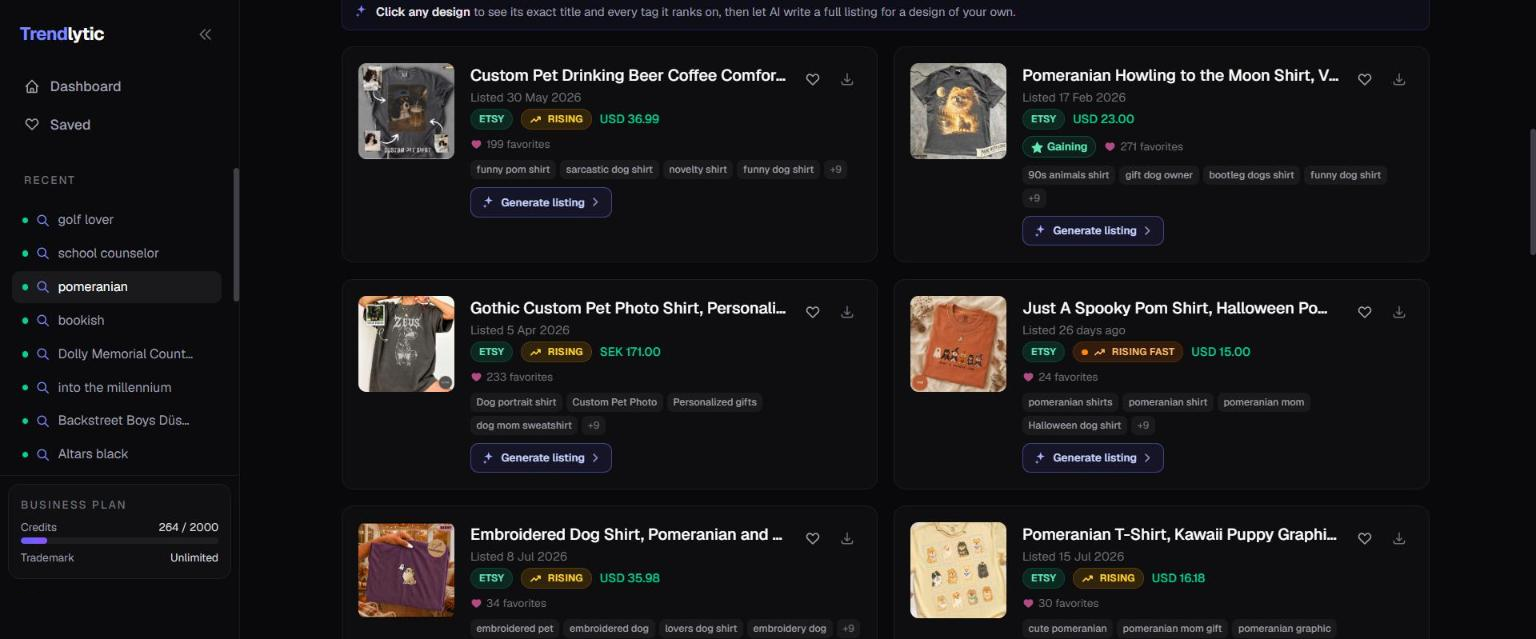
Trendlytic's Etsy tab shortens the earliest part of this read. A new listing that shoppers are taking to quickly gets an amber Rising badge, and the freshest of those get an orange Rising fast badge. A favourite is interest, not a purchase, so treat the badge as a pointer to what buyers are warming to and still confirm that sales sit behind it. For the Etsy-wide view, our Etsy trends finder explains the hourly list of listings gaining favourites fastest.
The categories that trend consistently on Etsy
Underneath the churn, the same categories keep producing trends. Individual products rotate; these lanes do not. Everything below is a pattern, and the example phrases illustrate the shape rather than claim anything about what is hot today.
| Category | The pattern | Example angles | When it peaks |
|---|---|---|---|
| Personalized & custom | A name, date, or photo makes it one-of-one | custom pet portrait, name necklace, family sign | Year-round, spikes at gift seasons |
| Gift & occasion | Bought for someone else, on a deadline | teacher thank-you, new home gift, retirement | With the occasion, ramping weeks early |
| Seasonal & holiday | Calendar-locked demand that returns yearly | Christmas ornament, Halloween decor, Easter printable | List 2 to 4 months ahead |
| Home & wall decor | Style-driven, buyers purchase in sets | gallery wall set, botanical print, kids room art | Steady, lifts new-year and spring |
| Digital downloads | Instant delivery, infinitely resellable | budget planner, Canva template, SVG cut file | Steady, planners spike at year change |
| Pet | Emotional buyers, low price resistance | breed-specific mug, pet memorial keepsake | Year-round, gift-season lift |
| Hobby & identity | The buyer is signalling who they are | crochet humor tee, trail running gift, nurse gift | Year-round, event-linked bumps |
| Aesthetic-driven | The style is the product, not the subject | cottagecore, coastal, minimalist line art | Style cycles, months to years |
Personalized and custom
Personalization is the closest thing Etsy has to a native advantage, and it is why buyers come here instead of a general marketplace. A product carrying a name, a date, or someone's photo cannot be price-matched, because there is nothing to match it against.
The pattern worth noticing is that personalization is a layer you add to other categories rather than a category of its own. A mug is a commodity. A mug with a specific dog's face on it is a gift. Trends inside this lane are usually about which base product is being personalized, so watch for new formats appearing with a customization option attached.
Gift and occasion
A large share of Etsy purchases are made for somebody else, which changes everything: there is a deadline, there is emotion, and price sensitivity drops. It also changes how people search, because they search by relationship and occasion rather than by product. Angles here should be phrased the way a gift-buyer thinks. "Gift for a friend moving away" is a real search shape; "ceramic mug" is not.
Occasions are also more numerous than most sellers plan for. Retirements, promotions, new pets, and first homes carry the same deadline-driven intent as the big holidays and are far less crowded.
Seasonal and holiday
Seasonal is the most predictable demand on Etsy and the one most sellers time badly. You already know the dates. The whole skill is preparing early enough that your listing has ranking history before the rush, then letting it ride.
Treat last season as research for the next, and look for the sub-occasions inside a season rather than the season itself. One holiday contains host gifts, teacher gifts, coworker exchanges, first-year keepsakes, and matching family sets, and those lanes are much thinner than the headline term.
Home and wall decor
Decor trends move with interior design rather than internet culture, which makes them slower and more forgiving. A style that takes hold here stays useful for a long time, and buyers often purchase several matching pieces at once.
The pattern is coherence. Buyers are furnishing a room, so a set sharing a palette and a style beats a strong individual piece. When watching for a rising decor trend, watch palettes and finishes rather than subjects, because the subject is usually interchangeable and the aesthetic is what the buyer is shopping for.
Digital downloads and printables
Digital products have no unit cost, no shipping, and no ceiling on how many times a file sells, which is why the category keeps expanding. It is also why the obvious versions are heavily contested. Anyone can list a basic planner, and many have.
Trends here usually come from a new tool or a new use case rather than a new look. When a design tool becomes popular, templates for it become a market. Watch adjacent software and adjacent habits and you will see these coming earlier than people who only watch Etsy.
Pet products
Pet owners buy the way parents buy, emotionally and without much comparison shopping. That makes the category dependable, and it stacks neatly with personalization, since a pet product is naturally about one specific animal.
The recurring pattern is specificity of breed and role: broad pet terms are saturated while narrow ones frequently are not. The product-level version of that, including what you can print for the animal itself and which marketplaces will carry it, is in print on demand pet products.
Hobby and identity niches
Much of what sells on Etsy is worn or displayed to signal something: a job, a hobby, a community, a family role. These buyers want the version that speaks their language, and they can tell instantly whether the maker actually understands the hobby.
That is both the pattern and the barrier. Insider accuracy is the product, which is why generic takes on a hobby fail while specific ones work. If you belong to a community yourself, this is usually your fastest lane.
Aesthetic-driven styles
Some trends are not about what a design shows but how it looks. Aesthetic movements cycle through Etsy and cut across categories, appearing on prints, apparel, stationery, and packaging in the same period.
These move fastest and are the most worth catching early, because an emerging aesthetic can be applied across your whole catalogue at once. They also fade hardest, so treat an aesthetic as a season of work rather than a foundation, and keep evergreen listings underneath it. The design-side version is in trending t-shirt designs.
The trend trap: saturation and trademarks
Two things go wrong when sellers chase trends, and they go wrong differently.
The first is timing. Entering at peak feels productive because the demand is obvious and easy to verify, which is exactly the problem: it is obvious to everyone. You design, list, and land pages deep behind shops that arrived months earlier with better reviews.
The second is legal, and it is the expensive one. Trend-driven designs are where sellers step on trademarks most, because trends often originate in a show, a song, a brand, a character, or a catchphrase somebody has registered. Marketplaces enforce this automatically and rarely warn you first. A listing can be pulled, and repeated infringement can take a shop with it.
The fix is a two-minute habit. Before designing anything built on a trending phrase, check the exact wording. You can run it through our free POD trademark checker with no login, or search the USPTO database directly. If a live mark exists in a relevant class, reword it. The underlying subject is almost never the problem; specific phrases are. Not legal advice, just the check that prevents most avoidable suspensions.
FAQ
What's trending on Etsy right now?
It genuinely changes, and any specific answer published in an article goes stale within weeks, so I will not hand you a list that misleads you later. Check yourself instead: read the autocomplete order when you type your seed phrases into Etsy's search bar, scan the related-searches row on a results page, skim Etsy's current gift guides, and read your own Shop Manager search terms if you already sell. Those surfaces reflect what buyers are typing today.
How do I find Etsy trending searches?
Etsy publishes no search volume, so you infer it. Autocomplete ordering is the closest free proxy, since suggestions are ranked by how commonly buyers enter them, and tracking how that order shifts over a few weeks shows direction. Add the related-searches row for adjacent phrases and category filters for structure. For interest over time rather than a snapshot, Trendlytic's Keyword Research scores phrases for demand against competition and plots a twelve-month interest curve.
What sells best on Etsy?
The consistently strong lanes are personalized and custom items, gift and occasion products, seasonal goods, home and wall decor, digital downloads, pet products, hobby and identity niches, and aesthetic-driven styles. The specific winner inside each rotates, so trust the categories and verify individual picks yourself. A fuller breakdown is in best-selling items on Etsy.
How do I know if an Etsy trend is already saturated?
Look at the first couple of pages for the exact angle you would compete on. If they are wall-to-wall polished listings from established shops with heavy review counts, and nothing recent has broken in, that angle is closed. A healthier signal is visible demand with obvious gaps: a style nobody tried, an occasion nobody targeted, a sub-audience nobody served. Saturation is about the specific angle, not the broad category, which is why narrowing often reopens a lane that looked shut.
When should I list seasonal products on Etsy?
Earlier than feels natural. Buyers shop for occasions weeks ahead, and Etsy tends to favour listings that have had time to gather signals, so publishing during the season starts you behind. As a rough guide, put major holiday work live two to four months ahead and smaller occasions several weeks ahead. Listing early costs almost nothing. Listing late costs the season.
Are Etsy trends worth chasing?
Chasing a named trend usually is not, because by the time it has a name the supply has arrived. Catching a rise early is worth a lot, and so is bringing a fresh angle to an evergreen category. The workable middle ground is a stable base of evergreen listings plus a small amount of trend work entered early and treated as temporary. Then a fading trend costs you a few designs rather than your catalogue.
Conclusion
What's trending on Etsy is the wrong question to ask an article and the right one to ask the marketplace. Etsy will tell you, through autocomplete order, related searches, category structure, what it features, and the search terms bringing people to your own shop. Add seasonal lead time, judge direction over raw popularity, confirm real sales sit behind the searches, and check the phrase for trademarks before you build. That method keeps working long after this post is old.
If you would rather not assemble that picture by hand every week, Trendlytic is my answer to it, so read the next sentence knowing I built it. One search shows what is actually selling across Etsy, Redbubble, TeePublic, and Amazon Merch, Trending Now surfaces niches currently picking up, Keyword Research scores phrases for demand against competition with a twelve-month interest curve, and any phrase you shortlist can be run against the USPTO register. It is $19.99 a month for 100 searches, with a free trial. Start the trial and compare what it shows against the trend you were about to design for.
What's the last Etsy trend you caught early, and what tipped you off before it was obvious? I would genuinely like to know what you watch.
Try Trendlytic
Find your next winning Etsy niche in 40 seconds
Live data from TeePublic, Amazon Merch, Redbubble, and Etsy, with a trademark check built in. Then turn any winner into a listing for a design of your own in that niche. Plans from $19.99/month.
Start researchingLike this? Get one like it every Wednesday.
Niche data, trademark alerts, one tactic per week.
Keep reading
- Trendlyticcustom calendars
Custom Calendars: A POD Product With an Expiry Date
The JournalCustom Calendars: A POD Product With an Expiry Date
September 23, 2026 · 18 min read
- Trendlyticcanva templates
How to Sell Canva Templates on Etsy, Start to Finish
The JournalHow to Sell Canva Templates on Etsy, Start to Finish
September 22, 2026 · 17 min read
- Trendlyticetsy dropshipping
Etsy Dropshipping Rules: What Etsy Allows in 2026
The JournalEtsy Dropshipping Rules: What Etsy Allows in 2026
September 20, 2026 · 16 min read