TL;DR: Stop pulling niches from "top niches 2026" listicles — by the time a niche is on a public list, it's already crowded. Instead, look at what's actually selling right now on TeePublic, Amazon Merch, and Redbubble — what buyers are paying for, not just what ranks. Keyword tools tell you what people search; they don't tell you what people buy. Validate any niche with two signals before you commit: recency (designs uploaded in the last few months that are already ranking) and sales evidence (favorites, review counts, best-seller badges). Go specific, not broad — "vintage bass tournament minimalist" beats "fishing" every time. And before you draw a single pixel, run the phrase through the USPTO trademark database. That last step is the one most sellers skip, and it's the one that gets accounts shut down.
Almost every piece of niche advice you'll read starts the same way: a list of "trending niches for 2026," ranked, with search volumes attached. The problem is that those lists are recycled. Whoever wrote it pulled from a keyword tool, sorted by search volume, and published. By the time you read it, thousands of other sellers have read the same list and uploaded the same designs.
There's a deeper problem too. Keyword tools measure searches, not sales. A keyword can have 50,000 monthly searches and still be a graveyard for sellers — either because the search intent isn't commercial, or because the niche is so saturated that ten established stores own every result. Search volume is an input. Sales are the output. You want to work backward from the output.
This guide is about a different approach I've come to rely on after two years of tracking POD sellers across marketplaces: the store-first method. Instead of guessing from search volume, you look at the designs that are already selling in real stores, this month, and reverse-engineer the patterns. It's slower than copying a listicle, but it's the only method I've seen that consistently surfaces niches before they're picked over. Let's get into it.
Niche research is really step two of building a print-on-demand business — if you're starting from zero, my step-by-step guide to starting a print on demand business shows where this fits in the whole process.
Don't miss the next one.
New POD niche analysis every Wednesday.
Why "best niches 2026" lists don't work
The core issue is recency. POD trends move on a cycle measured in weeks, not years. A static list published in January is describing what was working in the previous quarter — and it ages badly because the moment a niche gets named publicly, the supply of competing designs spikes.
Here's the lifecycle of a niche that ends up on a list:
- Stage 1 — Quiet demand. A handful of sellers notice buyers are searching for something specific. They make designs. They sell. Almost nobody else is in this space.
- Stage 2 — Visible to trackers. The niche starts showing up in best-seller positions. People watching stores closely (this is where store-first research lives) can see it before it's named.
- Stage 3 — Named in public. A blog or YouTube video calls it a "trending niche." Search interest in the niche term itself spikes. New sellers flood in.
- Stage 4 — Saturation. Supply overwhelms demand. The early sellers are still earning on their established listings; new entrants get buried.
By the time a niche is on a "best niches 2026" list, it's somewhere between Stage 3 and Stage 4. You're not early — you're the flood. The listicle was useful to the person who wrote it three months before they published it.
This doesn't mean public niches are worthless. It means you have to find the sub-angle that isn't on the list yet (more on that below), and you have to verify it's still climbing rather than already crashing. A list can't tell you that. Live store data can.
What people SEARCH vs what people BUY
This is the single most important distinction in niche research, and it's the one most tools get wrong.
Keyword tools are built for one job: estimating how many people type a phrase into a search bar. That's genuinely useful for SEO. But POD isn't pure SEO — it's a marketplace where the question is "will someone pay $22 for a shirt with this on it?" Search volume can't answer that.
| Search-first (keyword tools) | Store-first (what's selling) |
|---|---|
| Measures how many people type a phrase | Measures what people actually bought |
| High volume can mean high competition | Best-seller position already proves demand survived competition |
| Tells you the topic | Tells you the topic and the winning angle, style, and product type |
| Ages slowly — same list for months | Reflects this month's reality |
| "Cat" has 1M searches → useless to act on | "Black cat reading book vintage tee, 340 favorites, uploaded March" → actionable |
When you can see that a genuinely selling design this quarter is a minimalist line-art golden retriever on a sand-colored tee, you're not guessing. You're looking at the result of the market voting with its wallet. That single listing tells you the subject, the art style, the color palette, and the product type that's working — information no keyword tool will ever give you.
That's the entire philosophy behind store-first research: start from the sale, not the search.
The store-first method, in principle
The whole idea is simple: instead of trusting a search-volume number, look at what's actually being bought and reverse-engineer the patterns. You can do this manually; it just takes time. (Automating it is the reason Trendlytic exists, but the principle works with free tools and patience too.)
Start from the sale, not the search. Pick a marketplace and a broad seed term ("cat", "fishing", "nurse"), and pay attention to the designs that are genuinely selling — the ones with real engagement behind them, not just the ones that happen to rank for a keyword. TeePublic and Redbubble expose the most public signal because they show favorites and review counts; Amazon Merch is harder to read but its Best Sellers Rank is gold when you can see it.
Read the patterns, not single designs. A selling design tells you more than a keyword ever will — the specific subject, the art style (vintage, minimalist line art, retro sunset, distressed text), the product type, and how recent it is (fresh winners point to a live trend; ones from years ago are evergreen). What you're after is the recurring pattern across what's working, not any one listing.
Write down the angle, not the niche. Don't write "dogs." Write "breed-specific minimalist line art on muted tees, gift-framed in the title." That's a reusable angle you can apply across breeds, occasions, and product types — and an angle that shows up again and again, rather than once, is the one with real, durable demand.
Then run the trademark check (covered in its own section below — never skip it).
That's the loop: start from what's selling, read the patterns, distil a reusable angle, confirm it's not a fluke, and trademark-check before you design. Repeat across marketplaces and seed terms, and you build a private list of climbing niches that no public listicle has named yet.
Where to actually look (platforms, signals, tools)
Each marketplace gives you different signals. Here's what to read on each:
TeePublic
- Favorites count is public — treat it as a proxy for demand.
- Review counts on a listing are a direct sales signal (you only review what you bought).
- The most useful thing here is being able to see which designs are genuinely selling, not just ranking.
Redbubble
- Redbubble's relevance ranking already bakes in engagement, so high-ranking recent listings are a strong signal.
- The tags on top listings reveal the exact phrasing buyers respond to — useful for your own metadata later. (More on that in the Redbubble keywords and tags guide.)
Amazon Merch
- Hardest to read publicly, most valuable when you can. Best Sellers Rank (BSR) is the closest thing to a real sales number in POD. A shirt at BSR 50,000 in Clothing is moving units.
- Watch the "New Releases" and category best-seller lists for what's climbing.
Signals to trust, in rough order:
- Sales/BSR — direct purchase evidence (Amazon Merch).
- Review counts — proof of purchase (TeePublic).
- Favorites — strong interest signal (TeePublic, Redbubble).
- Best-seller / ranking position — the marketplace's own verdict.
- Recency — when the winners were uploaded tells you if the trend is rising or fading.
Tools. You can do this manually with the marketplaces themselves plus a spreadsheet. If you'd rather not click through hundreds of stores by hand, that's what dedicated tools automate — I've written an honest comparison of the options in the best POD niche research tools guide. The key thing to look for in any tool: does it show you what's actually selling in stores, or just keyword search volume dressed up? Most show the latter.
How to validate a niche before committing
Finding a promising angle isn't the same as validating it. Before you spend hours designing, run it through three checks.
1. Demand — is anything actually selling here? Look for listings in this niche with real engagement: review counts, high favorites, or strong best-seller positions. If the top result in a niche has 4 favorites and no reviews, there's no demand to capture — you'd be the most successful seller in an empty room.
2. Recency — is the trend rising or fading? Check the upload dates on the best-selling listings. From what I've tracked, this is the signal most people ignore:
- Top sellers uploaded recently (last 1–4 months) and already ranking → the niche is climbing. Best time to enter.
- Top sellers are 1–2+ years old and nothing new is breaking in → either a stable evergreen (fine, but competitive) or a closed niche where incumbents own it.
- Top sellers peaked months ago and recent uploads are flat → the trend is fading. Skip it.
3. Competition — can you realistically rank? Count how many strong listings already serve the exact angle. A niche with 3–4 decent listings and clear demand is an opportunity. A niche where the first three pages are all polished designs from established stores with thousands of favorites is a wall. You want demand that outstrips current supply.
The sweet spot is the same every time: proven demand + recent momentum + thin or beatable competition. All three. Two out of three isn't enough — high demand with heavy competition is a saturated niche, and recent momentum with no sales is a fad nobody's buying yet.
The one signal to prioritize: fresh and already selling
If you take a single thing from this guide, make it this: the most valuable design to study is one that's both recently uploaded and already selling. That overlap is the whole game.
Think about what each half tells you on its own. An old best-seller proves a niche worked — but not that there's still room for you; the incumbents may already own it. A brand-new upload with no traction proves someone had an idea — but not that anyone's buying. Only the overlap, new and selling at the same time, tells you both at once: real demand, and a niche still early enough to enter. That's Stage 1–2 of the lifecycle above, before the Stage 3–4 flood.
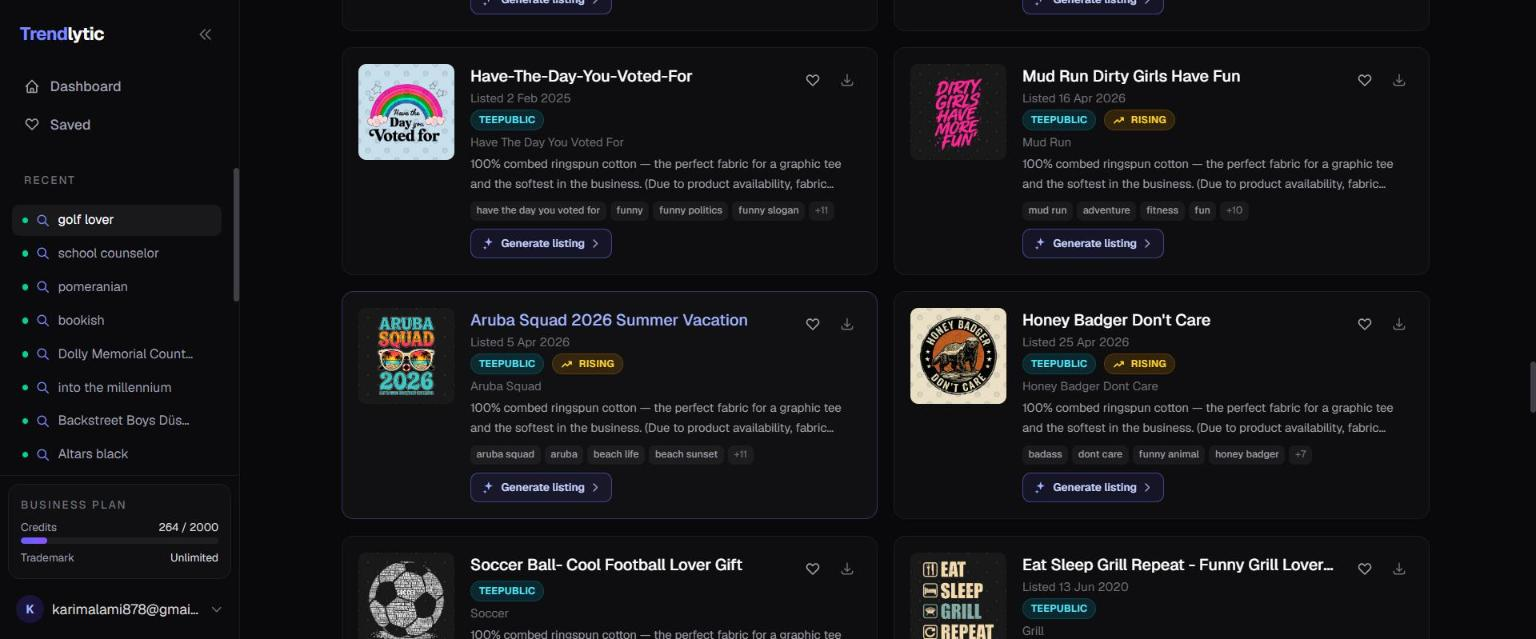
This is the exact signal Trendlytic surfaces as Rising. In a Discover search, every design card shows its listing date, and a design that is new and already outselling its own seller's older work gets an amber Rising badge next to that date. On TeePublic, that means listed within the last 180 days and ranked, on the seller's own best-selling page, above at least five designs the seller listed before it. Under 60 days old and already ahead of the seller's established designs earns the orange Rising fast badge. Redbubble uses the same idea with its own timing window, Etsy badges favourites momentum rather than sales, and Amazon has no badge at all; there the early signal is a design with 1 to 19 reviews, since every Amazon review is a confirmed sale. If you're deciding where to spend your next design hour, Rising is where the room is.
Here is what it looks like on a TeePublic tab for "golf lover": three April 2026 uploads carry the badge, while the ones from 2020 and early 2025 sit beside them unbadged.
Whatever you use to find them, the rule holds: prioritize fresh-and-selling over old-and-crowded. That's the difference between joining a trend and chasing one.
How to spot saturation (what saturated really looks like)
"Saturated" gets thrown around loosely. Here's what it concretely looks like when you're reading a store-first signal:
- The first 2–3 pages of results are wall-to-wall polished designs. Not amateur uploads — finished work from sellers who clearly know what they're doing.
- The top listings have huge favorite/review counts and are old. Incumbents are entrenched; a new upload won't displace them.
- New uploads aren't breaking into the top results. If recent designs are nowhere near the top of what's selling, the door is shut.
- Every angle is already covered. You try to think of a fresh take and find someone's already done it, well.
Contrast that with a healthy niche: clear demand signals, but the top results have gaps — an art style nobody's tried, an occasion nobody's targeted, a sub-subject that's underserved. That gap is your entry point.
Saturation isn't about how many listings exist. "Cat shirts" has millions of listings and is still enterable through the right sub-angle. Saturation is about whether the specific angle you'd compete on is already owned. Which is exactly why you go specific.
Sub-niche strategy: specific beats broad
The biggest single lever in POD niche research is specificity. Broad niches are where everyone competes and nobody ranks. Sub-niches are where demand is real and competition is thin enough to win.
A sub-niche stacks modifiers onto a broad subject until you reach a defined buyer with a defined taste:
Broad subject + sub-topic + style/vibe + occasion or identity
Examples of broad → specific:
| Broad niche (avoid) | Specific sub-niche (target) | Why the specific one wins |
|---|---|---|
| Fishing | Vintage bass tournament minimalist | Defined activity + retro art style + thin competition |
| Cats | Black cat reading books, cottagecore | Specific subject + aesthetic + a real buyer identity |
| Dogs | Corgi mom watercolor, mother's day gift | Breed + role + style + gift occasion |
| Coffee | Espresso enthusiast sarcastic office humor | Sub-drink + tone + workplace gifting context |
| Hiking | Retro national park sunset line art | Sub-topic + nostalgic style + clear visual lane |
| Teacher | First grade teacher appreciation, end of year | Grade-specific + occasion + gift intent |
Notice what specificity buys you:
- Lower competition. Far fewer sellers target "black cat cottagecore reading" than "cats."
- Higher buyer intent. Someone searching the specific phrase knows exactly what they want and is closer to buying.
- Better metadata. Specific phrases make stronger long-tail tags and titles (again, see the Redbubble tags guide).
- Repeatability. Once an angle works, you scale it sideways — same style across breeds, occasions, sub-topics.
The instinct to "reach more people" by staying broad is exactly backwards. Broad reaches more people and loses to everyone. Specific reaches fewer people and beats the competition for them.
The trademark step nobody talks about
This is the section most niche guides leave out, and it's the one that ends seller accounts.
A phrase can be the perfect trending niche — proven demand, climbing, beatable competition — and still be a trademarked term you're legally not allowed to print. Phrases like "boss babe," "main character," "Sunday Funday," and countless others are registered trademarks. Use one, and your listing can be deindexed without notice, or your whole account can be terminated. The marketplaces enforce this automatically and they don't warn you first.
So the rule is simple and non-negotiable: before you design anything, check the exact phrase against the USPTO trademark database.
- Go to the USPTO trademark search.
- Search your exact phrase.
- Pay attention to live marks in the relevant classes (apparel is typically Class 25; printed goods, mugs, etc. fall in other classes).
- A live registration for your phrase in a relevant class means do not use it. Find a different wording.
This takes two minutes and it's free. There is genuinely no excuse for skipping it, and yet sellers skip it constantly and lose everything they built. Build the check into your routine so it's automatic — every phrase, every time, before any design work.
A repeatable weekly niche research routine
Niche research isn't a one-time treasure hunt. Trends move, so the people who stay ahead make it a habit. Here's a routine you can run in about an hour a week:
- Pick 3–5 seed terms — broad subjects you want to explore (rotate them weekly).
- For each seed, look at what's genuinely selling on one marketplace — the designs with real engagement, not just the ones that rank.
- Note the recurring patterns — subject + style + product that keep showing up across what's working.
- Log every promising angle in a spreadsheet — write the angle, not just the niche.
- Tag each angle with its signals — demand (favorites/reviews), recency (how fresh the winners are), competition (how crowded).
- Confirm it's a trend, not a fluke — an angle that shows up again and again, not once.
- Run every winning phrase through the USPTO check. Kill anything with a live conflicting mark.
- Pick this week's 1–2 angles to design — the ones with demand + recency + thin competition + clean trademark.
- Note what to revisit next week — angles that looked early but not quite ready.
Do this consistently and you'll have a private, always-fresh pipeline of validated niches — instead of refreshing listicles hoping for inspiration.
Common mistakes
After watching a lot of sellers do this, the same errors come up over and over:
- Starting from search volume. High searches ≠ buyers. Start from sales, always.
- Copying public listicles. If it's named publicly, you're late. Use lists for seed terms only, never as a target.
- Staying broad. "Funny cat shirt" competes with everyone. Niche down until you have a defined buyer.
- Ignoring recency. Entering a niche that peaked six months ago feels productive and earns nothing.
- Confusing one store for a trend. Cross-check across multiple unrelated stores before you commit.
- Skipping the trademark check. The fastest way to lose an account. Two free minutes prevents it.
- Chasing one viral spike. A single seasonal or meme spike is a fad. Look for durable, repeatable angles.
- Never revisiting. Niches move. A one-time research session goes stale within weeks.
FAQ
How often do POD niches actually change? Faster than most people think. From what I've tracked, the winning angle within a subject can shift within a quarter — new styles, new occasions, new sub-topics rising while others fade. The broad subject (cats, fishing, teachers) is evergreen; the specific angle that's selling is what moves. That's why recency matters and why research is a weekly habit, not a one-off.
Do I really need a tool, or can I do this for free? You can absolutely do it for free — the marketplaces themselves are your data source, plus a spreadsheet. The trade-off is time. Manually reading hundreds of stores across four marketplaces is hours of clicking. Tools automate the reading and surfacing; they don't change the method. I broke down the honest options in the niche research tools comparison.
What's the best marketplace to research first? TeePublic and Redbubble, because their signals (favorites, reviews, best-seller sorting) are public and easy to read. Amazon Merch has the strongest signal (BSR) but it's harder to access. If you're deciding where to sell, I compared two of them in TeePublic vs Redbubble, and asked the harder question in Is Redbubble worth it?.
How specific is too specific? You've gone too far when there's no demand left — zero favorites, zero reviews, nobody searching the angle. The test is simple: a good sub-niche still has some existing listings with engagement (proving demand), just not enough strong ones to wall you out. If you can't find a single comparable listing that's selling, the niche may be too narrow to have a market.
Can I just look at a niche's search volume on a keyword tool? You can, but treat it as one weak input, not the decision. Search volume tells you a topic exists and roughly how popular the phrase is. It tells you nothing about whether those searchers buy, or whether the niche is already owned. Always validate against actual store sales before committing.
How many designs should I make once I find a niche? Enough to test the angle properly without over-investing — a small batch across a few product types, then watch what gets engagement before scaling the winners. Don't make 50 designs on an unvalidated guess; make a handful, read the signal, then double down on what moves.
What if a niche I want is trademarked? Change the wording. The subject (e.g., a fishing-themed design) is almost never the problem — it's specific phrases that get registered. Rework the text or angle so it doesn't use the protected mark, re-check the USPTO database, and proceed. A trademark on one phrase doesn't close an entire visual niche.
Final thoughts
The reason most niche advice fails is that it's built on the wrong input. Search volume and recycled lists describe what's popular to talk about, not what's selling right now. The store-first method flips that: start from the sale, read the patterns in stores that are actually earning, validate with recency and competition, go specific, and trademark-check before you design. It's more work than copying a list — and it's the only approach I've seen consistently put sellers in front of a trend instead of behind it.
This is exactly the loop Trendlytic automates. It scans top-selling designs across TeePublic, Amazon Merch, Redbubble, and Etsy — store-first, so you see what's selling, not just what's searched — and runs a USPTO trademark lookup on any phrase you choose, so you don't waste time on wording you can't legally use. It's $19.99/month for 100 searches, every plan includes the trademark check, and there's a free trial. If you want to try the method without the manual clicking, start here. And for the big-picture map of how niche research fits into the whole business, our complete print on demand guide ties every step together.
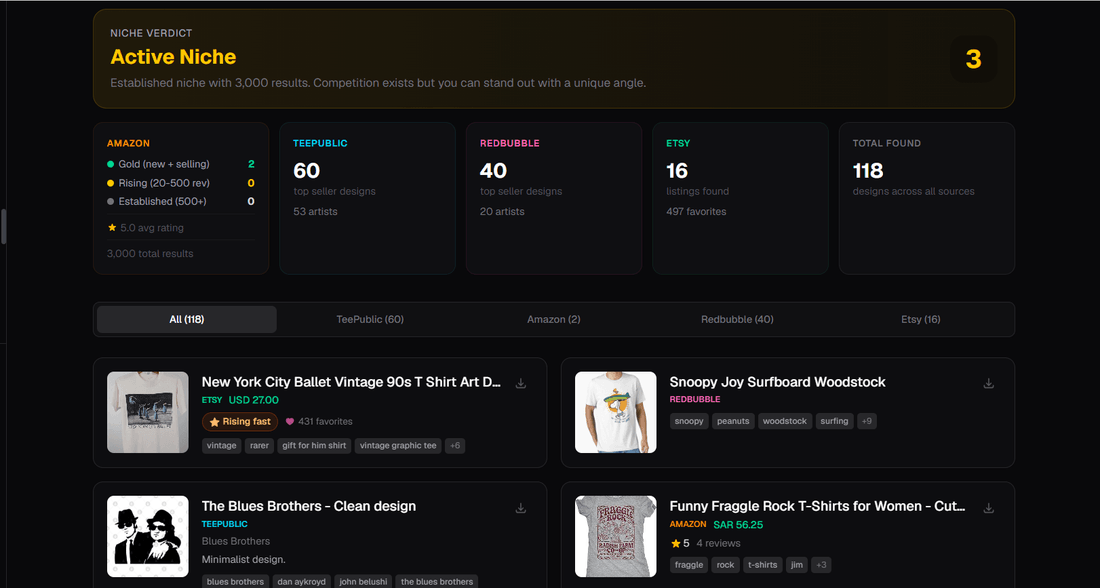
That's what a Trendlytic search returns — a niche verdict scoring demand against competition, with the proven top sellers pulled from all four marketplaces in one place.
What's the most specific sub-niche you've found that actually sold — and how did you find it? I'd genuinely like to know what's working for you.
Like this? Get one like it every Wednesday.
Niche data, trademark alerts, one tactic per week.
Try Trendlytic
Find your next winning POD niche in 40 seconds
Live data from TeePublic, Amazon Merch, Redbubble, and Etsy, with a trademark check built in. Then turn any winner into a listing for a design of your own in that niche. Plans from $19.99/month.
Start researchingKeep reading
- Trendlyticprint on demand
8 Print on Demand Niches That Actually Sell in 2026
The Journal8 Print on Demand Niches That Actually Sell in 2026
June 9, 2026 · 20 min read
- Trendlyticredbubble
8 Best Selling Redbubble Niches in 2026 (and How to Find Your Own)
The Journal8 Best Selling Redbubble Niches in 2026 (and How to Find Your Own)
June 15, 2026 · 20 min read
- Trendlyticprint on demand
8 Print on Demand Trends for 2026 (What's Actually Selling)
The Journal8 Print on Demand Trends for 2026 (What's Actually Selling)
June 17, 2026 · 22 min read