TL;DR: The biggest print on demand trends for 2026 are aesthetic micro-styles, nostalgia and Y2K revival, niche identity and community, seasonal designs published early, the swing back to original work as generic AI art saturates, sustainability and values-driven designs, hyper-personalization, and micro-fandom vibe designs. But here's the honest catch: any trend already on a public list is already crowding. The real edge isn't the list — it's spotting a rising trend early and validating real demand against saturation before you design. Trends are a starting signal, not a guarantee.
Most "POD trends" posts read like a horoscope. They list eight buzzwords, tell you to "lean into them," and send you off to design the exact same cottagecore mushroom sticker as the ten thousand people who read the same post. By the time a trend is famous enough to make a list like this, the easy money is already gone.
So I want to be honest with you up front, because honesty over hype is the whole point of this site. Trends content is genuinely dangerous if you treat it as a shopping list. The winners in print on demand are almost never the people who chased a named trend — they're the people who spotted a rising one early, validated that it was actually selling, and built into it before it became a list item. By the time you read "Y2K is hot" anywhere, a hundred thousand other sellers read it too.
This post is built differently. I'll name the eight POD directions I'm genuinely seeing rise into 2026, with concrete angles for each. But every section comes with a saturation warning and a design tip, because the trend itself is never the opportunity — the under-served corner of it is. And at the end I'll walk through how to spot a trend yourself before it's on anyone's list, which is the only part that actually compounds.
Don't miss the next one.
New POD niche analysis every Wednesday.
How POD trends actually work (and why most trend-chasing fails)
Before the list, the thing nobody tells you plainly: a trend being public is a warning, not a green light.
Here's the mechanic. A trend gets named in an article, a TikTok, or a YouTube video. Thousands of sellers see it the same week. They all open their design tool and make the most obvious version of it — the literal cottagecore mushroom, the literal "Y2K" word in a bubble font. Within weeks, the front page of that search is a wall of near-identical designs, and the trend that looked like an opportunity is now one of the most competitive corners on the platform. The trend was real. The way everyone chased it was the problem.
So most trend-chasing fails for three reasons, and they're worth naming:
- It's late. Public trends are, by definition, already known. The sellers who profited got in while it was still a faint signal, not a headline.
- It's obvious. Everyone designs the same first-thought version. The buyer sees forty identical designs and the one that wins is whoever has the most reviews already — which is never the newcomer.
- It's unvalidated. "Trending" on social media is not the same as "selling" on a marketplace. Plenty of things go viral as content and never convert as a product, and you can't tell the difference from a trend list.
The sellers who actually make money from trends do three things differently. They spot the rising signal early — they're watching what's newly selling, not reading last year's roundup. They validate before designing — they confirm real buyer demand exists and that there's still room to compete, instead of assuming a viral moment equals sales. And they design the vibe, not the obvious thing — a specific, original take on a trend rather than the first version everyone else makes, and never a trademarked name or character (more on that in nearly every section below, because it's what ends accounts).
Keep that lens on as you read the eight directions. Each one is a real, rising pattern for 2026. None of them is a guarantee, and the broad version of every single one is already crowded. The opportunity is always one layer in.
| Trend | Why it's rising in 2026 | Best products/platforms | Saturation risk |
|---|---|---|---|
| Aesthetic micro-styles (cottagecore, dark academia, coquette, Y2K) | Aesthetic identity keeps fragmenting into ever-more-specific moods | Stickers, wall art, phone cases / Redbubble | High at broad level |
| Nostalgia & retro (90s/2000s, vintage sports, retro tech) | Millennial/Gen-Z nostalgia cycle peaking; comfort buying | Tees, hoodies, stickers / TeePublic, Amazon Merch | Medium–High |
| Niche identity & community | Buyers increasingly shop their exact in-group, not broad topics | Tees, mugs / Amazon Merch, TeePublic | Medium |
| Seasonal & event-driven, published early | Reliable yearly demand the marketplaces reward early uploaders for | Apparel, stickers / Amazon Merch, Redbubble | Medium |
| Original / handmade-feel (AI-art swing-back) | Generic AI art is everywhere now, so distinctive work stands out | Wall art, tees, stickers / Redbubble, Etsy | High (AI) / Low (original) |
| Sustainability & values-driven | Conscious buyers increasingly choose what they wear and why | Tees, totes / Etsy, Amazon Merch | Medium |
| Hyper-personalization (name/region/role-specific) | Buyers expect designs that feel made for them specifically | Mugs, tees, gifts / Etsy, Amazon Merch | Low–Medium |
| Micro-fandom & vibe-based fan designs | Huge fandom demand, but only the trademark-safe vibe is sellable | Stickers, tees / Redbubble, TeePublic | High & policed |
1. Aesthetic micro-styles (cottagecore, dark academia, coquette, Y2K)
Aesthetics are visual moods — cottagecore, dark academia, coquette, grunge, Y2K, minimalist line art — and they keep fragmenting into ever-more-specific sub-moods. That fragmentation is the trend in 2026: not "cottagecore" but a defined corner of it with its own motifs and palette.
Why it's rising in 2026: Aesthetic identity is how a younger audience signals taste, and it keeps splintering. Each season a broad aesthetic spawns a more specific child mood, which opens a fresh, less-crowded space for the seller who recognizes it early. Browse-and-discover platforms reward this because the buyer shops on vibe, not on a precise text search.
Best products/platforms: Stickers first, then wall art and phone cases — decoration products where the look genuinely beats text. Redbubble is the native home for aesthetic micro-styles.
Saturation risk: High at the broad level. "Cottagecore" and "dark academia" as plain terms are wall-to-wall. The opening is always the specific sub-mood plus a specific motif in a consistent style — not the headline word.
Design / angle tip: Pick one aesthetic and one specific motif, and commit to a consistent art style across a small set so a buyer who likes one piece wants several. Before you design, validate which sub-motifs are actually selling for the top aesthetic sellers right now, not just which aesthetic is being talked about. The talked-about one is the crowded one.
2. Nostalgia & retro (90s/2000s, vintage sports, retro tech)
Nostalgia is one of the most durable forces in POD, and the cycle is peaking right where Millennial and Gen-Z buying power sits: the 90s and early 2000s. Vintage sports lettering, retro tech (cassette tapes, old game consoles as a vibe, CRT and Y2K computing), faded-print weekend graphics — comfort designs for an anxious moment.
Why it's rising in 2026: Nostalgia is comfort buying, and it intensifies in uncertain times. The generation that grew up in the late 90s and 2000s now has disposable income and wants to wear the era. Retro also reads instantly at thumbnail size, which suits how people shop POD.
Best products/platforms: Tees and hoodies lead (retro graphics are worn as statements), with stickers strong as cheap nostalgia hits. TeePublic and Amazon Merch fit the apparel-led demand well.
Saturation risk: Medium to high. Generic "retro" and "vintage" are crowded, and a lot of nostalgia art borrows protected logos, mascots, and brand marks — a fast way to get pulled. The thin, safe space is original retro style applied to a specific niche.
Design / angle tip: Combine the retro treatment with a specific niche rather than going generic — a profession's retro badge, a hobby's vintage-athletic crest, a region's faded-print souvenir look. And keep it original: no real team names, brand logos, console names, or mascots, all of which are trademarked. Run any borderline phrase through the USPTO trademark database before you commit.
3. Niche identity & community
Broad topics keep losing to narrow identity. The clearest direction in 2026 is buyers shopping their exact in-group — the specific profession, the specific hobby, the specific sub-community — rather than the broad category. "Nurse" is a flooded topic; "ICU night-shift nurse" is a community with its own in-jokes and almost no good designs.
Why it's rising in 2026: People buy POD to say something true about who they are, and the more crowded the internet gets, the more they want a design that signals their specific tribe, not a generic one. Narrow identity also means narrow competition, which is the seller's advantage. I dug into this whole pattern in print on demand niches that actually sell.
Best products/platforms: Tees and mugs lead for profession and hobby identity, with strong gift demand. Amazon Merch on Demand for reach and gift search; TeePublic for the design-aware crowd.
Saturation risk: Medium. The broad roles and hobbies are crowded; the specific role-plus-situation or hobby-plus-sub-discipline combinations still have real gaps. That's the layer you enter.
Design / angle tip: Write the line only a true insider would write — the specific shift, the specific specialty, the specific gear or running joke — never "world's best [role]." Validate that comparable insider designs are actually selling before you build a set, and check the exact phrase for trademarks, since punchy identity lines get registered constantly.
4. Seasonal & event-driven, published early
This is the trend that's "trending" every year — which is exactly why it's durable. Holidays, back-to-school, graduation, Mother's and Father's Day, and smaller recurring events deliver reliable, calendar-locked demand. The only real trick is timing: the marketplaces rank the sellers who uploaded six to eight weeks early, so in-season designs arrive to a race that's already over.
Why it's rising in 2026: It isn't rising so much as never fading — seasonal demand returns on schedule every year, which makes it the most predictable signal in POD. The "trend" each year is simply combining the season with whatever other trend on this list is fresh.
Best products/platforms: Apparel and mugs for gift-search peaks (Amazon Merch on Demand), plus seasonal stickers and decor (Redbubble).
Saturation risk: Medium. Generic holiday designs are crowded, but holiday-plus-a-specific-niche combines two filters and thins the field considerably. "First Christmas as an ICU nurse" competes far less than "Merry Christmas."
Design / angle tip: Publish six to eight weeks ahead of each demand curve, and stack the season onto a niche from this list rather than going generic. Plan the calendar backward from each holiday, and validate against last year's actual sellers in that seasonal niche — not just the assumption that the holiday will sell.
5. Original / handmade-feel designs (the AI-art swing-back)
Here's an honest one, because it's already a trap. Generic AI-generated art flooded POD over the past couple of years — and now it's everywhere, which means it no longer stands out. The 2026 direction I'm watching is the swing back toward original, distinctive, handmade-feel work that an algorithm can't mass-produce in one prompt.
Why it's rising in 2026: When everyone has access to the same generators and the same prompts, the output converges and the buyer's eye glazes over a feed of samey "AI look" designs. Distinctiveness becomes the scarce thing. Platforms and buyers both increasingly reward work that has a clear point of view, a consistent hand, or a real illustrative style.
Best products/platforms: Wall art, tees, and stickers where craft is visible. Redbubble and Etsy both reward distinctive, recognizable styles — Etsy especially, where buyers actively value the handmade-feel and original.
Saturation risk: High for generic AI art (it's the crowded trap), low for genuinely original or hand-finished work. The honest read: this is a trend you win by going against the obvious version of the previous one.
Design / angle tip: Whether or not you use AI as a starting tool, the output has to look like yours — a consistent style, a distinctive treatment, a point of view that doesn't read as a default prompt. Don't ship the first generation everyone else would also ship. And as always, validate that the style and subject are actually selling before you invest a body of work in them.
6. Sustainability & values-driven designs
Values keep moving from the margin to the mainstream of what people choose to wear. Sustainability, conscious-living, minimalism, and cause-aligned messaging are a real and growing direction — buyers increasingly want their merch to mean something, and to align with a product they feel okay buying.
Why it's rising in 2026: A meaningful slice of buyers now factors values into purchases, and they want designs that express those values plainly. This pairs naturally with eco-leaning product choices and with an audience that buys on belonging rather than price.
Best products/platforms: Tees and totes (the everyday values carrier). Etsy suits values-driven, story-led buyers especially well; Amazon Merch adds reach.
Saturation risk: Medium. The broadest slogans ("save the planet") are crowded and clichéd. The room is in specific, sincere, original phrasing tied to a defined community or cause.
Design / angle tip: Be specific and genuine rather than generic — the exact value in original wording beats the slogan everyone has already made. This space is dense with copied designs and trademarked phrases, so write your own line and trademark-check it. Sincerity is what the audience recognizes as theirs; a borrowed cliché reads as a cash grab.
7. Hyper-personalization (name/region/role-specific)
Buyers increasingly expect a design that feels made for them — their name, their town, their exact role, their specific situation. Hyper-personalization isn't new, but the expectation keeps deepening, and the generic "one design for everyone" approach keeps losing to the one that feels personal.
Why it's rising in 2026: Personalization converts because it removes the "this is for me, specifically" doubt entirely. A buyer who sees their own town, role, or situation reflected back buys on emotion and rarely on price. Gift demand is enormous here, which widens the buyer pool well beyond the person it's about.
Best products/platforms: Mugs, tees, and giftable items. Etsy is strong for personalized and made-to-feel-custom buyers; Amazon Merch for gift search at scale.
Saturation risk: Low to medium. Broad personalization is common, but specific region-plus-role or situation-plus-detail combinations stay thin because no large seller bothers to cover one small town or one narrow situation well.
Design / angle tip: Stack specifics — region plus role, milestone plus exact number of years, situation plus emotion — until the design could only belong to one kind of person. Be careful with team names, school names, and local business names, which are frequently trademarked; check before you print. Validate that the personalized angle is actually selling, not just that it feels thoughtful.
8. Micro-fandom & vibe-based fan designs
Fandom is one of the largest demand pools in POD, and it's still growing — but here is the non-negotiable, honest part: names, characters, logos, and art are trademarked and copyrighted. Put a franchise name or character on a design and it gets pulled, or your account gets suspended, with no warning. The trend that's actually sellable in 2026 is micro-fandom vibe designs — the aesthetic and in-jokes of a community, never the protected property.
Why it's rising in 2026: Fandoms keep fragmenting into smaller, more specific communities, and each micro-fandom is intensely identity-driven and underserved. The demand is real and evergreen; the danger is using anything protected.
Best products/platforms: Stickers (the fandom default) and tees for stronger belonging signals. Redbubble and TeePublic both suit fandom-vibe designs.
Saturation risk: High and heavily policed. The named-franchise space is both crowded and legally radioactive, which is exactly why the vibe-only approach is the viable one.
Design / angle tip: Design the feel of a genre or community without any name, character, logo, or lyric — "cozy farming-sim life," "retro JRPG energy," "soulslike difficulty humor," "old-school punk scene." Recognizable to insiders, owned by no one. Run every phrase through the USPTO trademark database before you design, and when in doubt, abstract further. The vibe sells; the name gets you banned.
How to spot a trend before it's crowded (yourself)
Here's the honest part again, and it's the only part that compounds. Every direction above is a starting signal, and the broad version of each is already crowded the moment a post like this circulates. The durable skill isn't reading trend lists — it's learning to spot a rising trend yourself, early, before anyone names it. A few principles do most of the work.
Watch what's newly selling, not last year's list. A roundup tells you what was hot months ago. What you actually want is what's breaking through right now — fresh designs gaining traction in the last few weeks, in spaces that weren't crowded yet. Recency is everything: a trend with new winners still landing is alive and climbing; one that peaked a year ago with nothing new breaking through is a closed, competitive evergreen at best.
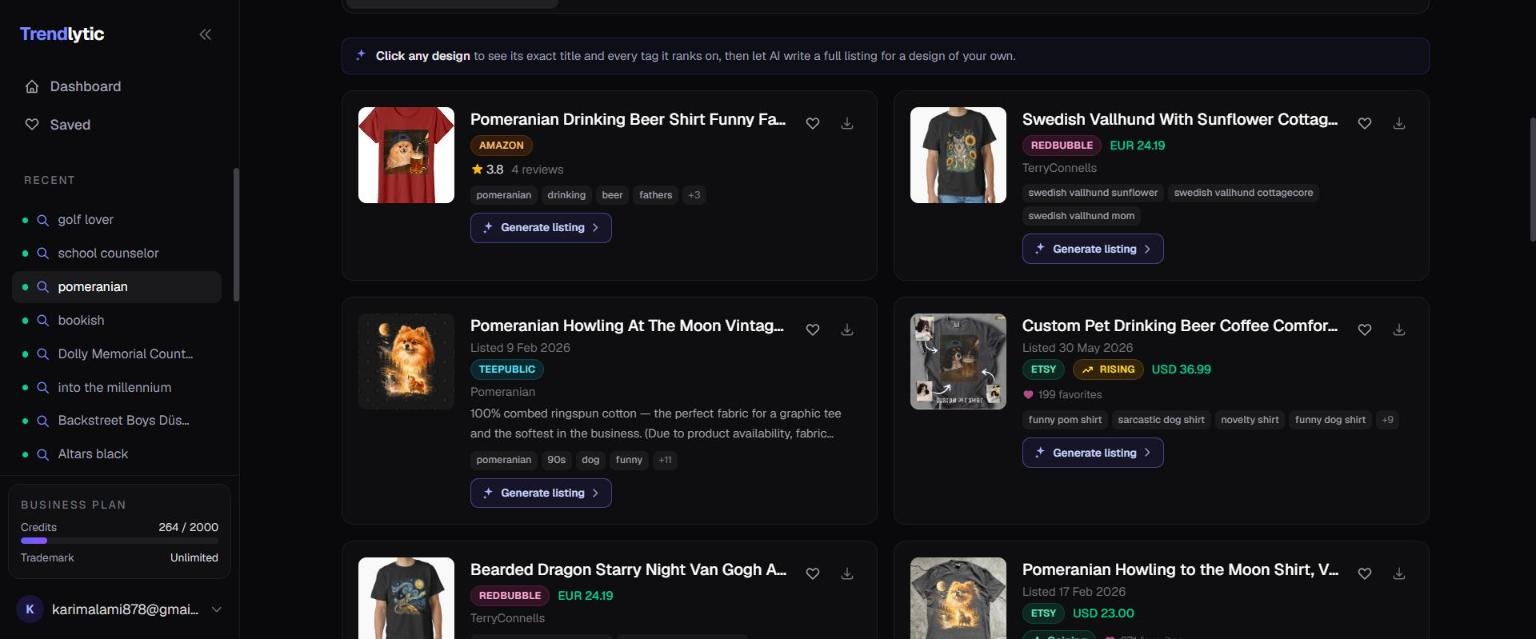
Trendlytic flags that overlap with a Rising badge on the design card itself. Below is a Discover search for "pomeranian" on the All tab, where Amazon, Redbubble, TeePublic and Etsy results sit in one list and an Etsy listing from late May 2026 is marked Rising because its favourites are growing faster than most of the niche.
Look for rising demand with thin supply. A trend is only an opportunity where buyers want it and there aren't already forty polished designs answering them. Study what's genuinely selling in a space — proven designs, not a search-volume guess — and gauge whether there's still room: real demand with competition you can realistically beat. Wall-to-wall entrenched sellers means the door is shut; visible gaps mean the door is open.
Move early, then validate before you design. Speed only matters if you're right. When you catch a faint rising signal, confirm it's actually converting on a marketplace before you build a body of work — viral as content is not the same as selling as a product. Validate first, design second. That order is what separates the sellers who profit from a trend from the ones who design forty pieces into an empty room.
Trademark-check every phrase. Non-negotiable, especially for fandom, retro, and values designs. Search the exact phrase in the USPTO trademark database, watch for live marks in relevant classes (apparel is typically Class 25), and reword if there's a conflict. Two free minutes prevents an account suspension.
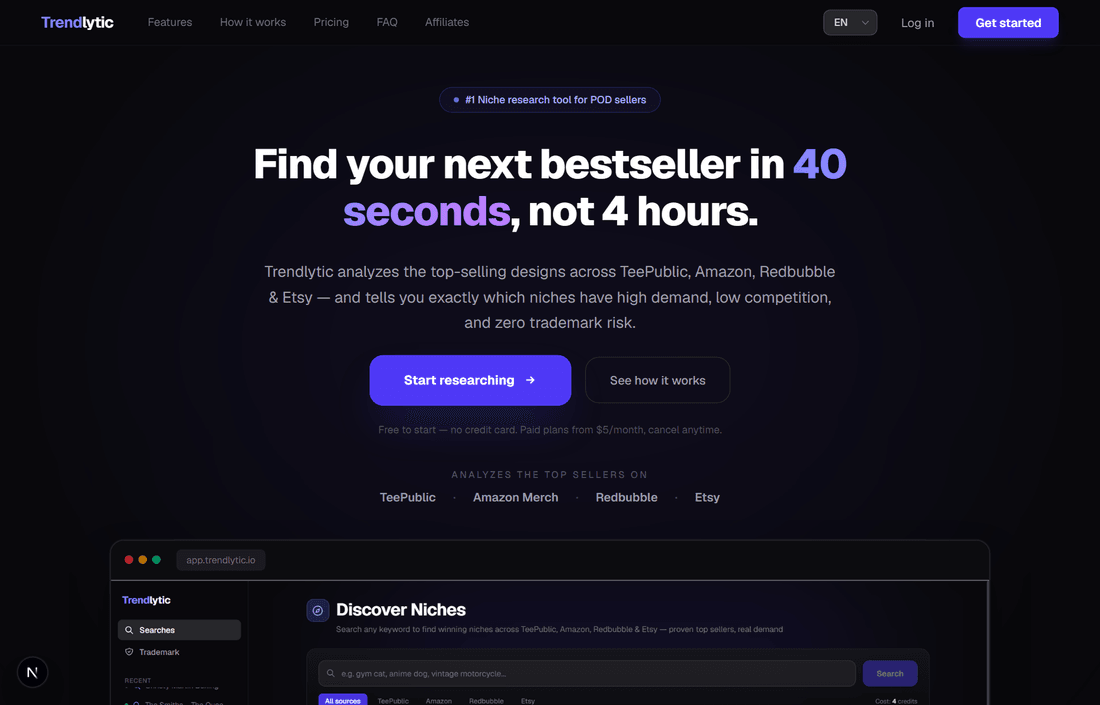
Doing all of that by hand is slow — it's the boring research most sellers skip, which is exactly why most trend-chasers earn nothing. You'd be checking what's actually selling across four marketplaces, one niche at a time, then trademark-checking each phrase separately. That's hours of clicking for a single trend, and it's the gap I built Trendlytic to close. One search shows you what the top sellers are genuinely moving across TeePublic, Amazon Merch on Demand, Redbubble, and Etsy — store-first, so you see what's bought rather than what's merely searched — refreshed hourly, with a live USPTO trademark check on every keyword, on every plan. It's $9 a month for 100 searches, with a free trial. You can research what's actually selling before you spend a day designing into a trend.
I'll be honest about the limits, because honesty over hype is the whole point: it's newer and smaller than something like Merch Informer, and it shows proven-seller and trademark signals plus a search-interest curve of whether a trend is rising or fading, rather than raw search-volume numbers. Etsy is covered — all four marketplaces in one search. It does the boring homework well; it is not a money printer, and no tool turns a saturated trend into an open one.
Two free tools pair with this. Once you've validated a trend and you're ready to list, the Redbubble tag generator turns your niche into a grouped set of buyer-search tags in one click, no login. And because product economics decide whether a trend is even worth chasing — cents on a sticker, a few dollars on a tee — run your idea through the POD profit calculator before you commit a single design.
If you want to go deeper on the research signal itself, how to find trending POD niches walks through reading recency and demand in depth, and best selling Redbubble niches applies the same lens to one platform. For the big picture, our complete print on demand guide ties every step together, and best print on demand products helps you pick what to put a trend on.
FAQ
What's trending in print on demand 2026? The biggest print on demand trends for 2026 are aesthetic micro-styles (cottagecore, dark academia, coquette, Y2K), nostalgia and retro (90s/2000s, vintage sports, retro tech), niche identity and community designs, seasonal designs published early, the swing back to original and handmade-feel work as generic AI art saturates, sustainability and values-driven designs, hyper-personalization, and micro-fandom vibe designs. But the honest answer is that any trend already on a public list is already crowding — the edge is spotting a rising one early and validating it yourself before you design.
What print on demand niches are growing in 2026? Narrow identity and community niches are the clearest growth area — specific professions and shifts, specific hobby sub-disciplines, micro-fandom vibes, and hyper-personalized region or role designs. The pattern is the same across all of them: broad topics are flooded, while the specific in-group corner of a trend still has room. Growth is in the layer beneath the headline trend, not the headline itself.
Is print on demand still profitable in 2026? Yes, but not the way most beginners hope. Print on demand is profitable for sellers who do real niche research and validate demand against saturation before designing — and unprofitable for those who chase obvious public trends and design the same thing as everyone else. The platform works; the lazy, copy-the-list approach doesn't. I set honest expectations in is print on demand profitable.
How do I find trends before they saturate? Watch what's newly selling rather than reading last year's roundups, look for rising demand with thin supply, move early on faint signals, and validate that the trend actually converts on a marketplace before you design a body of work. Then trademark-check every phrase. The whole skill is catching a rising signal early and confirming it's real — by the time a trend is on a public list, the easy opportunity is usually gone.
Are AI-generated POD designs still worth it in 2026? Honestly, generic AI art is now so common that it no longer stands out — a feed of samey "AI look" designs is exactly the crowded trap. AI can still be a useful starting tool, but only if the final output looks distinctly like yours: a consistent style and point of view, not a default prompt anyone could reproduce. The 2026 direction is the swing back toward original, distinctive work, so the value is in differentiation, not in shipping the first generation everyone else also ships.
What sells best on Redbubble in 2026? On Redbubble, aesthetic micro-styles and identity designs on stickers lead, because stickers are its signature impulse buy and the audience shops on vibe — followed by micro-fandom vibe designs and humor on tees. The honest answer is the same as every year: the specific, fresh, trademark-safe sub-angle decides whether you sell, far more than the broad trend does. Best selling Redbubble niches covers this in depth.
What sells best on Etsy in 2026? On Etsy, hyper-personalized and original, handmade-feel designs sell best, because Etsy buyers actively value craft, story, and the made-for-me feeling more than mass-market marketplaces do. Sustainability and values-driven designs also fit Etsy's audience well. The same rule applies: validate the specific angle against what's actually selling before you design, since Etsy is one of the four marketplaces real store-first research should cover.
Conclusion
Here's the takeaway I want you to keep. The print on demand trends for 2026 are real — aesthetic micro-styles, nostalgia, niche identity, early seasonal, the swing back to original work, sustainability, hyper-personalization, and micro-fandom vibes. But a trend on a public list is a warning, not a green light. Everyone reading this post sees the same eight directions, and the ones who profit won't be the ones who design the obvious version of each. They'll be the ones who spotted a rising signal early, validated that it was actually selling against survivable competition, and built into the specific under-served corner before it became a headline.
That research loop is exactly what Trendlytic does the boring part of — one search across TeePublic, Amazon Merch on Demand, Redbubble, and Etsy showing what's actually selling, refreshed hourly, with a live USPTO trademark check on every keyword. Start a free trial — and validate a trend before you spend a day designing into a crowded one.
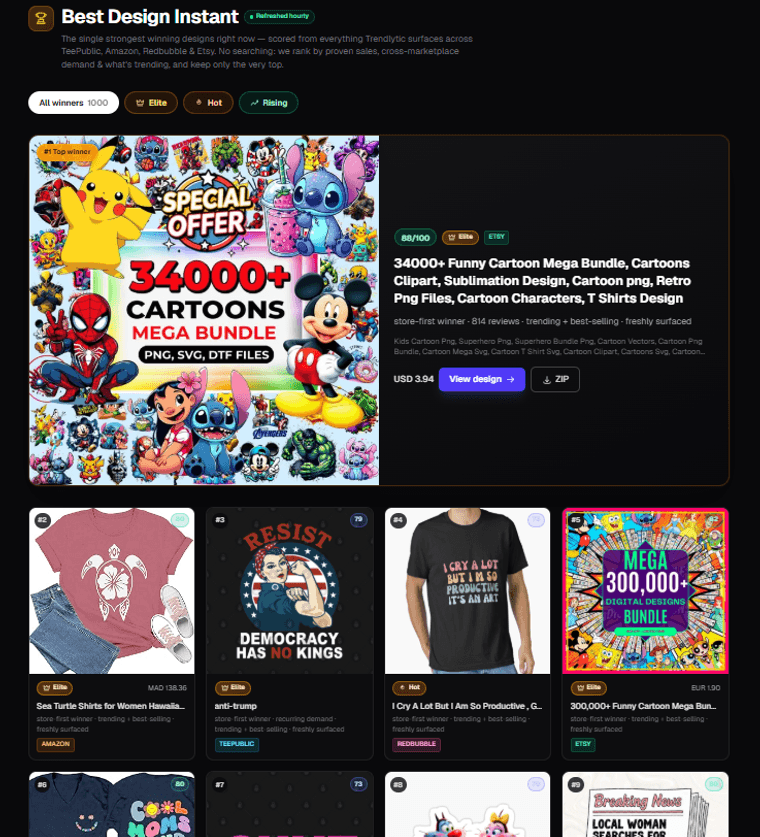
If you don't even have a niche in mind yet, Trendlytic's Best Design Instant is a no-input feed — refreshed hourly — of the strongest current winners, scored across all four marketplaces.
What's a trend you caught early that actually sold — and how did you spot it before everyone else piled in? I'd genuinely like to know what's working for you.
Like this? Get one like it every Wednesday.
Niche data, trademark alerts, one tactic per week.
Try Trendlytic
Find your next winning POD niche in 40 seconds
Live data from TeePublic, Amazon Merch, Redbubble, and Etsy, with a trademark check built in. Then turn any winner into a listing for a design of your own in that niche. Plans from $9/month.
Start researchingKeep reading
- Trendlyticredbubble
8 Best Selling Redbubble Niches in 2026 (and How to Find Your Own)
The Journal8 Best Selling Redbubble Niches in 2026 (and How to Find Your Own)
June 15, 2026 · 20 min read
- Trendlyticprint on demand
8 Print on Demand Niches That Actually Sell in 2026
The Journal8 Print on Demand Niches That Actually Sell in 2026
June 9, 2026 · 20 min read
- Trendlyticpod niches
How to Find Trending POD Niches in 2026 (Without Guessing)
The JournalHow to Find Trending POD Niches in 2026 (Without Guessing)
May 23, 2026 · 20 min read