TL;DR: The categories that consistently sell best on Etsy are personalized jewelry, stickers, digital downloads (planners and templates), personalized and custom gifts, home decor and wall art, craft supplies, wedding and party items, apparel, candles, pet products, seasonal items, and vintage. The honest catch is that "best-selling" shifts constantly and Etsy publishes no official bestseller ranking, so any static list is a starting point, not the answer. The real edge is checking what is genuinely selling right now, not trusting a list someone wrote a year ago.
If you searched "best-selling items on Etsy," you want to know what is actually moving volume right now so you can point your own shop at it. I will answer that with the durable categories below, but I want to be straight with you first.
Etsy does not publish a public bestseller ranking. There is no official chart of top-selling items updated weekly. So every "best-selling items on Etsy" list, including this one, is inferred from proxies (review counts, favorites, sales badges, what established shops are clearly built on) and it starts going stale the day it is published. The broad categories stay durable for years. The specific products winning inside them rotate constantly.
I run Trendlytic, a niche-research tool for Etsy and print-on-demand sellers, so I spend a lot of time looking at what actually sells versus what people assume sells. This post covers both halves of the honest answer: the categories that reliably sell best, and how to read live demand so you are not building on a snapshot that expired months ago.
Don't miss the next one.
New POD niche analysis every Wednesday.
How "best-selling" is decided on Etsy (and why static lists mislead)
Here is the thing most listicles skip. Etsy keeps sales figures private at the platform level. There is no button that shows the top 100 items sitewide. What buyers and sellers see are signals: a listing's review count, its favorites, an occasional "Bestseller" badge Etsy assigns to strong listings in a category, and the rough sales count on a shop's profile. People stitch those signals together and call the result "best-selling."
That is a reasonable way to infer demand, but it has a shelf life. A listicle published last spring reflects what sold last spring. Trends move, seasons turn, a viral product floods with copycats within weeks, and Etsy's algorithm reshuffles what surfaces. By the time a static list has circulated for a few months, a chunk of its specific picks are already crowded or fading.
So read the categories below as the durable layer. These have sold well for years and will keep selling. What changes underneath is the specific winning product and the sub-niche that still has room, which is the layer a static article cannot keep current and exactly where reading live demand beats reading a list. More on how I do that near the end. For now, the categories.
| Category | Why it sells on Etsy | Competition |
|---|---|---|
| Personalized jewelry | Gift + self-treat, emotional, repeat buyers | High |
| Stickers | Cheap impulse buy, high volume, easy to bundle | High |
| Digital downloads | Instant delivery, near-100% margin, sold infinitely | Medium–High |
| Personalized & custom gifts | Etsy's core reason-to-buy, hard to price-shop | Medium |
| Home decor & wall art | Constant, style-driven, buyers buy sets | Medium |
| Craft supplies & materials | Sell to makers who reorder | Low–Medium |
| Wedding & party items | Deadline-driven, high intent, low price resistance | Medium |
| Apparel & t-shirts (POD) | Evergreen gift + identity demand, no stock | High |
| Candles, bath & body | Consumable, reorders, strong gift intent | Medium–High |
| Pet products | Emotional buyers, very low price resistance | Medium |
| Seasonal & holiday items | Predictable, recurring demand spikes | Medium |
| Vintage | Genuinely scarce, no direct copycats | Low–Medium |
1. Personalized jewelry
Jewelry is one of the largest and most consistent sellers on Etsy, and the part of it moving the most volume is personalized: name necklaces, birthstone pieces, initial rings, coordinate bracelets, custom pendants. This is not the handmade-silversmith corner (that exists too), it is the customizable, made-to-order layer that a lot of sellers run through print-on-demand and dropship jewelry providers.
What sells: name and initial necklaces, birthstone jewelry, custom coordinate and date pieces, minimalist gold-filled everyday jewelry with a personalization option.
Why it sells on Etsy: jewelry is both a gift and a self-treat, and personalized jewelry carries emotional, deadline-driven intent. Someone buying a necklace with their daughter's name is not comparing forty listings on price. It is also a repeat category, a happy buyer comes back.
Who buys: gift shoppers (partners, parents, friends) and women buying for themselves, skewing toward milestone moments like anniversaries, births, and graduations.
Competition: high, and I will not pretend otherwise. This is a deep category with serious sellers and strong photography. The way to stand out is a specific personalization angle and genuinely good product photos, not competing head-on with generic plain chains.
2. Stickers (die-cut, planner, laptop)
Stickers are one of the highest-volume sellers on Etsy because the price is low enough that buyers do not deliberate. A few dollars, add to cart, done. That low friction is the whole point.
What sells: die-cut vinyl stickers, kiss-cut sticker sheets, planner sticker kits, laptop and water-bottle stickers, and themed packs built around a hobby, job, or identity.
Why it sells on Etsy: impulse pricing plus real demand. Buyers grab several at once, especially sheets and packs, which lifts the order value past the low per-unit price. Design variety is nearly infinite, so fresh niches keep surfacing.
Who buys: students, planner enthusiasts, hobbyists, and anyone decorating a laptop or journal. Younger buyers over-index here.
Competition: high. There are an enormous number of stickers on Etsy and generic designs disappear. The move is a cohesive pack for a tight community (a specific profession, a niche hobby, a regional in-joke) rather than scattered one-offs. Stickers are also cheap to test, so many sellers use them to validate a niche before committing to higher-overhead products.
3. Digital downloads (planners, templates, printables)
Digital downloads are one of the fastest-growing and highest-margin sellers on Etsy, and for a lot of shops they are the single best-selling line. You make the file once and sell it forever. No printing, no shipping, no inventory, no returns, and the delivery is automatic.
What sells: printable planners and budget trackers, Canva templates, resume and CV layouts, social-media templates, digital art files, printable wall art, and party printables.
Why it sells on Etsy: buyers want the result now, and Etsy is full of people searching for ready-made templates they can print at home or edit themselves. Margins are near 100% because there is no unit cost. Planner and budgeting products spike hard every December and January.
Who buys: small-business owners, students, event planners, and anyone who wants a done-for-you template instead of building from scratch.
Competition: medium to high. Low barriers mean everyone piles in, so generic "daily planner" listings are brutally saturated. The shops that win go specific (an ADHD-friendly weekly planner, an editable Canva version rather than a flat PDF) and present the product beautifully.
4. Personalized and custom gifts
If Etsy has a defining reason-to-buy, this is it. Custom mugs, engraved cutting boards, personalized signs, monogrammed items, custom portraits. Buyers come to Etsy specifically because they want something made for one person, which is exactly what the big marketplaces cannot do well.
What sells: personalized mugs and tumblers, custom family and pet signs, engraved keepsakes, monogrammed home items, and custom illustration or portrait products.
Why it sells on Etsy: personalization is emotional, and emotional purchases are not price-shopped. A custom "first home" sign or a portrait of someone's family is bought for a reason, on a deadline, for someone the buyer cares about. That intent converts.
Who buys: gift shoppers across every occasion, weddings, housewarmings, birthdays, holidays, memorials.
Competition: medium, and lower than you would expect, because personalization is a natural moat. Once a name or date goes on your product it is, by definition, a little different from every other listing. Pick a product where customization genuinely matters and make the process effortless in your listing.
5. Home decor and wall art (including prints)
Home decor is a constant seller on Etsy because people are always decorating homes, dorms, nurseries, and offices. Wall art in particular works two ways: as an instant printable digital file or as a physical print-on-demand poster or canvas.
What sells: wall-art prints (digital and physical), typography and quote art, botanical and abstract prints, custom family or pet portraits as decor, and small decor objects.
Why it sells on Etsy: decor is style-driven and buyers search by aesthetic and theme. Someone who likes one of your pieces often buys a coordinated set, which raises the order value.
Who buys: homeowners and renters decorating a space, plus gift shoppers buying for new homes and nurseries.
Competition: medium. Generic motivational quotes and mass-market knock-offs are saturated. A defined aesthetic (a specific color palette, a clear illustration style, a niche theme like vintage botanical or retro travel) is not. A cohesive visual identity beats a broad theme every time, and gallery-wall bundles beat single prints.
6. Craft supplies and materials
A category a lot of people overlook: selling to other makers. Etsy is full of crafters buying inputs for their own projects, and that audience buys with real intent and comes back.
What sells: SVG cut files, knitting and crochet patterns, embroidery designs, sewing patterns, digital brushes, beads and jewelry findings, and physical craft materials.
Why it sells on Etsy: makers are repeat buyers with specific needs. They are not browsing, they are sourcing. Digital patterns and cut files in particular have zero overhead and instant delivery, so they combine a motivated audience with the easiest fulfillment on the platform.
Who buys: hobbyist and semi-pro crafters, small makers scaling up, and people who sell their own handmade goods.
Competition: low to medium, especially for well-made digital patterns and files. This lane is less saturated than the consumer-facing categories because it requires an actual skill: you have to be able to design the pattern or curate the supply. If you can already knit, sew, cut, or design, you have a built-in moat here.
7. Wedding and party items
Weddings, birthdays, baby showers, and parties are a reliable well of high-intent buyers, and many of the products work as zero-overhead digital downloads.
What sells: printable and editable invitation suites, signage, place cards, favors, party decorations, and personalized party goods.
Why it sells on Etsy: event buyers have a deadline and a budget and they are emotionally invested. Nobody bargain-hunts for a wedding sign at 2am, they want the right one and will pay for it. Editable templates are especially strong because the buyer can self-serve and reprint.
Who buys: couples, party hosts, and parents planning events, plus the friends and family helping them.
Competition: medium. The generic "wedding invitation template" lane is crowded, but specific styles and themes have real room. The winning move is bundling: offer a coordinated suite (invitation, RSVP, details card, signage, thank-you) in one style so buyers who want everything to match pick you over single-item shops.
8. Apparel and t-shirts (print-on-demand)
Apparel is a perennial best-seller on Etsy, and most of the volume newer sellers can access runs through print-on-demand: you design, a provider prints and ships when an order comes in, and you never hold stock.
What sells: niche text and graphic t-shirts, sweatshirts and hoodies, and matching designs sold as product pairs.
Why it sells on Etsy: apparel is evergreen. People buy shirts for themselves, as gifts, for events, and for in-jokes. Niche text designs do especially well because a shirt is how people wear a statement or signal a community.
Who buys: gift shoppers and identity-driven buyers who want to represent a hobby, job, family role, or fandom-adjacent interest.
Competition: high, the most saturated print-on-demand category there is. Generic ideas are hopeless. The only way through is a narrow, well-defined niche where you are one of a handful of sellers, not one of thousands. "Dog mom" is a market; "Australian Shepherd agility mom" is a niche you can actually rank for.
9. Candles, bath and body
Candles, wax melts, soaps, and bath products are a strong seller for makers who want a hands-on product with genuine repeat-buy potential. This one needs real production, so it is not a same-day start, but loyalty and margins can be excellent.
What sells: scented candles with a theme or story, wax melts, bath bombs, soaps, and gift sets.
Why it sells on Etsy: fragrance and bath products are consumable, so buyers run out and reorder, which is rare and valuable in a marketplace. They are also reliable gifts, and scent-plus-story (a candle named for a feeling, a place, or a mood) sells far better than a plain unscented jar.
Who buys: self-care shoppers and gift buyers, with strong repeat purchasing from customers who like a scent.
Competition: medium to high. The basic version is crowded, but branding and scent storytelling create room because buyers are choosing a vibe, not a commodity. Because there is real overhead here (materials, testing, shipping fragile glass) it is worth confirming the specific aesthetic already sells for others before you buy a pallet of jars.
10. Pet products
Pet owners spend on their animals the way parents spend on kids, and they do not price-shop. That makes pet products a consistent Etsy seller, especially the personalized and breed-specific corners.
What sells: anything tied to one specific animal, from custom portraits and memorial keepsakes to the gear the pet itself wears. Which of those you can actually print, and which marketplace is allowed to carry each one, is the full breakdown in print on demand pet products.
Why it sells on Etsy: this is an emotional, identity-driven category with very low price resistance. A custom portrait of someone's dog, or a memorial piece for a pet that passed, is meaningful rather than a commodity, and meaning sells here.
Who buys: pet owners buying for themselves and gift shoppers buying for the pet lovers in their life.
Competition: medium. The broad "dog mom" lane is crowded, but breed-specific and personalized angles are wide open. "Corgi dad gift" beats "dog dad gift," and a custom-portrait product beats a generic print. Print-on-demand handles the physical side while personalization gives you a natural moat.
11. Seasonal and holiday items
Christmas ornaments, Halloween decor, Valentine's gifts, Easter printables, and back-to-school items ride predictable, recurring demand spikes. Seasonal selling is a real strategy on Etsy, and some shops earn the bulk of their year in Q4 alone.
What sells: personalized Christmas ornaments, holiday decor and signage, seasonal printables, and dated keepsakes like "our first Christmas."
Why it sells on Etsy: the demand is calendar-locked and it comes back every year. The same holidays, the same search terms, the same buyers. Personalized seasonal items carry strong gift intent on top of that.
Who buys: gift shoppers and decorators prepping for a specific holiday, often weeks ahead.
Competition: medium, but timing-sensitive. The category is competitive during its season, which is exactly why the listings that win are the ones that went live months early and built ranking history before the rush. A Christmas ornament published in September outranks one published in December.
12. Vintage
Vintage is the category people forget Etsy even has, and it is one of the few where you are genuinely protected from copycats. Etsy allows items 20+ years old to be sold as vintage, and each piece is effectively one of a kind.
What sells: vintage clothing and accessories, mid-century home goods, retro kitchenware, old prints and ephemera, and collectible odds and ends.
Why it sells on Etsy: scarcity. A true vintage item cannot be mass-produced or undercut by a print-on-demand copy, so you are not fighting ten thousand identical listings. Buyers come to Etsy specifically because it is one of the few marketplaces that curates this well.
Who buys: collectors, decorators chasing a specific era, and shoppers who want something with history rather than something new.
Competition: low to medium, but it is a sourcing game rather than a design game. Your edge is finding good stock cheaply and photographing and describing it well. It suits people who enjoy the hunt more than those who want a repeatable digital product.
How to find what's actually selling on Etsy right now
Here is the honest limitation of everything above. A category list tells you where demand lives in general. It cannot tell you which specific product, in which sub-niche, is selling this week versus already flooded with copycats. That gap is where most sellers lose months: they pick a category from a list, design the obvious version of it, and launch straight into the most crowded corner.
The fix is a mindset, not a trick: do not trust a static list, look at what is genuinely selling right now. That means reading real demand signals (recent sales, favorites, review velocity on listings that are clearly moving) and weighing that demand against saturation before you make anything. A category with real demand and beatable competition is a business. The same category, entered through its most generic product, is a graveyard. Validate that a specific niche has demand and room before you spend a week designing for it, not after.
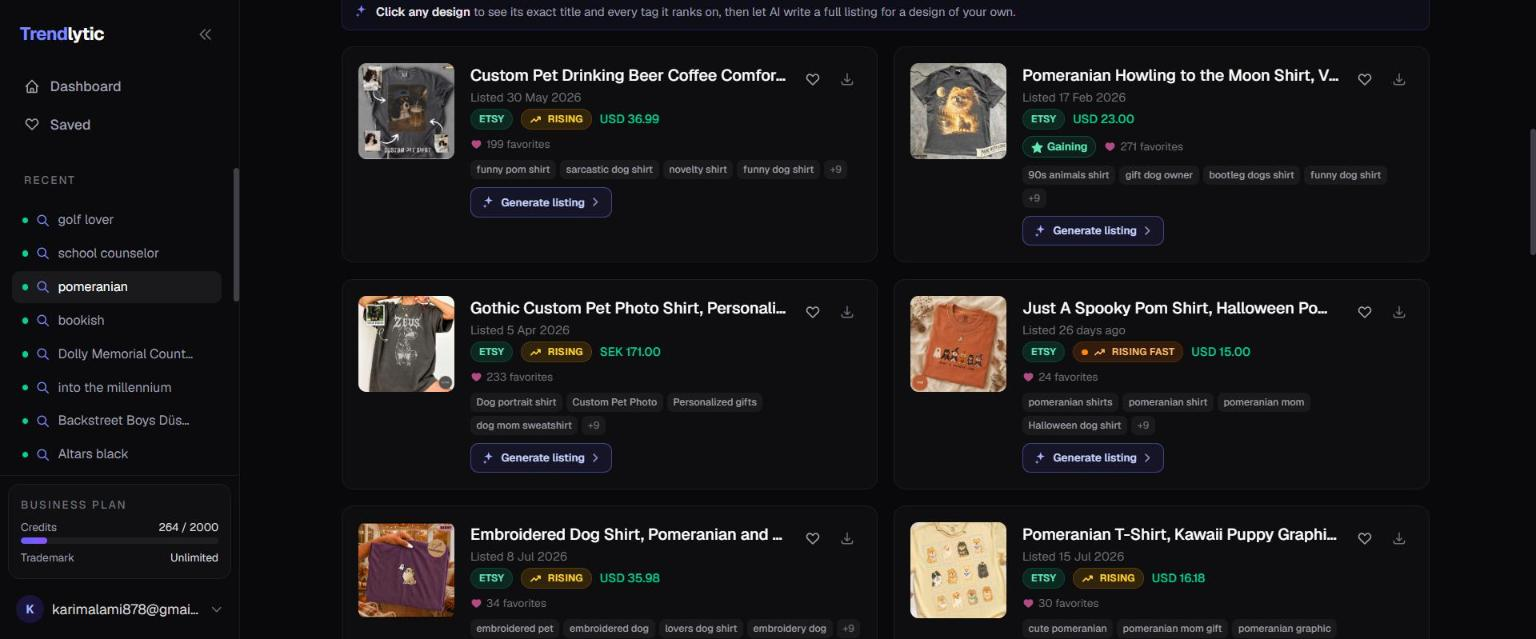
Doing that by hand is slow. You are reading listings, cross-checking favorite and review counts, comparing across marketplaces, then checking your phrase against the USPTO database so you do not build on a trademarked name. That is hours per niche. Trendlytic collapses it into one search: it surfaces the designs and items actually selling in a niche across Etsy, Redbubble, TeePublic, and Amazon Merch, using real demand data rather than search-volume guesses, and lets you look up any phrase on the live USPTO register in one click, so you see what is registered before you design around it. The Best Sellers and Best Design Instant views are the live version of the list on this page, built from what is moving now instead of what was moving when an article was written.
On the Etsy tab, each listing card also shows how many favourites it has and when it was listed, and the ones gathering favourites fastest are badged: Rising when a listing ranks in the top third of the niche for favourites growth and is under 180 days old, Rising fast for the fastest tenth under 40 days with 10 or more favourites. Favourites measure interest rather than orders, so read the badge as an early pointer and still check that the item is actually selling.
It is not a money printer, it just removes the guesswork from the one step beginners get wrong. It is $19.99/month for 100 searches, with a free trial. If you want the live read on a niche instead of a snapshot, start a 3-day trial and compare what it shows against your assumptions. For the manual method, how to find trending POD niches goes deeper, and for a broader, opportunity-focused take on what to make (rather than what is currently selling), best things to sell on Etsy is the complementary read to this one.
FAQ
What are the best-selling items on Etsy? The categories that consistently sell best are personalized jewelry, stickers, digital downloads (planners and templates), personalized and custom gifts, home decor and wall art, craft supplies, wedding and party items, apparel, candles and bath products, pet products, seasonal items, and vintage. Those are durable. The specific top products inside each one rotate over time, so treat the categories as reliable and the individual picks as things to verify against current demand.
Does Etsy show best sellers or a bestseller list? Etsy does not publish a public, sitewide bestseller ranking. It assigns a "Bestseller" badge to some strong listings within a category, and you can infer demand from a listing's review count, favorites, and a shop's rough sales count. But there is no official chart of the top items, which is why every "best-selling on Etsy" list is inferred and why reading live signals beats trusting a static one.
What sells the most on Etsy? By volume, low-friction impulse and gift products lead: stickers, digital downloads, and personalized gifts move a lot of units because they are cheap, instant, or emotionally driven. By margin, digital products win because there is no unit cost. By total revenue, personalized physical gifts and jewelry often earn the most per shop because buyers pay premium prices. "The most" depends on whether you mean units, margin, or revenue.
Are digital products the best-selling items on Etsy? Digital products are one of the biggest and fastest-growing categories, and for many shops they are the best-selling line, largely because the margin is near 100% (no printing, shipping, or inventory) and delivery is automatic. That low barrier is also why the generic versions are heavily saturated. Digital sells extremely well, but only when you go specific rather than listing the same planner everyone else has.
How do I find what's currently selling on Etsy? Read live demand instead of old lists: look at listings clearly moving right now (recent sales, high favorite and review velocity) and weigh that against how crowded the niche already is. Trendlytic automates this by surfacing the items actually selling in a niche across Etsy, Redbubble, TeePublic, and Amazon Merch, plus a USPTO lookup you can run on any phrase before you commit to it. You can try it for 3 days, or do it manually using the method in the trending-niches guide linked above.
Is it too late to sell popular items on Etsy? No, but not by entering the generic version of a popular category. "Too late" is true for broad, flooded lanes ("funny mom shirt") and false for specific sub-niches with proven demand and room to compete. New shops break through every month by owning a narrow niche rather than fighting head-on in a crowded one. Pick a sub-niche, validate it, and you are not late.
The bottom line
The best-selling items on Etsy sit in a set of durable categories: personalized jewelry, stickers, digital downloads, custom gifts, home decor, craft supplies, wedding goods, apparel, candles, pet products, seasonal items, and vintage. Those have sold well for years and will keep selling. What a list like this cannot do is stay current on the specific product winning inside each category, because Etsy publishes no official ranking and the winners rotate.
So use this as your starting map, then read what is actually selling before you commit. That is the real skill, and it is the difference between building on live demand and building on a snapshot that expired. If you want the current read rather than a static list, start a Trendlytic trial and see the Best Sellers view for a niche you are considering. It is a faster, more honest answer than any article, including this one, can give you. And if you are still deciding which marketplace to build on, the Etsy niche research page, the Etsy best sellers finder and the free Etsy tag generator are good next stops, with the Etsy SEO guide covering how to rank once you are live.
So which of these categories are you eyeing, and what specific niche are you thinking of building inside it? I would genuinely like to know what is working out there right now.
Like this? Get one like it every Wednesday.
Niche data, trademark alerts, one tactic per week.
Try Trendlytic
Find your next winning POD niche in 40 seconds
Live data from TeePublic, Amazon Merch, Redbubble, and Etsy, with a trademark check built in. Then turn any winner into a listing for a design of your own in that niche. Plans from $19.99/month.
Start researchingKeep reading
- Trendlyticmost profitable etsy shops
Most Successful Etsy Shops: What They Have in Common
The JournalMost Successful Etsy Shops: What They Have in Common
September 12, 2026 · 17 min read
- Trendlyticetsy
Is Etsy Legit & Safe in 2026? Honest Answer for Buyers and Sellers
The JournalIs Etsy Legit & Safe in 2026? Honest Answer for Buyers and Sellers
July 8, 2026 · 19 min read
- Trendlyticetsy fees
Etsy Fees Explained (2026): How Much Does Etsy Really Take?
The JournalEtsy Fees Explained (2026): How Much Does Etsy Really Take?
July 8, 2026 · 14 min read