TL;DR: The most durable trending t-shirt designs are evergreen niche and nostalgia themes, not the viral phrase everyone can already see. By the time a design is visibly everywhere, the lane is flooded and often trademarked, so copying it is the losing move. This post does two things: it maps the design directions that keep recurring year after year (retro, minimalist line art, statement typography, decade nostalgia, nature, identity humor), and it teaches you the honest skill of catching a rising trend early, before it lands on a list like this one. Look at what's actually selling right now, not just what's searched, and get in before the flood.
I want to open with the uncomfortable thing, because most articles with this title skip it. A list of "trending t-shirt designs" has a short shelf life. Whatever I put in a ranked list today is a design thousands of other sellers are also reading about today, and by the time it feels safely "proven," the front page of that search is a wall of near-copies. The trend was real. Piling into it after it went public is what fails.
So I'm going to be useful in a different way. I'll walk through the design directions that actually keep coming back, season after season, because those are the ones worth building on. Then I'll spend the back half on the part that compounds: teaching you to read a trend on the way up instead of at the top. Catching a rise early is where the money lives. Catching it on a listicle is usually where the money already left.
Don't miss the next one.
New POD niche analysis every Wednesday.
Why "just copy what's trending" quietly loses
Here is the pattern I watch play out constantly. Someone spots a design selling well, screenshots it, makes their own version that weekend, uploads it, and waits. Nothing happens. Then they wonder what they did wrong, when the honest answer is that they did nothing wrong except arrive third-hundredth.
A visible trend is a crowded trend. Three things go wrong at once when you chase one:
You're late by definition. If you can plainly see a design everywhere, so can everyone else with the same feed. The sellers earning from it got in while it was still a quiet signal, and their listings already carry the reviews and ranking that keep a newcomer buried.
The obvious version is taken. When a hundred people design "the trending thing," they mostly make the same first-thought take on it. The buyer scrolls past forty interchangeable shirts and buys from whoever looks most established. That's never the person who joined last week.
The phrase might not even be yours to print. Viral t-shirt trends cluster around exactly the material that gets people suspended: a hot catchphrase, a character, a brand reference, a lyric. Trending and trademarked overlap far more than beginners expect, and I'll come back to that.
None of this means trends are useless. It means the opportunity is never the headline trend. It's either an evergreen angle you can own for years, or the specific under-served corner of a rising one that you caught before the crowd. Both of those beat racing the pack to the obvious design. The broad trends pillar, 8 print on demand trends for 2026, goes wide on this across products; this post keeps the lens on t-shirts specifically.
Evergreen design directions that keep trending
These aren't fads with an expiry date. They're durable styles and angles that recur every year because the underlying buyer never goes away. That durability is the whole point. A dated meme dies in a quarter; a well-made retro profession tee sells the same way in 2027 as it does now. Below are the directions I'd anchor a t-shirt catalog to, with who buys and why each one lasts.
| Design direction | Who buys it | Example angle | Why it lasts |
|---|---|---|---|
| Retro / vintage aesthetics | Nostalgia buyers, comfort shoppers | Faded-print badge for one hobby or town | Nostalgia is comfort buying; it never fully fades |
| Minimalist line art | Design-aware, gift buyers | One continuous-line drawing of a subject | Clean, timeless, easy to reprint across products |
| Statement typography | Humor and identity buyers | A bold true-to-life line for one job or hobby | Text reads instantly and communities always exist |
| Decade nostalgia / revival | Millennials, Gen Z | A 90s or Y2K treatment on a specific niche | Each generation buys back its own youth |
| Cottagecore / nature | Slow-living, outdoor buyers | Soft botanical art with a quiet phrase | Aesthetic identity keeps splintering into new corners |
| Specific-identity humor | Professions, hobbies, pet parents | An in-joke only that group fully gets | People always want to signal their exact tribe |
| Aesthetic movements | Younger, taste-signaling buyers | A defined dark-academia or y2k motif set | Moods rotate but the appetite for a "look" is constant |
| Seasonal / occasion evergreen | Gift buyers on a deadline | Holiday stacked onto a niche, not generic | Calendar demand returns on schedule every year |
Read the table as directions, not designs. The value is in picking one and going a layer deeper than the obvious version.
Retro and vintage aesthetics
Vintage never really leaves. Faded prints, weathered textures, athletic-varsity lettering, and old-souvenir layouts read as comfortable and familiar, and they photograph well at thumbnail size. The trap is generic "retro" with nothing behind it. The opening is retro treatment applied to a specific niche: a trades badge in a worn 70s palette, a hobby crest in vintage-athletic type, a small-town souvenir look. Keep the art original and skip any real team, brand, or mascot, since that's borrowed IP.
Minimalist line art and clean typography
On the opposite end, spare designs keep selling because they're timeless and they suit people who want to wear something without shouting. A single-line drawing, one clean word, a small motif with a lot of breathing room. These also travel well across products, so one strong mark becomes mugs, totes, and prints without a redraw. For a fuller list of specific concepts in this vein, my companion post 40 t-shirt design ideas that actually sell breaks them down by niche and occasion.
Nostalgia and decade revivals
Each generation buys back the era it grew up in. Right now the 90s and early 2000s sit squarely where Millennial and Gen-Z spending is, so retro tech vibes, faded weekend graphics, and Y2K flourishes keep moving. The direction is durable because the cycle repeats; only the decade in focus shifts forward over time. Anchor the nostalgia to a niche rather than leaning on a protected logo, and it stays both fresh and safe.
Identity humor and specific communities
The most reliable statement tees are the ones aimed at one exact person. A profession with a specialty, a hobby with a sub-style, a pet breed with a situation. Broad humor is brutally crowded; the insider line only that group would write is where the room is. This is durable because communities and the urge to signal belonging never go away, they only fragment into smaller pieces you can serve.
What trending designs actually look like right now
Separate from the theme is the treatment, the way a design is executed. A few format habits are winning at the moment, and they're evergreen enough to build on rather than chase.
- Bold, readable text that survives a thumbnail. Almost everyone shops on a phone, so the design competes as a small square in a grid. If the message isn't legible at that size, it loses before anyone clicks. Big, centered, high-contrast type wins.
- Distressed and vintage textures. A slightly worn, printed-and-washed finish reads as premium and lived-in rather than flat and default. It's a small touch that separates a design from the clean-vector look everyone ships.
- A hand-drawn feel. As generic AI-look art floods feeds, work that reads as genuinely hand-made stands out again. A visible point of view is becoming the scarce, valuable thing.
- Simple one-color statement tees. A single strong line in one ink color, nothing else. Cheap to print, easy to read, and it lets the message carry the shirt.
If I had to compress the treatment advice into one rule, it's this: design for the thumbnail first. The buyer meets your shirt as a tiny image among dozens. Whatever reads instantly at that size, and makes the right person feel seen, is what gets the tap. A quick test: drop the file into our t-shirt mockup generator and judge it on the small cards, not on the big preview.
How to spot a trend early (the honest method)
This is the part that actually compounds, and the reason a post like this shouldn't be treated as a shopping list. Every direction above is a starting signal. The skill that pays over years is learning to see a rise yourself, early, before it's named anywhere. A handful of principles do most of the work.
Watch where culture moves before it reaches POD. Trends usually show up in the wider world first: a show, a sound, a subculture, a shift in how people talk, and only later become t-shirt searches. If you're paying attention to the communities you actually design for, you often feel a rise weeks before it's a keyword. That head start is the entire advantage.
Read what's selling now versus a year ago. A search-volume number tells you a phrase is popular; it doesn't tell you anyone is buying, and it definitely doesn't tell you whether the buying is new. What you want is designs that are freshly gaining traction, recent winners still landing, not a niche that peaked last year and is now a closed, crowded evergreen. Recency separates a climbing trend from a done one.
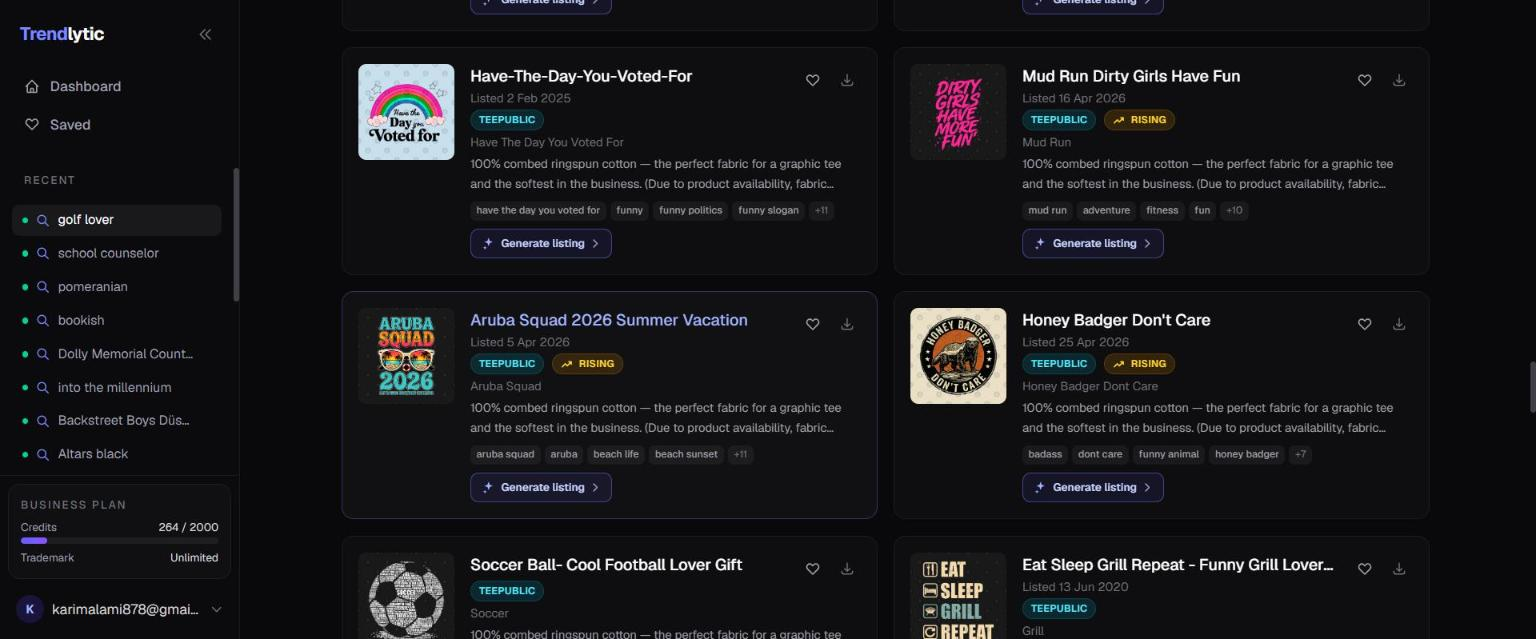
That comparison is what the Rising badge in Trendlytic does per design. In the TeePublic results below for a "golf lover" search, three shirts listed in April 2026 are marked Rising because, on its seller's best-selling page, each one now outranks five or more shirts that seller put up earlier; a shirt under 60 days old doing the same would show Rising fast. The 2020 and early 2025 shirts next to them, still selling but not new, get no badge.
Look at the sub-niches next to a saturated one. When a broad space is a wall of established sellers, the opening is rarely the space itself. It's the adjacent corner one layer in: the specific sub-hobby beside the flooded hobby, the narrow role beside the crowded profession. The demand spills sideways faster than the competition follows.
Respect seasonal lead time. Calendar demand is the most predictable signal there is, and the marketplaces reward whoever uploaded early. In-season is a race that's already over. If you can see a seasonal or occasion angle rising, you generally have weeks to act before the curve, not days.
The honest core of all four is the same. Look at what is genuinely selling right now, not just what's being searched or talked about, and move in before the flood. That's the difference between joining a trend and chasing one. My deeper walkthrough of reading recency and demand lives in how to find trending POD niches.
Doing this by hand is slow, which is exactly why most sellers skip it and then wonder why chasing trends earned them nothing. You'd be reading what's actually selling across four marketplaces, one niche at a time, comparing it against what sold a year ago, then checking each phrase for trademarks. Hours of clicking per idea. That boring loop is what I built Trendlytic to close: one search shows what the top sellers are genuinely moving across TeePublic, Amazon Merch on Demand, Redbubble, and Etsy, store-first so you see what's bought rather than merely searched, refreshed hourly, with a live USPTO lookup on any wording you like. It's $19.99 a month for 100 searches, free trial. It doesn't design the shirt and it won't turn a saturated trend into an open one; it just removes the guesswork from the step most people skip. If you'd rather try the free side first, the free POD tools need no login at all.
Trend timing: where to enter and where to stay out
Every trend moves through the same arc, and where you catch it decides almost everything. The same design idea is a goldmine at one stage and a waste of a weekend at another. Here's how to read your position before you commit a day to designing.
| Stage | What it looks like | Should you enter? |
|---|---|---|
| Too early | A faint cultural signal, almost no designs yet, no proof it converts | Watch closely, don't build a body of work until it's actually selling |
| Rising (the sweet spot) | New designs gaining traction weekly, real sales, competition still thin | Yes, this is the window; move with an original, specific take |
| Peak | Everywhere at once, heavy competition, the phrase on every feed | Only with a genuinely fresh sub-angle, otherwise skip |
| Saturated | Front pages are walls of near-identical designs from entrenched sellers | No, the door is shut; look at the adjacent under-served corner instead |
The mistake nearly everyone makes is entering at peak, because peak is the first time a trend is obvious enough to notice from the outside. The sellers who win entered at "rising," when it took a little judgment to see the demand was real but the shelf wasn't full yet. Too early has its own risk: a signal that never converts leaves you with forty designs in an empty room. That's why spotting early and validating that it's actually selling have to travel together. Catch it on the way up, confirm the demand is real, then design.
The trademark caveat you can't skip
One line, because it matters more than any design tip here: trending t-shirt designs are exactly where trademark trouble concentrates, since viral phrases, characters, and brand references are the most likely to be someone's registered property, and apparel sits in its own trademark class. Printing a phrase you don't own can get a listing pulled or a whole shop suspended, so run your exact wording through the USPTO trademark database before you design. This isn't legal advice, just the check that prevents most avoidable suspensions. My full walkthrough is in the print on demand trademark guide.
Once an idea is validated and trademark-safe and you're ready to list, getting it found is its own step. The Amazon Merch keyword generator turns your niche into a set of buyer-search terms in one click, no login, so the shirt actually surfaces in results instead of sitting invisible.
FAQ
What t-shirt designs are trending in 2026? The most durable trending t-shirt designs are evergreen niche and nostalgia themes, not viral memes. Retro and vintage treatments, minimalist line art, bold statement typography, 90s and Y2K decade revivals, cottagecore and nature designs, and specific-identity humor for professions, hobbies, and pet parents all keep recurring. The honest caveat is that any design visible enough to name in a list is already crowding, so the real edge is catching a rising angle early and going a layer deeper than the obvious version.
Why doesn't copying a trending design work? Copying a visibly trending design usually fails because by the time you can plainly see it everywhere, the niche is already flooded and the established listings hold the reviews and ranking that keep newcomers buried. On top of that, viral phrases and characters are frequently trademarked, so the exact thing that looks hottest is often the thing most likely to get a listing or shop pulled. The opportunity is never the crowded headline trend; it's an evergreen angle you can own or the under-served corner of a rising one.
How do I spot a trend before it saturates? Watch where culture moves before it reaches print on demand, read what's actually selling now versus a year ago rather than trusting search volume alone, look at the sub-niches next to a saturated one, and respect seasonal lead time. The common thread is studying real sales, not just searches or social buzz, and moving in while a trend is rising rather than at its peak. By the time a design is on a public list, the easy window has usually closed.
Are trending designs risky for trademarks? Yes, trending designs are where trademark problems cluster the most, because viral catchphrases, characters, brand references, and lyrics are exactly the material most likely to be registered property, and apparel falls in its own trademark class. Printing something you don't own can cost you a listing or an entire shop. Search your exact phrase in the free USPTO database before you design, and when a design leans on anything protected, abstract it into an original vibe instead.
What's the best time to enter a t-shirt trend? The best time to enter is the rising stage, when new designs are gaining traction weekly and there are real sales but competition is still thin. Entering at peak means fighting a wall of near-identical designs, and entering a saturated trend means the door is effectively shut. Too early carries its own risk, since a signal that never converts leaves you designing into an empty room, which is why spotting early and confirming the demand is real have to go together.
Do evergreen or trending designs sell better? Evergreen designs are the steadier bet because they sell to a defined audience year after year, while a chased trend can spike and then die within a quarter. The strongest approach uses both: build a base of evergreen niche and nostalgia designs for reliable sales, and layer in rising trends you've caught early and validated. That way your catalog isn't dependent on any single fad, and each trend you enter is a bonus rather than the whole strategy.
Conclusion
The honest takeaway is short. A trend you can already see everywhere is a warning, not an invitation, and the sellers who profit from trends are almost never the ones racing to make the obvious version. They're the ones who anchor a catalog to durable, evergreen directions and then catch a rising trend early, in the narrow corner that's still open, and validate that it's genuinely selling before spending a day designing.
That validation is the boring, slow part most people skip, which is exactly why chasing trends earns most sellers nothing. Trendlytic does that homework for you: one search across TeePublic, Amazon Merch on Demand, Redbubble, and Etsy showing what's actually selling, store-first and refreshed hourly, with a USPTO lookup one click away for any phrase. It's $19.99 a month for 100 searches, with a free trial. Read what's rising before you design into it, not after.
What's a t-shirt trend you caught while it was still on the way up, and how did you know it was real before everyone else piled in? I'd genuinely like to hear what's working for you.
Like this? Get one like it every Wednesday.
Niche data, trademark alerts, one tactic per week.
Try Trendlytic
Find your next winning POD niche in 40 seconds
Live data from TeePublic, Amazon Merch, Redbubble, and Etsy, with a trademark check built in. Then turn any winner into a listing for a design of your own in that niche. Plans from $19.99/month.
Start researchingKeep reading
- Trendlyticmeme shirts
Meme Shirts: How to Find and Sell Meme T-Shirt Niches in 2026
The JournalMeme Shirts: How to Find and Sell Meme T-Shirt Niches in 2026
July 11, 2026 · 17 min read
- Trendlyticcustom napkins
Custom Napkins: Sets, Weddings and What Sells in 2026
The JournalCustom Napkins: Sets, Weddings and What Sells in 2026
October 10, 2026 · 20 min read
- Trendlyticdtf vs sublimation
DTF vs Sublimation in 2026: Which One Fits Your Product?
The JournalDTF vs Sublimation in 2026: Which One Fits Your Product?
October 6, 2026 · 18 min read