TL;DR: Print on demand lets you sell your own designs on products — shirts, mugs, stickers, posters — with no inventory and no upfront cost. A platform prints and ships each item only after someone buys it, and you earn a royalty. It's one of the lowest-risk businesses you can start, but the margins are thin and it's a research-driven volume game, not passive income. This page is the hub: a genuinely useful overview of the whole model, with links out to deep guides on each step — starting up, choosing a platform, finding a niche, picking products, pricing, SEO, and the free tools that speed up the boring research.
This is the page I'd hand to anyone who asks me "what is print on demand, and where do I even begin?" It's the complete map — the honest one, not the "quit your job in 30 days" one — and every step here links out to a full deep-dive when you're ready to go further.
I've spent the last two years tracking print-on-demand (POD) sellers across Redbubble, TeePublic, and Amazon Merch. I've watched a handful build real monthly income, and I've watched far more upload a few designs, earn nothing, and walk away calling the model a scam. It isn't a scam. It also isn't the money printer the thumbnails promise. The truth is an unglamorous middle, and this guide lays the whole thing out so you can decide if it's for you and find your next step fast.
It's written for total beginners — if you've never sold a thing online, start here and follow the links in order.
What is print on demand?
Print on demand is a fulfillment model. You upload a design. A platform prints it onto a product — a t-shirt, hoodie, mug, sticker, poster, phone case — only after someone orders it. The platform handles printing, packing, shipping, and customer service. You never touch inventory and never pay anything up front. When a sale happens, you earn a royalty.
That's the whole reason it's so beginner-friendly: there's no money at risk. You don't buy 200 shirts and pray they sell. You design something, list it, and if nobody buys it, you've lost nothing but time.
Here's the honest catch, and it runs through this entire guide: low risk also means low margin and high competition. Because anyone can start for free, everyone does. Per-sale royalties are small — usually $2 to $5 on a t-shirt — and the popular niches are brutally crowded. You make real money through volume across many researched designs over time, not from one viral hit. POD is real income for disciplined people. It is not a passive lottery ticket.
Is print on demand legit and worth it?
Short answer: yes, it's legitimate, the platforms are real, and they pay on time. People earn genuine side income from it every month — some earn a full income. The skepticism usually comes from the gap between what gurus promise (easy passive money) and what the model actually is (a slow, research-driven volume game). When you measure POD against the right expectation, it's one of the most honest low-risk businesses out there.
The doubts usually cluster around specific platforms, so I tackled each one head-on: is Redbubble legit and is TeePublic legit both answer the trust question with real detail, is Redbubble worth it weighs whether the small royalties are worth your time, and is print on demand profitable lays out the actual math behind a $1,000/month goal. If you only read one before starting, read the profitability breakdown — it's the best expectation-reset I can offer.
How to start a print on demand business
The whole path is six steps: pick where you'll sell (a marketplace or your own store), research a niche before you design, create the design, trademark-check every phrase, list like a search engine, and upload consistently for longer than feels comfortable. Most beginners fail not because the model is broken but because they skip the boring discipline — they design what they think is cool, never check demand, and quit at month three right before things would have started compounding.
I wrote the full step-by-step with realistic timelines and the common mistakes that kill new shops here: how to start a print on demand business. It's the natural next read after this page.
Choosing a platform
There are two broad routes, and the choice between them is your most important early decision. Marketplaces (Redbubble, TeePublic, Amazon Merch) give you built-in traffic — buyers are already there searching — but you compete on their turf and they take a large cut. Your own store (Etsy with Printful, or Shopify) gives you full control over branding and pricing, but you must drive every single visitor yourself. For a first-timer, a marketplace is the gentler on-ramp: pick one, learn it well, then expand.
Here's a quick orientation table:
| Platform | Type | Built-in traffic | Best for |
|---|---|---|---|
| Redbubble | Marketplace | High | Total beginners, stickers & apparel |
| TeePublic | Marketplace | Medium–high | Beginners, apparel-focused |
| Amazon Merch | Marketplace | Very high | Reach, but invite/tier-gated |
| Etsy + Printful | Own store | Medium (Etsy search) | Building a real brand |
For the deep dives: my step-by-step guide to selling on Redbubble is the easiest place to learn the mechanics with zero cost. Can't decide between the two beginner marketplaces? I broke them down in TeePublic vs Redbubble. If you're weighing a marketplace against running your own branded shop, Printful vs Redbubble is the comparison you want. And for the two biggest individual routes, I covered Amazon print on demand under its new tiered royalties and the Etsy print on demand own-store path in detail.
Finding a niche
This is the single most important step, and it's the number-one reason beginners earn $0. Most new sellers do it backwards: they make a design they think is cool, upload it, and hope. Nobody buys it. Buyers search for very specific things and buy listings that match those searches — so a design with no audience behind it is invisible, no matter how good the art is.
The mental shift: a niche is not a topic, it's an audience plus a specific situation. "Cats" is a flooded topic. "Tired senior-cat owner who's done explaining why I have four of them" is a niche — specific, emotional, and the kind of thing someone pays full price for without comparison-shopping. And before you design, you have to check saturation: a mediocre design in a fresh niche beats a great design in a flooded one, because the fresh-niche design actually ranks where buyers can see it.
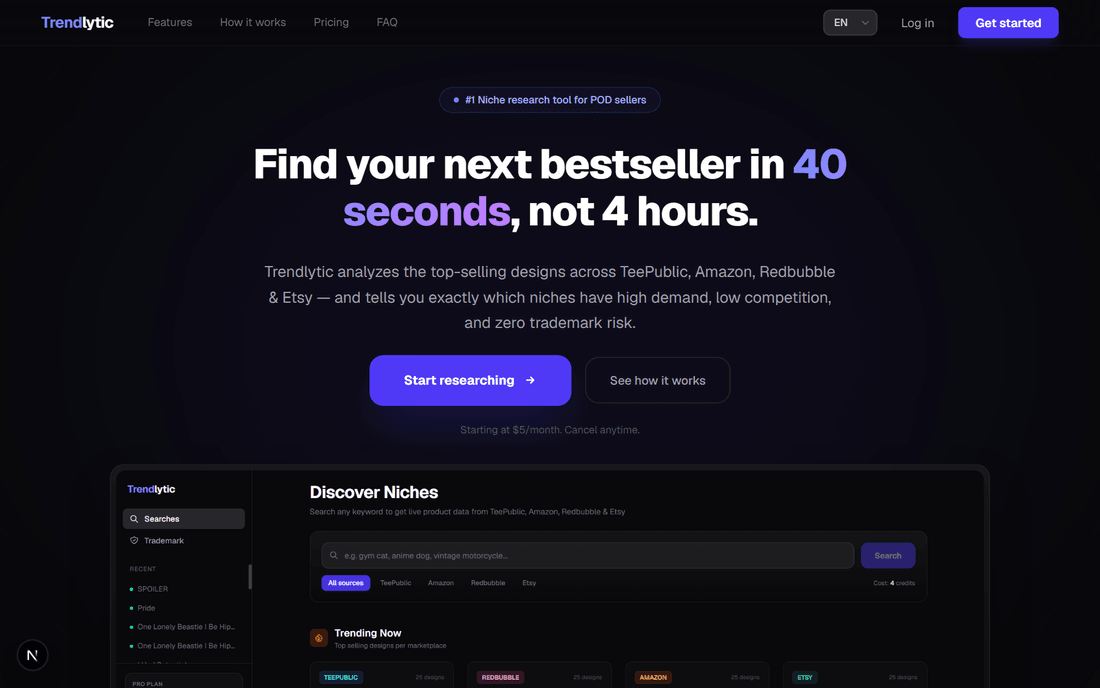
This is the pillar, so the plug is short: Trendlytic is my tool for the research step. It reads Redbubble, TeePublic, Amazon Merch, and Etsy in one pass, shows where the buying is and how crowded it already is, and lets you check the phrase you land on against the USPTO register before a single design is committed. $19.99/month for 100 searches, free trial. Its core is research. You do not need it, and I did the same work with a spreadsheet and two browser tabs before it existed; it just gets you to the answer in minutes instead of evenings.
For the full method, read print on demand niches for ideas and validation, how to find trending POD niches for the demand-discovery process, and the best POD niche research tools if you're deciding which tool (if any) is worth paying for.
What to sell: products and designs
Here's something that surprises people: product choice matters far less than niche and design. A great phrase aimed at the right audience sells across shirts, mugs, and stickers — while a weak design sells on none of them. So get the niche right first, then put it on the products your audience actually buys (apparel and stickers do most of the volume on marketplaces). You also don't need to be an illustrator: a huge share of POD sales are simple, bold text designs that read clearly at thumbnail size.
For the specifics: the best print on demand products covers which products are worth listing and why, the best selling Redbubble products drills into what moves on that platform specifically, and the best print on demand for artists is for anyone selling original illustration rather than text designs.
Pricing and profit
Per-platform margins are small and mostly out of your hands on marketplaces, so pricing is less about squeezing more per sale and more about staying in the competitive band. The verified 2026 anchors: Redbubble pays roughly $4 on a tee at the default 20% markup; Amazon Merch's new-seller Creator tier pays about $2.44 on a $19.99 shirt; and on Etsy with Printful you set your own retail price, but a Printful tee base costs around $11.69 before Etsy's fees, so you have to price deliberately to keep any margin. Push your markup too high on a marketplace and you simply convert fewer sales.
That reframes the whole profit question into a volume question: at ~$4 per sale, a $1,000/month goal means roughly 250 sales — which you reach with a large catalog of researched designs each earning a trickle, not one hit. For the full math and where each platform's numbers come from, read is print on demand profitable, and for setting your own price and seeing real take-home, run the deep dive on how to price print on demand products. To plug in your own numbers in seconds, the free POD Profit Calculator shows your per-sale profit after base cost and fees, and how many sales your income goal needs.
SEO, tags, and getting found
Here's the mental shift that changes everything: these marketplaces are search engines, not art galleries. Buyers type a query, and the algorithm surfaces matching listings based on your title, tags, and description. Beautiful design plus bad tags equals invisible. Lead your title with the main keyword, use the maximum number of tags the platform allows, and make every tag a phrase a buyer would actually type ("night shift nurse gift") rather than a single generic word ("nurse").
The full system is in my Redbubble keywords, tags & SEO guide — and the principles carry over to TeePublic, Amazon Merch, and Etsy because they're all search-driven. To skip the blank page entirely, the free Redbubble tag generator turns a niche into a grouped set of buyer-search phrases in one click, no login, and because they're plain search phrases the same tags work across platforms.
Free tools
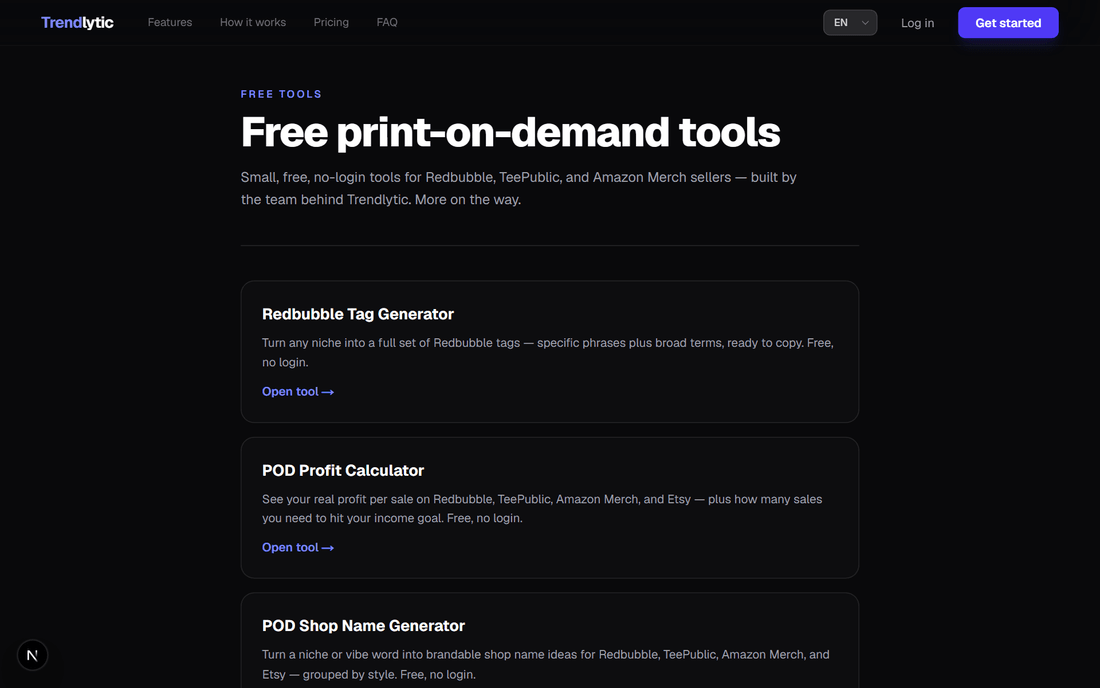
There are 20+ free tools on the site now, none of them behind a login. The ones I'd start with:
- Redbubble tag generator — turn a niche into phrase-based tags buyers actually search.
- POD profit calculator — see your real per-sale take-home and the sales needed to hit an income goal.
- POD shop name generator — brandable shop-name ideas when you're stuck on what to call your store.
- Mockup generator: see one design on 8 t-shirt photos, with no account and no watermark.
You can find all of them on the free tools hub.
Research tools and Trendlytic
If there's one throughline in everything above, it's this: the sellers who make money research demand before they design, and the ones who earn $0 skip it. That research step is the entire reason I built Trendlytic. It's the boring part — checking what's already selling, how saturated a niche is, and whether a phrase is trademarked — done in one search and one lookup instead of an afternoon of manual digging across four marketplaces. $19.99/month, 100 searches, free trial. I'll keep saying it honestly: it does the research step, it is not a money printer, and you can absolutely succeed without it.
If you want to see how it stacks up against the alternatives, I wrote an honest comparison of POD niche research tools and a direct Trendlytic vs Merch Informer breakdown. Or just start a free trial and try it on a niche you're curious about.
FAQ
What is print on demand? Print on demand is a fulfillment model where you upload a design, a platform prints it onto a product only after a customer orders it, and you earn a royalty. You hold no inventory and pay nothing up front — the platform handles printing, shipping, and customer service. It's one of the lowest-risk ways to start an online business.
Is print on demand profitable in 2026? Yes, but it's a low-margin volume game, not passive income. Per-sale royalties are small (around $2–$5 on a t-shirt), so hitting $1,000/month means roughly 250 sales spread across a researched catalog of many designs. The people earning real money find under-served niches and build a catalog over months; most people make $0 because they design without researching demand and quit before month three.
Is print on demand legit? Yes. Platforms like Redbubble, TeePublic, and Amazon Merch are legitimate businesses that pay sellers on time. The model is real and so is the income — it's just slower and smaller per sale than the "easy money" framing suggests.
How do I start print on demand? Pick one marketplace, research a niche before you design, create a clear design, trademark-check every phrase in the free USPTO database, list with keyword-led titles and phrase tags, and upload consistently. Expect first sales in weeks to months, and meaningful income only after you've built a real catalog.
Which platform is best for beginners? Redbubble, for most people — it's free, has built-in traffic, and teaches you the mechanics with zero risk. TeePublic is a close second for apparel. Save Etsy and Shopify for when you're ready to build a brand and drive your own traffic.
How much does it cost to start print on demand? On a marketplace, basically nothing — accounts are free, design tools like Canva have a free tier, and there's no inventory to buy. Your only real cost is time. Costs only grow if you choose the own-store route (Etsy listing fees, Shopify subscription) or pay for optional research tools.
Do I need a research tool to succeed? No. You can research manually by searching keywords on each marketplace and studying the top sellers — that's how I started. A tool like Trendlytic just makes that faster by checking demand and saturation across four marketplaces in one search, with the trademark lookup a click away. It's a time-saver, not a requirement.
Where to start
Print on demand is one of the few genuinely low-risk ways to start a business — no inventory, no upfront money, no penalty for trying. But the low barrier is exactly why it's competitive, and why the people who win are the ones who do the boring research step everyone else skips.
If you're a complete beginner, here's the logical reading order from here: start with is print on demand profitable to set honest expectations, then how to start a print on demand business for the full step-by-step, then how to find trending POD niches when you're ready to research your first niche. Grab phrase tags with the free Redbubble tag generator for your first listings.
And when you want the research step done in one search, what's actually selling, how saturated a niche is, and a USPTO lookup on the phrase you pick, that is Trendlytic. Mine, so weigh it. $19.99/month, 100 searches, free trial, with Redbubble, TeePublic, Amazon Merch, and Etsy covered in a single search. It carries the slow part. Sales are still yours to earn; the flooded niche and the trademarked phrase are what it helps you see before you commit.
One question before you start: which step feels like the biggest unknown for you right now — choosing a platform, finding a niche, or getting your listings found? Tell me where you're stuck, and I'll point you to the right deep-dive.
Try Trendlytic
Find your next winning POD niche in 40 seconds
Live data from TeePublic, Amazon Merch, Redbubble, and Etsy, and a one-click USPTO lookup on any phrase. Then turn any winner into a listing for a design of your own in that niche. Plans from $19.99/month.
Start researchingLiked this? Learn niche research in 5 short emails.
One email a day for 5 days: how sellers pick niches, why designs fail, and how to check yours. Unsubscribe in one click.
Keep reading
- Trendlyticprint on demand
How to Start a Print on Demand Business in 2026: A Step-by-Step Guide
The JournalHow to Start a Print on Demand Business in 2026: A Step-by-Step Guide
June 5, 2026 · 17 min read
- Trendlyticprint on demand
How to Price Print on Demand Products in 2026 (Without Guessing)
The JournalHow to Price Print on Demand Products in 2026 (Without Guessing)
June 10, 2026 · 15 min read
- Trendlyticprint on demand
Is Print on Demand Profitable in 2026? An Honest Breakdown
The JournalIs Print on Demand Profitable in 2026? An Honest Breakdown
June 8, 2026 · 14 min read