TL;DR: "Merch" is short for merchandise: branded or designed products (t-shirts, hoodies, mugs, stickers, posters) tied to a person, brand, community, or idea. Today it usually means creator or print-on-demand merch, where you upload a design and a service prints and ships it on demand with no inventory. Merch by Amazon is Amazon's version of that. Below: what merch means, the types of merch, how print-on-demand merch works, and how to start selling your own.
If you have seen a musician sell tour shirts, a YouTuber sell hoodies, or an artist sell stickers, you have seen merch. But the word gets used loosely, and depending on where you heard it, it can mean slightly different things. This guide clears that up in plain language, then narrows down to the meaning most people are actually searching for today: print-on-demand merch that anyone can create and sell without holding stock.
I run a print-on-demand research tool and I have watched this space for a couple of years, so I will keep this honest and beginner-friendly. No jargon, no hype. Just what merch is, the different kinds, and how the modern version works.
Don't miss the next one.
New POD niche analysis every Wednesday.
What does "merch" mean?
Merch is simply the shortened, casual form of the word "merchandise." Merchandise means goods that are bought and sold, and in this context it means physical products that carry a design, logo, slogan, or name.
The word started in music. For decades, "band merch" meant the t-shirts, posters, and pins sold at concerts and on band websites. Fans bought a shirt partly for the shirt and mostly to show they belonged to something. Over time the word spread far beyond music.
Now "merch" covers almost any branded or designed product tied to an identity:
- A YouTuber selling hoodies with their catchphrase on them.
- A brand handing out logo tote bags.
- A gaming community selling stickers with an inside joke.
- An independent artist selling their illustrations on mugs and shirts.
The common thread is the same in every case. Merch is a physical product that lets someone show what they like, who they follow, or which group they belong to. It is identity you can wear or carry.
Types of merch
Merch is not one single thing. It helps to break it into the main types, because the person searching "what is merch" could be thinking of any of them.
| Type of merch | Who makes it | What it is | Typical products |
|---|---|---|---|
| Band and music merch | Musicians and bands | Products sold to fans at shows and online | T-shirts, hoodies, posters, vinyl, pins |
| Influencer and creator merch | YouTubers, streamers, TikTokers | Branded products with a creator's name or catchphrase | Hoodies, tees, caps, mugs |
| Brand and company merch | Businesses | Branded goods for promotion or staff and fans | Logo tees, tote bags, water bottles, stickers |
| Community and fandom merch | Fans and online communities | Designs built around a shared interest or joke | Stickers, tees, mugs, posters |
| Print-on-demand merch | Independent sellers | Original designs sold without holding inventory | Shirts, stickers, mugs, phone cases, posters |
The first four are usually tied to an existing audience: a band, a creator, a company, a fandom. The last one is different, and it is the one most beginners are curious about because anyone can do it, with no following required. That is the version worth explaining in detail.
What is print-on-demand merch?
For most people googling "what is merch" today, the practical answer is print-on-demand merch. This is the modern, accessible form of selling merch, and it removed the biggest barrier that used to exist: money and stock upfront.
The old way of selling merch meant ordering a box of 500 t-shirts, paying for all of them in advance, and hoping they sold. If they did not sell, you were stuck with 500 shirts in your garage. Print on demand flips that completely.
Here is how print-on-demand merch works, step by step:
- You create a design. A phrase, an illustration, a logo, anything that can be printed.
- You upload it to a print-on-demand platform and place it on products (a shirt, a mug, a sticker).
- A customer orders one of your products.
- The platform prints that single item only after the order comes in.
- The platform ships it directly to the customer.
- You earn a royalty or profit on the sale, and you never touched any inventory.
Nothing gets printed until someone buys it, so there is no upfront cost and no leftover stock. You are not a manufacturer or a warehouse. You are the designer, and the platform handles printing, shipping, and often customer support.
This is why print on demand became the entry point for so many people who want to sell merch. The financial risk is close to zero, which means you can test ideas freely. If you want the fuller picture of how the whole business works, I wrote a detailed piece on the best print-on-demand companies and how they compare.
What is Merch by Amazon?
Merch by Amazon, now usually called Amazon Merch on Demand, is Amazon's own print-on-demand program. If you searched "what is merch by amazon" specifically, this is the piece for you.
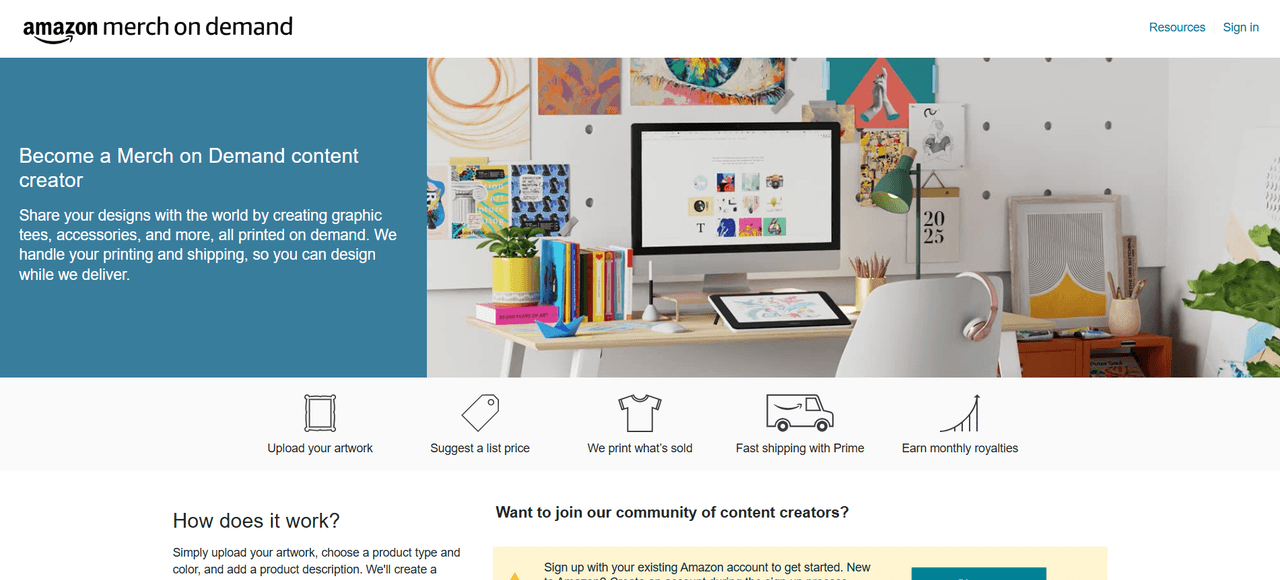
It works on the same print-on-demand principle described above, but inside Amazon's ecosystem:
- You upload your designs to the Merch on Demand platform.
- You choose which products to place them on and set a price.
- When a customer buys, Amazon prints the item, ships it, and handles customer service and returns.
- You earn a royalty on each sale.
The two things that make Amazon Merch stand out are reach and simplicity. Your designs can appear on Amazon itself, which is one of the largest shopping destinations anywhere, so buyers are already there searching. And because Amazon manages the printing, shipping, and support, your job is essentially just the designs.
There are a couple of honest caveats worth knowing. Merch by Amazon is invitation and tier based, meaning you apply for an account and you start with a limited number of design slots that grow as you make sales. Not every application is accepted right away, and moving up tiers takes selling. It is a genuinely good platform, but it is not an instant open door the way some other marketplaces are.
If Amazon Merch is the platform you are aiming at, I put together a dedicated guide on how to research what sells there: Amazon Merch research. And when you are ready to write a listing, our free Amazon Merch keyword generator turns any niche into title and bullet keywords.
Where to sell merch
Once you understand what merch is, the next question is usually where to sell it. There are two broad paths, and they suit different people.
The first path is open marketplaces, where you upload designs and the platform brings the audience. The second is your own store, where you connect a print provider to a storefront you control and drive your own traffic.
| Option | Type | Who brings the buyers | Best for |
|---|---|---|---|
| Redbubble | Marketplace | The platform (browse and search) | Beginners, stickers, art-led designs |
| TeePublic | Marketplace | The platform | Beginners, apparel, design-aware buyers |
| Amazon Merch on Demand | Marketplace | Amazon's massive traffic | Apparel, gift search, wide reach |
| Etsy plus Printful or Printify | Your own store | You, plus Etsy search | Sellers wanting more control and branding |
| Shopify plus Printful or Printify | Your own store | You (your marketing) | Creators with an existing audience |
Marketplaces like Redbubble, TeePublic, and Amazon Merch are the easiest place to start because the buyers are already there. You do not need a following or a marketing budget. The trade-off is more competition and lower margins.
Running your own store through Etsy or Shopify with a print partner like Printful or Printify gives you more control over branding and pricing, but you are responsible for bringing in the traffic. That works best when you already have an audience, like a creator selling to existing fans.
Most beginners I talk to start on a marketplace to learn what sells, then branch into their own store once they have found something that works.
How to start selling your own merch
Here is the honest part, and it is the part most beginner guides skip. The hard part of selling merch is not the platform. Signing up for Redbubble or applying to Amazon Merch takes an afternoon. The hard part is deciding what to make and knowing whether anyone actually wants it.
Almost every beginner makes the same mistake. They pick a topic they personally like, design twenty products around it, upload them, and wait. Weeks later there are no sales, and they conclude merch does not work. The real problem is that they designed first and validated never.
The better order is the reverse:
- Pick a specific niche, not a broad topic. "Cats" is a topic competing against millions of designs. "Senior cat foster mom" is a niche with a defined buyer and far less competition. Narrow wins. I go deep on this in how to find trending POD niches.
- Check that it actually sells before you design. Look at whether similar designs on the marketplace are getting favorites, reviews, and best-seller positions. Real demand is people buying, not just a topic that sounds fun.
- Make sure there is room to compete. If the first pages are wall-to-wall polished designs from established sellers, the door may be closed even if demand exists. You want demand that outstrips supply.
- Check the phrase for trademarks. Many catchy phrases are registered trademarks, and using one can get your listing or account removed. A quick search on the free USPTO trademark database takes a minute and saves a lot of pain.
- Then design, only after the idea passes those checks.
That validation step is genuinely the difference between selling and not selling, and doing it by hand is slow. You are clicking through several marketplaces, reading store after store, trying to tell what is actually selling versus what just exists. That tedious research is exactly why I built Trendlytic: one search shows you what is actually selling across TeePublic, Amazon Merch, Redbubble, and Etsy at once, with a live trademark lookup for any phrase, so you can validate a niche before spending a day designing for an empty room. It does the homework faster. It is not a magic money button, and I will not pretend otherwise.
If you want more direction on niche choice, the most profitable print-on-demand niches breaks down which categories genuinely sell and why.
FAQ
What does merch mean? Merch is short for merchandise. It means branded or designed physical products, like t-shirts, hoodies, mugs, stickers, and posters, that are tied to a person, brand, community, or idea. The word started with band merch sold at concerts and now covers creator merch, brand merch, and print-on-demand merch made by independent sellers.
What is merch by Amazon? Merch by Amazon, now called Amazon Merch on Demand, is Amazon's print-on-demand program. You upload designs, choose products and prices, and when a customer buys, Amazon prints the item, ships it, handles support, and pays you a royalty. It is invitation and tier based, so you apply for an account and unlock more design slots as you make sales.
What is print on demand merch? Print-on-demand merch is merch that is only printed after a customer places an order. You upload a design, place it on products, and the platform prints and ships each item on demand. There is no upfront cost and no inventory to hold, which makes it the easiest and lowest-risk way to start selling merch.
Is selling merch profitable? It can be, but not automatically. Per-sale profit is often a few dollars, so income comes from volume across many designs over time, not from a single sale. The sellers who make real money research under-served niches and validate demand before designing. Beginners who upload generic designs to broad, saturated topics usually earn very little.
How do I make my own merch? Pick a specific niche, confirm that similar designs are actually selling and that there is room to compete, check your phrases for trademarks, then create a design and upload it to a print-on-demand platform like Redbubble, TeePublic, or Amazon Merch. The platform prints and ships each order, and you keep a royalty. The design work is the easy part; choosing and validating the niche is what determines whether it sells.
What's the difference between merch and print on demand? Merch is the product itself: the branded or designed item someone buys. Print on demand is a method of producing and fulfilling that product, where each item is printed only after it is ordered so no inventory is held. In short, merch is the what, and print on demand is one of the ways it gets made and shipped.
Conclusion
So, what is merch? At its simplest, merch is designed or branded products, from band shirts to creator hoodies to an independent seller's stickers. Today the most accessible version is print-on-demand merch, where you upload a design and a platform prints and ships each order with no inventory and no upfront cost. Merch by Amazon is Amazon's take on exactly that.
If you are thinking about selling your own, remember the real lesson: the platform is easy, and the niche is everything. Design after you validate, not before. Do that and you skip the most common beginner mistake by a mile.
If you want to skip the manual clicking and see what is actually selling before you design, start a free Trendlytic trial, and validate a niche in a few seconds instead of a few hours.
What kind of merch are you thinking about making, and what is the one niche you keep coming back to? I would genuinely like to hear what you are considering.
Like this? Get one like it every Wednesday.
Niche data, trademark alerts, one tactic per week.
Try Trendlytic
Find your next winning POD niche in 40 seconds
Live data from TeePublic, Amazon Merch, Redbubble, and Etsy, with a trademark check built in. Then turn any winner into a listing for a design of your own in that niche. Plans from $19/month.
Start researchingKeep reading
- Trendlyticamazon merch on demand
Merch by Amazon: The Complete Guide to Amazon Merch on Demand (2026)
The JournalMerch by Amazon: The Complete Guide to Amazon Merch on Demand (2026)
June 7, 2026 · 19 min read
- Trendlyticshopify vs etsy
Shopify vs Etsy in 2026: Fees, Buyers and Which to Pick
The JournalShopify vs Etsy in 2026: Fees, Buyers and Which to Pick
October 3, 2026 · 18 min read
- Trendlyticcustom tumblers
Custom Tumblers: Shapes, Buyers and the Brand-Name Trap
The JournalCustom Tumblers: Shapes, Buyers and the Brand-Name Trap
October 2, 2026 · 18 min read