TL;DR: The best print on demand for artists depends on your art style and your goal, not on a single "winner." Illustrators do best on Redbubble and INPRNT, apparel-and-typography artists on TeePublic and Amazon Merch, decor and fine-art on Society6 and Fine Art America, and collector niches on Displate. But the platform is a smaller lever than picking work that sells in a space that is not already flooded. Start on one or two, learn them, then cross-list.
Most artists who try print on demand upload beautiful work and earn almost nothing. The art is rarely the problem. The problem is putting it on the wrong platform for that style, or printing a subject that is already saturated with ten thousand near-identical versions.
A delicate watercolor illustration that would sell as a wall print on Society6 gets buried as a t-shirt on Amazon Merch. A sharp typographic joke that would move on TeePublic earns nothing as a fine-art print. The platform shapes who sees your work and what they came to buy. (New to all of this? Start with how to start a print on demand business for the full setup, then come back to choose where to sell.)
This guide is honest. Trendlytic is ours — it is the research tool we built — so I will not pretend a tool fixes everything. The goal here is to help you pick the right platform for your art and then put work on it that can actually sell.
Don't miss the next one.
New POD niche analysis every Wednesday.
What makes a platform good for artists
Not every print on demand site fits every artist. A platform is a good home for your work when these line up — and most "best of" lists only mention the first.
- Royalty model — do you get a fixed cut, or do you set your own markup? Set-your-own gives you control but you compete on price; fixed is simpler but capped.
- Audience type — who is actually browsing? Impulse browsers, gift shoppers, design-aware buyers, and serious art collectors behave very differently and pay very differently.
- Product range — apparel only, prints only, decor, or everything? Illustration travels across many products; a single punchy phrase usually does not.
- Print quality — collectors and decor buyers notice paper stock, color accuracy, and framing. Impulse buyers care less.
- Competition and saturation — how crowded is the platform, and how hard is it for a new seller to get discovered at all?
- Control — do you own the customer relationship and the storefront, or are you renting space on someone else's marketplace?
There is one more thing that matters more than which platform you pick: whether the subject you are printing is already flooded. Before you commit, it helps to look at what is actually selling — which niches and angles top sellers are quietly moving across Redbubble, TeePublic, Amazon Merch, and Etsy, instead of guessing. That store-first research is how you avoid pouring weeks into a subject that is already a graveyard. You can research what's actually selling before you commit a single design.
The table below lines up all eight platforms first, then each gets its own section.
| Platform | Best for | Royalty model | Competition |
|---|---|---|---|
| Redbubble | Illustrators wanting reach + product range | Fixed base + your markup | Very high |
| Society6 | Home decor and art-print aesthetics | Fixed % (set markup on art prints) | Medium |
| TeePublic | Apparel-first artists and typography | Fixed, sale-driven | High |
| INPRNT | Curated illustrators selling art prints | Fixed split, prints only | Low–medium (gated) |
| Displate | Collectors — gaming, anime, film art | Fixed royalty per metal poster | Medium |
| Amazon Merch | Apparel artists chasing buyer traffic | Fixed royalty tiers | High |
| Etsy + POD provider | Artists who want their own storefront | You set price, keep margin | Medium (you drive it) |
| Fine Art America | Traditional and fine artists, framing | You set markup, wide range | Low–medium |
1. Redbubble
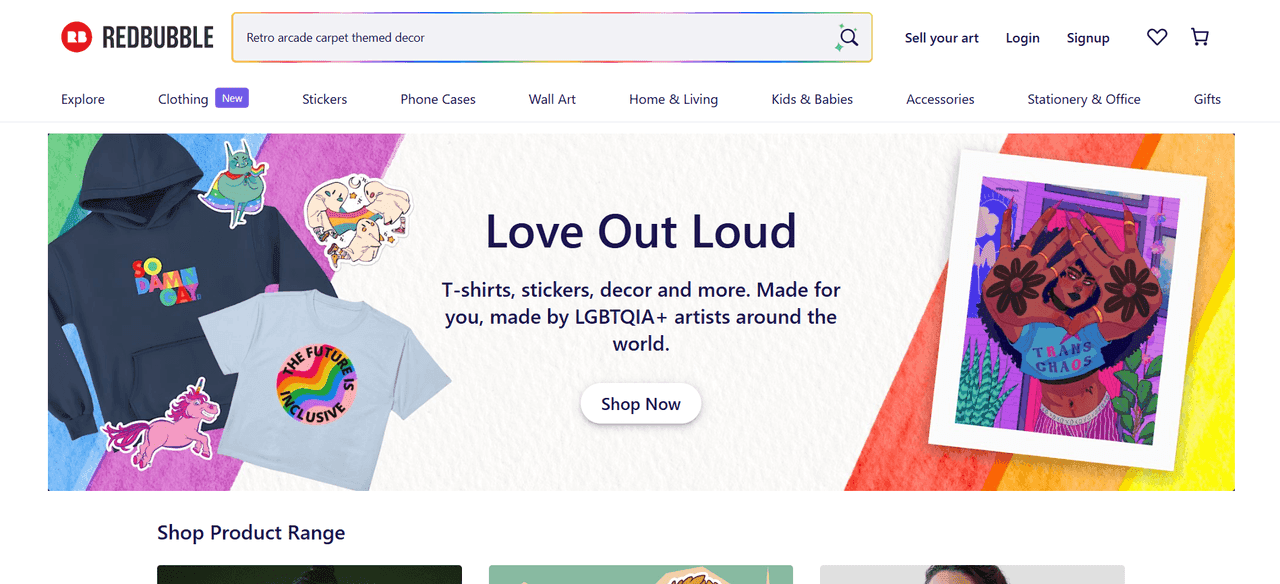
Redbubble is the most beginner-friendly place to start, and the widest. One upload can become a sticker, a poster, a tote, a phone case, a mug, and a shirt, all in minutes.
Who it's best for: Illustrators and pattern artists who want maximum product range and steady browse traffic without an application process. If your strength is artwork rather than a single phrase, Redbubble lets one design earn across many products.
Demand and audience: Redbubble's audience browses to discover. People arrive looking for art on things, which suits illustration and aesthetic-driven work. Stickers and wall prints are especially strong here.
Competition: Very high. This is one of the most saturated platforms in print on demand, so generic subjects are hopeless. The way through is a narrow, well-defined niche where you are one of a handful of sellers, not one of thousands.
Practical tip: Lean on tags and a tight niche identity — Redbubble is search-and-browse driven, so discovery lives in your listing. The how to sell on Redbubble guide covers setup end to end, and if you are weighing it against the apparel-first option, the TeePublic vs Redbubble comparison goes deeper.
2. Society6
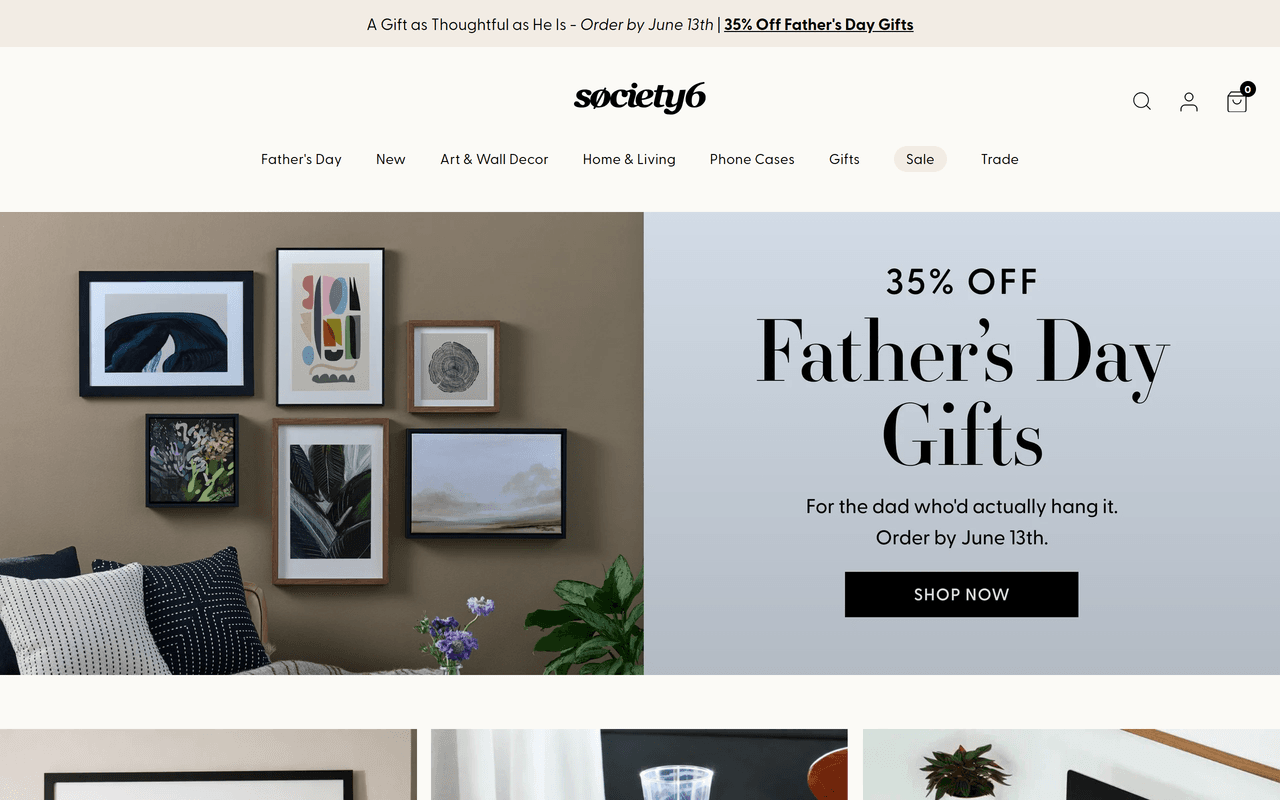
Society6 is the design-led platform. It leans into home decor and art prints with a tasteful, curated feel, and its audience reflects that.
Who it's best for: Artists making home decor and art-print aesthetics — wall art, framed prints, throw pillows, tapestries, and patterns. If your work looks at home in a styled room, this is your platform.
Demand and audience: Society6 shoppers tend to be decor-minded and design-aware rather than impulse buyers. They are buying to furnish a space, which means they care about how the piece looks on a wall, not just the price.
Competition: Medium. Less brutal than Redbubble's apparel side, but visibility and traffic are also lower — discovery on Society6 is harder, so you cannot rely on the platform to push your work for you.
Practical tip: You can set your own markup on art prints, so a cohesive, recognizable style pays off — decor buyers who like one print often buy several. Build a collection around one visual identity rather than scattering single pieces.
3. TeePublic
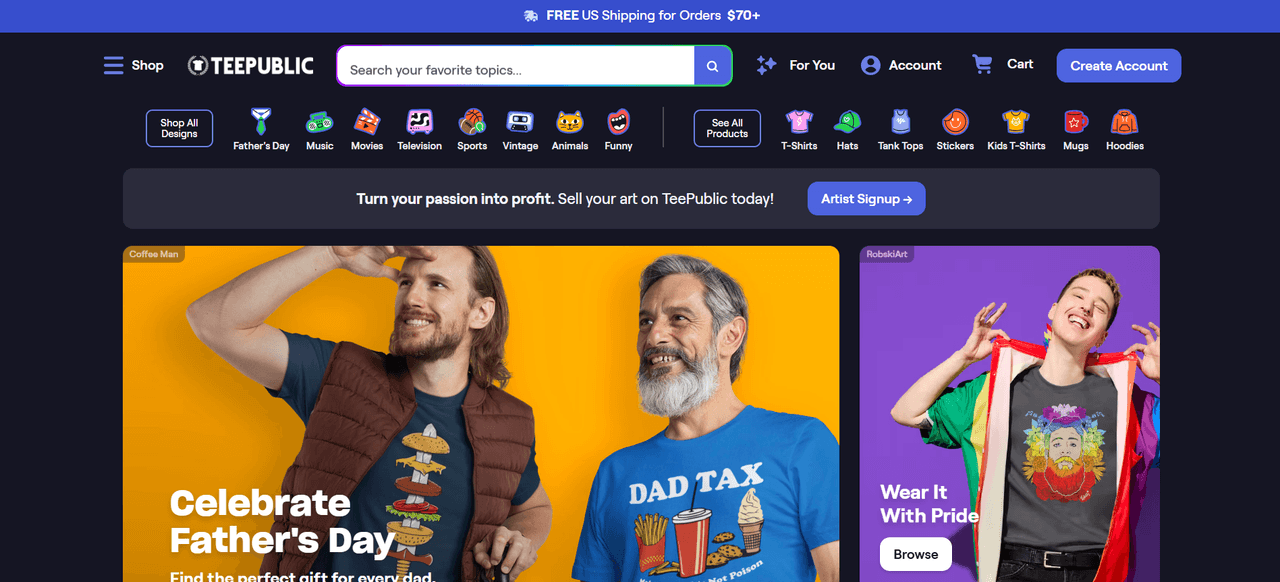
TeePublic is apparel-first and built around a design-aware browsing crowd. It runs frequent sitewide sales, which drives volume. It is part of the Redbubble group, so the two share some DNA.
Who it's best for: Apparel and typography artists — sharp text, niche humor, fandom-adjacent designs that read well on a shirt or hoodie. If you write tight, specific phrases, this is a strong home.
Demand and audience: The audience is design-savvy and shops for shirts and hoodies during the platform's regular sales. TeePublic tends to offer some of the better apparel royalties in this group, especially on full-price sales.
Competition: High. New-seller discovery is tougher here than on Redbubble — the catalog is deep and the front page favors established sellers. You earn visibility through volume and tight niches, not luck.
Practical tip: Build product pairs — the same niche text usually works on a shirt and a hoodie, so list both. If you are checking whether the platform is trustworthy before committing, is TeePublic legit answers the common worries.
4. INPRNT
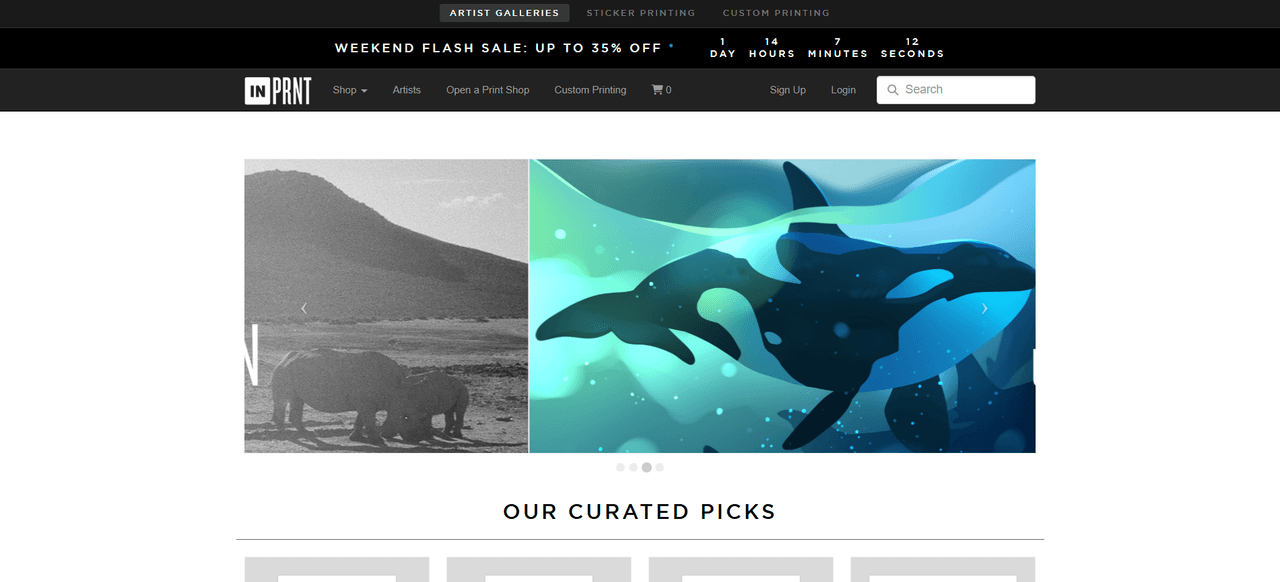
INPRNT is the curated, quality-first platform for illustrators selling art prints. It is application-based, so the bar is higher — and so is the perceived value of the work.
Who it's best for: Skilled illustrators and concept artists who want better margins on high-quality art prints and an audience that came specifically to buy art. If your portfolio is strong and prints are your product, INPRNT rewards it.
Demand and audience: The audience is art-buyers, not impulse browsers. They expect quality paper and color, and they pay accordingly — margins per print tend to be better than the big marketplaces.
Competition: Lower in practice because it is gated — approval filters out the flood of low-effort uploads. The trade-off is that you have to be accepted, and you are limited to prints (and a few related products), not a full apparel-and-decor range.
Practical tip: Treat your application like a portfolio submission — curate your strongest, most cohesive work. Once in, the curated audience means a smaller, serious buyer pool rather than a high-traffic gamble.
5. Displate
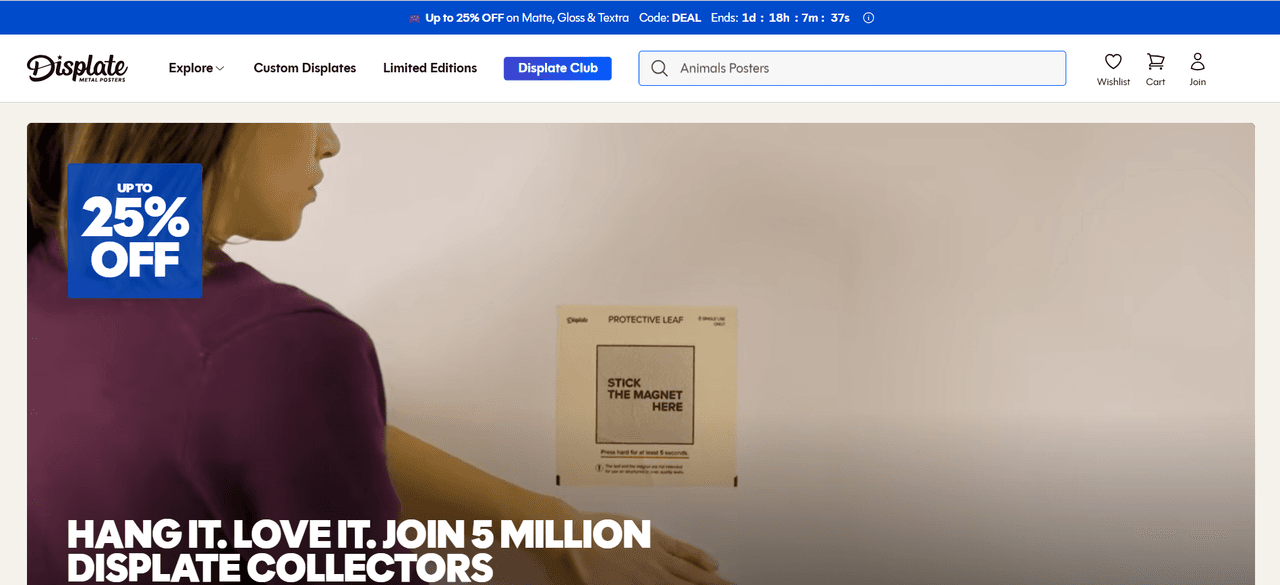
Displate is a niche all its own: metal posters. It has a passionate collector base built around gaming, anime, film, and music, and that focus is its strength.
Who it's best for: Artists with bold, high-contrast work aimed at collectors — gaming, anime, film, sci-fi, and fan-culture aesthetics that look striking printed on metal.
Demand and audience: Collectors, not casual shoppers. The audience is enthusiastic and willing to pay for a statement piece, and Displate's margins on metal posters are reasonable for the format.
Competition: Medium. The collector niches are contested, but the single-product focus keeps out a lot of the noise you see on general marketplaces. The catch is that it is one product type — if your work does not suit a metal poster, it is not your platform.
Practical tip: Design for impact at a distance — metal posters reward bold composition and saturated color over fine detail. Lean into a specific fandom or aesthetic the collector base already loves.
6. Amazon Merch on Demand
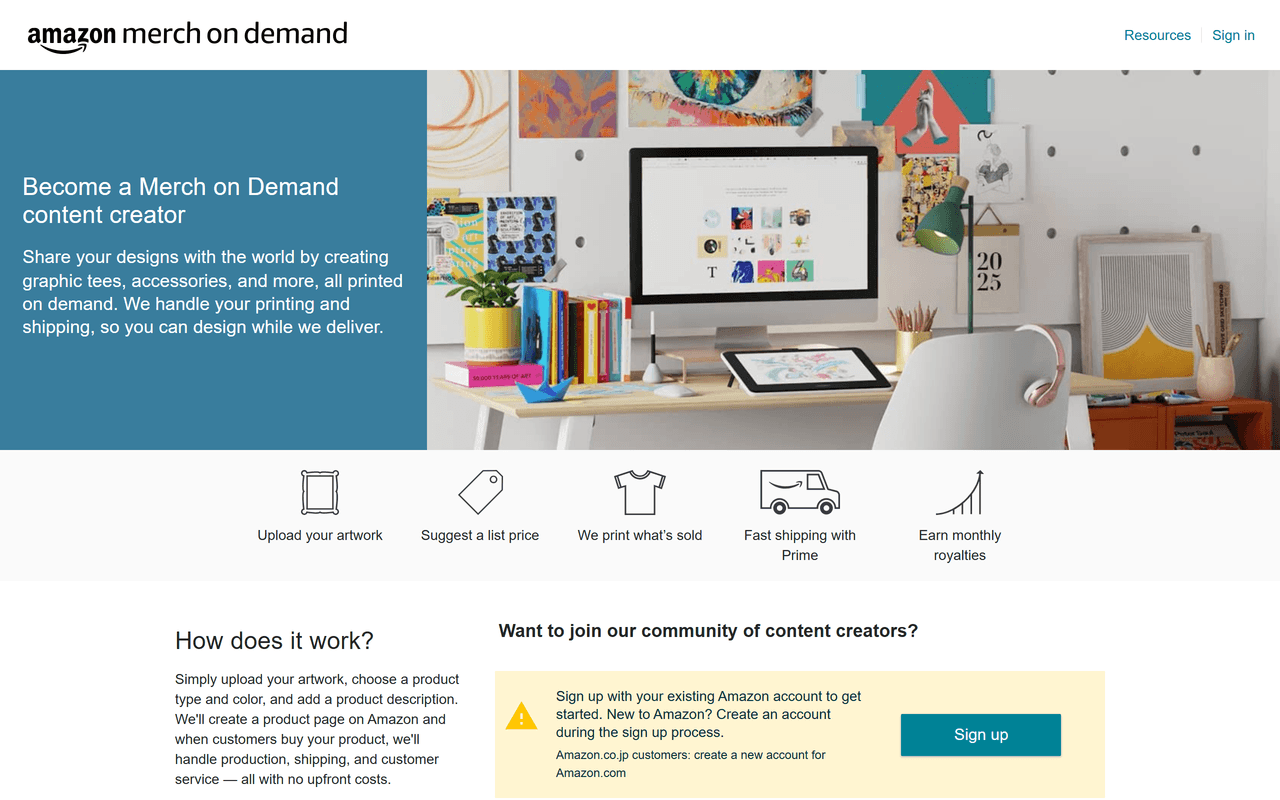
Amazon Merch puts your apparel in front of the biggest buyer pool in the world. That reach is the whole appeal — and the strict rules are the whole catch.
Who it's best for: Apparel artists, especially text-and-graphic designers, who want raw buyer traffic over a curated art audience. It is less "art gallery" and more "shirt that sells on Amazon."
Demand and audience: Amazon shoppers arrive ready to buy, with trust and fast shipping built in. That intent is unmatched, and it favors clear, niche apparel over delicate illustration.
Competition: High, and the platform is invite-based with tiered selling limits — you start small and earn more slots as you sell. It is also the strictest on trademarks, and a single registered phrase can get your account banned. This is not the place for fine-art prints.
Practical tip: Trademark-check every phrase before you upload — Amazon suspends sellers for terms that sound generic but are registered marks. A live check on each keyword is the simplest way to stay safe.
7. Etsy + a POD provider (Printful / Printify / Gelato)
Etsy is not a print-on-demand marketplace itself — you pair it with a provider like Printful, Printify, or Gelato that prints and ships your orders. The result is your own storefront with the best margins and the most control.
Who it's best for: Artists who want to own the customer relationship, set their own prices, and build a brand rather than rent space on a marketplace. If control and margin matter more than handed-to-you traffic, this is the path.
Demand and audience: Etsy buyers shop for handmade and original work and are open to art. But Etsy does not feed you traffic the way a marketplace browse page does — you drive it through SEO, listings, and sometimes ads.
Competition: Medium on the platform, but the real work is traffic and search ranking. You also handle fees, listing SEO, and customer questions yourself — more control means more responsibility.
Practical tip: Treat your listings like a search engine, because Etsy is one. The Etsy print on demand guide covers choosing a provider and ranking listings. Worth noting: Trendlytic now researches Etsy too, so a single search covers all four marketplaces — TeePublic, Amazon Merch, Redbubble, and Etsy — including real Etsy listings with favorite-count demand data.
8. Fine Art America / Pixels
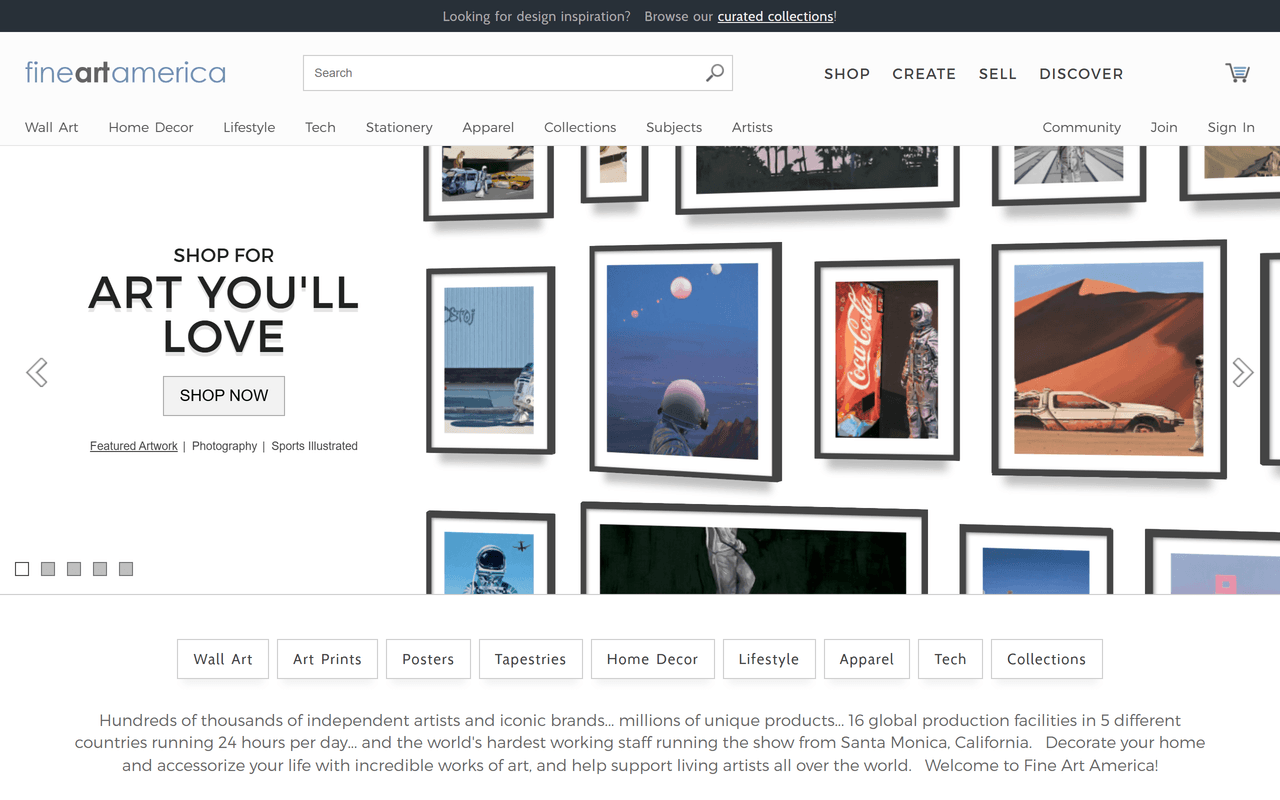
Fine Art America (which also runs Pixels) is built for traditional and fine artists. It offers framing, canvas, and a wide range of print products for work that belongs on a wall.
Who it's best for: Painters, photographers, and traditional fine artists who want professional framing options and a buyer who values an original piece. It suits work that is sold as art first, merchandise second.
Demand and audience: A fine-art buying audience, including some print-on-demand-to-gallery crossover. Volume is lower than the big marketplaces, but the buyers are intentional and the average order value is higher.
Competition: Low to medium. Less crowded than the apparel platforms, partly because the fine-art focus self-selects. The honest limit is a dated interface and a slower-moving platform than the modern marketplaces.
Practical tip: Use the framing and canvas options to present work as finished pieces — that presentation is exactly what this audience pays for. Photographers in particular do well here.
Pick the platform, then do the part that matters
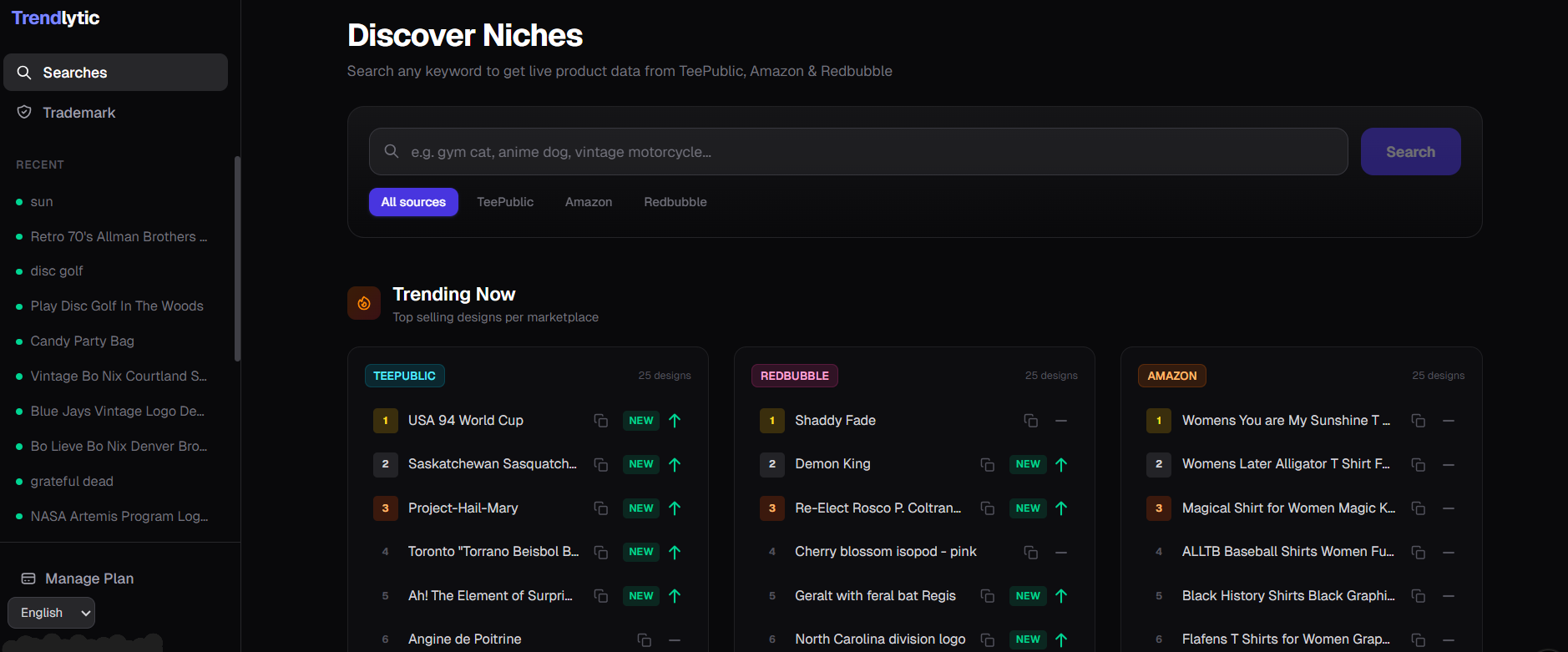
Here is the honest pivot. Choosing the right platform helps, but it is a smaller lever than three things almost no one does well: picking a subject that is not already flooded, trademark-checking your phrases, and listing like a search engine.
You can put your art on the perfect platform and still earn nothing if the subject is saturated. A flooded niche on Redbubble buries good work; a fresh angle on the same platform gets found. So before you spend a week on a series, look at what is actually selling — not what is searched, but what top sellers are moving — and design into a gap they have not filled.
That is what we built Trendlytic for. For each search it starts from the sellers who are really moving product in a niche and shows what is selling in their stores, across TeePublic, Amazon Merch on Demand, Redbubble, and Etsy in one search. It also puts a USPTO register lookup a click away from any keyword, so you do not design something that gets your account suspended. It is $19.99 a month for 100 searches, with a free trial. (It covers all four: TeePublic, Amazon Merch, Redbubble, and Etsy.)
Don't miss the next one.
New POD niche analysis every Wednesday.
The listing step matters too. Once you know what to make, your tags decide whether anyone finds it. For Redbubble specifically, the free tag generator gives you a starting set of keywords to work from. None of this is a shortcut around making good art — it is the homework that lets good art get seen. You can research before you design instead of guessing.
Which should you choose?
There is no single best print on demand site for artists — there is a best one for your style and goal. Match yourself to the segment below.
- Illustrators and character artists → Redbubble for range and reach, plus INPRNT once your portfolio is strong enough for its application. Redbubble gets your work on many products; INPRNT gets it in front of art-buyers at better margins.
- Apparel and typography artists → TeePublic for the design-aware crowd and sales, plus Amazon Merch for raw buyer traffic. Build niche text designs and list them on both.
- Home decor and wall-art artists → Society6 for the design-led decor audience, plus Fine Art America for framing and a fine-art buyer.
- Collector and gaming/anime artists → Displate, where a passionate collector base pays for bold metal prints.
- Artists who want control and the best margins → Etsy with a POD provider, where you own the storefront and the customer — as long as you are willing to drive the traffic yourself.
Whatever you pick, the practical advice is the same: start with one or two platforms, not eight. Master them for about 60 days — learn the audience, the tags, the products that move — before adding more. Sellers who try to be everywhere on day one usually end up nowhere. And when you are deciding what to actually put on these platforms, the best print on demand products breakdown ranks products by demand and competition.
FAQ
What is the best print on demand site for artists? There is no single best site — it depends on your art and your goal. Illustrators do best on Redbubble and INPRNT, apparel and typography artists on TeePublic and Amazon Merch, decor and fine-art artists on Society6 and Fine Art America, and collector niches on Displate. Match the platform to your style, then start with one or two before expanding.
Can you make money selling art on print on demand? Yes, but not by uploading and hoping. The artists who earn consistently pick a niche that is not already flooded, trademark-check their phrases, and list with strong tags so their work gets found. The platform matters less than choosing a subject that actually sells in a space with room to breathe.
Is Redbubble or Society6 better for artists? It depends on your work. Redbubble is better for illustrators who want a wide product range and high browse traffic, but it is very saturated. Society6 is better for home-decor and art-print aesthetics with a more design-minded audience, though its traffic and visibility are lower. Many artists eventually list on both.
Do I keep the copyright to my art on POD sites? On the major platforms, yes — you keep the copyright to your original work and grant the platform a license to print and sell it on your behalf. Always read the specific terms of each site, but reputable platforms like Redbubble, Society6, and TeePublic do not take ownership of your art. If you are worried about a platform's trustworthiness, is Redbubble legit walks through the common concerns.
Which print on demand has the best profit margin for artists? For control and margin, an Etsy storefront paired with a provider like Printful or Printify wins, because you set your own price and keep the difference. Among marketplaces, INPRNT and Fine Art America tend to offer better per-print margins for art prints, while Society6 and Redbubble let you set your own markup on prints. The trade-off is that the higher-margin paths usually require more effort to drive traffic.
Is print on demand worth it for artists in 2026? It is worth it if you treat it as a real business rather than a passive upload. Saturation is high, so success comes from research and listing discipline, not volume of uploads. For artists who are willing to find fresh niches and stay trademark-safe, it remains a low-risk way to sell original work without holding inventory.
Conclusion
The best print on demand for artists is not one platform — it is the one that fits your style and goal, with work on it that is not already flooded. Illustrators lean Redbubble and INPRNT, apparel artists TeePublic and Amazon Merch, decor artists Society6 and Fine Art America, collectors Displate, and control-seekers an Etsy storefront. Pick one or two, learn them for 60 days, then cross-list.
The harder part is the research — making sure the subject you print can actually sell and will not get your account suspended. Trendlytic, which is mine, is built for that: it finds the designs top sellers are actually moving on TeePublic, Amazon Merch on Demand, Redbubble, and Etsy in one search, and before a phrase reaches a print you can put it through the USPTO register yourself. Start a free trial — and research what is selling before you spend a week designing.
Which platform fits your art best — and what subject are you thinking of putting on it?
Like this? Get one like it every Wednesday.
Niche data, trademark alerts, one tactic per week.
Try Trendlytic
Find your next winning POD niche in 40 seconds
Live data from TeePublic, Amazon Merch, Redbubble, and Etsy, with a trademark check built in. Then turn any winner into a listing for a design of your own in that niche. Plans from $19.99/month.
Start researchingKeep reading
- Trendlyticwhere to sell ai art
Where to Sell AI Art: The Best Marketplaces (Honest Guide)
The JournalWhere to Sell AI Art: The Best Marketplaces (Honest Guide)
July 18, 2026 · 18 min read
- Trendlyticcan you sell ai art on redbubble
Can You Sell AI Art on Redbubble? What's Allowed
The JournalCan You Sell AI Art on Redbubble? What's Allowed
July 17, 2026 · 15 min read
- Trendlyticprintify alternatives
8 Best Printify Alternatives in 2026 (Faster & More Reliable)
The Journal8 Best Printify Alternatives in 2026 (Faster & More Reliable)
July 6, 2026 · 14 min read