TL;DR: The best selling Redbubble products are led by stickers — the platform's signature product — with t-shirts, hoodies, wall art, and everyday accessories following. But the product you enable matters far less than the design and niche you put on it. Redbubble shoppers browse and discover, lean younger, and buy on aesthetic and identity, so what sells is a tight niche in a fresh, trademark-safe angle. The durable skill is validating what is actually selling before you design — not picking the "right" product.
Most "best selling Redbubble products" lists just rank product types by how many of them exist on the platform. That is backwards. A product being everywhere on Redbubble is a sign of saturation, not opportunity — it tells you a lot of sellers chose it, not that there is room for one more.
This post is Redbubble-specific. Not "what sells in print on demand generally" — for that, I keep a broader cross-platform best print on demand products guide that ranks product types across Redbubble, TeePublic, and Amazon Merch. This one is narrower on purpose: what actually moves on Redbubble, given its particular audience — browse-and-discover shoppers, sticker-heavy, younger, fandom- and aesthetic-driven. The strongest categories here are not the same mix you would lead with on Amazon Merch.
I have tracked POD sellers for about two years across Redbubble, TeePublic, and Amazon Merch, so I will keep this honest: the goal is to help you pick a Redbubble product and a niche that can actually sell — not to talk up a list. You will get realistic royalties, the design styles that fit each product here, and how saturated each one really is.
What makes a product sell on Redbubble specifically
Redbubble is not Amazon Merch with a different logo. The audience and the mechanics are different, and that changes what sells.
It is a browse-and-discover marketplace. People land on Redbubble looking to express an interest, a fandom, or an aesthetic — and they scroll. They are not always searching a precise phrase the way an Amazon shopper does. That rewards visual designs that catch the eye in a grid of thumbnails, and products that suit impulse and self-expression.
The audience skews younger and aesthetic-driven. Redbubble's core buyer is closer to a student decorating a laptop, a room, or a tote than a gift-shopper hunting a specific occasion shirt. That is exactly why stickers are the platform's signature product and why "aesthetic" — cottagecore, dark academia, Y2K, minimalist line art — is a real, sellable category here in a way it is not everywhere.
It is sticker culture first, and mostly mobile. No other major POD platform has the sticker volume Redbubble does — cheap, collectible, bought several at a time, often the gateway to the rest of your products in a niche. And designs are judged at thumbnail size on a phone, so bold and readable beats intricate. A huge slice of demand is fandom-adjacent — anime, games, music, shows — but most fandom names are trademarked, so the winners design the vibe of a community without using the protected name.
Here is the honest part the ranking lists skip: the blank product almost never decides whether you make money. Sales come from demand versus saturation versus how well your design fits the niche. A mug in a fresh, well-defined community will out-earn a t-shirt in a flooded keyword every time. So before any product below matters, the move is to check what's actually selling in your target niche right now — real demand you can see, not what a keyword count guesses — and whether there's still room for one more seller. More on that near the end.
The table ranks the products in the order I would consider them on Redbubble — starting with its signature product, not alphabetically.
| Product | Why it sells on Redbubble | Best design style | Competition |
|---|---|---|---|
| Stickers | Cheap, collectible, bought in multiples — the platform's signature product | Bold die-cut icons, aesthetic, niche-identity humor | High |
| T-shirts | Evergreen self-expression; the browse audience wears statements | Sharp niche text, clean line art | High |
| Hoodies & sweatshirts | Higher ticket, seasonal, strong fandom-vibe identity | Bold central graphic or text, fandom-adjacent | Medium |
| Wall art / posters & prints | Younger audience decorating rooms and dorms | Illustration, aesthetic, cohesive style | Medium |
| Phone cases | Constant device upgrades; personalization product | Pattern, aesthetic, bold icon | Medium |
| Tote bags | Identity and values carriers for niche communities | Statement text, line art, aesthetic | Low–Medium |
| Mugs & water bottles | Gift-adjacent and self-buy; pairs with a niche | Humor text, cute illustration, hobby icon | Medium |
| Notebooks & stationery | Student and planner demand; sleeper category | Clean typography, tidy aesthetic illustration | Low |
1. Stickers
Stickers are Redbubble's signature best-seller, and on this platform they come first — it is not close. No other major POD marketplace moves stickers the way Redbubble does. They are a cheap, collectible impulse buy, so buyers do not deliberate, and they buy several at once.
Why it sells on Redbubble: Redbubble's younger, browse-and-discover audience is the exact crowd that decorates laptops, water bottles, journals, and phone cases with stickers. The format suits scrolling, the price is a frictionless yes, and the basket adds up. This is the product Redbubble is genuinely known for.
Best design style: Bold, die-cut-friendly icons that read at thumbnail size — single clear subjects, aesthetic pieces (cottagecore plants, dark-academia symbols, minimalist line art), and niche-identity humor (a specific job, hobby, or in-joke). Detail-heavy art that disappears at small size does not move.
Competition / saturation: High. There are an enormous number of stickers, but demand and design variety are wide enough that fresh niches surface every month — the way through is a tightly defined community, not a broad theme.
Margin / pricing reality: The sticker base price is around $2, so at the default 20% markup your royalty is small — cents up to roughly a dollar. Stickers are a volume product, not a per-sale earner; they reward breadth and work best as the entry point of a niche where the buyer who loves the joke also wants it on a tee or a tote. New to the platform? The how to sell on Redbubble guide covers setup end to end.
2. T-shirts
T-shirts are the backbone of every POD platform, and Redbubble is no exception. The market is the biggest, which cuts both ways — huge demand, but the most competition you will face anywhere.
Why it sells on Redbubble: Redbubble's browse audience wears statements. A shirt is how someone signals an identity, a fandom vibe, or an in-joke, and the discovery feed surfaces visual, statement-led designs well. Text-based and clean graphic tees do the heavy lifting.
Best design style: Sharp, specific niche text and clean line art. Bold and readable wins because most buyers are on mobile, judging a thumbnail. Lean into a precise identity — a specific role, a micro-community, a regional in-joke — rather than a broad theme.
Competition / saturation: High. This is the most saturated product on the platform, full stop. Generic shirt ideas are hopeless. The only path is a narrow niche where you are one of a handful of sellers, not one of thousands.
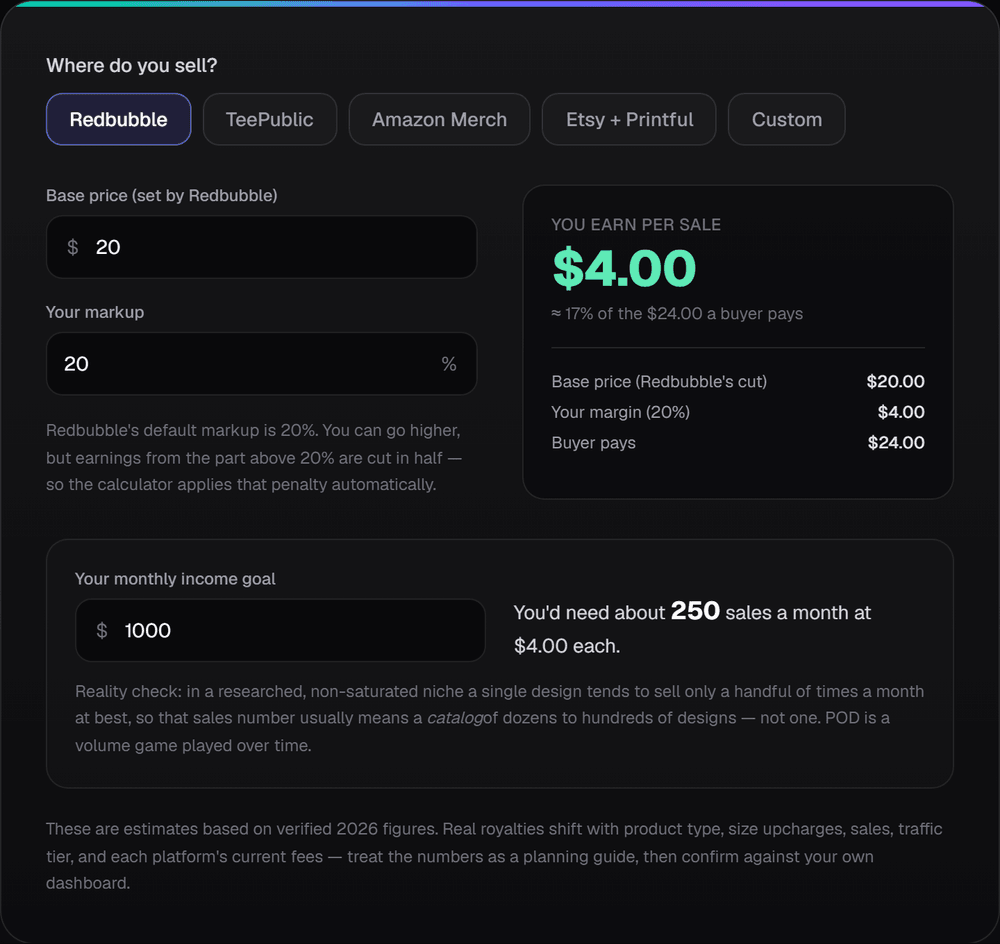
Margin / pricing reality: A roughly $20 base tee at the default 20% markup earns around $4, retailing at $24 — healthy enough that a few sales a day is real money, and better per sale than a sticker. One caution: pushing markup far above 20% is penalized — earnings on the portion above 20% are halved — so cranking the price is not a free lever. Because competition is so heavy, store-first validation matters most here. The how to find trending POD niches post breaks down that process.
3. Hoodies & sweatshirts
Hoodies are the higher-ticket play on Redbubble. Fewer units sell, but each one earns more, and demand is strongly seasonal.
Why it sells on Redbubble: Cold months drive a real spike from autumn through winter, and Redbubble's identity-driven audience treats a hoodie as a stronger statement of belonging than a tee. Fandom-adjacent and group-pride designs do well — a hoodie is something people wear to be seen in a community.
Best design style: A bold central graphic or a confident piece of text that carries the whole garment. Fandom-vibe designs — the aesthetic of a show, game, or scene without the trademarked name — are strong here.
Competition / saturation: Medium. Less saturated than t-shirts, because the higher price point scares off lazy sellers, but the good niches are still contested.
Margin / pricing reality: Royalty runs higher than a tee in absolute terms — roughly $4 to $6 at sensible markups — so even a handful of sales matters. Plan around the season: get designs live before the autumn demand curve, not during it. The same niche text that works on a shirt usually transfers, so build product pairs rather than starting cold on a hoodie.
4. Wall art / posters & prints
Wall art is where illustration sellers outperform text sellers on Redbubble — and Redbubble's younger audience decorating rooms and dorms makes it a genuinely strong category here, stronger than on apparel-first platforms.
Why it sells on Redbubble: Students and twenty-somethings decorate spaces on a budget, and they browse for art by style and aesthetic rather than a precise search phrase. That suits posters, photographic prints, and canvas perfectly. Aesthetic-driven, illustration-heavy work is the home category here.
Best design style: Cohesive illustration and a defined visual identity — a recognizable aesthetic (botanical, retro, minimalist, dark academia) beats a one-off. Generic motivational quotes are saturated; a specific style is not.
Competition / saturation: Medium. The broad, generic end is crowded, but distinctive aesthetics and illustration styles have room. A buyer who likes one print often buys several, which rewards a consistent body of work.
Margin / pricing reality: Royalties on prints sit in the modest-to-decent range — canvas and larger prints earn more per unit than a poster. The real advantage is that one strong illustration travels: the same artwork becomes a sticker, a tote, and a phone case in the same niche, so a poster design is rarely just a poster.
5. Phone cases
Phone cases ride a permanent demand wave — people upgrade devices constantly, and a new phone means a new case. On Redbubble they are squarely a personalization and aesthetic product.
Why it sells on Redbubble: Recurring, built-in demand — every device launch and upgrade cycle refreshes the buyer pool. Redbubble's aesthetic-led audience treats a case as an accessory that signals taste, so pattern and aesthetic designs sell alongside niche-identity humor.
Best design style: Patterns, aesthetics, and bold single icons read best at case proportions. Like wall art, cases favor illustration and pattern over heavy text — a busy slogan rarely fits the shape.
Competition / saturation: Medium. Plenty of sellers, but constant device turnover keeps demand fresh, so good niches are not locked up the way shirt niches are.
Margin / pricing reality: Royalty per case is moderate — better than a sticker, below a hoodie. Cases are a strong second or third product in an aesthetic niche. If you already have a pattern or icon working on stickers or posters, a case is a low-effort extension of the same niche.
6. Tote bags
Tote bags are underrated on Redbubble. They carry lower saturation than the headline products and strong appeal in specific communities.
Why it sells on Redbubble: Totes are identity and values carriers — reusable, statement-bearing, a little aesthetic. Book lovers, plant people, market-goers, and cause-driven communities buy them reliably, and Redbubble's lifestyle browsing surfaces them well.
Best design style: Statement text, clean line art, and aesthetic illustration all work. A tote is a flexible canvas — both a sharp phrase and a tidy illustration land — which makes it a natural second product for almost any niche.
Competition / saturation: Low to medium. One of the less-crowded products, which is exactly why it deserves attention. Less noise means a good niche design gets seen faster.
Margin / pricing reality: Royalty is modest but better than a sticker per unit. Totes shine as part of a niche family rather than alone — design for a community with a habit of carrying things, and pair the tote with the sticker and tee in the same angle.
7. Mugs & water bottles
Mugs and water bottles are quietly solid on Redbubble because they straddle gift and self-buy. A mug is bought for a coworker or a friend; a water bottle is bought to express an identity on the go.
Why it sells on Redbubble: Drinkware demand is steady year-round and spikes around gifting occasions. Redbubble's browse audience picks up a mug or bottle as a cheaper way to commit to a niche than apparel — lower stakes, still personal. Humor and hobby designs do well.
Best design style: Punchy humor text, cute illustration, and clear hobby or job icons. The design has to read on a curved surface, so keep it centered and bold rather than edge-to-edge.
Competition / saturation: Medium. The classic "best [role] ever" mug space is crowded, but specific relationship, hobby, and occasion niches still have room.
Margin / pricing reality: Royalty is modest — more than a sticker, less than apparel per unit. Drinkware works best inside a niche where you also offer stickers and a tee. Design for the giver as much as the user: who buys this, for whom, and why.
8. Notebooks & stationery
Notebooks and stationery are a sleeper category on Redbubble — low saturation, steady student and planner demand, and a natural fit for both clean text and tidy illustration.
Why it sells on Redbubble: Redbubble's younger audience is exactly the journaling, planning, back-to-school crowd. Buyers want a notebook that matches an identity or a goal, which is precisely where a niche design wins. It is also a low-stakes way to commit to an aesthetic.
Best design style: Clean typographic covers and tidy aesthetic illustration. A calm, cohesive look beats a busy one on a cover — and the same artwork extends straight to stickers and totes.
Competition / saturation: Low. Far less crowded than apparel, so a clear niche design stands out quickly — one of the easier categories to surface in early.
Margin / pricing reality: Royalty is modest, in the mug range. Notebooks are a low-competition extension of a niche rather than a flagship earner — design for planner communities, students, and hobbyists, and let one cover style carry across your other products.
How to find what's actually selling on Redbubble (yourself)
Every product above is only as good as the niche and design you put on it. Here are the principles I would use to find what is genuinely selling on Redbubble, without guessing.
Look at what's actually selling, not just what's searched. A keyword count tells you a phrase is popular; it does not tell you anyone buys. Study what the top sellers in your niche are genuinely moving — the proven designs, not a search-volume guess — and gauge whether there is still room: real demand with competition you can realistically beat. This is the single most useful habit, and almost nobody does it consistently.
Make sure the trend is climbing, not fading. A niche that was hot two years ago and is flat now is a trap. Check that fresh designs are still breaking through, so you are designing into rising demand rather than a fading one. The how to find trending POD niches post walks through reading that signal.
Trademark-check every phrase. This is non-negotiable on Redbubble — one registered phrase can get a design pulled or an account suspended. Common-sounding phrases like "boss babe," "main character," and "Karen" are live marks. Check every phrase against the USPTO trademark database before you design.
Doing all of that by hand for every niche is slow — it is the boring research most sellers skip, which is exactly why most sellers earn nothing. That is the gap I built Trendlytic to close. It does store-first analysis across TeePublic, Amazon Merch on Demand, Redbubble, and Etsy in a single search, so you see what the top sellers are actually moving instead of trusting a keyword count, and any phrase can be checked against the live USPTO register in a click, whichever plan you are on. Entry is $19.99 a month for 100 searches, with a free trial. You can research what's actually selling before you spend a day designing.
I will be honest about the limits, because honesty over hype is the whole point: it is newer and smaller than something like Merch Informer, and in place of a raw search-volume figure it shows the search-interest trend, whether demand is climbing or cooling, next to the proven sellers and the trademark check. It does the boring homework well; it is not a money printer.
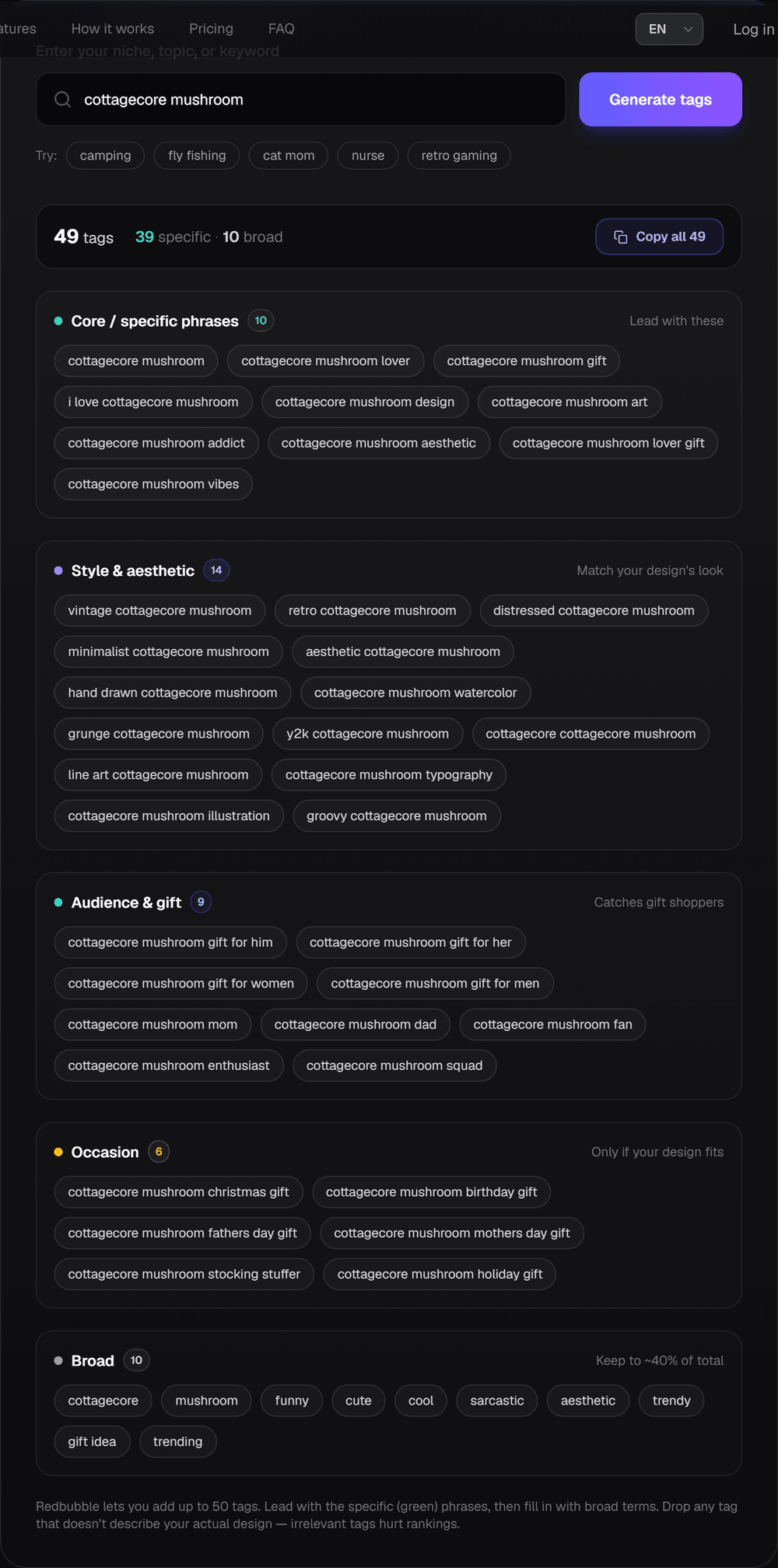
Two free tools pair with this. Once you have picked a product and a niche, the Redbubble tag generator turns it into a grouped set of buyer-search phrase tags in one click, no login.
And because Redbubble's sticker-versus-apparel economics differ so much — cents on a sticker, around $4 on a tee — run your idea through the POD profit calculator to sanity-check the margin first.
The Redbubble keywords and tags SEO guide goes deeper on tagging, and the print on demand niches breakdown helps if you are still choosing a community.
FAQ
What sells best on Redbubble? Stickers sell best on Redbubble — they are the platform's signature product, bought cheaply and in multiples by its browse-and-discover, laptop-and-water-bottle audience. After stickers, t-shirts, hoodies, wall art, and accessories like phone cases, totes, and mugs all sell well. But "sells best" by volume also means "most competitive," so the real answer is a tight, fresh niche on any of these products rather than the product itself.
Are stickers worth it on Redbubble? Yes, with realistic expectations. Stickers are the best product to start with because demand is enormous and the low price is an easy yes for buyers. The catch is the royalty: with a sticker base around $2 and a default 20% markup, you earn cents to about a dollar per sticker. Treat them as a high-volume, tight-niche entry product and the gateway to your higher-margin apparel — not a per-sale earner.
What's the best thing to sell on Redbubble for beginners? Stickers, then mugs. Both are inexpensive, low-risk impulse buys, so they convert without the buyer deliberating, and they forgive early mistakes. Start with a sticker in one specific niche, find an angle that works, then scale that same niche into t-shirts and hoodies. Do not start with hoodies — the higher price point makes early mistakes more expensive.
How much do Redbubble products actually pay? You set a markup, default 20%, on each product's base price. A roughly $20 base t-shirt at 20% earns about $4, retailing at $24. A sticker with a roughly $2 base earns cents to about a dollar. Hoodies earn more per sale, in the rough $4 to $6 range. One rule: markup above 20% is penalized — earnings on the part above 20% are halved — so you cannot simply price your way to a bigger royalty. Match the product to the goal: stickers for volume, apparel for per-sale earnings.
Is Redbubble saturated? Parts of it are. The headline products — generic stickers and t-shirts in broad themes — are heavily saturated, and competing there as a new seller is brutal. But saturation is per-niche, not platform-wide. Specific communities and fresh aesthetics still have room every month. The move is to take a proven product and pair it with a niche that has not been flooded — exactly what store-first research is for. For the bigger picture, is Redbubble worth it covers the earnings reality honestly.
What design style sells best on Redbubble? Bold, readable designs that work at thumbnail size on mobile, aimed at a specific identity or aesthetic. Redbubble's younger audience buys on vibe — aesthetics like cottagecore, dark academia, Y2K, and minimalist line art genuinely sell here — alongside sharp niche-identity humor and fandom-adjacent designs that capture a community's feel without a trademarked name. Intricate, detail-heavy art that disappears at small size underperforms, however good it looks full-size.
What are the best Redbubble products to sell in 2026? Stickers, t-shirts, and hoodies for demand and reach, with wall art, phone cases, totes, mugs, and notebooks offering lower competition for sellers willing to look past the obvious. But the best Redbubble products in 2026 are whichever ones carry a fresh, trademark-safe niche your audience can actually find — the product is the easy part, the niche and design are the game.
Conclusion
The best selling Redbubble products in 2026 are stickers first, then t-shirts, hoodies, wall art, and everyday accessories — but no product on this list sells itself. On Redbubble, sales come from the design and niche far more than the blank product: a tight, fresh, trademark-safe angle in a community your audience actually browses for. Sales are product × fresh niche × trademark-safe, and the product is the smallest of the three.
The hard part is finding that fresh, safe niche before you design. That is what Trendlytic does — it surfaces what top sellers are actually moving across Redbubble, TeePublic, Amazon Merch on Demand, and Etsy in one search, and lets you check a phrase against the live USPTO register before a design is built on it. Start a free trial — and research what is actually selling before you spend a day designing.
Which Redbubble product are you starting with — and what niche are you putting on it?
Try Trendlytic
Find your next winning Redbubble niche in 40 seconds
Live data from TeePublic, Amazon Merch, Redbubble, and Etsy, and a one-click USPTO lookup on any phrase. Then turn any winner into a listing for a design of your own in that niche. Plans from $19.99/month.
Start researchingLiked this? Learn niche research in 5 short emails.
One email a day for 5 days: how sellers pick niches, why designs fail, and how to check yours. Unsubscribe in one click.
Keep reading
- Trendlyticprint on demand
Best Print on Demand Products to Sell in 2026 (Data-Backed)
The JournalBest Print on Demand Products to Sell in 2026 (Data-Backed)
June 3, 2026 · 17 min read
- Trendlyticprint on demand stickers
Print on Demand Stickers: How to Design, Sell, and Actually Profit
The JournalPrint on Demand Stickers: How to Design, Sell, and Actually Profit
June 22, 2026 · 17 min read
- Trendlyticcustom trucker hats
Custom Trucker Hats: The Seller's Product Guide
The JournalCustom Trucker Hats: The Seller's Product Guide
September 24, 2026 · 18 min read