TL;DR: The best print on demand niches in 2026 are narrow identity, profession, and hobby micro-niches — not broad topics like "cats" or "fishing," which are hopelessly saturated. The money is in a specific audience in a specific situation ("ICU night-shift nurse," not "nurse"). Any list of specific niches saturates the moment it publishes, so the durable skill is not copying a list — it's validating demand against saturation yourself, on the marketplace, before you design. This post gives you 8 niche categories with concrete examples, then the repeatable method to find under-served niches nobody has named yet.
Most beginners pick a niche the same way: they think of something they like — cats, coffee, fishing — and start designing. Six weeks later they have forty uploads and zero sales, and they conclude print on demand doesn't work. The problem was never the platform. It was that "cats" isn't a niche. It's a topic, and it's competing against literally millions of existing designs.
A niche is not a topic. A niche is a specific audience in a specific situation — narrow enough that you can actually be the best answer for those people, emotional enough that they buy on identity rather than price. That distinction is the whole game, and almost nobody tells beginners this plainly.
So here is my honest promise for this post. I've tracked POD sellers for two years across Redbubble, TeePublic, and Amazon Merch, and I'll give you 8 niche categories that genuinely sell in 2026, with concrete examples. But the examples are a starting point and a method — not a copy-paste goldmine. The minute a list like this publishes, the specific examples on it get crowded. The real skill is finding your own. I'll show you both.
What makes a print on demand niche actually profitable
Before the list, the filter. A niche is worth your time when five things line up. Most lists check the first one and skip the rest.
- Narrow audience. Not "dog owners" — "tired senior-cat foster moms" or "first-year vet students." The narrower the audience, the fewer sellers compete for it and the more precisely your design can speak to them. Specificity is not a limitation; it's the entire advantage.
- Emotional identity. People buy POD products to say something about themselves — their job, their hobby, their pet, their town, their faith, their hard year. A niche works when the buyer sees the design and thinks "that's me." Decoration sells; identity sells harder.
- Real demand. Someone has to actually be buying. A niche can be perfectly narrow and emotionally sharp and still be an empty room. You confirm demand by looking at whether comparable designs are selling — favorites, reviews, best-seller positions — not by whether the idea feels clever.
- Survivable saturation. Demand alone isn't enough. If the first three pages of results are polished designs from entrenched sellers with thousands of favorites, the door is shut no matter how much demand exists. You want demand that outstrips current supply — a gap, not a wall.
- Trademark-safe. A niche phrase can be perfect and still be a registered trademark you're legally not allowed to print. "Boss babe," "main character," and "Sunday Funday" are all registered marks. Use one and your listing gets pulled — or your whole account does.
Notice what those five points share: you can't judge any of them from a list. You judge them by looking at what's actually selling on the marketplace right now — start from the sale, not from the idea — and that thread runs through every section below. (For more on reading those signals, I wrote it up in how to find trending POD niches.)
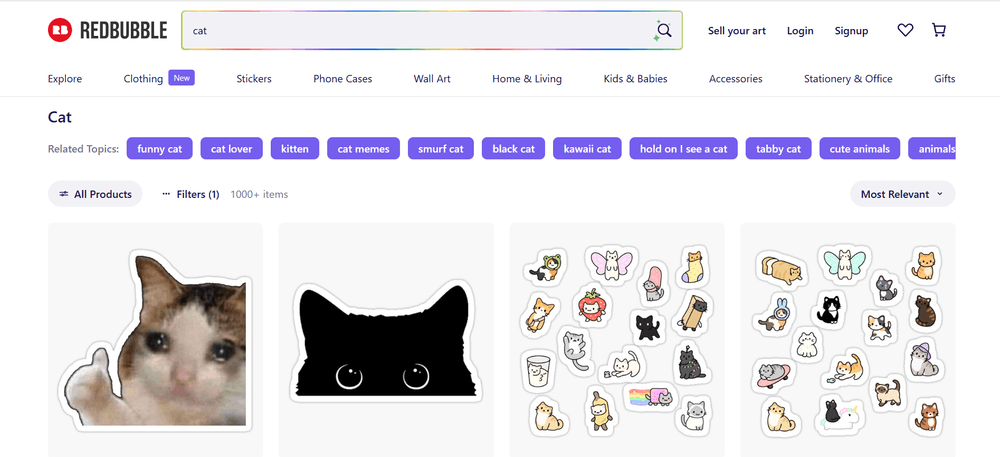
You can see the difference in a few seconds. Search a broad topic like "cat" on Redbubble and every result is a polished, established design — you're one face in a wall of thousands:
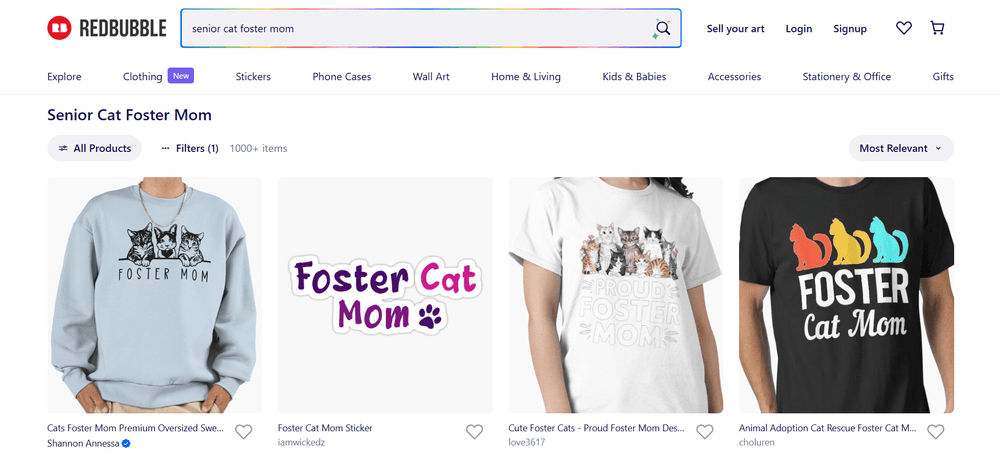
Now search a narrow niche like "senior cat foster mom." Only a handful of results actually match the phrase before Redbubble starts padding the page with loosely related designs — which is exactly the gap you want. In a space like this, one well-aimed design can be the best answer instead of the ten-thousandth:
| Niche | Why it sells | Best marketplace | Saturation |
|---|---|---|---|
| Profession & job-identity | Pride + in-group humor, gift-driven | Amazon Merch / TeePublic | Medium |
| Niche hobbies & subcultures | Strong identity, low broad-search noise | Redbubble | Low–Medium |
| Pet breed & pet-parent identity | Emotional, breed-specific, gift-heavy | Redbubble | Medium |
| Local & regional pride | Hometown loyalty, little competition | Amazon Merch / Redbubble | Low |
| Milestone & life-event | Occasion-driven, urgent gift intent | Amazon Merch | Low–Medium |
| Faith & values communities | Identity + belonging, repeat buyers | Amazon Merch / TeePublic | Medium |
| Hyper-specific humor / in-jokes | Tag-and-share, occupation + situation | TeePublic | Medium–High |
| Seasonal & event-driven | Predictable spikes, time-boxed demand | Amazon Merch / Redbubble | Medium |
1. Profession & job-identity
People are proud of what they do, and they like wearing it. Profession is one of the most reliable POD niches because the audience is built-in, gift-driven, and emotionally invested in their work identity.
But "nurse" is not a niche — it's one of the most saturated terms in POD. The money is one layer down, in the specific role and situation: ICU night-shift nurse, pediatric ER nurse, hospice nurse, first-year vet student, large-animal vet tech, special-ed teacher, third-grade teacher on the last week of school. Each of those is a distinct person with distinct in-jokes.
Why it sells: Identity plus in-group humor. A specific role-based design says "I see you, and I get the part of this job nobody else understands." It also sells as a gift — coworkers and family buy these for each other constantly, and gift buyers are far less price-sensitive.
Best marketplace: Amazon Merch on Demand for apparel reach and gift search, with TeePublic strong for the design-aware crowd.
Saturation: Medium. The broad roles ("nurse," "teacher") are flooded. The specific role-plus-situation combinations still have real gaps — that's where you enter.
Design / angle tip: Text leads here. Write the line only an insider would write — the specific shift, the specific specialty, the specific running joke — not "world's best nurse." Before you commit, look at what's actually selling in the profession space and find the role nobody has covered well yet.
2. Niche hobbies & subcultures
Hobby niches are some of the healthiest in POD because the broad search terms are quiet, so the spaces stay less saturated than the obvious topics — but the people inside them are intensely identity-driven.
Think disc golf, bouldering and trad climbing, fly tying, mechanical keyboards, tabletop wargaming, sourdough baking, axe throwing, pickleball, vintage synth collecting. These are communities with their own language, and they reward designs that prove you're actually one of them.
Why it sells: Belonging. Hobbyists wear their hobby as a flag, and they recognize insider references instantly. The narrower the subculture, the stronger the identity signal and the thinner the competition.
Best marketplace: Redbubble — its browse-and-discover audience suits subcultures, and stickers do especially well as cheap identity markers for laptops, water bottles, and gear.
Saturation: Low to medium. The well-known hobbies (yoga, gym, gaming) are crowded; the specific sub-disciplines often aren't. Fly tying is thinner than fishing; bouldering is thinner than hiking.
Design / angle tip: Use the real vocabulary of the subculture — the specific move, the specific tool, the specific gear. Outsider-flavored "I love hiking" designs get ignored; insider phrasing gets bought. Validate by checking which sub-hobbies have buyers (favorites, reviews) before designing into them.
3. Pet breed & pet-parent micro-identities
Pets are evergreen and deeply emotional, which is exactly why "dogs" and "cats" are dead ends. The opportunity is in breed-specific and situation-specific identities, where the buyer feels personally seen.
Not "dog mom" — corgi mom, senior-rescue greyhound dad, three-legged cat parent, reactive-dog owner, tired senior-cat foster mom, first-time betta keeper, axolotl owner. Each breed and each pet-parent situation is its own little world with its own emotional weight.
Why it sells: Pet owners are among the least price-sensitive buyers in POD, and they buy on pure emotion. A breed-specific design says "this is my dog, not just any dog." Gift demand is enormous — friends and family buy these constantly.
Best marketplace: Redbubble for range (stickers, mugs, totes, magnets all sell to this crowd), with Amazon Merch solid for apparel and gift search. Those are the owner-facing half; the gear the animal itself wears sells on Etsy instead, which print on demand pet products walks through.
Saturation: Medium. Popular breeds (golden retriever, French bulldog) are getting crowded; rarer breeds and specific pet-parent situations (foster, senior, special-needs, reactive) are far thinner.
Design / angle tip: Combine breed plus situation plus a little emotion ("senior-cat foster mom — fueled by coffee and goodbyes"). Check the breed on the marketplace first — some popular breeds are walls, while specific situations around them are wide open.
4. Local & regional pride
Hometown loyalty is a quietly powerful POD niche because it's almost impossible for big sellers to cover at scale. "USA" is meaningless and saturated. A specific town, county, lake, or regional in-joke is a small, defensible market that genuinely loves the design.
Think a specific small town's name in a vintage athletic font, a regional food obsession (a state's particular sandwich or chili style), a lake-community identity, a specific mountain range, a neighborhood nickname, a regional accent joke.
Why it sells: Place is identity. People are proud of where they're from in a way that's almost tribal, and there's very little competition because no large seller bothers designing for one small town. The audience is small but loyal and underserved.
Best marketplace: Amazon Merch for apparel and local gift search, with Redbubble good for stickers and mugs tied to a place.
Saturation: Low. This is one of the least-crowded categories on the list precisely because it doesn't scale for big operators — which makes it ideal for a focused seller.
Design / angle tip: Go genuinely local — the specific town, the specific in-joke only locals get. Generic state pride is crowded; a single town's running joke is wide open. Be careful with team names, school names, and local business names, which are often trademarked — check before you print.
5. Milestone & life-event
Life events create urgent, occasion-driven demand with a built-in deadline, which is exactly what makes them convert. Someone retiring, a new dad, a five-year sobriety chip, a thirtieth wedding anniversary — these buyers have a date and a reason, and they're shopping with intent.
Specifics: retirement after 30 years of teaching, new dad of twins, five years sober, beating cancer (one year clear), graduating nursing school, becoming a grandparent for the first time, a 25-year work anniversary.
Why it sells: Occasion plus emotion plus a deadline. The buyer isn't browsing — they need something for a specific moment, and they'll pay for the right one. These also make natural gifts, which widens the buyer pool well beyond the person living the milestone.
Best marketplace: Amazon Merch on Demand — gift search around milestones is strong, and apparel and mugs both convert.
Saturation: Low to medium. Generic "retirement" and "new dad" are crowded; the specific combinations (profession plus milestone, milestone plus number of years) still have gaps.
Design / angle tip: Stack the milestone with a specific detail — the profession, the exact number of years, the relationship. "Retired after 30 years in the ICU" beats "happily retired." Validate that comparable milestone designs are actually selling before you build a set.
6. Faith & values communities
Faith and values niches sell on belonging and repeat purchase. People express their beliefs visibly, and communities organized around shared values are some of the most loyal, identity-driven buyers in POD.
This spans religious identity, recovery communities, environmental and cause-driven values, parenting philosophies, and other belief-based groups. The pattern is the same: a clear shared identity that people want to wear and gift within their community.
Why it sells: Identity plus community. These designs aren't decoration — they're a statement of who the buyer is and what group they belong to. That emotional weight drives both self-purchase and gifting within tight-knit communities, and it produces repeat buyers.
Best marketplace: Amazon Merch for apparel reach and gift search, with TeePublic strong for the community-aware audience.
Saturation: Medium. The broadest expressions are crowded; specific community sub-identities and gentler, original phrasings still have room.
Design / angle tip: Be specific and sincere rather than generic. Borrow the real language of the community, not the obvious cliché everyone has already done. This is also a category dense with trademarked phrases and copyrighted text, so trademark-check every line carefully before designing.
7. Hyper-specific humor / in-jokes
Humor is one of the strongest POD drivers because funny designs get tagged and shared — but generic humor is brutally saturated. The opportunity is in hyper-specific jokes that only a defined group fully gets: occupation plus situation, hobby plus frustration, identity plus running gag.
Think the specific complaint only a particular job understands, the in-joke shared by people who do one specific hobby, the dark humor of a particular shift or season. The narrower and more insider the joke, the better it works.
Why it sells: Recognition plus shareability. A hyper-specific joke makes the right person laugh because it's so precisely about them, and they tag the friends who'd get it. That built-in sharing is free distribution generic humor never earns.
Best marketplace: TeePublic — its design-aware, browse-happy audience is exactly who buys and shares clever niche humor.
Saturation: Medium to high. Generic "funny" is one of the most flooded spaces in POD. Insider humor for a narrow group is far less crowded — the specificity is what saves you.
Design / angle tip: Text is everything here, and the joke must be genuinely insider — written by someone who lives it, not borrowed from a meme. Cross-check across stores to make sure the exact joke isn't already done well, and run the phrase through a trademark check, since punchy phrases get registered constantly.
8. Seasonal & event-driven
Seasonal niches give you predictable, recurring demand — but only if you publish early. The single biggest mistake here is designing in-season; by the time the holiday arrives, the marketplace has already ranked the sellers who uploaded 6 to 8 weeks ahead.
This covers holidays (Halloween, Christmas, Mother's Day, Father's Day), back-to-school, graduation season, Valentine's Day, and smaller recurring events. The demand is reliable because it returns every year on schedule.
Why it sells: Predictability plus urgency. Demand spikes on a known calendar, and during the spike buyers shop with real intent and a deadline. The time-boxed nature is a feature — you know exactly when the window opens.
Best marketplace: Amazon Merch for gift-search reach during holiday peaks, with Redbubble strong for seasonal stickers and decor.
Saturation: Medium. Generic holiday designs are crowded, but holiday plus a specific niche (a profession's Christmas, a hobby's Halloween, a specific milestone for Mother's Day) combines two filters and thins the field considerably.
Design / angle tip: Publish 6 to 8 weeks early, and combine the season with another niche from this list rather than going generic. "First Christmas as an ICU nurse" beats "Merry Christmas." Plan your seasonal calendar backward from each holiday's demand curve.
How to find and validate your own niches
Here's the honest part again. Every specific example above is a starting point, and the specific ones will get crowded as lists like this circulate. The durable skill isn't picking from a list — it's learning to read a niche yourself so you find under-served ones before anyone names them. A few principles do most of the work.
Brainstorm narrow identities. Don't write topics — write people in situations. Take a broad subject and stack modifiers until you reach a specific audience: profession plus shift, hobby plus sub-discipline, breed plus situation, milestone plus number of years. The output here is a long list of narrow audiences, not topics.
Weigh demand against saturation. For each candidate, ask whether there's real demand and room to compete. Wall-to-wall polished designs from entrenched sellers with huge favorite counts means the door is shut. A gap — an angle or sub-audience nobody has covered well, with clear demand underneath it — is the opening you want.
Look at what's actually selling, not just what's searched. A keyword count tells you a phrase is popular; it doesn't tell you anyone buys. Study what the top sellers in a space are genuinely moving and how recent those winners are — fresh designs still breaking through mean a live, climbing trend, while a space that peaked years ago with nothing new landing is a competitive evergreen at best. You're reading the result of buyers voting with their wallets.
Trademark-check every phrase. Before you design, search the exact phrase in the USPTO trademark database. A live mark in a relevant class (apparel is typically Class 25) means do not use that wording — find another. This step takes two minutes, it's free, and skipping it is the fastest way to lose an account.
Design only after it all lines up. Real demand plus survivable saturation plus a climbing signal plus a clean trademark. Two out of four isn't enough.
Doing this by hand across four marketplaces is a lot of clicking, and that's the exact reason I built Trendlytic. It does the boring research part of this loop: one search shows you what's actually selling across TeePublic, Amazon Merch on Demand, Redbubble, and Etsy at once — store-first, so you see what's bought, not just what's searched — and you can run a live USPTO lookup on whatever you plan to print, on every plan. It's $19.99 a month for 100 searches, with a free trial. I'll be honest about what it isn't: it's newer and smaller than tools like Merch Informer, and by design it shows buyer-intent signals rather than search-volume numbers. It does the homework faster — it is not a money printer. If you want to skip the manual clicking, research what's actually selling before you design.
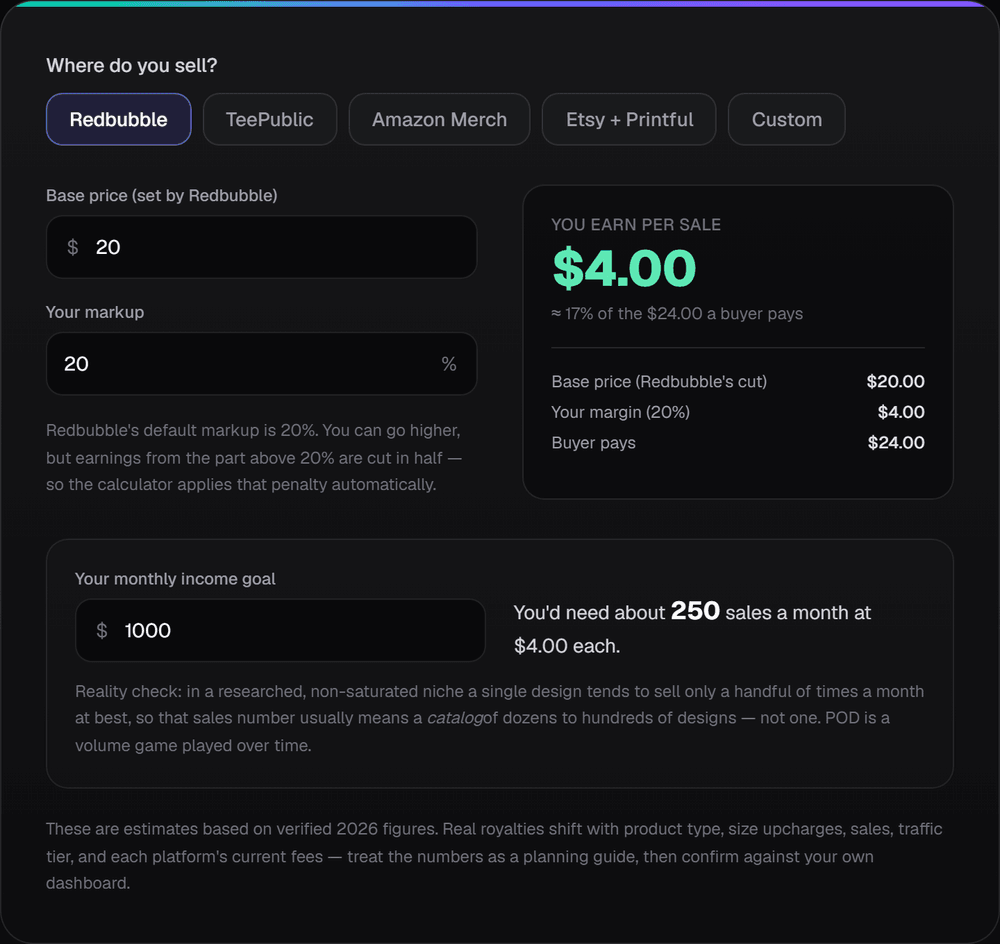
Two free tools help with the steps around the research. Once you're weighing whether a niche's typical product is worth it, run the numbers through the POD Profit Calculator to sanity-check the margin before you commit a single design to it.
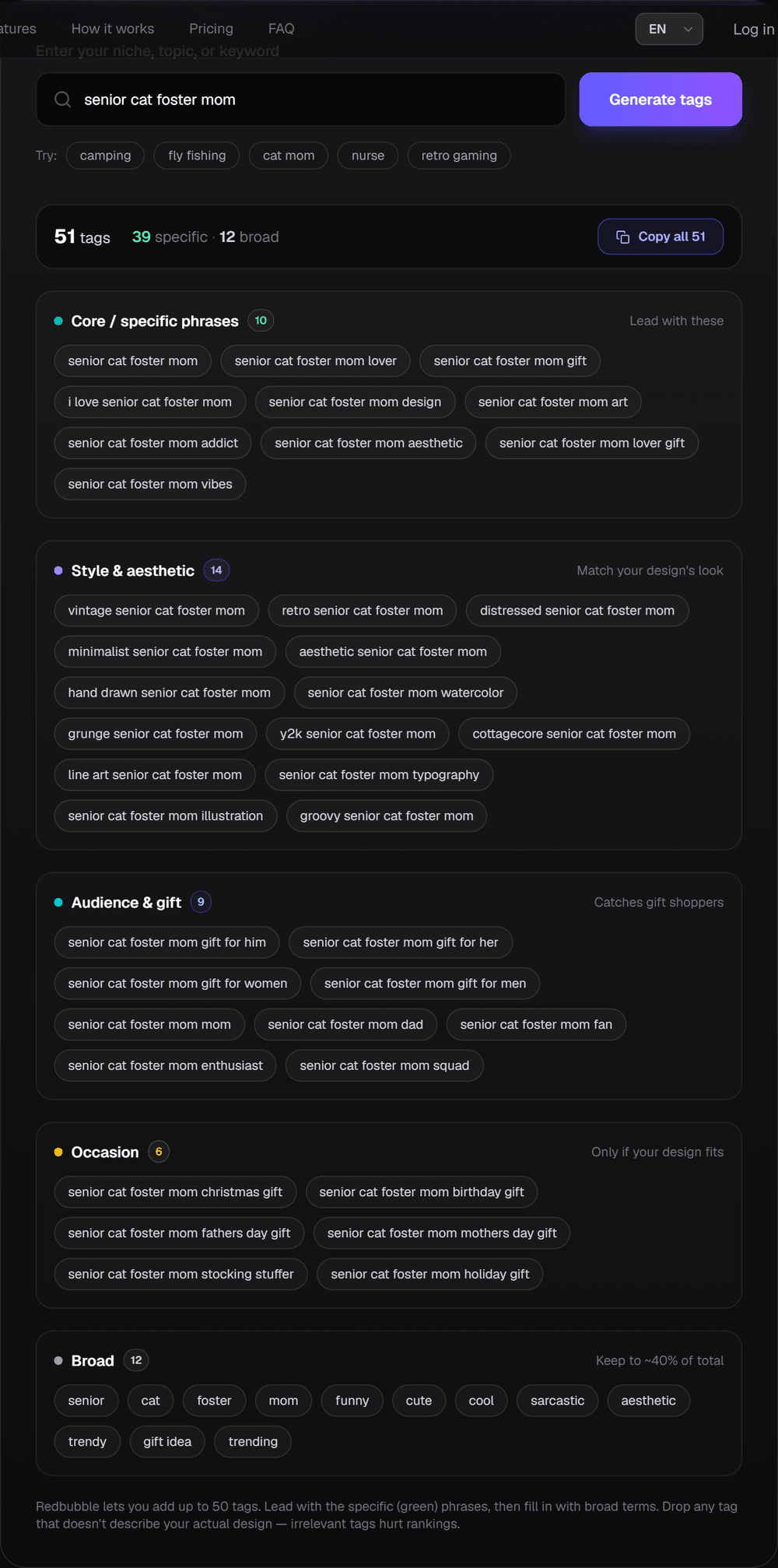
And once you've chosen a niche and you're ready to list, the Redbubble tag generator turns it into a full set of search tags in one click — pair it with the Redbubble keywords and tags SEO guide.
If you're earlier in the journey, is print on demand profitable sets honest expectations, how to start a print on demand business covers the full setup, and best print on demand products helps you pick what to put your niche on. And for the big-picture map of how niche research fits with everything else, our complete print on demand guide is the hub that ties it all together.
FAQ
What is a print on demand niche? A print on demand niche is a specific audience in a specific situation that you design for — not a broad topic. "Cats" is a topic; "tired senior-cat foster mom" is a niche. The difference matters because broad topics are saturated with millions of designs, while a narrow, identity-driven niche has a defined buyer and far less competition. The best niches are narrow enough that you can be the best answer for those exact people.
What are the most profitable print on demand niches? The most profitable POD niches in 2026 are narrow identity, profession, hobby, and life-event micro-niches — specific roles ("ICU night-shift nurse"), specific subcultures (disc golf, mechanical keyboards), specific pet identities (corgi mom, senior-rescue dog dad), local and regional pride, and milestones (retirement after 30 years, five years sober). They're profitable because buyers purchase on emotional identity rather than price, and the narrowness keeps competition survivable. Broad topics like "coffee" or "fishing" are not profitable for new sellers because they're flooded.
How do I find an untapped, low-competition POD niche? Brainstorm narrow audiences (not topics), then check each one for a gap — clear demand but thin or beatable competition. Look at what's genuinely selling rather than just what's searched, confirm the trend is climbing not fading, and trademark-check the phrase before designing. An untapped niche has some selling listings (proving demand) but not a wall of entrenched ones.
Are these POD niches already saturated? The broad versions are, and any specific example on a public list gets crowded once the list circulates — that's honest and it's why this post emphasizes the method over the list. But "saturated" isn't about how many listings exist; it's about whether the specific angle you'd compete on is already owned. "Cats" is saturated; a specific sub-angle within it often isn't. Always check the exact angle on the marketplace yourself rather than trusting any list's verdict.
How many niches should I focus on? Start with one. Pick a single narrow niche, learn what its buyers respond to, and build a small batch of designs across a few product types before scaling the winners. Sellers who chase ten niches at once usually end up shallow in all of them. Once one niche is working, expand sideways into adjacent sub-audiences using the same proven angle.
Which marketplace is best for niche designs? It depends on the niche. Amazon Merch on Demand is strongest for profession, milestone, and gift-driven apparel niches because of its reach and gift search. Redbubble suits hobby, pet, and seasonal niches with its browse-and-discover audience and wide product range (stickers, mugs, totes). TeePublic is strong for humor and design-aware communities. Match the niche to where its buyers actually shop rather than picking one platform for everything.
Do I need a tool to find POD niches? No — you can run the entire method for free with the marketplaces and a spreadsheet. The trade-off is time: manually reading hundreds of stores across four marketplaces is hours of clicking. A tool like Trendlytic automates the reading and the trademark check; it doesn't change the method. The method is what matters, with or without a tool.
Conclusion
Here's the takeaway I want you to keep, because it's both the honest one and the true one: a niche is not a topic. The print on demand niches that actually sell in 2026 are narrow, emotional, identity-driven micro-niches — a specific person in a specific situation — not broad subjects everyone has already flooded. The 8 categories above are a real starting point, but every specific example saturates the moment lists like this spread. The durable skill is the method: brainstorm narrow identities, check saturation on the marketplace, study what's actually selling, trademark-check, then design.
That research loop is exactly what Trendlytic does the boring part of — one search across TeePublic, Amazon Merch on Demand, Redbubble, and Etsy showing what's actually selling, with a live USPTO lookup on whatever phrase you choose. Start a free trial — and validate a niche before you spend a day designing for an empty room.
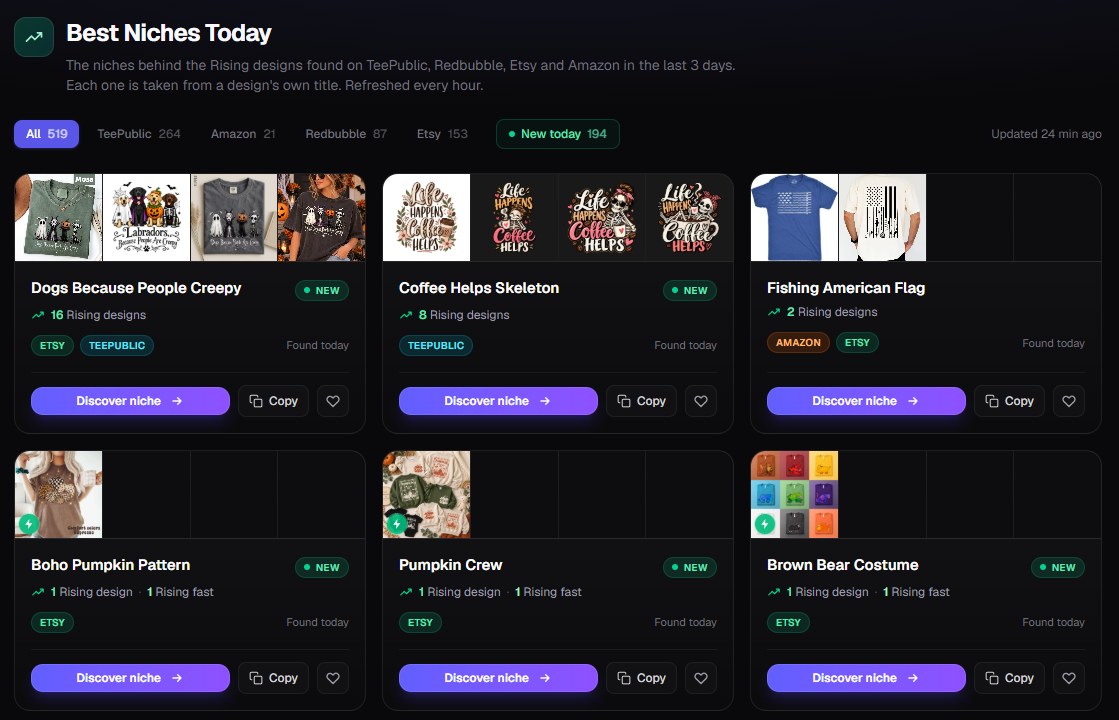
And when you have no niche in mind at all, Trendlytic's Best Niches Today lists, every hour, the niches behind the Rising designs of the last three days. Each one is a narrow micro-niche taken from a real design's title, which is exactly the kind this post argues for. The niche finder page shows the three ways in, from an interest, from a niche you already sell, or from that list.
What's the narrowest niche you've found that actually sold — and how did you stumble onto it? I'd genuinely like to know what's working for you.
Try Trendlytic
Find your next winning Redbubble niche in 40 seconds
Live data from TeePublic, Amazon Merch, Redbubble, and Etsy, and a one-click USPTO lookup on any phrase. Then turn any winner into a listing for a design of your own in that niche. Plans from $19.99/month.
Start researchingLiked this? Learn niche research in 5 short emails.
One email a day for 5 days: how sellers pick niches, why designs fail, and how to check yours. Unsubscribe in one click.
Keep reading
- Trendlyticpod niches
How to Find Trending POD Niches in 2026 (Without Guessing)
The JournalHow to Find Trending POD Niches in 2026 (Without Guessing)
May 23, 2026 · 20 min read
- Trendlyticredbubble
8 Best Selling Redbubble Niches in 2026 (and How to Find Your Own)
The Journal8 Best Selling Redbubble Niches in 2026 (and How to Find Your Own)
June 15, 2026 · 20 min read
- Trendlyticprint on demand
8 Print on Demand Trends for 2026 (What's Actually Selling)
The Journal8 Print on Demand Trends for 2026 (What's Actually Selling)
June 17, 2026 · 22 min read