TL;DR: Printful and Redbubble aren't really direct competitors. Redbubble is a marketplace — it has built-in traffic and buyers, you upload a design and set a markup, and it keeps a big cut while you get a small one and no brand. Printful is a supplier — it has no marketplace and no traffic of its own; you connect it to your own store (Etsy, Shopify, WooCommerce), set your own retail price, pay the base cost, and keep a much bigger margin, but you have to drive every visitor yourself. Total beginners who want the easiest start pick Redbubble. Sellers ready to build a brand and bring their own traffic pick Printful, usually through Etsy or Shopify. Many people do both.
Most "Printful vs Redbubble" articles get one thing wrong from the first sentence: they treat it as a straight head-to-head, like two phones on a spec sheet. It isn't. These two things don't do the same job.
I've spent the last two years tracking print-on-demand sellers across Redbubble, TeePublic, and Amazon Merch — watching what sells, what stalls, and where people quietly lose money. The single most common confusion I see from beginners is this exact comparison, because they assume Printful and Redbubble are two versions of the same thing. They aren't. One is a place that sells for you. The other is a factory that prints for you.
So this is the honest version — not a sponsored review, not a "both are great" hedge. By the end you'll know which one fits where you actually are right now, and why the real question isn't which is better, but which kind of business you want to run.
The core difference: marketplace vs supplier
This is the whole article in one section, so I'll say it plainly and then repeat it where it matters.
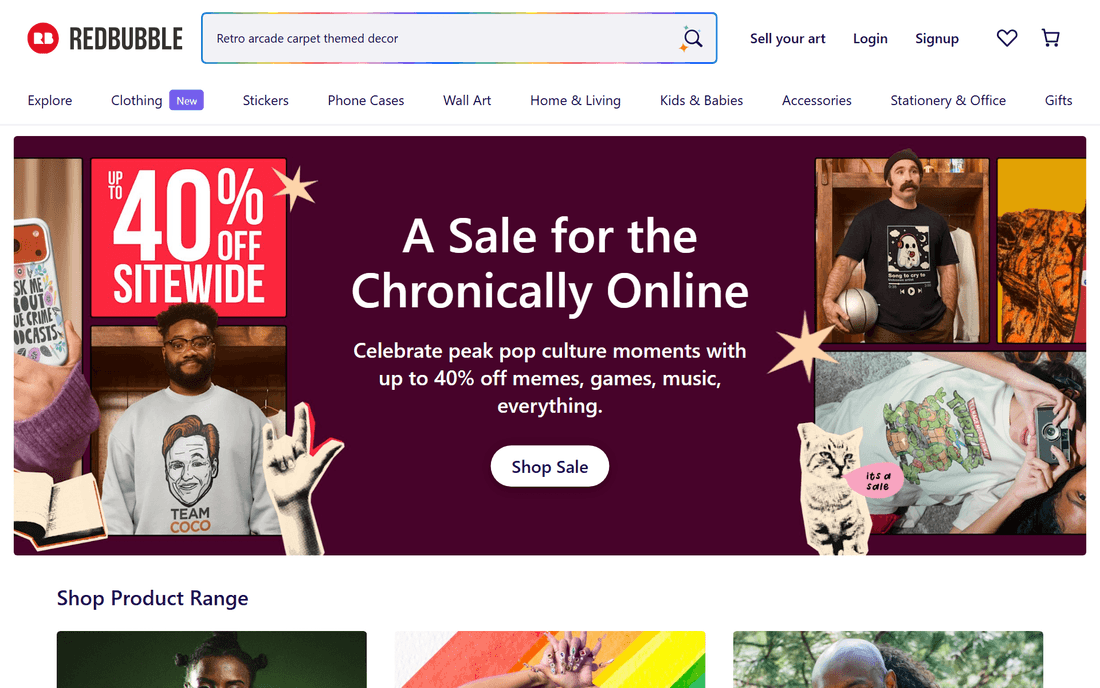
Redbubble is a marketplace. It is a website with its own audience, its own search, its own buyers already there looking to buy. You upload a design, set a markup, and Redbubble handles everything else — printing, shipping, payment, customer service, returns. You get free traffic that you didn't have to create. In exchange, you take a small cut, you have little control, and you build no brand of your own. The customer is Redbubble's customer, not yours.
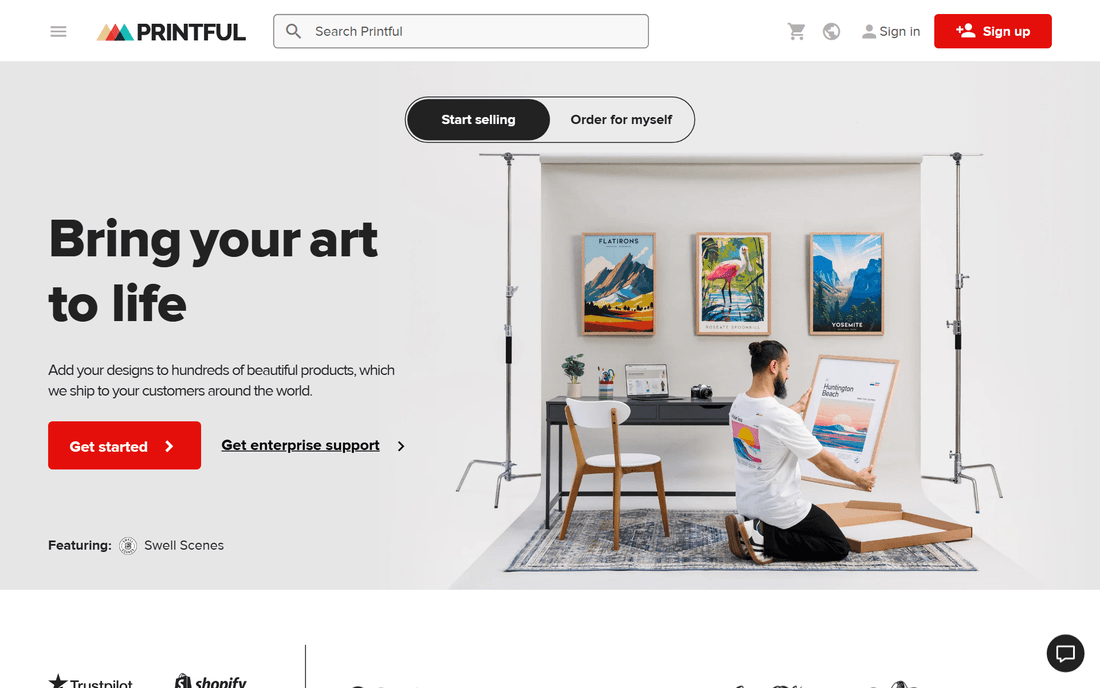
Printful is a print-on-demand supplier — a fulfillment service. It has no marketplace. It has no traffic. Nobody browses Printful to buy a t-shirt. Instead, you connect Printful to a store that you own — Etsy, Shopify, WooCommerce, or you order directly — and when someone buys from your store, Printful prints and ships the item for you under your brand. You set the retail price, you pay the base cost, and you keep the difference. But there's a catch that decides everything: you have to bring every single visitor yourself.
So the honest reframing is this: the real question isn't "which is better," it's "do you want to sell on a marketplace, or build and drive your own branded store?" Redbubble is the marketplace path. Printful is the own-store path. They're answers to two different questions, and the right one depends entirely on what you want to build.
Hold onto that as we go through the details — because every difference below comes back to this one.
How each one works
Redbubble — upload, set a markup, done
The Redbubble flow is about as simple as POD gets:
- You make a free account.
- You upload a design and let it apply across products (t-shirts, stickers, mugs, phone cases, posters — 70+ types).
- You set a markup percentage. Redbubble's traffic finds your design through its own search.
- When someone buys, Redbubble prints, ships, and handles the customer. You earn your markup.
You never touch fulfillment, you never see the customer, and you never have to send a single visitor to the page. Redbubble's built-in audience does the discovery. That's the entire appeal — and the entire trade-off. (If you want the full walkthrough, I wrote a step-by-step guide to selling on Redbubble.)
Printful — connect it to your store, you drive the traffic
The Printful flow has more moving parts because you own the storefront:
- You make a free Printful account.
- You connect it to a store you control — most beginners use Etsy or Shopify.
- You pick a product, design it, and set your own retail price on your store.
- You — not Printful — have to get people to your store. Etsy search, Pinterest, Instagram, ads, your own audience.
- When someone buys, Printful charges you the base cost and ships the item, often white-label under your brand.
The key line: Printful only prints and ships. Finding the buyer is entirely your job. That's the price of the bigger margin and the real brand. The most common beginner-friendly version of this path is Etsy plus Printful, where Etsy at least gives you some search traffic to start with — I covered that route in detail in Etsy print on demand.
Pricing and profit margins
This is where Printful looks like the obvious winner on paper — and where the honest caveat matters most. Let's use real, verified numbers.
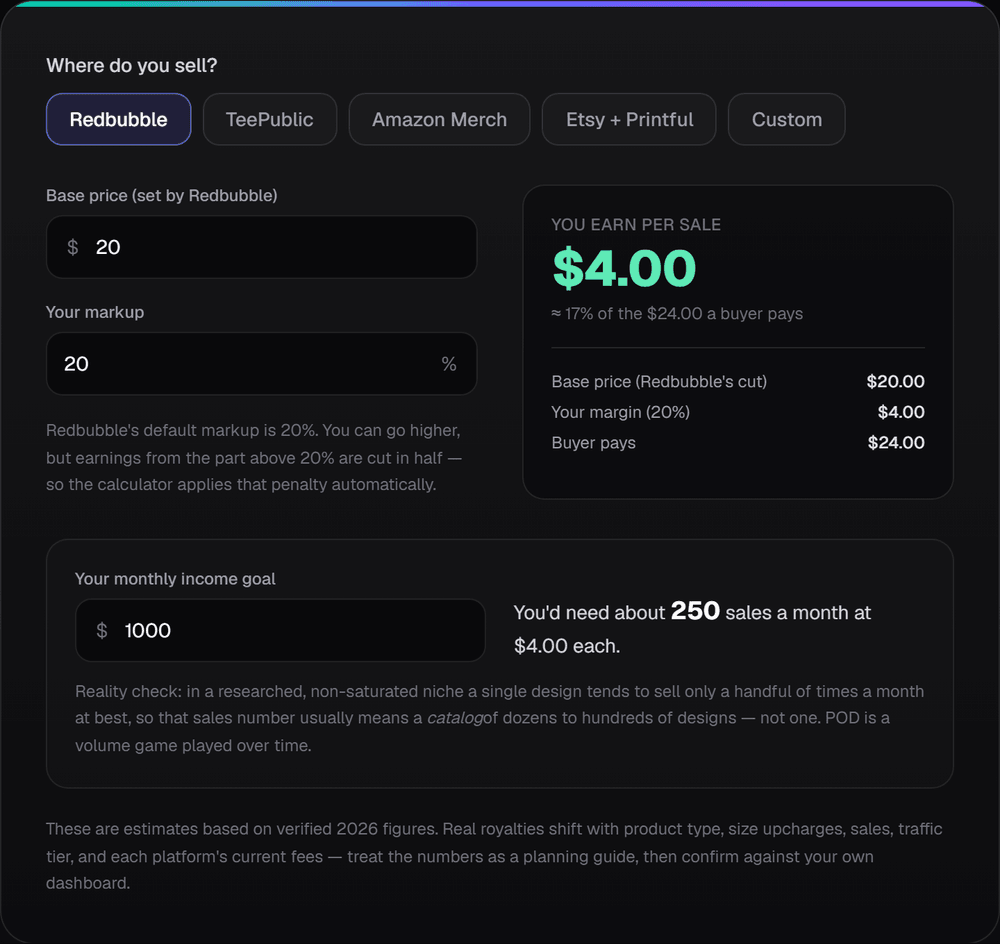
Redbubble — markup on a fixed base. You don't set a retail price directly. You set a markup percentage on top of a base price Redbubble controls, and your earnings are base × markup. The default markup is 20%. On a standard tee with a base price of around $20, a 20% markup earns you about $4, and the shirt retails at roughly $24. The catch most beginners miss: markup above 20% is penalized — Redbubble effectively halves your earnings on the portion above the default, so cranking it to 40% does not double your profit, it just raises your price and tanks your conversion. For most sellers the practical move is to stay near 20%.
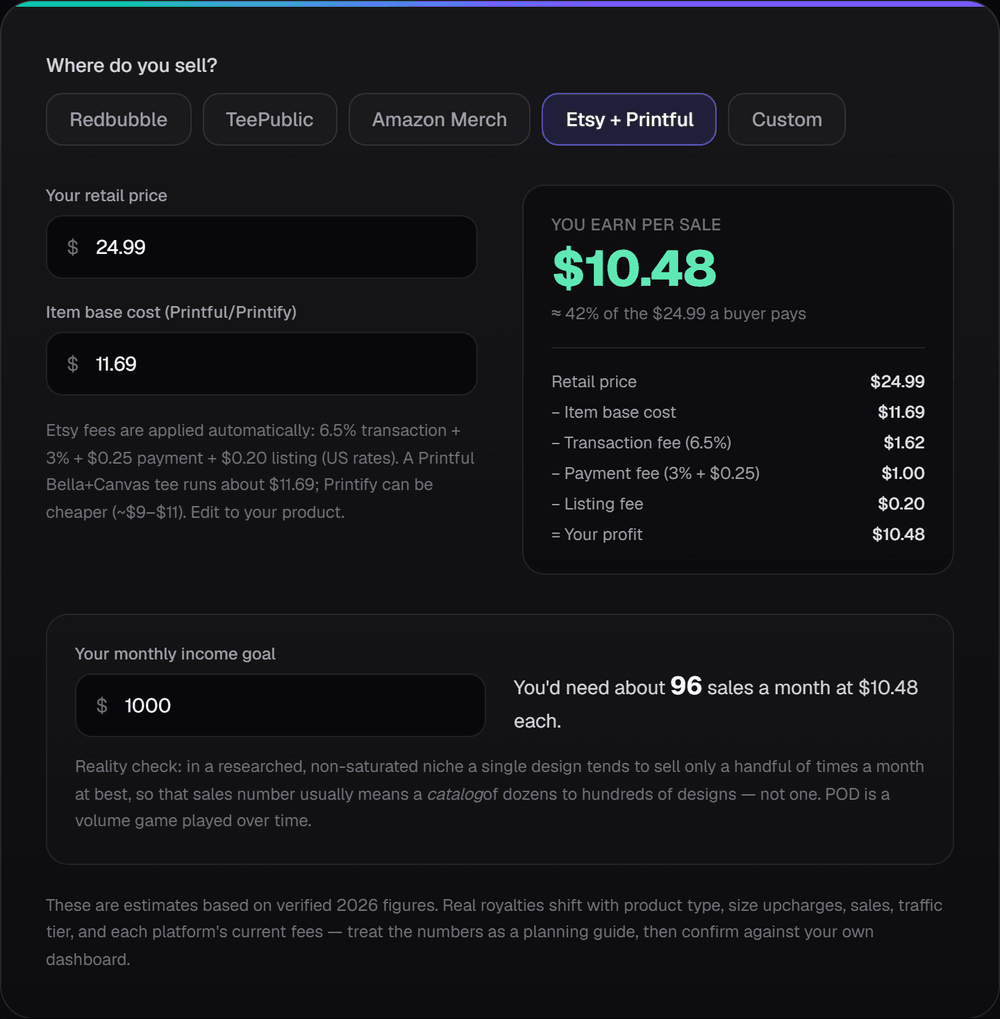
Printful — you set retail, you pay base cost. Your profit is simply retail − base cost − your store's fees. A Printful tee (a Bella+Canvas, the kind sellers praise for quality) has a base cost of around $11.69. If you list it on your own Etsy store at $24.99, then after the ~$11.69 base and roughly 9.5% + $0.45 in Etsy fees, you keep around $10+ per sale. On your own Shopify store with lower fees, you keep even more.
Here's the head-to-head on the same tee:
| Redbubble | Printful (via Etsy) | |
|---|---|---|
| Who sets the price | Redbubble (you set markup %) | You (full control) |
| Who pays the base cost | Redbubble (built into base) | You (~$11.69 per tee) |
| Typical retail | ~$24 at 20% markup | ~$24.99 (your choice) |
| Your profit per tee | ~$4 | ~$10+ |
| Who finds the buyer | Redbubble's traffic | You |
That ~$10 vs ~$4 gap is real — Printful lets you keep more than double the margin per sale. But read the last row of that table again, because it's the whole story: on Redbubble the buyer is already there; on Printful you have to go get them. A higher margin on a sale that never happens is worth exactly zero. So Printful's bigger margin is a real advantage, but it only matters if you can actually drive sales — and that's the hard part.
You can see the gap in the free POD Profit Calculator, which covers both models. On Redbubble, a $20 base tee at the default 20% markup leaves you about $4:
On the Etsy + Printful side, the same kind of tee priced at $24.99 keeps you around $10 after the ~$11.69 base cost and Etsy's fees — more than double, but only if you bring the buyer:
Plug in your own numbers for either path, and for the deeper breakdown across every platform, I wrote a whole piece on how to price print on demand products.
Traffic: the deciding factor
If you remember one section, make it this one. For most people, traffic is the entire decision — not margin, not product quality, not branding.
Redbubble gives you buyers. Its whole value is that millions of people already browse and search it, and your design can show up in those searches with zero marketing from you. You upload, you tag well, and the platform's existing traffic does discovery. A new seller with no audience and no marketing skill can still make a first sale on Redbubble, because the buyers were already there.
Printful gives you zero buyers. None. Printful is a printer in the back; the storefront and every visitor to it are your responsibility. Connect Printful to a brand-new Shopify store and do no marketing, and you get zero visitors and zero sales — forever. The Etsy + Printful route softens this because Etsy has its own search, but even there you're competing in Etsy's results and usually leaning on Pinterest, social, or ads.
This is why I keep hammering the margin point. People see "$10 profit vs $4 profit" and assume Printful wins — but that comparison silently assumes the sale happens. On Redbubble, the platform handles the hardest, most expensive part of any business — getting a qualified buyer in front of your product — for free. With Printful, that part is on you, and it's the part most beginners can't do yet.
Blunt version: a higher margin is meaningless without traffic, and Printful comes with none. If you don't yet know how to drive traffic, Redbubble's free buyers are worth far more to you than Printful's fatter margin.
Control and branding
This is the flip side, and it's where Printful genuinely wins for the long game.
Printful is your brand. Your store, your store name, your domain, your packaging (often white-label, no Printful logo on the package), your customer email list. When someone buys, you own that customer — you can email them, retarget them, sell them a second product, build a repeat business. You're building an asset that's yours.
Redbubble is not your brand. It's Redbubble's marketplace, Redbubble's checkout, Redbubble's customer. You can't email your buyers, you can't retarget them, you can't build a list. If Redbubble changes its algorithm, its fees, or its rules tomorrow, your business changes with it and you have no say. You're a tenant, not an owner.
For someone just testing whether they can design things people want, being a tenant is fine — it's the point, because you skip all the overhead. But if your goal is a real, lasting brand you own and can grow, Redbubble structurally can't give you that and Printful + your own store can. This is the deeper reason serious sellers eventually move toward the Printful path even though it's harder.
Product range and quality
Both are solid here, and I won't overstate either.
Printful is widely praised for apparel quality and garment choice. You're choosing specific, named blanks — Bella+Canvas tees, quality hoodies, embroidered caps — and printing onto them, with white-label packaging that makes the order feel like it came from your brand. The range is more apparel- and accessory-focused, and the quality reputation is a real reason people use it for a serious store.
Redbubble wins on sheer breadth. The same design can land on 70+ product types — stickers, mugs, phone cases, posters, journals, pillows, water bottles, tote bags — without much hand-scaling. Stickers in particular are a Redbubble staple the Printful path doesn't replicate as easily. Quality is decent across the range; it's just a different model — wide and automatic versus chosen and branded.
Neither is "low quality." If garment feel and a branded unboxing matter, Printful has the edge. If you want one design monetized across the widest spread of products with the least effort, Redbubble's range is hard to beat.
Ease of starting
Redbubble: minutes, free. Sign up, upload a design, set a markup, publish. You can have a live, sellable listing in front of real buyers in under an hour, with no store, no setup, no upfront cost. For a complete beginner, nothing is faster.
Printful: more setup, still free to start. Printful itself is free and you only pay when you make a sale — but Printful alone isn't a store. You need to connect it to something: an Etsy shop (small listing fees, fastest of the store options) or a Shopify store (a monthly subscription, more setup, but fully yours). So the real "start" cost with Printful is building and connecting the storefront, then doing the marketing. It's not expensive, but it's more steps and more skill than Redbubble's upload-and-done.
If "I want to be selling today with zero setup" is your priority, Redbubble wins ease cleanly. If you're willing to spend a weekend setting up a store because you want what that store gives you, Printful's extra setup buys you the brand and margin.
Which should you choose?
Here's the honest decision framework. Be real with yourself about which list you're actually in.
Choose Redbubble if you...
- Are a total beginner and want to be live today.
- Want free, built-in traffic and don't yet know how to drive your own.
- Have no interest in marketing, Pinterest, ads, or running a store.
- Are testing the waters — you want to find out if you can make designs people buy before investing in anything.
- Want the absolute lowest-effort, lowest-risk start. (Is Redbubble worth it digs into exactly who it does and doesn't pay off for.)
Choose Printful if you...
- Want to build a real brand you own, with your own store and customer list.
- Are willing and able to drive your own traffic (Etsy search, Pinterest, social, ads).
- Want bigger margins — and understand that bigger margins only pay off once you have traffic.
- Are building for the long term, not testing a quick idea.
- Already have an audience, a niche, or a marketing channel to plug in.
The common smart path
The route I see work most often isn't either/or — it's both, in order. Many sellers start on Redbubble to learn the craft cheaply: what niches sell, how tagging works, what designs convert, all using Redbubble's free traffic as a sandbox. Then, once they know they can make things people buy, they move to a Printful + Etsy or Shopify store to capture the brand and the bigger margin. You can also run both at once — keep cross-listing passive designs on Redbubble for free volume while you build the owned store on the side. The two paths aren't enemies; one is the cheap classroom, the other is the real business. (How to start a print on demand business walks the whole journey.)
If you're weighing marketplaces specifically, my TeePublic vs Redbubble comparison covers the other big marketplace decision.
Where research fits — on either path
Here's the part that matters no matter which side of this you land on: before you design anything, you have to know what's actually selling. A perfectly branded Printful store and a free Redbubble listing both earn exactly $0 if the design is in a flooded, no-demand niche. The platform decision is downstream of the niche decision.
That's the boring, unglamorous research step — and it's the one I built Trendlytic to do. One search shows what's actually selling across Redbubble, TeePublic, Amazon Merch, and Etsy, with a live USPTO lookup you can point at any phrase, so a registered one shows up before you design it. $19.99/month, 100 searches, free trial. It does the research step so you're not scrolling marketplaces by hand for hours. Honest about it: it is not a money printer, and you don't need it to succeed. It just makes the find a niche that isn't saturated part faster.
Whichever path you pick, the workflow is the same: research the niche, trademark-check the keyword, then design and list. When it's time to list, the free Redbubble tag generator gets you phrase tags fast.
FAQ
Is Printful better than Redbubble? Neither is universally better — they do different jobs. Printful is a supplier that gives you full control, your own brand, and a bigger margin (~$10+ vs ~$4 on a tee), but no traffic at all. Redbubble is a marketplace that gives you built-in buyers and a near-zero-effort start, but a small cut and no brand. Printful is "better" if you can drive your own traffic and want to build a brand; Redbubble is "better" if you're starting out and want free buyers with minimal setup.
Can you use Printful and Redbubble together? Yes, and many sellers do. They're not exclusive. A common approach is to keep passive designs on Redbubble for free marketplace volume while building a branded Printful store (via Etsy or Shopify) on the side for higher margins. They're different channels, so running both just means more income streams from the same designs.
Which is better for beginners — Printful or Redbubble? For a true beginner with no audience and no marketing experience, Redbubble is the easier start. You can be live and in front of real buyers in under an hour, for free, with no store to build and no traffic to drive. Printful is better suited to people ready to set up their own store and bring their own visitors. A lot of sellers start on Redbubble to learn, then graduate to Printful once they know what sells.
Does Printful have its own marketplace? No. Printful is purely a print-on-demand supplier and fulfillment service — it prints and ships, nothing more. It has no storefront, no audience, and no buyers of its own. You must connect it to a store you own (Etsy, Shopify, WooCommerce) and drive all the traffic yourself. This is the single biggest difference from Redbubble, which is a marketplace with its own traffic.
Which makes more money, Printful or Redbubble? Per sale, Printful — around $10+ on a tee versus about $4 on Redbubble. But total money depends on traffic, and Printful gives you none while Redbubble gives you a built-in audience. A beginner who can't drive traffic often makes more total on Redbubble despite the smaller margin, because the sales actually happen. Sellers who can market well make far more with Printful, keeping the bigger margin on the traffic they bring.
Is Redbubble or Printful cheaper to start? Both are free to start, but Redbubble is simpler and effectively zero-cost — sign up and upload, no store needed. Printful is also free (you only pay the base cost when you sell), but it needs a store connected to it, so the real start cost is whatever that store runs: small per-listing fees on Etsy, a monthly subscription on Shopify. Redbubble is the cheaper, simpler start; Printful is free but requires a storefront around it.
Where to go from here
Printful vs Redbubble isn't really a contest between two similar tools — it's a choice between two kinds of business. Redbubble is a marketplace: free traffic, easy start, small cut, no brand. Printful is a supplier: your store, your brand, your margin, but every visitor is on you. The honest decision is about which path you want to walk, not which logo wins a spec sheet. Beginners and testers lean Redbubble. Brand-builders who can drive traffic lean Printful. Plenty of people start on the first and move to the second.
Whatever you choose, the design decision sits underneath all of it — and that's the boring step worth getting right first. Trendlytic shows what's actually selling across Redbubble, TeePublic, Amazon Merch, and Etsy with a live USPTO trademark check, $19.99/month for 100 searches, free trial — it does the research so you don't dig by hand. It's not a money printer; it just points you at niches that aren't already flooded. From there, run your real numbers with the free POD Profit Calculator, and if you're setting up the owned-store route, Etsy print on demand walks the Printful path step by step. For the big-picture map of how this decision fits with everything else, our complete print on demand guide is the hub that pulls it all together.
One question before you decide: are you trying to learn whether you can sell right now, or are you ready to build a brand you own? Tell me which one you're in, and I'll tell you which path actually fits — because the honest answer really does come down to that.
Try Trendlytic
Find your next winning POD niche in 40 seconds
Live data from TeePublic, Amazon Merch, Redbubble, and Etsy, and a one-click USPTO lookup on any phrase. Then turn any winner into a listing for a design of your own in that niche. Plans from $19.99/month.
Start researchingLiked this? Learn niche research in 5 short emails.
One email a day for 5 days: how sellers pick niches, why designs fail, and how to check yours. Unsubscribe in one click.
Keep reading
- Trendlyticprintify alternatives
8 Best Printify Alternatives in 2026 (Faster & More Reliable)
The Journal8 Best Printify Alternatives in 2026 (Faster & More Reliable)
July 6, 2026 · 14 min read
- Trendlyticbest print on demand companies
The 10 Best Print-on-Demand Companies of 2026
The JournalThe 10 Best Print-on-Demand Companies of 2026
July 1, 2026 · 20 min read
- Trendlyticetsy vs redbubble
Etsy vs Redbubble: Which Is Better for Print on Demand?
The JournalEtsy vs Redbubble: Which Is Better for Print on Demand?
June 25, 2026 · 15 min read