TL;DR: Keywords for t-shirts are the phrases a buyer types when looking for a shirt like yours, and the good ones name a person and a subject, not the product: "nicu nurse shirt" or "halloween nurse shirt," not "t-shirt." Find them in the marketplace's search box, in the titles and tags of shirts that already sell, and in the words buyers use about themselves. Before you design, check four things: the phrase names a buyer, shirts with it sell, few enough shirts compete for it, and it isn't a registered trademark. Then fit it to each marketplace: Amazon Merch has no tags (the brand, title and two bullets carry it), Etsy gives 13 tags of up to 20 characters, Redbubble 15 of up to 50, and TeePublic weights one main tag.
Most t-shirt listings I look at have the same problem, and it isn't the design. The title says "Funny Nurse Shirt," the tags say "shirt, tee, funny, gift, nurse," and nobody finds it. The words describe the product, not the person typing into the search bar.
This guide covers the keywords a seller puts on a t-shirt listing (title, tags, brand line, bullets) on Amazon Merch on Demand, Etsy, Redbubble, TeePublic or your own shop, using real data we pulled on 15 October 2026 for one niche: nurse shirts. For depth on a single marketplace, see the Redbubble keywords and tags guide and the best keywords for Etsy.
Don't miss the next one.
New POD niche analysis every Wednesday.
What a t-shirt keyword actually is
A t-shirt keyword is not the word "shirt." Every listing in the category is already a shirt, so the word tells the search engine almost nothing about which one to show.
The phrases that bring buyers are built from three parts:
- Who it's for: a nurse, an ER nurse, a dad, a teacher, an axolotl lover.
- What is on it: a ghost, a flag, an axolotl, a joke.
- Style or occasion: funny, cute, retro, Halloween, fall, a birthday.
Two of those together usually make a phrase a real person types: "halloween nurse shirt," "funny axolotl." All three describe one design for one buyer.
The product word still belongs in your title, because buyers type it ("pink nurse t shirt" came straight out of Amazon's search box). It just can't do the work. A quick test: remove "shirt" from the keyword. If what's left names nobody and nothing, it's weak.
Good t-shirt keywords double as design briefs. "Ghost nurse" tells you who buys and what to draw. "Premium soft cotton" tells you neither, and on Amazon a fabric claim is against the content policy anyway.
How to find keywords for t-shirts
Three sources, in the order I trust them. All of them come from buyers or from sales, not from someone's guess.
1. The marketplace's own search box
The suggestions that drop down when you type into Amazon's, Etsy's or Redbubble's search bar are completions shoppers have typed. It's free buyer language, specific to the marketplace you sell on.
By hand it's slow: type, read, add a letter, read again. Our free Amazon Merch Keyword Generator (no login) does it in one go. I gave it "nurse." It read Amazon's search box live (US store) and returned 68 phrases, grouped by the stem they grew from.
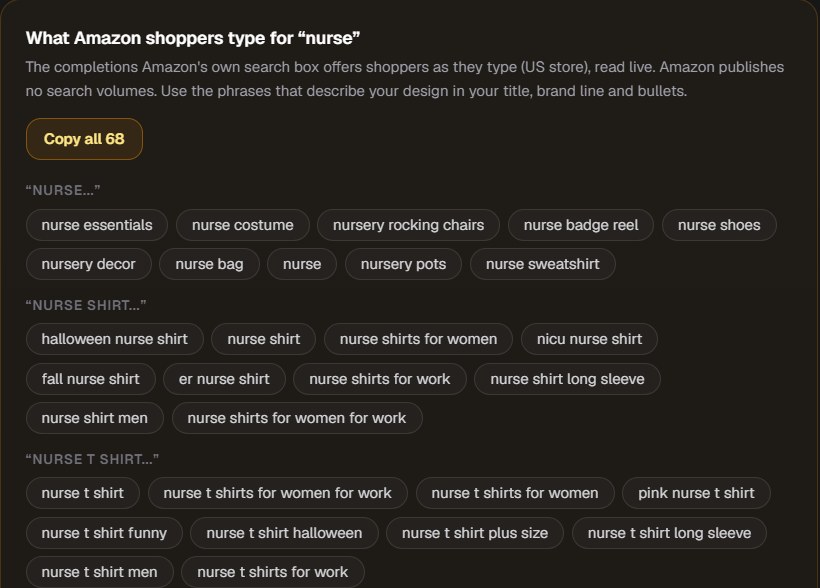
The "nurse shirt..." stem gave halloween nurse shirt, nicu nurse shirt, er nurse shirt, fall nurse shirt, nurse shirts for work and nurse shirt long sleeve. The "nurse t shirt..." stem gave nurse t shirt funny, pink nurse t shirt, nurse t shirt halloween and nurse t shirt plus size. Seasons, specialties, a tone, a color, a fit: a page of real angles.
But the bare "nurse..." stem also gave nursery decor and nursery rocking chairs, because Amazon completes letters, not intent, plus nurse shoes and a nurse badge reel, which aren't shirts. The lesson: autocomplete is raw material, not a list to paste. Keep the phrases that describe a shirt you would make. Autocomplete also shows only that a phrase is typed, not how often (Amazon publishes no search volume) or how crowded it is.
2. The titles and tags of shirts that already sell
Autocomplete shows what people type. The listings that sell show which of those words end in a purchase.
On Redbubble, tags are public, so you can count them. Our free Redbubble Tag Generator (10 lookups a day, no account) reads the best-selling Redbubble t-shirts for a niche live. For "axolotl," it read the top 30:
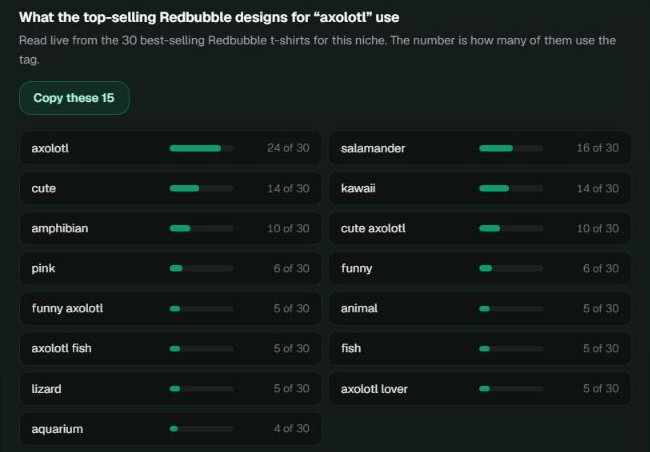
Axolotl was a tag on 24 of the 30. Salamander on 16, cute and kawaii on 14 each, amphibian and cute axolotl on 10, funny axolotl on 5, down to aquarium on 4. A button copies the top 15, Redbubble's tag limit.
Two things stand out. Sellers who sell use buyers' words, not only accurate ones: "axolotl fish" and "lizard" each appear on 5 of the 30, though an axolotl is neither. And a count shows what is common among shirts that sell, not what made them sell. High counts are the words the niche can't do without; low counts are often where the angles are.
The principle holds everywhere: look at what actually sells before you choose words or a design, then make your own version for the same buyer, never the same design or someone's title word for word. By hand across Amazon, Etsy, Redbubble and TeePublic, that takes hours per niche.
3. The words buyers use about themselves
In the nurse data, "nicu," "er" and "rn" are the words nurses use for their own jobs, and each turns a generic "nurse shirt" into a shirt for one person. Every hobby and job has this layer of abbreviations and in-jokes. Read where buyers talk (subreddits, Facebook groups, comments under videos), note the words that repeat, then confirm them in the marketplace's search box.
What I don't trust: unchecked keyword lists from an AI chatbot, full of plausible phrases nobody types, and Google volume treated as marketplace volume. Use them to brainstorm, then confirm inside the marketplace.
How to judge a t-shirt keyword before you design
Before I spend an hour on a design, I want four answers for the keyword it's built on:
- Does it name a buyer? "Registered nurse" does. "Funny" doesn't.
- Do shirts with it sell? A phrase can be typed often and still not lead to sales. Are the shirts under it picking up reviews, or sitting still?
- How many shirts already compete for it? Enough demand to matter, few enough competitors that a new listing gets seen. The answer differs by marketplace.
- Is it trademarked? A phrase registered for clothing is a phrase you can't use.
Here's what answers two and three look like in our own tool. This is Trendlytic's Keyword Research (a paid feature) for "nurse" on Amazon, the same day. It read the shirts that sell and returned 81 phrases, sorted by opportunity:
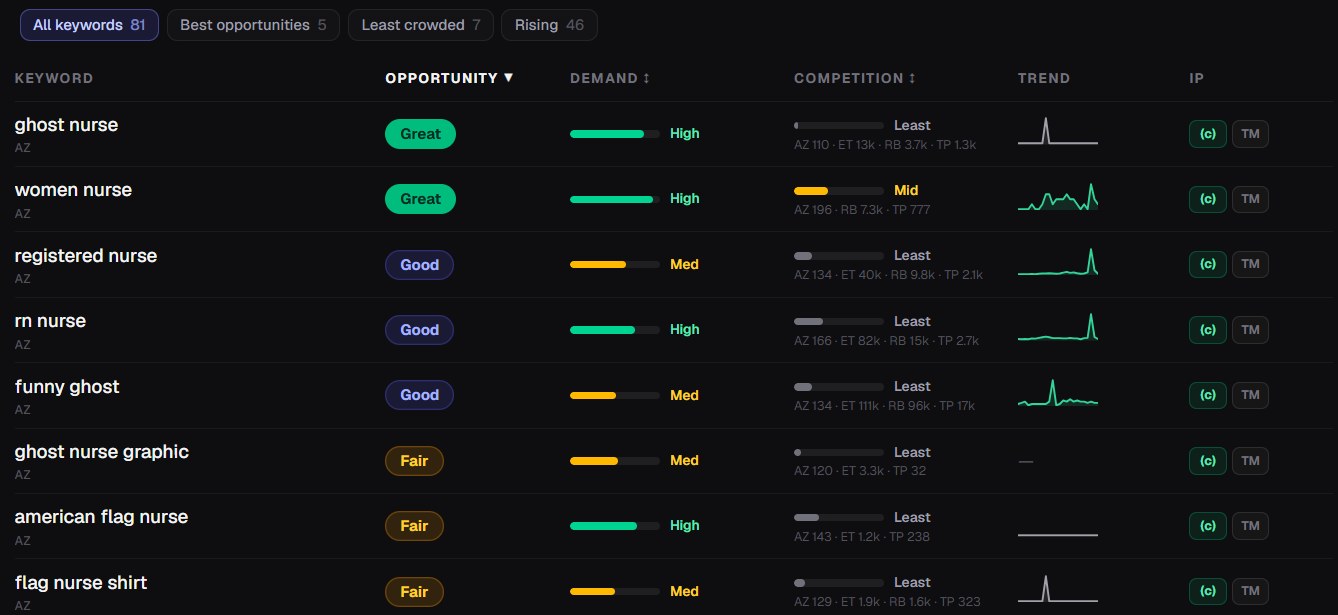
"Ghost nurse" tops the list, rated Great. Amazon returns 110 results for "ghost nurse t-shirt," against about 13k on Etsy, 3.7k on Redbubble and 1.3k on TeePublic. "Women nurse" is also Great. "Registered nurse" and "rn nurse" are Good, with 134 and 166 results on Amazon, and so is "funny ghost." Lower down, "ghost nurse graphic," "american flag nurse" and "flag nurse shirt" are Fair.
To read it correctly: the Amazon competition number is Amazon's own result count for the phrase plus "t-shirt." Demand, competition and opportunity are positions within this one search, not absolute numbers, so "High" demand means high among the nurse phrases. Each line also has a 12-month trend and a TM button for a USPTO lookup.
Why "nurse" deserves this work at all: an Amazon-only Trendlytic search for "nurse" that day read Hot Niche, with 48 shirts that have 1 to 19 reviews (marked New & selling) among 70,000 Amazon results. New shirts sell here, but 70,000 results makes the bare "nurse shirt" a wall. The opening is in narrower phrases; how to find low-competition keywords covers the general method.
Here's how I'd sort weak t-shirt keywords from strong ones, using phrases from the data above:
| Weak keyword | Stronger keyword | Why |
|---|---|---|
| t-shirt | nicu nurse shirt | Every listing in the category is a t-shirt. "NICU nurse" names one buyer, straight from Amazon's search box. |
| nurse shirt | halloween nurse shirt | The bare niche is where the 70,000 Amazon results sit. The occasion narrows it to one moment. |
| funny shirt | funny axolotl | "Funny" is a tone every seller claims. With a subject it's a search: a tag on 5 of the 30 best-selling Redbubble axolotl shirts. |
| cute animal tee | cute axolotl | Buyers name the animal they want. "Cute axolotl" was a tag on 10 of those 30. |
| soft premium cotton tee | ghost nurse | Nobody searches quality words, and Amazon's content policy bans claims about fabric. "Ghost nurse" rated Great, with 110 Amazon results. |
| nursery decor | (drop it) | It came from Amazon's autocomplete for "nurse," but it names a different product for a different buyer. |
The trademark check
On Amazon Merch, trademarked phrases are the most common reason accounts get into trouble, and every marketplace removes listings when a rights holder complains. Before a phrase becomes your main keyword or the text on the shirt, search the USPTO register, mainly Class 25, which covers clothing. A live registration for that phrase on clothing is a reason to drop it. Our free POD Trademark Checker runs the search (three checks a day, no login).
It's a first screen, not legal advice: rights can exist without a registration, and other countries keep their own registers. If a phrase matters to your business, ask a trademark attorney. More in the print-on-demand trademark guide.
Where t-shirt keywords go on each marketplace
Once a phrase passes, the same idea gets written differently on each marketplace, because each one reads different fields.
| Marketplace | Where the keywords go | Limits | What to watch |
|---|---|---|---|
| Amazon Merch on Demand | Brand name, title, two bullet points, description | No tags field. Amazon publishes no search volume. | The content policy bans claims about fabric or delivery and asking for reviews. Trademarked phrases are the most common reason accounts get into trouble. |
| Etsy | Title and tags | Title up to 140 characters. 13 tags, each up to 20 characters. | "registered nurse tee" fits a tag exactly; "registered nurse t-shirt" does not. |
| Redbubble | Title, tags, description | 15 tags, each up to 50 characters. | Length is rarely the limit; choice is. There's room for a full buyer phrase in every tag. |
| TeePublic | Main tag, additional tags, title, description | The main tag is weighted separately. TeePublic's own guidance is 6 to 15 relevant tags, and more is not better. | The main tag should be the one phrase that best describes the design. |
| Your own shop | Product title, description, page URL | Whatever your platform allows. | Buyers arrive from Google, so write the phrase the way someone types it there. |
Three notes the table can't hold:
- Amazon Merch has no tags, so every text field counts. A descriptive brand line does more than a made-up company name nobody searches. Put the main phrase first in the title and use the bullets for angles the title can't fit: the specialty, the occasion, who it's a gift for.
- Etsy's 20-character tags fit "halloween nurse tee" but rarely a phrase with "t-shirt" spelled out. Lead the title with your strongest phrase; the Etsy keywords guide goes deeper.
- On Redbubble, start from the tags the best-selling shirts share, then add phrases specific to your design. A few one-word tags are normal (the axolotl sellers used them); the Redbubble tags guide has the details.
A worked example: keywords for a nurse t-shirt
Here's the whole process on one niche: narrow, choose, check, write.
Narrow. "Nurse shirt" alone is too broad, but the Hot Niche reading says new shirts are selling, so the niche is worth narrowing rather than leaving.
Collect the angles. Amazon's search box gave specialties (nicu, er), seasons (halloween, fall), a tone (funny), a color (pink) and fits (plus size, long sleeve). Keyword Research added ghost nurse, women nurse, registered nurse, rn nurse and american flag nurse.
Choose one. In mid-October, two signals line up: "halloween nurse shirt" and "nurse t shirt halloween" are in autocomplete, and "ghost nurse" tops Keyword Research, rated Great, with 110 Amazon results. Its trend line is a single sharp spike, the shape of a seasonal phrase. So the design is a ghost nurse: my own version for the nurse buyer, not anyone else's ghost. Seasonal also means a short window; if it's too late this October, it's a note for next September.
Check. Before designing, I click TM on "ghost nurse" (or use the free checker) and look for a live registration on clothing, and I do the same for any slogan printed on the shirt.
Write it four ways. Examples of the shape, not a template to paste.
On Amazon Merch, everything goes into the text fields:
- Brand: Ghost Nurse Halloween Designs
- Title: Funny Ghost Nurse Halloween Shirt for RN, ER and NICU Nurses
- Bullet 1: Cute ghost nurse design for registered nurses, ER nurses and NICU nurses working the Halloween shift.
- Bullet 2: A Halloween gift for a nurse friend, a nursing student or the whole unit's fall party.
Notice what isn't there: nothing about the fabric, nothing about shipping, no request for a review.
On Etsy, the title leads with "Ghost Nurse Shirt" and the 13 tags each stay at 20 characters or fewer:
ghost nurse shirt
halloween nurse
funny nurse shirt
rn halloween shirt
er nurse shirt
nicu nurse shirt
fall nurse shirt
women nurse shirt
gift for nurse
spooky nurse tee
registered nurse tee
nursing student gift
cute ghost shirt
On Redbubble, start from the tags the best-selling shirts for "ghost nurse" share (the tag generator reads them in seconds), then add your own. At 50 characters a tag, "funny ghost nurse halloween shirt" fits in a single slot.
On TeePublic, the main tag is "ghost nurse," with eight supporting tags: nurse, halloween, registered nurse, rn, er nurse, nicu nurse, funny ghost, spooky. That's inside TeePublic's 6 to 15.
The buyer phrase is the same in all four. Only the shape changes.
T-shirt keyword mistakes I see most
Using the product as the keyword. "Shirt," "tee" and "graphic tee" are on every listing. Attach the product word to a buyer phrase; don't spend a tag on it alone.
Pasting autocomplete wholesale. Paste all 68 nurse phrases unread and some of your keywords are for rocking chairs.
Writing a clever title nobody types. A pun works on the shirt, rarely in search. The buyer's words go in the title; the joke goes on the design.
Using one list for every marketplace. Amazon has no tags, Etsy cuts tags at 20 characters, TeePublic weights one main tag. One list pasted four times fits none of them.
Repeating the same phrase everywhere. "Nurse shirt" five times across a Merch title and bullets reads as spam and wastes room for other angles.
Skipping the trademark check. The costliest mistake, especially on Merch. A generic-sounding phrase can still be registered for clothing.
Polishing keywords for a niche that doesn't sell. Judge the niche first, then the words. For a starting point, 40 t-shirt design ideas groups ideas by niche and occasion.
Frequently asked questions
What are the best keywords for t-shirts?
The best keywords for t-shirts are specific phrases that name a buyer and a subject, like "nicu nurse shirt," "ghost nurse" or "funny axolotl," rather than broad words like "shirt" or "funny." The strongest are typed by real shoppers, used on shirts that already sell, not too crowded where you sell, and not registered as a trademark for clothing.
How do I find keywords for t-shirts?
Start with the marketplace's own search box: type your niche and read the suggestions, which are phrases shoppers type. Then read the titles and tags of shirts that already sell in that niche, and listen to how buyers describe themselves in their communities.
How many keywords should a t-shirt listing have?
It depends on the marketplace. Etsy gives 13 tags of up to 20 characters, Redbubble 15 tags of up to 50, and TeePublic's guidance is 6 to 15 relevant tags plus one main tag. Amazon Merch has no tags, so the keywords go in the brand, title, two bullets and description.
Should I put "t-shirt" in my keywords?
In the title, yes, because buyers type it. As a keyword on its own, no: every listing in the category is a shirt, so it doesn't help the search engine choose yours. Attach it to a buyer phrase, like "halloween nurse shirt."
Do the same t-shirt keywords work on Amazon, Etsy, Redbubble and TeePublic?
The buyer phrases carry over, but the competition and the fields don't. On the same day, "ghost nurse" had 110 results on Amazon and about 13k on Etsy. Check each marketplace, then rewrite the keywords for its fields.
How do I check if a t-shirt phrase is trademarked?
Search it on the USPTO trademark register and look for a live registration in Class 25, which covers clothing. Our free POD Trademark Checker runs that search for you. Treat it as a first screen, not legal advice, and ask a trademark attorney about any phrase your business depends on.
Does Amazon show search volume for t-shirt keywords?
No. Amazon publishes no search volume, so any volume figure for an Amazon keyword is an outside estimate. What you can see is whether a phrase appears in Amazon's search box, how many results Amazon returns for it, and whether the shirts listed under it sell.
The short version
Keywords for t-shirts aren't a trick. Find the phrases buyers type (the search box, the shirts that sell, the community's own words), keep the ones that name a buyer and still have room, check them for trademarks, and write them into each marketplace's own fields.
The slow part is the middle: which phrases the shirts that sell are listed under, and how crowded each is on four marketplaces. We built Trendlytic to do that part, so weigh this knowing it's ours. Keyword Research shows the phrases the shirts that sell are listed under, how many shirts compete for each on Amazon, Etsy, Redbubble and TeePublic, a 12-month trend, and a USPTO lookup on any phrase in one click. Plans start at $19.99 a month for 100 credits, after a 3-day trial that opens with a $1 card check. If you'd rather start free, the keyword generator, tag generator and trademark checker linked above need no account.
What niche are you writing t-shirt keywords for right now, and which phrase are you stuck on?
Like this? Get one like it every Wednesday.
Niche data, trademark alerts, one tactic per week.
Try Trendlytic
Find your next winning POD niche in 40 seconds
Live data from TeePublic, Amazon Merch, Redbubble, and Etsy, with a trademark check built in. Then turn any winner into a listing for a design of your own in that niche. Plans from $19.99/month.
Start researchingKeep reading
- Trendlyticlow competition keywords
How to Find Low-Competition Keywords (Without Guessing)
The JournalHow to Find Low-Competition Keywords (Without Guessing)
July 25, 2026 · 13 min read
- Trendlyticmost searched keywords on amazon
Most Searched Keywords on Amazon: What Sellers Actually Type (2026)
The JournalMost Searched Keywords on Amazon: What Sellers Actually Type (2026)
July 20, 2026 · 18 min read
- Trendlyticbest keywords for etsy
Best Keywords for Etsy: How to Find the Ones That Actually Sell
The JournalBest Keywords for Etsy: How to Find the Ones That Actually Sell
July 14, 2026 · 17 min read