TL;DR: The best t-shirt design ideas are specific to a niche or an occasion, not generic. Text and typographic designs win in identity and humor niches — professions, hobbies, pets — while occasion shirts (white lie parties, senior year, Christmas, Mother's Day, field day, cruises) sell in predictable bursts around their event. Below are 40 ideas grouped by niche and occasion. But an idea only makes money if there's real demand and the niche isn't already flooded — so validate before you print a batch.
You came here for ideas, so I'll give you forty real ones — grouped, specific, and usable, not "make something funny and it'll sell." But I want to be straight with you up front, because most idea lists skip this part: an idea is the easy half. The same shirt concept that quietly earns for one seller is dead weight for the seller next door, and the difference is almost never the design. It's whether anyone is actually searching for it and how many people already got there first.
So read this two ways. If you're a seller or designer, treat each idea as a starting point you still have to validate. If you're just trying to make a shirt for your group trip or your kid's field day, skip straight to the occasion sections — those are written for you too. Either way, the goal is the same: a specific idea aimed at a specific person, not a vague slogan aimed at everyone.
Don't miss the next one.
New POD niche analysis every Wednesday.
How to use these ideas
Every idea below is a prompt, not a finished product. The reason matters: t-shirt printing is one of the most saturated corners of online selling, so a generic concept ("funny coffee shirt") is competing against tens of thousands of near-identical designs the moment you upload it. The ideas that earn are the narrow ones — a specific profession, a specific in-joke, a specific occasion with a date attached.
Here's the principle I'd hold onto. Before you commit time to designing, do two quick checks: is there real demand (are comparable shirts actually selling, not just being browsed), and is the specific angle already flooded by established sellers. Demand without a gap is a wall; a gap with no demand is an empty room. You want both — real buyers and room to compete.
Doing that by hand means digging through what's actually selling across several marketplaces, which is slow. I'll come back to that at the end. For now, the ideas. I've split them into evergreen niche ideas (sell year-round) and occasion ideas (sell in bursts around an event).
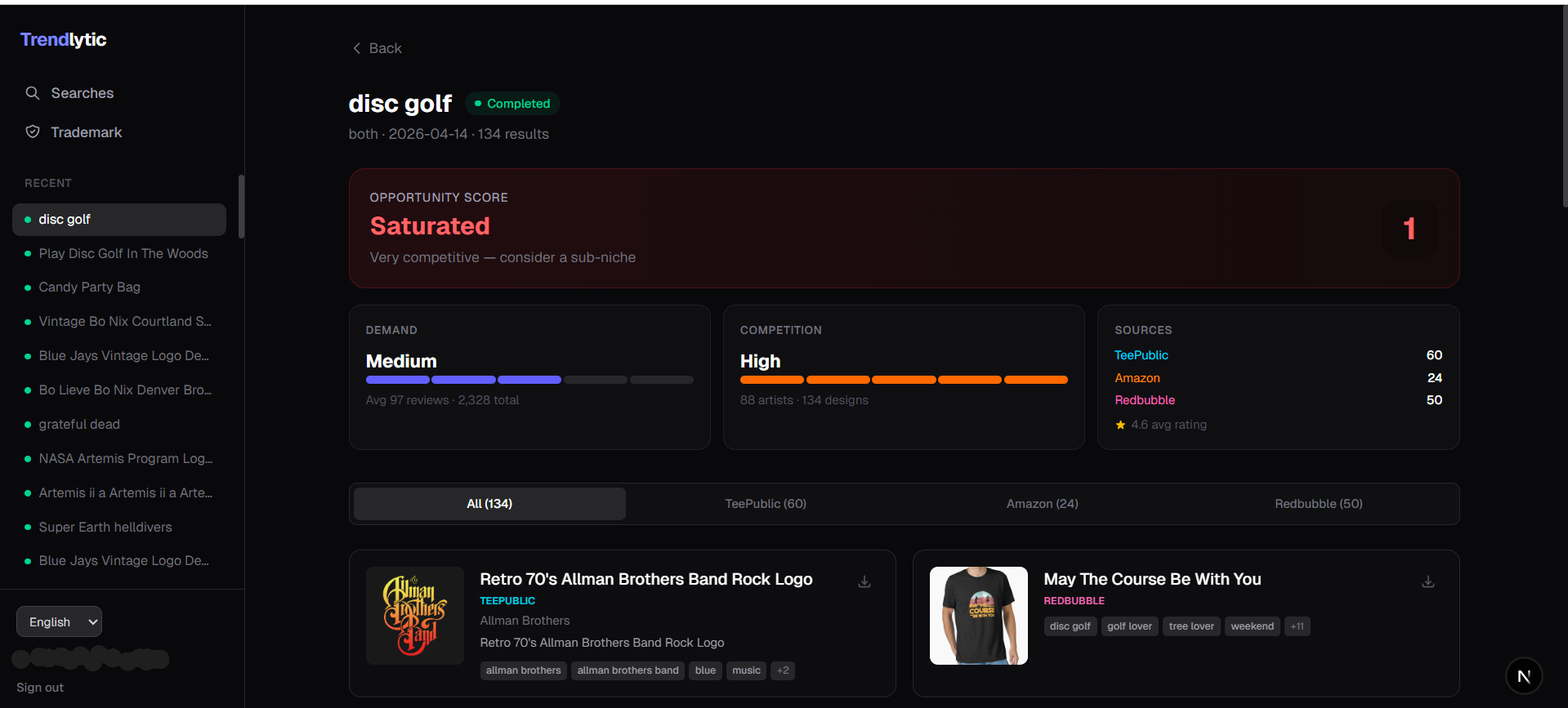
That "saturated vs. open" read is the check that decides whether an idea is worth your time — demand on one side, how crowded the lane already is on the other.
| Niche / occasion | Example design idea | Best marketplace |
|---|---|---|
| Profession pride | "Powered by caffeine and patient charts" for a specific nursing specialty | Amazon Merch / TeePublic |
| Hobby & passion | An insider line for one fishing style, not "I love fishing" | Redbubble |
| Pet parent | Breed-plus-situation: "senior rescue greyhound dad" | Redbubble |
| Funny one-liner | A relatable original gripe tied to one job or hobby | TeePublic |
| Aesthetic / trend | Retro sunset arch with a single niche word | Redbubble |
| White lie party | A short, true-but-absurd confession line | Etsy / Amazon Merch |
| Senior year | "Class of [year]" with a school-specific in-joke | Amazon Merch / Etsy |
| Christmas | A profession's first Christmas, not "Merry Christmas" | Amazon Merch |
| Mother's Day | A specific kind of mom, named and seen | Amazon Merch / Etsy |
| Field day | Matching team-color slogans by class or grade | Etsy / Amazon Merch |
| Cruise / group trip | A named group + year, in a vacation font | Etsy |
Niche-based t-shirt design ideas
These sell year-round because the audience always exists. The trap is going broad — "nurse," "dog mom," "gym." The opportunity is one layer narrower.
Profession & job-pride
People wear what they do, and coworkers and family buy these as gifts constantly. The money is in the specific role, not the broad job title.
- A typographic shirt for one nursing specialty with an insider gripe — pediatric, ICU night shift, hospice — not "world's best nurse."
- A teacher shirt tied to one grade and the last week of the year ("third grade is officially over").
- An engineering-discipline joke only that discipline gets — the running frustration of one specific field.
- A trucker shirt about life on long hauls, written in the actual language of the road, not "I love trucks."
- A trades shirt (electrician, welder, plumber) with a dry one-liner about the part of the job nobody sees.
The angle: text leads here. Write the line only an insider would write. Generic profession pride is flooded; role-plus-situation still has gaps.
Hobby & passion
Hobby communities are intensely identity-driven and the narrow sub-disciplines stay quieter than the broad topics.
- A fly-tying or fly-fishing line, not generic "fishing" — the specific style has far less competition.
- A camping shirt about one camping style (overlanding, hammock camping, dispersed) rather than "happy camper."
- A gaming shirt for one genre's in-joke — the specific frustration of a strategy player or a speedrunner.
- A gym shirt aimed at one lift or one training style, with a line a casual gym-goer wouldn't write.
- A gardening shirt that names the specific obsession — heirloom tomatoes, native plants, a particular zone.
The angle: use the real vocabulary of the hobby. "I love hiking" gets ignored; the insider phrasing gets bought.
Pet & animal lover
Pet owners buy on pure emotion and are among the least price-sensitive shoppers there are. "Dogs" and "cats" are dead ends; breed and situation are the opening.
- Breed-specific pride for a less common breed (corgi, Australian shepherd, dachshund) rather than generic "dog mom."
- A breed-plus-situation line: "senior rescue greyhound dad" or "reactive dog owner — we don't do dog parks."
- A cat shirt for a specific cat type or situation — three-legged cat parent, foster, senior-cat caretaker.
- A small-pet identity that's wide open — axolotl owner, betta keeper, house-rabbit person.
- A memorial or "fueled by coffee and a senior dog" emotional line — gentle, original, genuinely felt.
The angle: combine breed plus situation plus a little emotion. The more specific, the more the buyer feels personally seen.
Funny & sarcastic
Humor gets tagged and shared, which is free distribution — but generic "funny" is brutally saturated. Hyper-specific wins, and you must keep the line original.
- A dry one-liner about one specific job's daily annoyance — the complaint only that role understands.
- An introvert or "I had plans, the plans were canceled, this is the best day" style original line.
- A hobby-plus-frustration joke ("I'm not arguing, I'm explaining why the recipe is wrong" for home bakers).
- A parenting in-joke about one specific stage — toddler bedtime, teenager logic — written fresh, not copied from a meme.
- A seasonal mood line that's evergreen the rest of the year ("running on iced coffee and spite").
The angle: write the joke yourself, from inside the experience. And a real warning — punchy phrases get registered as trademarks constantly. Many famous funny lines you'd think are fair game are owned. Check before you print (more on that below).
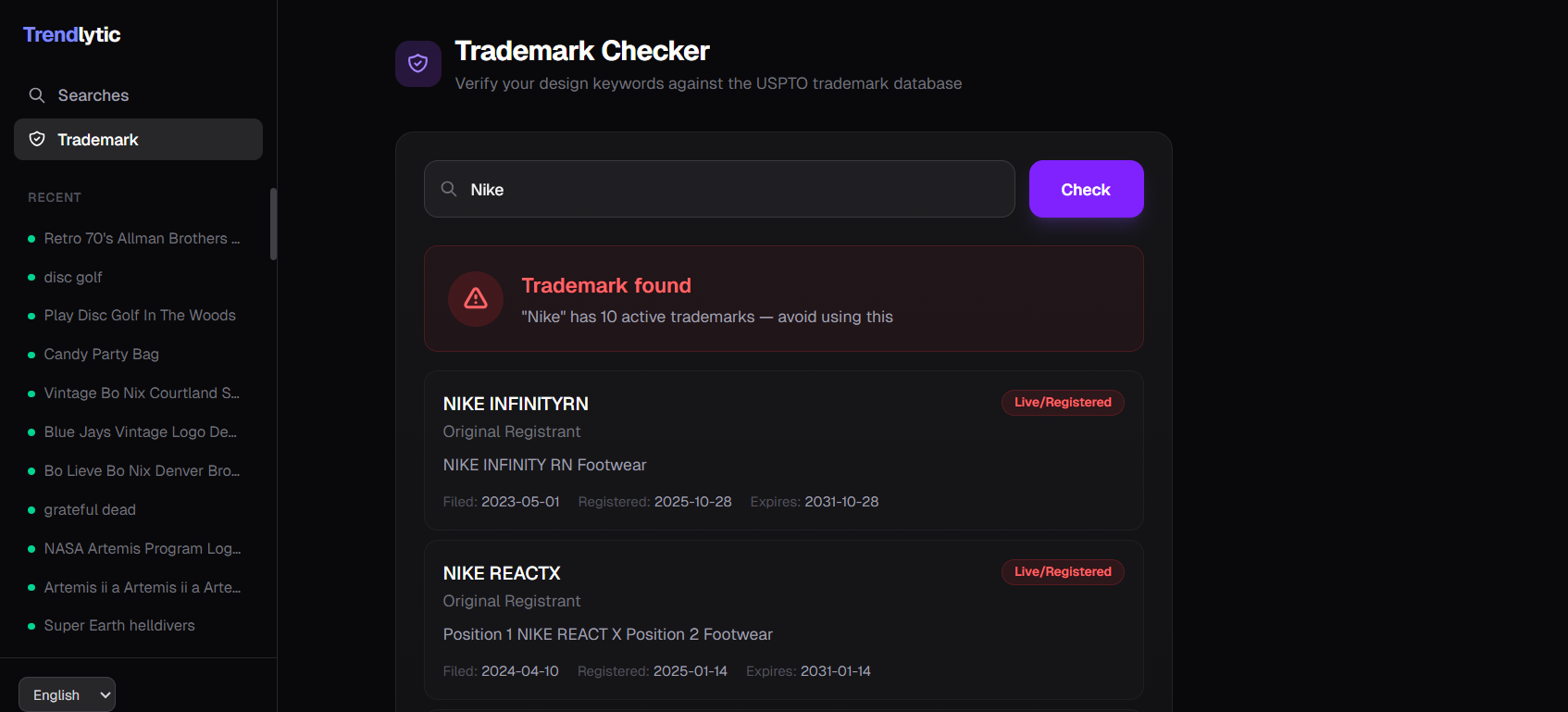
A two-minute check like this is the difference between a listing that stays up and one that gets your shop suspended.
Aesthetic & trend
Some buyers shop the look, not the message. These lean visual, and a coherent style beats a clever line.
- A retro/vintage sunset arch with a single niche word inside it — pairs with almost any hobby or place.
- A cottagecore design — soft botanical line art with a quiet, gentle phrase.
- A y2k-flavored design with bubble type and a nostalgic palette, aimed at a specific micro-trend.
- Minimalist single-line art — one continuous-line drawing of a subject (a plant, a face, an animal).
- A muted "groovy" 70s-revival layout with wavy text, applied to a narrow interest.
The angle: pick a defined aesthetic and stay consistent across a small set, so a buyer who likes one piece buys two.
Mental health & affirmation
Affirmation shirts sell on belonging and self-expression. The generic versions are crowded; specificity and sincerity make room.
- A grounded affirmation that isn't a cliche — original phrasing about rest, boundaries, or a hard year.
- A recovery-community line, sincere and specific to the milestone, written in the community's real language.
- A neurodivergent-identity design (original, respectful) for a specific lived experience.
- A gentle anxiety-relatable line that the right person reads and thinks "that's exactly it."
- A "still here" resilience design tied to a specific situation rather than a vague platitude.
The angle: be sincere and specific, and avoid the cliches everyone has already printed. This category is also dense with trademarked phrases — check every line.
Occasion & event t-shirt ideas
Occasion shirts don't sell year-round — they spike around their event, every year, on schedule. That predictability is the feature. The catch is timing: for the seasonal ones, you need designs live and ranking weeks before the demand curve, not during it.
White lie party shirt ideas
A white lie party is a theme party where everyone wears a shirt printed with a small, obviously-untrue "lie" about themselves — the funnier and more self-aware, the better. It's a genuinely popular search because attendees need a shirt fast, and it's one of the lower-competition occasion terms.
Concrete ideas (keep them original and true-to-absurd):
- "I'll start Monday."
- "I read the terms and conditions."
- "I'm five minutes away."
- "Just one episode."
- "I'm totally fine."
The angle: short, big, centered text. People want to read it across a room. A printable or quick-ship product wins here because the buyer usually needs it for a specific weekend.
Senior / class of [year] shirt ideas
Senior-year and "class of [year]" shirts sell in a reliable spring spike, and they sell to a whole graduating group at once — which is why a single good design can move volume.
- "Class of [year]" in a bold athletic font, plus a small school-specific in-joke.
- A "finally seniors" line with the year worked into the artwork.
- A countdown or "the last first day" sentimental design for parents to buy.
- A grade-wide matching design meant to be ordered in bulk by a class.
The angle: the year and the group are the whole point. Avoid official school logos and mascots — those are usually protected. Lean on the year, the vibe, and an original in-joke instead.
Christmas & holiday shirt ideas
Holiday shirts are the classic seasonal spike, and the ones that win combine the holiday with a second niche so they're not competing against every generic "Merry Christmas" shirt.
- A profession's first Christmas ("first Christmas as a [specific role]").
- A family matching set with an original, non-cliche holiday line.
- A specific-hobby Christmas ("a very [hobby] Christmas") for the enthusiast on the list.
- An "adulting at Christmas" original humor line for the relatable gift market.
The angle: publish six to eight weeks early so the listing has time to rank, and stack the holiday with another niche from above. Generic holiday shirts are a wall; holiday-plus-niche thins the field.
Mother's Day / Father's Day shirt ideas
These are gift-driven, deadline-driven, and emotional — strong intent. The generic "best mom" lane is flooded; the specific kind of parent is open.
- A shirt for one specific kind of mom — dog mom, plant mom, boy mom, NICU mom — named and seen.
- A "first Mother's Day" or "first Father's Day" milestone design.
- A grandparent version ("promoted to grandma") tied to a specific year.
- A dad-hobby crossover ("[hobby] dad") that doubles as a year-round gift.
The angle: specificity is the gift. "Soccer mom of three" beats "world's best mom" because the buyer recognizes their exact person.
Field day shirt ideas
School field-day shirts are a small but reliable late-spring term, usually ordered in bulk by a class, grade, or color team — so one design can sell in quantity.
- Color-team slogans ("Team Blue — here to win") meant to be ordered per team color.
- A grade-wide field-day design with the year and a playful, original tagline.
- A teacher/staff version that pairs with the student shirts.
- A simple "field day [year]" layout a school can reorder annually.
The angle: design for bulk and for matching sets across colors or grades. Keep it generic enough to reuse next year by swapping the year.
Cruise / group trip shirt ideas
Cruise and group-trip shirts are a fun, underrated occasion term. A group books a trip, someone wants matching shirts, and they need them before the sail date — high intent, deadline attached.
- A named-group design ("[Family name] Cruise [year]") in a relaxed vacation font.
- A "cruise mode: on" or original beach-pun line for a whole group to wear day one.
- A matching set with roles ("the planner," "the one who's late") for a friend group.
- A reunion-trip design that names the destination and the year.
The angle: customization is the value here — the group's name and the year. This is a great fit for a personalized listing, since every order is a little different and that's a natural moat.
Turning an idea into a design that sells
Here's the honest part, and it's the part that separates a hobby from income. Coming up with the idea is the easy half — you have forty of them now. The hard half is making sure the idea is one people actually buy before you commit a day to designing it.
Three checks, every time:
Real demand. Are comparable shirts actually selling — not just being browsed? Search volume tells you a phrase is popular; it doesn't tell you anyone buys. The signal you want is comparable designs with favorites, reviews, and best-seller positions. One viral shirt is a fluke; several selling shops in the same lane is demand.
Survivable saturation. Even with demand, if the first pages are wall-to-wall polished designs from entrenched sellers, the door is shut. You want demand that outstrips the current supply — a gap, not a wall. The narrow ideas above exist precisely to give you that gap.
Trademark-safe. This one ends accounts. A perfect funny line can be a registered trademark you're legally not allowed to print — punchy phrases get registered constantly, and apparel sits in a specific trademark class. Run your exact phrase through the USPTO trademark database before you design. It's free and takes two minutes, and skipping it is the fastest way to get a listing — or a whole shop — pulled.
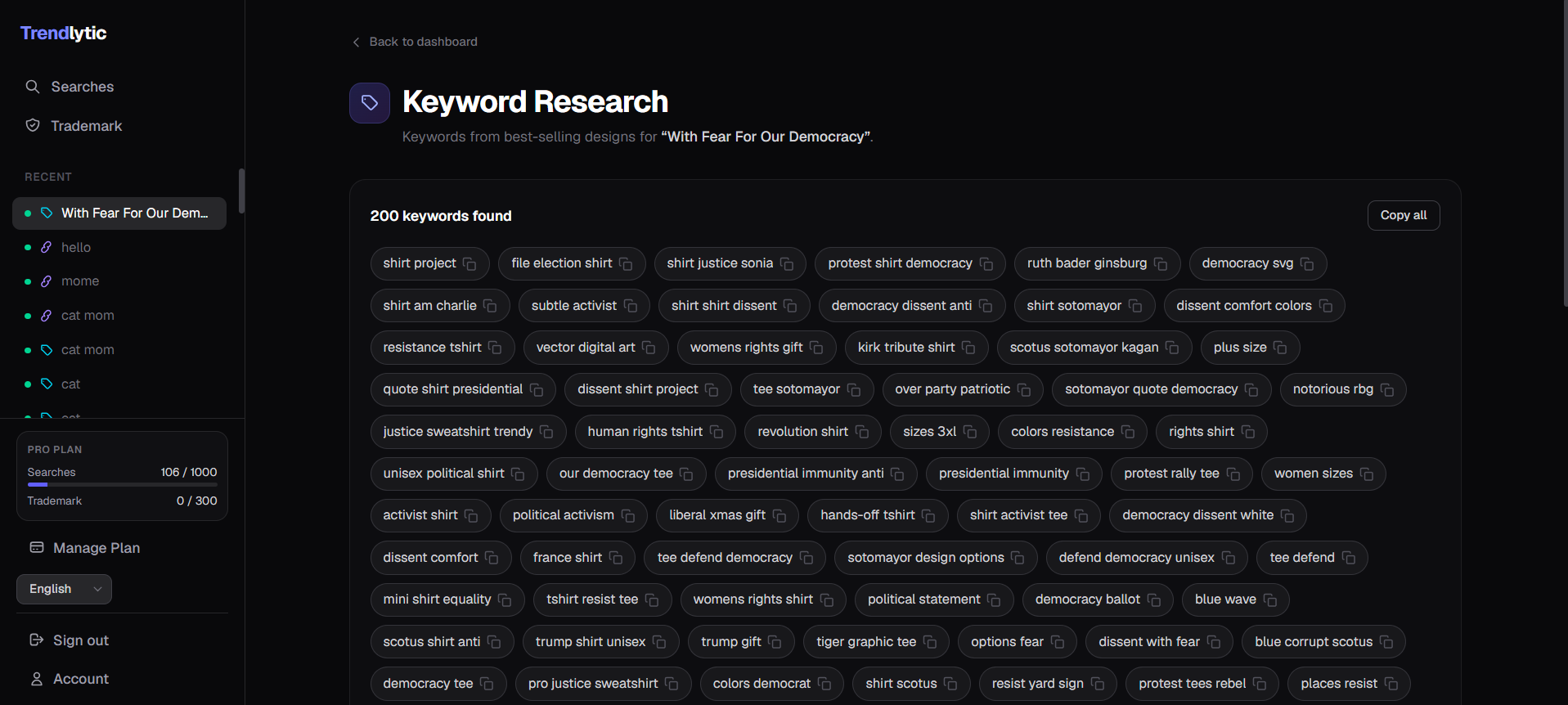
Doing all three by hand means reading what's actually selling across Etsy, Redbubble, Amazon Merch, and TeePublic, then checking the phrase against USPTO — hours of clicking per idea. That boring loop is exactly what Trendlytic handles: one search shows what's genuinely selling across all four marketplaces, store-first so you see what's bought rather than just searched, with a live USPTO check on every keyword. It doesn't design the shirt for you and it isn't a money printer — it just removes the guesswork from the step most people skip. If you want the deeper method, the most profitable print on demand niches and how to find trending POD niches guides walk through it, and print on demand niches covers the niche-versus-topic distinction that underpins all of this.
Once an idea is validated and you're ready to list, the Redbubble tag generator turns your niche into a full set of search tags in one click, so the design actually gets found.
FAQ
What t-shirt designs sell best? Specific, identity-driven and occasion designs sell best — not generic ones. Text and typographic shirts win in profession, hobby, pet, and humor niches because people wear them to say something about themselves. Occasion shirts (white lie parties, senior year, holidays, cruises) sell in reliable bursts around their event. The common thread is narrowness: a shirt aimed at one specific person in one specific situation beats a slogan aimed at everyone, because it has a real buyer and far less competition.
How do I come up with t-shirt design ideas? Start from people, not topics. Take a broad subject and stack details until you reach a specific audience: a profession plus a specialty, a hobby plus a sub-style, a pet breed plus a situation, an occasion plus a year. The list above is forty starting points. Then, before you design, check that comparable shirts are actually selling and that the specific angle isn't already flooded — the idea is only worth pursuing if there's real demand with room to compete.
What are good t-shirt ideas for an occasion or party? For a white lie party, print a short, obviously-untrue confession ("I'll start Monday"). For senior year, a "class of [year]" design with a group in-joke. For Christmas, combine the holiday with a niche ("first Christmas as a nurse") rather than going generic. For Mother's or Father's Day, name the specific kind of parent. For field day, matching color-team slogans. For a cruise or group trip, the group's name plus the year in a vacation font. Match the design to the occasion and, for the seasonal ones, prepare it weeks ahead.
Are funny t-shirts profitable? They can be, but generic humor is one of the most saturated spaces there is, so a vague "funny" shirt usually disappears. Hyper-specific humor profits — an in-joke only one job, hobby, or community fully gets — because it makes the right person laugh and tag their friends, which is free distribution. The big caveat: write the line yourself and trademark-check it, because punchy phrases get registered constantly and printing one you don't own can cost you the listing or the account.
Do I need to worry about trademarks on t-shirt designs? Yes — this is the single most important check. Many common-sounding funny phrases, pop-culture lines, slogans, and even ordinary-seeming sayings are registered trademarks, and apparel falls in a specific trademark class. Printing a phrase someone else owns can get your listing removed or your whole shop suspended. Search your exact wording in the USPTO trademark database before you design. It's free, it takes two minutes, and it prevents most avoidable suspensions.
What's a white lie party shirt? A white lie party is a theme party where everyone wears a shirt printed with a small, obviously-untrue statement about themselves — the more self-aware and funny, the better ("I read the terms and conditions," "I'm five minutes away"). The shirts are the whole point of the party, which is why people search for ready-made ideas and quick-ship options close to the event. For sellers, it's a fun, lower-competition occasion term; for partygoers, the design just needs to be short, big, and readable across a room.
Where should I sell t-shirt designs? Match the design to where its buyers shop. Amazon Merch on Demand is strong for profession, milestone, and gift-driven apparel because of its reach and gift search. Redbubble suits hobby, pet, and aesthetic designs with its browse-and-discover audience. TeePublic is strong for humor and design-aware communities. Etsy is the home for personalized and occasion shirts (cruises, parties, custom group orders) where the margins live. Many sellers validate across the open marketplaces, then build their branded shop on Etsy — see best things to sell on Etsy for that side.
Conclusion
Forty ideas, but the takeaway is one line: a good t-shirt idea is specific, and a profitable one is specific and validated. The niche designs above sell year-round to a defined audience; the occasion designs sell in predictable bursts to people with a date and a reason to buy. Any of them can work. None of them works just because it's on a list — the design is the easy half, and the buyer is the half that decides.
So before you spend a day designing, spend a minute checking the idea is real. Trendlytic does that boring research for you — one search across Etsy, Redbubble, Amazon Merch, and TeePublic showing what's actually selling, store-first, with a live USPTO trademark check on every keyword. It's $9 a month for 100 searches, with a free trial. Validate the niche, then design with confidence.
Which of these forty are you going to try first — and is it for selling, or for your own group? I'd genuinely like to know what you're making.
Like this? Get one like it every Wednesday.
Niche data, trademark alerts, one tactic per week.
Try Trendlytic
Find your next winning POD niche in 40 seconds
Live data from TeePublic, Amazon Merch, Redbubble, and Etsy, with a trademark check built in. Then turn any winner into a listing for a design of your own in that niche. Plans from $9/month.
Start researchingKeep reading
- Trendlyticcustom mouse pads
Custom Mouse Pads: What Sells and What Does Not
The JournalCustom Mouse Pads: What Sells and What Does Not
September 25, 2026 · 18 min read
- Trendlyticcustom coasters
Custom Coasters: What Sells, and Why It Is Sets
The JournalCustom Coasters: What Sells, and Why It Is Sets
September 25, 2026 · 18 min read
- Trendlyticcustom trucker hats
Custom Trucker Hats: The Seller's Product Guide
The JournalCustom Trucker Hats: The Seller's Product Guide
September 24, 2026 · 18 min read