TL;DR: There is no single best print-on-demand company. It depends on your model. If you want to run your own store, the leading fulfillment services are Printful (quality and branding), Printify (low base cost and huge product choice), and Gelato (global production and fast international shipping). If you want a ready-made audience and a hands-off setup, the marketplaces are Redbubble, Amazon Merch on Demand, and TeePublic. Etsy sits in between: your own storefront paired with a fulfillment service. Below, each company is ranked by what it is genuinely best for, not by a fake overall score.
Almost every "best print on demand companies" list ranks ten brands in a straight line and crowns one winner. That framing is wrong, because these companies do not do the same job. Some print and ship orders for a store you already run. Others are marketplaces that bring their own buyers and pay you a royalty. Comparing Printful to Redbubble as if they compete is like comparing a delivery van to a shopping mall.
So this guide is organized the honest way: by the two real categories, and by what each company is actually best for. I run Trendlytic, a POD research tool, so I want to be clear up front that Trendlytic is not one of these companies and does not compete with any of them. It is the research step that comes before you pick one. More on that where it is relevant, and not before.
(Brand new to all of this? Start with the difference between the two categories below, then match yourself to a company.)
Don't miss the next one.
New POD niche analysis every Wednesday.
How to choose a print-on-demand company
Before you look at any brand, you need to know which of two categories you are shopping in. They are completely different businesses.
Fulfillment / integration services. These connect to a store you own, usually Etsy, Shopify, WooCommerce, or a similar platform. You design the product and set the price; when a customer orders, the service prints it and ships it under your brand. You keep the margin between the base cost and your retail price. You also own the customer relationship. The catch is that these services do not send you a single buyer. Traffic is entirely your job. Printful, Printify, Gelato, Gooten, and SPOD all fall here.
POD marketplaces. These are destinations with their own shoppers. You upload a design, they handle everything else, and you earn a royalty on each sale. The buyers are already there, browsing. The trade-off is that you compete inside a crowded catalog, you do not own the customer, and your margin is capped by the platform. Redbubble, Amazon Merch on Demand, TeePublic, Society6, and Zazzle fall here. Etsy is a special case: it is a marketplace with real buyer intent, but you pair it with a fulfillment service to actually print orders.
Three questions decide which category, and then which company, fits you:
- Do you want your own store, or a ready audience? Your own store means more control, better margins, and more work driving traffic. A marketplace means built-in buyers but a capped royalty and no customer list.
- Do you prioritize margin or quality? Some services win on low base costs, which protects your margin. Others win on print quality and branding, which builds repeat buyers but costs more per unit.
- How hands-on do you want to be? Marketplaces are close to passive once a design is live. Running your own store with a fulfillment service is an active business: listings, ads, customer service, and returns are all yours.
Here is the full lineup at a glance before each company gets its own section.
| Company | Type | Best for |
|---|---|---|
| Printful | Fulfillment service | Quality and branding for your own store |
| Printify | Fulfillment service | Low base costs and the widest product choice |
| Gelato | Fulfillment service | Global production and fast international shipping |
| Gooten | Fulfillment service | Home decor range and scaling operations |
| SPOD / Spreadshirt | Fulfillment service + marketplace | Fast production and an easy start |
| Redbubble | Marketplace | Hands-off selling with a browse-and-discover audience |
| Amazon Merch on Demand | Marketplace | Maximum reach and buyer trust |
| TeePublic | Marketplace | Apparel and niche-humor communities |
| Society6 | Marketplace | Home decor and design-led art prints |
| Etsy + a fulfillment service | Marketplace + service | Your own storefront with buyer intent |
Best print-on-demand fulfillment services
These are the companies you connect to a store you own. You bring the traffic; they print and ship.
1. Printful
Printful is the premium option, and the one most people think of first. It prints much of its catalog in its own facilities, which gives it tighter control over quality and consistency than services that rely on a network of third-party printers.
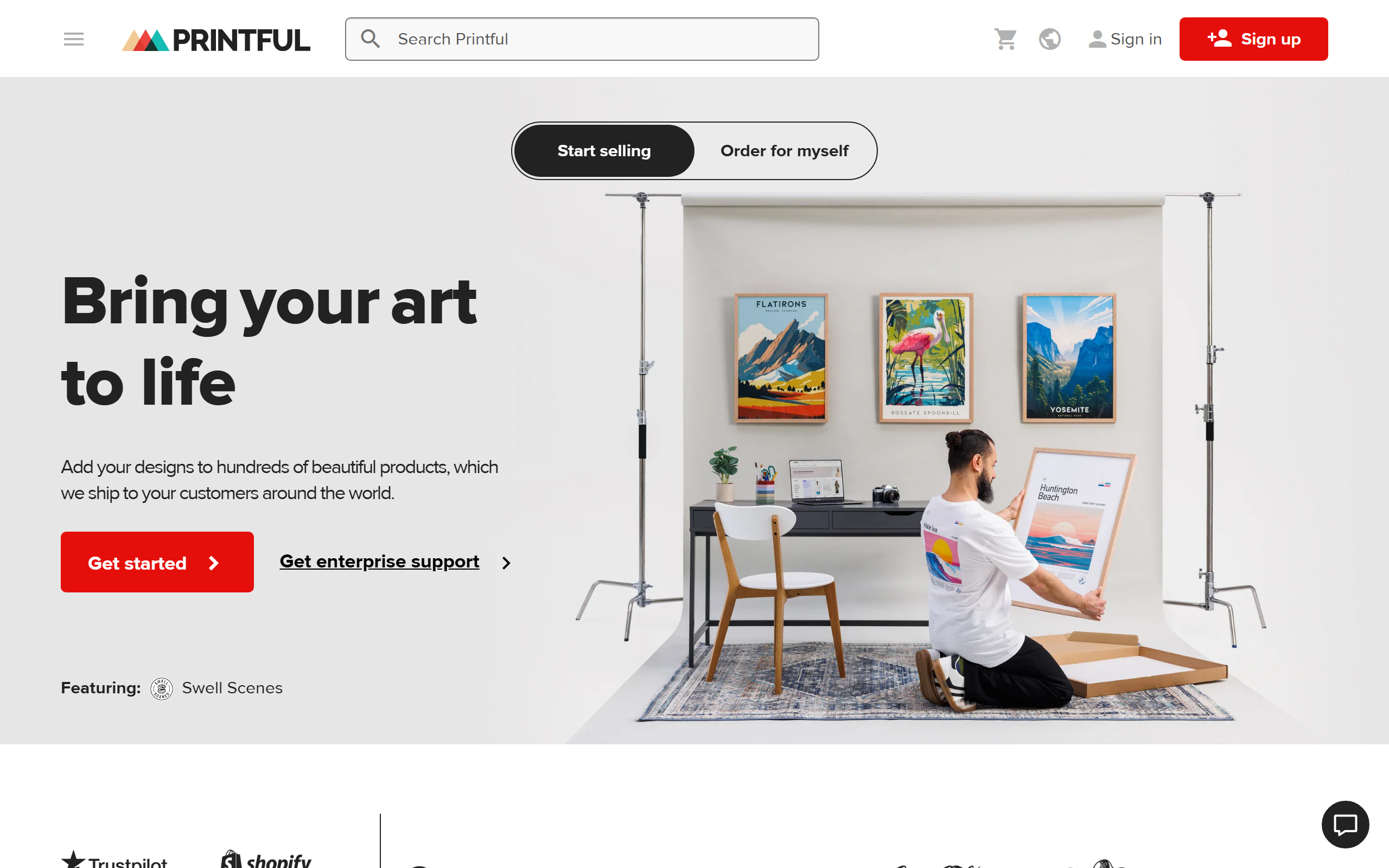
What it is: A fulfillment service that integrates with Etsy, Shopify, and most major store platforms. It leans into branding, with options like custom labels, packaging inserts, and pack-ins that make the order feel like it came from your brand, not a print shop.
Best for: Sellers who care about print quality and want to build a real brand, not just move cheap units. If repeat buyers and a professional unboxing matter to you, Printful is the safer choice.
The honest trade-off: Base costs run higher than the budget services, which squeezes your margin unless you price for it. You are paying for consistency and branding, and that only pays off if your customers value it. If you are racing to the lowest possible price, Printful is not where you win. If you are unsure between the two big names, the Printful vs Printify comparison breaks the decision down in detail.
2. Printify
Printify takes the opposite approach. Instead of printing in-house, it is a marketplace of independent print providers you choose from, which is exactly what makes it cheap and flexible.
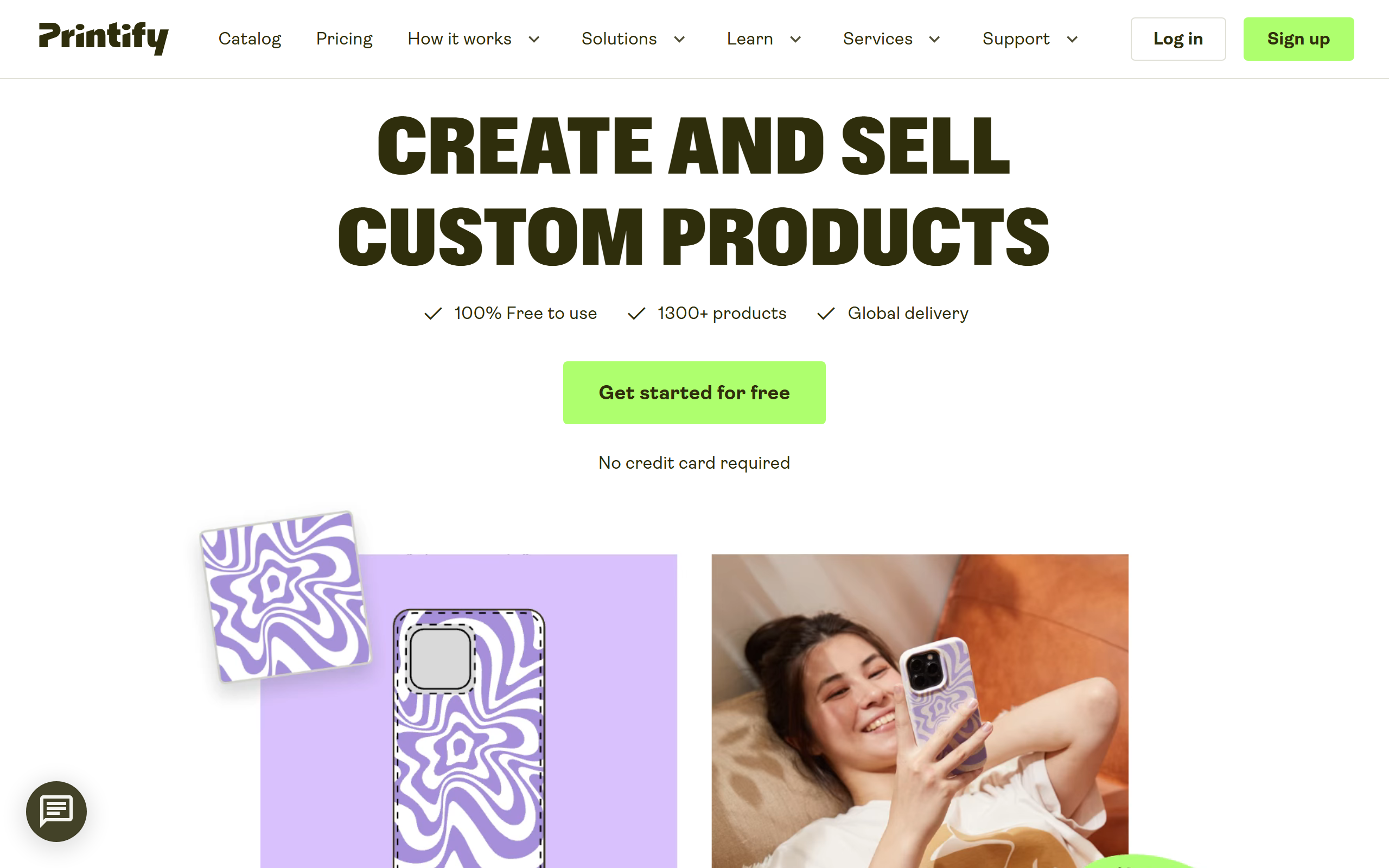
What it is: A fulfillment service that connects the same store platforms as Printful, but routes each order to a third-party print provider you select. Because providers compete, base costs tend to be lower, and the combined catalog is enormous.
Best for: Margin-focused sellers and anyone who wants the widest possible product and provider choice. If you want to shop around for the cheapest base cost on a given product, or find a provider close to your buyers, Printify gives you that control.
The honest trade-off: Quality and turnaround vary by provider, because you are not dealing with one company's standard. You have to vet providers yourself, order samples, and sometimes switch when a provider underperforms. The flexibility is real, but so is the homework. A paid upgrade tier lowers base costs further if you sell at volume.
3. Gelato
Gelato's whole pitch is geography. It runs a global network of production partners, so an order placed in Australia can be printed in Australia rather than shipped across the world.
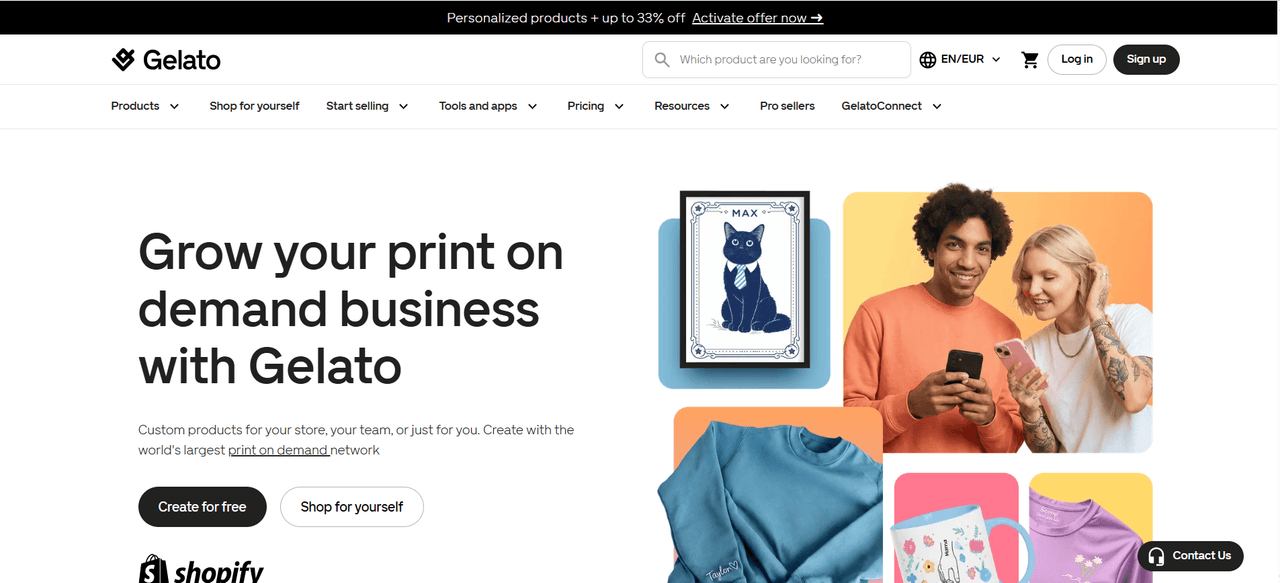
What it is: A fulfillment service with production spread across many countries. When a customer orders, Gelato routes the job to a facility near them, which shortens shipping distance and time and can lower shipping cost for international buyers.
Best for: Sellers with an international audience, or anyone who wants faster, cheaper delivery outside one home country. If your buyers are spread across continents, local production is a genuine advantage that the mostly-US-centric services cannot match as easily.
The honest trade-off: The catalog, while solid, is more focused than Printify's sprawling provider marketplace, and product availability can differ by region depending on which local partner handles it. For a purely domestic US store, the global-network advantage matters less, and a US-focused service may serve you just as well.
4. Gooten
Gooten is the quieter operations-focused option. It is less of a household name than Printful or Printify, but it has a reputation for a broad catalog and a setup aimed at sellers scaling up.
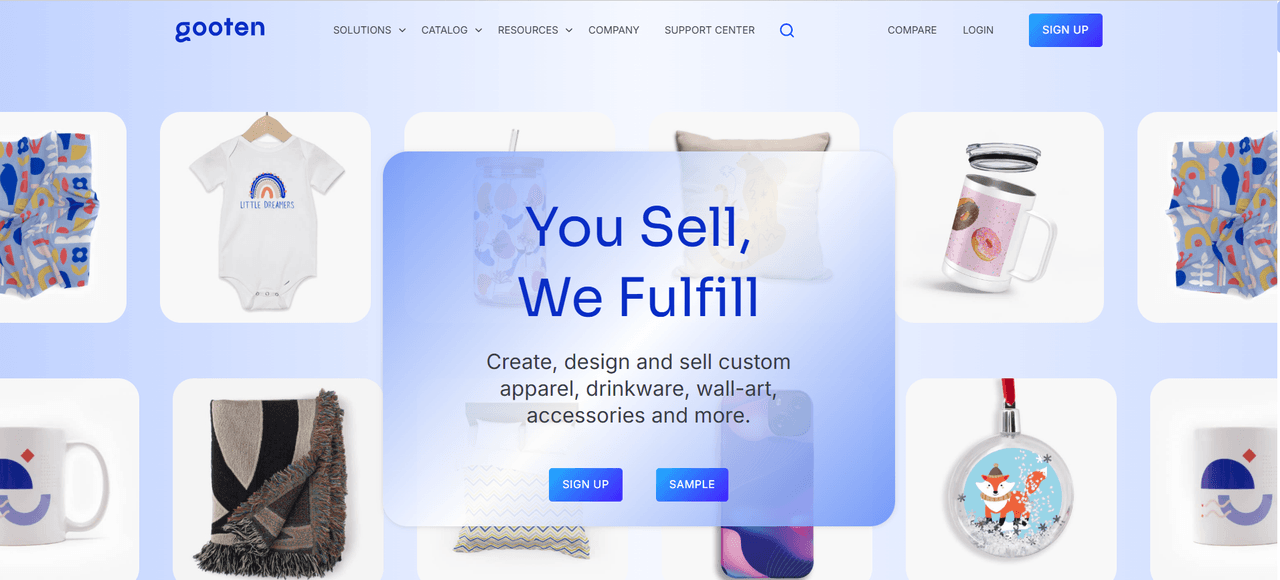
What it is: A fulfillment service with a large product range, strong on home and lifestyle items alongside apparel. It integrates with the usual store platforms and positions itself around reliable operations for growing stores.
Best for: Sellers who want a wide home-decor and lifestyle catalog, or who are scaling and want a fulfillment partner built around volume rather than a beginner's first store.
The honest trade-off: It has a smaller community and fewer tutorials than the big two, so you will find less hand-holding when something goes wrong. For a first-time seller, that thinner support ecosystem can matter more than the catalog breadth.
5. SPOD / Spreadshirt
SPOD and Spreadshirt are two sides of the same company. SPOD is the fulfillment service you plug into your own store; Spreadshirt is a marketplace where you can also sell without one. Its calling card is fast production. SPOD has since been renamed Spreadconnect, and spod.com now redirects to it. My SPOD review goes through the service in detail.
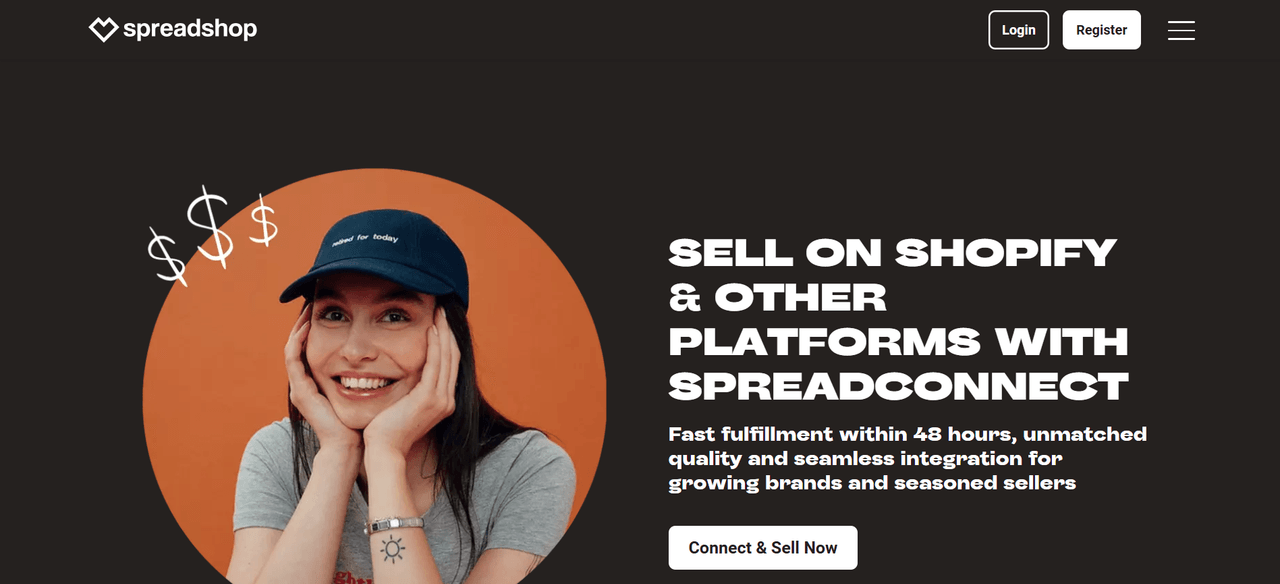
What it is: SPOD is a fulfillment service known for quick turnaround, which shortens the gap between order and delivery. Spreadshirt is the connected marketplace, so the same company gives you both a fulfillment option and a ready-audience option.
Best for: Sellers who prioritize production speed, and beginners who want a low-friction start, either on the Spreadshirt marketplace or by connecting Spreadconnect to a store they run.
The honest trade-off: The catalog is narrower and leans hard into apparel, so it is less suited to sellers who want a wide decor and lifestyle range. The dual model can also be confusing at first, since SPOD and Spreadshirt are related but not the same thing.
Best print-on-demand marketplaces
These companies bring their own buyers. You upload designs and earn a royalty, with far less to manage.
6. Redbubble
Redbubble is the classic hands-off marketplace and, for many sellers, the easiest place to start. One upload can become a sticker, a poster, a mug, a tote, a phone case, and a shirt in minutes.
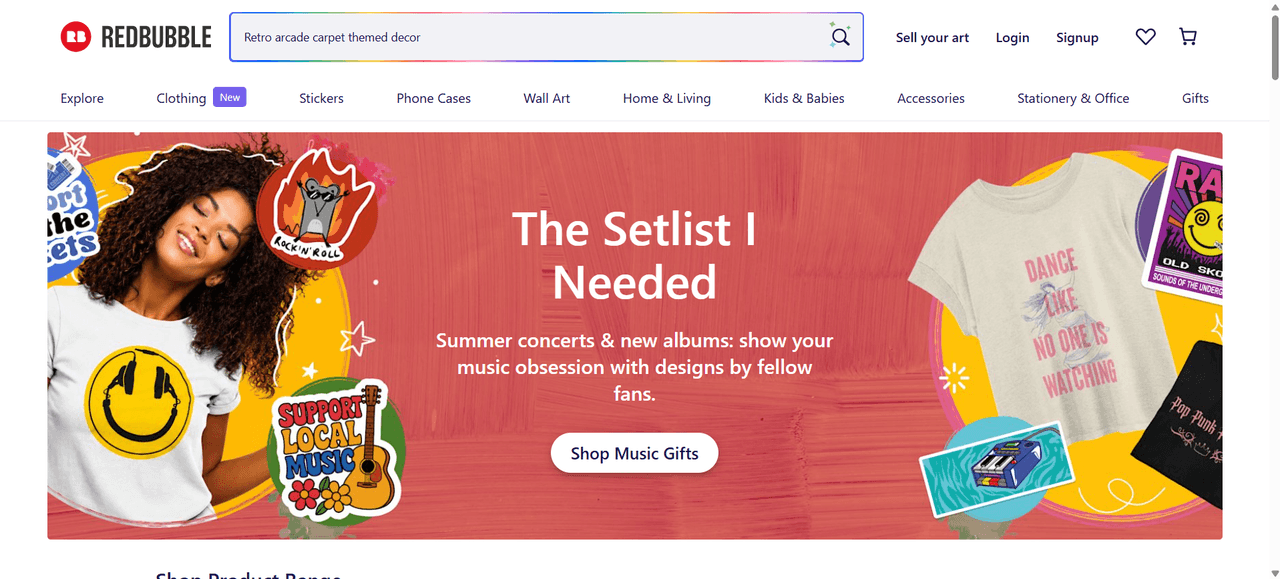
What it is: A browse-and-discover marketplace with a huge catalog and a large audience that arrives looking for art on things. You upload once, and Redbubble handles printing, shipping, payment, and returns. Your income is a royalty, and you can set your markup on many products.
Best for: Sellers who want the most hands-off setup and the widest product range from a single design, especially illustration-driven work. If you want to test many niches with low effort, Redbubble is the natural home.
The honest trade-off: It is one of the most saturated platforms in print on demand, so generic subjects are invisible. Discovery lives in your tags and a tight niche. If you are weighing it against Etsy, the Etsy vs Redbubble comparison covers the control-versus-convenience trade in depth.
7. Amazon Merch on Demand
Amazon Merch puts your designs in front of the largest buyer pool in the world. That reach is the entire appeal, and the strict access rules are the entire catch.
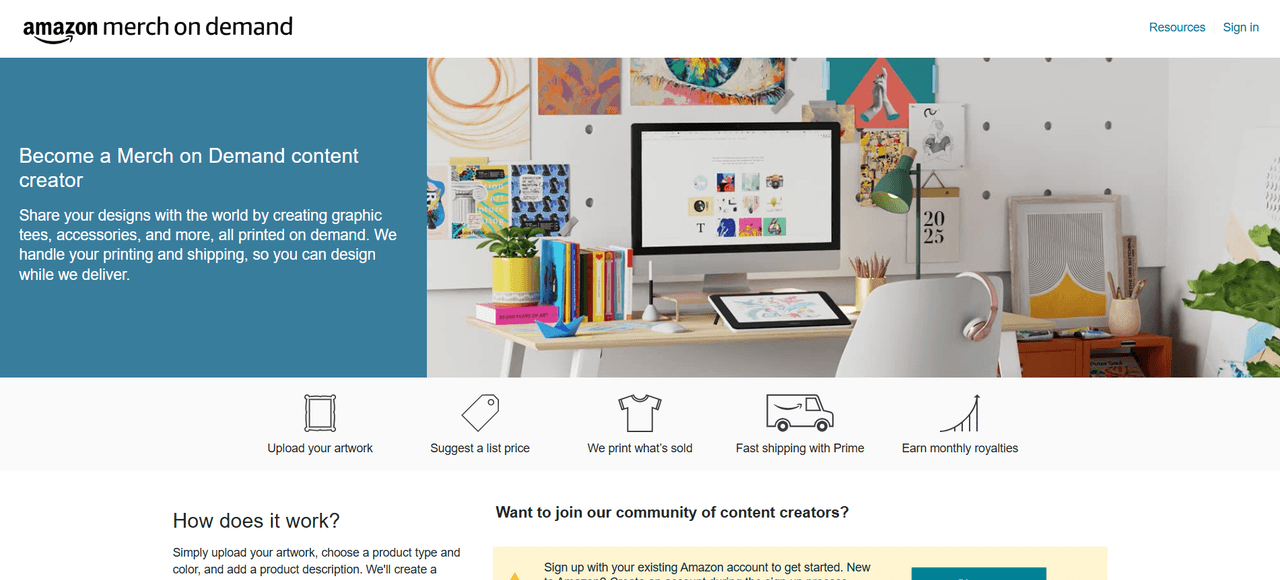
What it is: A marketplace where you upload apparel designs and earn a royalty when they sell on Amazon (if the name is new to you, here's what Merch by Amazon is). Buyers arrive with trust and fast shipping already built in, which is intent no independent store can match easily.
Best for: Reach, and the buyer trust that comes with Amazon. Text-and-graphic apparel designers who want raw traffic over a curated art audience do best here.
The honest trade-off: It is invitation-based and tier-gated. You start with a small number of design slots and unlock more as you sell, so early progress is slow. It is also the strictest on trademarks, and a single registered phrase can get your account suspended. Trademark-checking every phrase before you upload is not optional here.
8. TeePublic
TeePublic is apparel-first and built around design-aware, humor-driven communities. It runs frequent sitewide sales that drive volume, and it is part of the Redbubble group.
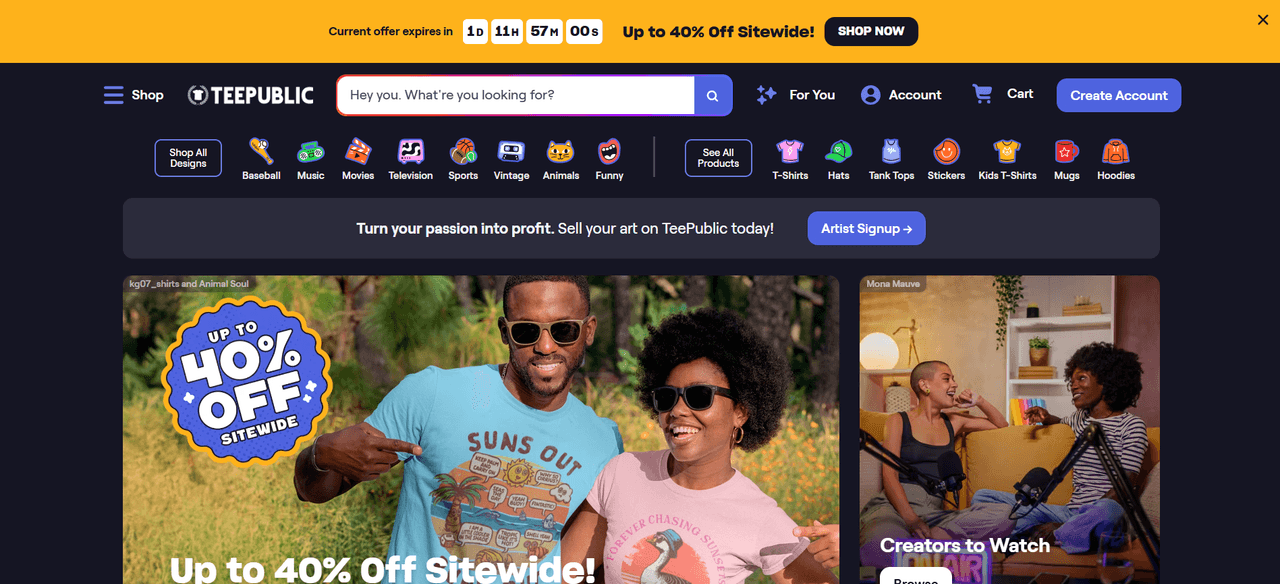
What it is: A marketplace focused on shirts and hoodies for a browsing crowd that shops during regular sales. Like Redbubble, it handles fulfillment end to end and pays you a royalty.
Best for: Apparel and niche-humor artists. Sharp text, fandom-adjacent jokes, and specific-community designs that read well on a shirt find their audience here.
The honest trade-off: New-seller discovery is tougher than on Redbubble because the catalog is deep and the front page favors established sellers. You earn visibility through tight niches and volume, and a lot of your sales will happen during the platform's discounts rather than at full price.
9. Society6
Society6 is the design-led marketplace. It leans into home decor and art prints with a curated, tasteful feel, and its audience reflects that.
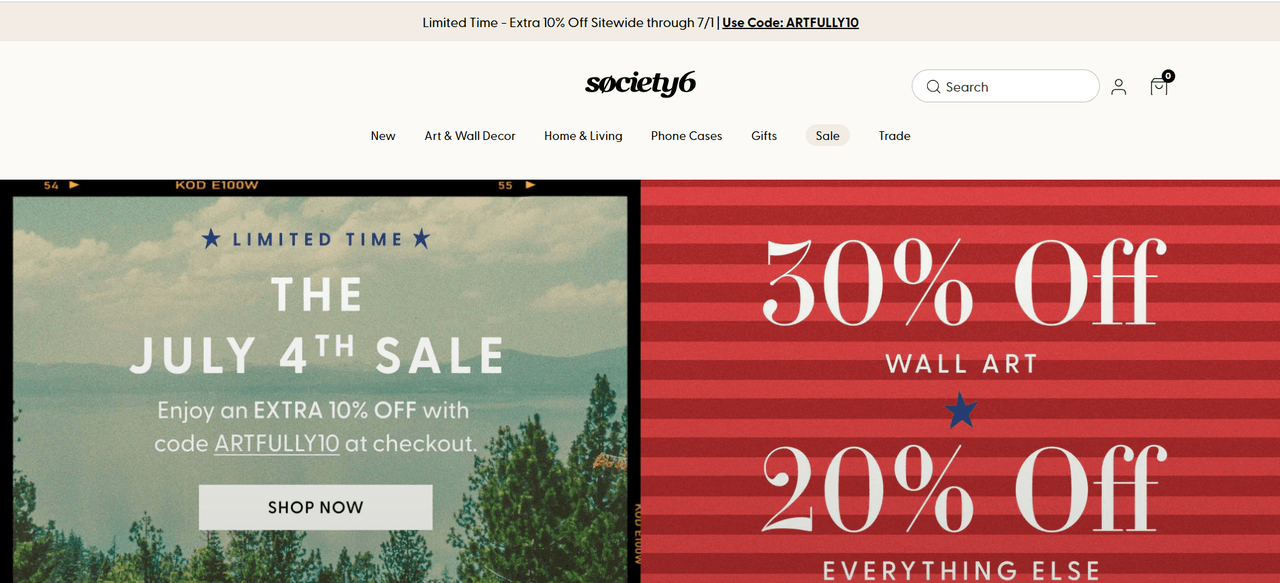
What it is: A marketplace built around wall art, framed prints, throw pillows, tapestries, and patterns, aimed at decor-minded, design-aware shoppers rather than impulse buyers. You upload, and Society6 handles the rest for a royalty, with markup control on art prints.
Best for: Home decor and art-print aesthetics. If your work looks at home in a styled room, Society6's audience is buying to furnish a space and cares how a piece looks on a wall.
The honest trade-off: Traffic and discovery are lower than on the big apparel marketplaces, so you cannot lean on the platform to push your work. A cohesive, recognizable style matters more here because decor buyers who like one print often buy several.
10. Etsy + a fulfillment service
Etsy is the in-between option, and for many sellers the best of both worlds. It is a marketplace with genuine buyer intent, but you pair it with a fulfillment service like Printful, Printify, or Gelato to print and ship your orders.
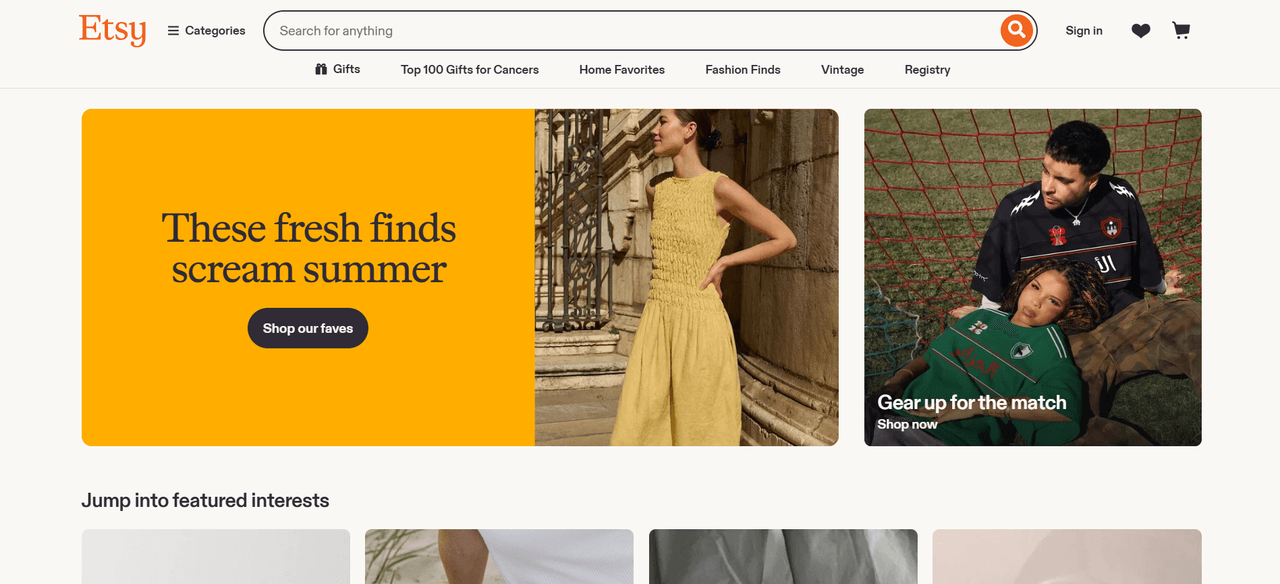
What it is: Your own storefront inside a marketplace people actively shop for original and personalized goods. Etsy brings search traffic and buyer trust; the connected fulfillment service does the printing. You set prices and keep the margin, and you own more of the customer relationship than on a pure royalty marketplace.
Best for: Sellers who want buyer intent without building a store from scratch, plus better margins and more control than Redbubble or TeePublic allow. Personalized and gift-driven products do especially well on Etsy.
The honest trade-off: You handle listings, SEO, fees, and customer questions yourself, and Etsy does not hand you traffic the way a browse page does. You drive it through search ranking and sometimes ads. This is where I will note, since Etsy research is easy to get wrong, that Trendlytic now covers Etsy alongside the other three marketplaces, so one search shows which designs are genuinely moving on Etsy, Redbubble, Amazon Merch, and TeePublic at once. More on that below.
Which print-on-demand company should you choose?
There is no overall winner, so here are the honest "best for X" verdicts. Match yourself to the one that fits your goal.
| Your goal | Best pick | Why |
|---|---|---|
| Best overall for your own store | Printful | Quality and branding build repeat buyers |
| Best for margins | Printify | Low base costs and provider competition |
| Best for global shipping | Gelato | Local production near international buyers |
| Best hands-off marketplace | Redbubble | Widest product range from one upload |
| Best for reach | Amazon Merch on Demand | Largest buyer pool and built-in trust |
| Best for buyer intent with control | Etsy + a fulfillment service | Your storefront plus real search traffic |
- Best overall for your own store: Printful. If you are building a brand and want consistent quality, its in-house production and branding options are worth the higher base cost.
- Best for margins: Printify. If protecting your margin is the priority, its provider marketplace gives you the lowest base costs and the most flexibility, as long as you vet providers.
- Best for global shipping: Gelato. If your buyers are international, local production shortens delivery and cuts shipping cost in a way US-centric services cannot match.
- Best hands-off marketplace: Redbubble. If you want the least work and the widest product range from a single design, this is the easiest place to start.
- Best for reach: Amazon Merch on Demand. If raw buyer traffic matters most and you can clear the invitation and trademark hurdles, nothing matches Amazon's audience.
- Best for buyer intent with control: Etsy plus a fulfillment service. If you want a real storefront and better margins without giving up marketplace traffic entirely, this is the balanced path.
Here is the honest part that no company on this list will tell you, because none of them profit from it. Whichever company you pick, the harder question is not who prints your shirt. It is what to design and sell. You can choose the perfect fulfillment service or the ideal marketplace and still earn nothing if you print a subject that is already flooded with ten thousand near-identical designs.
That is the gap Trendlytic fills, and the only reason I mention it. Trendlytic is not a POD company and does not compete with any brand above. It is the research step before you print. It reads Etsy, Redbubble, Amazon Merch on Demand and TeePublic together and reports which designs are moving in one search, not what is merely searched for, and a one-click lookup shows whether a phrase is registered with the USPTO, so you do not design around one that gets your account suspended. Once you know the niche is real and safe, then you pick the company from this list that fits how you want to sell it. If you want the process for spotting fresh niches, how to find trending POD niches walks through it, and the most profitable print-on-demand niches covers where the demand actually sits.
FAQ
What is the best print on demand company? There is no single best print on demand company, because they do different jobs. For your own store, Printful is best for quality and branding, Printify for low base costs, and Gelato for global shipping. For a ready-made audience with less work, Redbubble, Amazon Merch on Demand, and TeePublic are the leading marketplaces. Etsy paired with a fulfillment service sits in between. Pick based on whether you want your own store or a built-in audience.
Which is better, Printful or Printify? Neither is universally better. Printful prints much of its catalog in-house, so it wins on consistent quality and branding, but base costs are higher. Printify is a marketplace of independent providers, so it wins on low base costs and product choice, but quality varies by provider and you have to vet them yourself. Choose Printful if quality and repeat buyers matter most, and Printify if margin and flexibility do. The full Printful vs Printify comparison goes deeper.
What is the best free print on demand company? Most reputable POD companies are free to start. Marketplaces like Redbubble, TeePublic, Amazon Merch on Demand, and Society6 cost nothing to join, since they only make money when you make a sale. Fulfillment services like Printful, Printify, and Gelato are also free to sign up for, though you pay the base cost of each product when it sells and sometimes a small subscription for lower base costs. The real cost is the store platform and any ads, not the POD company itself.
What is the best print on demand site for beginners? Redbubble is the most beginner-friendly, because it is a hands-off marketplace: you upload a design once, it becomes many products, and the platform handles printing, shipping, and payment. For a first store of your own, Etsy paired with Printify or Printful is the gentlest way to learn, since Etsy brings some buyer traffic while you learn listings and SEO. Start with one platform, learn it well, then expand.
Which print on demand company pays the most? It depends on the model. On your own store through a fulfillment service like Printify or Printful, you set the retail price and keep the full margin, which is usually the highest earning potential, but you have to drive all the traffic. On marketplaces, royalties are capped by the platform, though they bring the buyers for you. Higher pay usually means more work, so match the payout model to how hands-on you want to be, not to a single headline number.
Do I need my own website for print on demand? No. If you sell on a marketplace like Redbubble, Amazon Merch on Demand, or TeePublic, you need no website at all, since they provide the storefront and the buyers. You only need a store platform if you use a fulfillment service, and even then Etsy counts as your storefront, so you do not need a standalone website to start. A full website with Shopify plus a fulfillment service is a later step once you want maximum control.
Is print on demand still worth it? Yes, if you treat it as a real business rather than a passive upload. Saturation is high, so success comes from picking a niche that is not already flooded and staying trademark-safe, not from uploading in bulk. The company you choose matters less than what you sell on it. Do the niche research first, then pick the company that fits your model.
Conclusion
The best print-on-demand company is the one that fits how you want to sell, not a single winner on a leaderboard. For your own store, Printful leads on quality, Printify on margin, and Gelato on global shipping. For a ready audience with less work, Redbubble, Amazon Merch on Demand, and TeePublic bring the buyers, while Etsy paired with a fulfillment service gives you a storefront with real intent. Pick one category, pick one company inside it, and learn it before you spread out.
The part none of these companies solve is the one that actually decides whether you make money: choosing a niche that can sell and is not already flooded or trademarked. That is what Trendlytic does. It surfaces what top sellers are actually moving across Etsy, Redbubble, Amazon Merch on Demand, and TeePublic in one search, and lets you check any phrase against the USPTO register while the design is still a sketch. Start a free trial, and validate the niche before you pick a company and print a single product.
Which company are you leaning toward, and what niche are you thinking of putting on it?
Like this? Get one like it every Wednesday.
Niche data, trademark alerts, one tactic per week.
Try Trendlytic
Find your next winning POD niche in 40 seconds
Live data from TeePublic, Amazon Merch, Redbubble, and Etsy, with a trademark check built in. Then turn any winner into a listing for a design of your own in that niche. Plans from $9/month.
Start researchingKeep reading
- Trendlyticprintify alternatives
8 Best Printify Alternatives in 2026 (Faster & More Reliable)
The Journal8 Best Printify Alternatives in 2026 (Faster & More Reliable)
July 6, 2026 · 14 min read
- Trendlyticprintful alternatives
8 Best Printful Alternatives in 2026 (Cheaper & Faster POD)
The Journal8 Best Printful Alternatives in 2026 (Cheaper & Faster POD)
July 5, 2026 · 13 min read
- Trendlyticprintful vs printify
Printful vs Printify: Which Supplier Fits You?
The JournalPrintful vs Printify: Which Supplier Fits You?
June 30, 2026 · 16 min read