TL;DR: The best digital products to sell on Etsy are the ones with proven demand and low competition, not just the trendiest type. The perennial winners are printable wall art, planners, Canva templates, SVGs, and digital stickers, because they sell instantly with no shipping and near-100% margin. The honest catch is that most categories are crowded, so the real money is in finding a low-competition sub-niche with actual buyers, which is where the work is.
Digital products are the easiest thing to love about Etsy. There is no printing, no inventory, and no shipping. A buyer pays, gets an instant download, and you keep almost all of it because your margin is close to 100%. You make the file once and you can sell it forever.
That is also the catch. Because they are cheap and quick to make, the popular digital categories are packed. So "best" depends far less on the product type you pick and far more on whether you can find a sub-niche inside it with real demand and few sellers. A generic budget planner is a coin toss. A budget planner built for freelance tattoo artists paid in cash might be a quiet winner.
I run Trendlytic, a research tool. It is not a digital-product maker, it is how you check whether a niche is worth making for. I will flag where it helps and not before. Everything below is about picking the right lane first, then finding the low-competition corner of it.
Don't miss the next one.
New POD niche analysis every Wednesday.
What makes a digital product actually sell on Etsy
Before the list, it helps to know what separates a listing that earns from one that sits at zero. Four things matter more than the category:
- Proven demand, not just search volume. People searching a term is not the same as people buying. What you want to see is money actually changing hands in that niche right now. A term can have thousands of searches and still be a graveyard if nobody is converting.
- Low competition or a specific sub-niche. If the front page is a wall of near-identical listings from established shops, a new seller starts buried. The win is a narrower angle where demand exists but sellers are thin.
- Instant usefulness to the buyer. The strongest digital products solve a small problem the moment they are downloaded. A ready-to-print birthday invite, a Cricut-ready SVG, a plug-and-play Canva template. The less the buyer has to fiddle, the better it sells.
- A clean trademark. This one quietly kills shops. If your file uses a phrase, character, or logo that someone has trademarked, Etsy can pull the listing and flag your account. Checking the phrase before you build is cheap insurance.
That first point is the whole game, and it is where a research step earns its keep. The mistake is designing something first and hoping demand shows up. The better order is to confirm buyers exist and competition is beatable, then make the product for that specific gap. Doing that check honestly means looking at what is genuinely selling, not just what ranks in a keyword tool. More on how I do that near the end.
Here are the 12 categories worth your attention in 2026, at a glance:
| Digital product | Who buys it | Why it sells | Competition |
|---|---|---|---|
| Printable wall art | Home decorators, gift buyers | Cheap, instant, endless styles | Very high |
| Planners / digital planners | Students, professionals, ADHD/productivity crowd | Recurring need, reusable in apps | High |
| Canva templates | Small businesses, creators, other sellers | Editable, saves buyers hours | High |
| SVG / cut files | Cricut and Silhouette crafters | Feeds a huge crafting hobby | High |
| Printable invitations / party decor | Parents, party planners | Time-sensitive, personal, repeat need | High |
| Digital / printable stickers | Journalers, planner fans, GoodNotes users | Cheap impulse buy, collectible | Medium-high |
| Spreadsheets / budget trackers | Budgeters, freelancers, small businesses | Solves a real money problem | Medium |
| Coloring pages / books | Parents, teachers, adult-relaxation buyers | Low price, gift and classroom use | Medium |
| Wall calendars / habit trackers | Planners, New Year buyers, goal-setters | Seasonal spikes, evergreen habits | Medium |
| Ebooks, guides, courses | Learners in a niche you know | High price, high perceived value | Low-medium |
| Fonts / design assets | Designers, other Etsy sellers, crafters | Reused constantly by buyers | Medium |
| Business templates / kits | Freelancers, small-business owners | Saves professional time, higher price | Low-medium |
1. Printable wall art (digital prints)
Printable wall art is the classic Etsy digital product. The buyer downloads a high-resolution file, prints it at home or a print shop, and frames it. Think typography quotes, botanical prints, abstract shapes, nursery art, and travel posters.
Who buys it: people decorating a room on a budget, and gift buyers who want something personal without the shipping wait.
Why it sells: it is cheap for the buyer, instant, and the styles are endless, so demand never really dries up.
Competition note: this is one of the most saturated categories on the entire platform. Generic "boho neutral wall art" is a bloodbath. Do not enter it broad.
How to stand out: go narrow on the room, the buyer, or the moment. Art for a climber's home gym, prints for a specific hobby, or quote art aimed at one profession. Validate that the narrow angle actually has buyers before you design a full set.
2. Planners and digital planners (GoodNotes / PDF)
Planners come in two flavors: printable PDFs the buyer prints and binds, and digital planners with hyperlinked tabs used in apps like GoodNotes on a tablet. Both sell well.
Who buys it: students, working professionals, and the large productivity and neurodivergent-organization crowd who are always hunting for a system that fits their brain.
Why it sells: planning is a recurring need, and digital planners are reusable year after year, which buyers love.
Competition note: high. Generic daily and weekly planners are everywhere.
How to stand out: design for a specific life, not a generic one. A meal-prep planner for shift workers, a study planner for nursing students, a client planner for freelance photographers. The tighter the buyer, the less you compete with the flood.
3. Canva templates (social media, invitations, resumes)
You sell an editable Canva template as a link the buyer opens and customizes. Popular formats include Instagram post packs, story templates, resume and CV designs, and invitations.
Who buys it: small businesses, content creators, and, notably, other Etsy sellers who want to move fast without hiring a designer.
Why it sells: it saves the buyer hours, and Canva's editor is friendly enough that non-designers feel confident buying.
Competition note: high and getting higher, because these are quick to produce.
How to stand out: pick a niche buyer and speak their language. Canva templates for real estate agents, for wedding photographers, for coaches. A themed, cohesive pack beats one-off designs. Confirm the niche is buying before you build a 30-template bundle.
4. SVG and cut files (Cricut / Silhouette)
SVG files feed the massive Cricut and Silhouette crafting hobby. Buyers use them to make shirts, mugs, tumblers, decals, and signs at home.
Who buys it: home crafters, small handmade sellers, and hobbyists who bought a cutting machine and now need designs to justify it.
Why it sells: the crafting audience is huge and buys files constantly, often in bundles.
Competition note: high, and this is also the category most exposed to trademark trouble because crafters love pop-culture and quote designs.
How to stand out: original artwork plus a specific occasion or hobby (a full set for a craft fair theme, for example). This is the category where a trademark check matters most, because a popular phrase can get your whole shop flagged. Check the phrase before you commit the design.
5. Printable invitations and party decor
A bundle here might include an invitation, thank-you cards, banners, cupcake toppers, and signs, all matched to one theme. The buyer edits the text and prints.
Who buys it: parents planning kids' parties, and adults planning showers, birthdays, and small events.
Why it sells: parties are time-sensitive and personal, so buyers pay for a matching set that saves them the design work, and they come back for the next event.
Competition note: high, especially for the common themes (dinosaurs, unicorns, safari).
How to stand out: own a less-served theme or an underserved age group. A first-birthday theme built around a niche hobby, or elegant adult-party sets that skip the childish look. Editable text via a template tool is table stakes now.
6. Digital and printable stickers
This splits into printable sticker sheets (print and cut at home) and digital stickers for planner apps like GoodNotes. Both are cheap impulse buys.
Who buys it: journalers, planner enthusiasts, and digital-planner users who collect sticker packs the way people collect washi tape.
Why it sells: low price makes it an easy add-on purchase, and the collectible nature drives repeat buying.
Competition note: medium-high. It is crowded but the low price and impulse behavior leave room for a distinctive style.
How to stand out: a recognizable visual style plus themed packs (mental-health check-ins, specific hobbies, seasonal sets). A consistent aesthetic turns one sale into a repeat customer.
7. Spreadsheets and budget trackers (Excel / Google Sheets)
These are functional templates: budget trackers, debt payoff planners, small-business bookkeeping sheets, savings challenges, and inventory trackers, usually in Google Sheets or Excel.
Who buys it: people trying to get their money in order, freelancers, and small-business owners who want structure without accounting software.
Why it sells: it solves a concrete, stressful problem, and a well-built sheet with automatic formulas feels like real value.
Competition note: medium. Less flooded than the visual categories because it takes some spreadsheet skill to build a good one.
How to stand out: build for a specific financial situation. A budget sheet for irregular freelance income, a tracker for someone paying off a specific type of debt, a bookkeeping kit for a particular small trade. Function and clarity win here over pretty design.
8. Coloring pages and coloring books
You sell printable coloring pages, either single sheets or full downloadable books. The market spans kids and the adult-relaxation crowd.
Who buys it: parents, teachers who need classroom material, and adults using coloring to unwind.
Why it sells: low price, wide appeal, and strong gift and classroom use. Adult coloring in particular has stayed steady for years.
Competition note: medium. Generic kids' pages are crowded, but themed and adult sets have room.
How to stand out: pick a theme with a devoted audience (a specific animal, hobby, or aesthetic) and make the linework genuinely good. Bundle depth (50-plus pages) raises the perceived value versus single sheets.
9. Printable wall calendars and habit trackers
Calendars spike hard around New Year and back-to-school, while habit and goal trackers sell year-round. Both are simple prints buyers hang or file.
Who buys it: planners, goal-setters, and the wave of New Year buyers looking to reset.
Why it sells: the seasonal spike is real and predictable, and habit trackers ride the evergreen self-improvement demand.
Competition note: medium, with brutal competition right at the January peak.
How to stand out: launch calendars early (buyers shop in November and December) and theme them. A calendar built around a hobby, or a habit tracker aimed at one specific goal like sobriety, fitness, or reading. Validate the theme has buyers before you design all twelve months.
10. Ebooks, guides and courses
If you know a subject, you can package it as a downloadable ebook, guide, or mini-course. This is one of the few digital products with genuinely high price points.
Who buys it: people trying to learn a skill or solve a problem in a niche you happen to know well.
Why it sells: high perceived value and high margin. A good guide can sell for many times the price of a printable.
Competition note: low-to-medium, because it takes real knowledge to produce, which keeps casual sellers out.
How to stand out: teach something specific you actually understand, and make the outcome concrete (not "how to be productive" but "how to plan a month of content in one afternoon"). Confirm people are searching for and buying help in that exact area before you write 40 pages.
11. Fonts and design assets
This covers fonts, clip art, digital paper, textures, mockups, and Procreate brushes. Buyers use these as raw material for their own projects.
Who buys it: designers, crafters, and other Etsy sellers who need assets for their listings and products.
Why it sells: these get reused constantly, so a buyer who likes your style comes back, and bundles command decent prices.
Competition note: medium. It rewards actual design skill, which thins the field.
How to stand out: a cohesive style and clear commercial licensing. Sellers buying assets to use in products they sell need to know the license allows it, so spell it out. A tight themed bundle beats a random grab-bag.
12. Business templates (contracts, pricing sheets, small-business kits)
These are practical documents for running a small business: contract templates, client onboarding kits, pricing sheets, social-media calendars, and welcome packets.
Who buys it: freelancers and small-business owners who want to look professional without paying a lawyer or designer for every document.
Why it sells: it saves professional time and reduces anxiety, which supports higher prices than a decorative printable.
Competition note: low-to-medium. It requires domain knowledge, which keeps it less crowded.
How to stand out: build kits for a specific type of business. An onboarding kit for wedding planners, a pricing toolkit for freelance designers, a client-contract set for virtual assistants. The more it feels made for one trade, the more that trade will pay for it. (For legal templates, remind buyers to have a professional review before use.)
How to find low-competition digital products that actually sell
Notice that every section above ended with the same advice: go narrow, and check that the narrow angle has buyers before you build. That is not filler, it is the whole difference between a shop that earns and one that does not.
The mistake most new sellers make is picking a product type everybody already sells, making a generic version of it, and waiting. The win is the opposite: find a sub-niche where people are clearly buying but few sellers are competing, then make the product for that gap. To do that honestly you have to look at what is genuinely selling right now, not just how many people typed a phrase into search. Search volume tells you interest. It does not tell you whether that interest is turning into sales or whether fifty shops already own the demand.
You also want to check the phrase against the USPTO trademark database before you design, so you do not build a bundle around a term you cannot legally use.
Doing all of this by hand is the slow part. You would open marketplace after marketplace, dig through what is actually moving, compare demand against how crowded the results are, and then separately check the trademark. That is hours per idea, and most sellers skip it, which is exactly why so many shops stall.
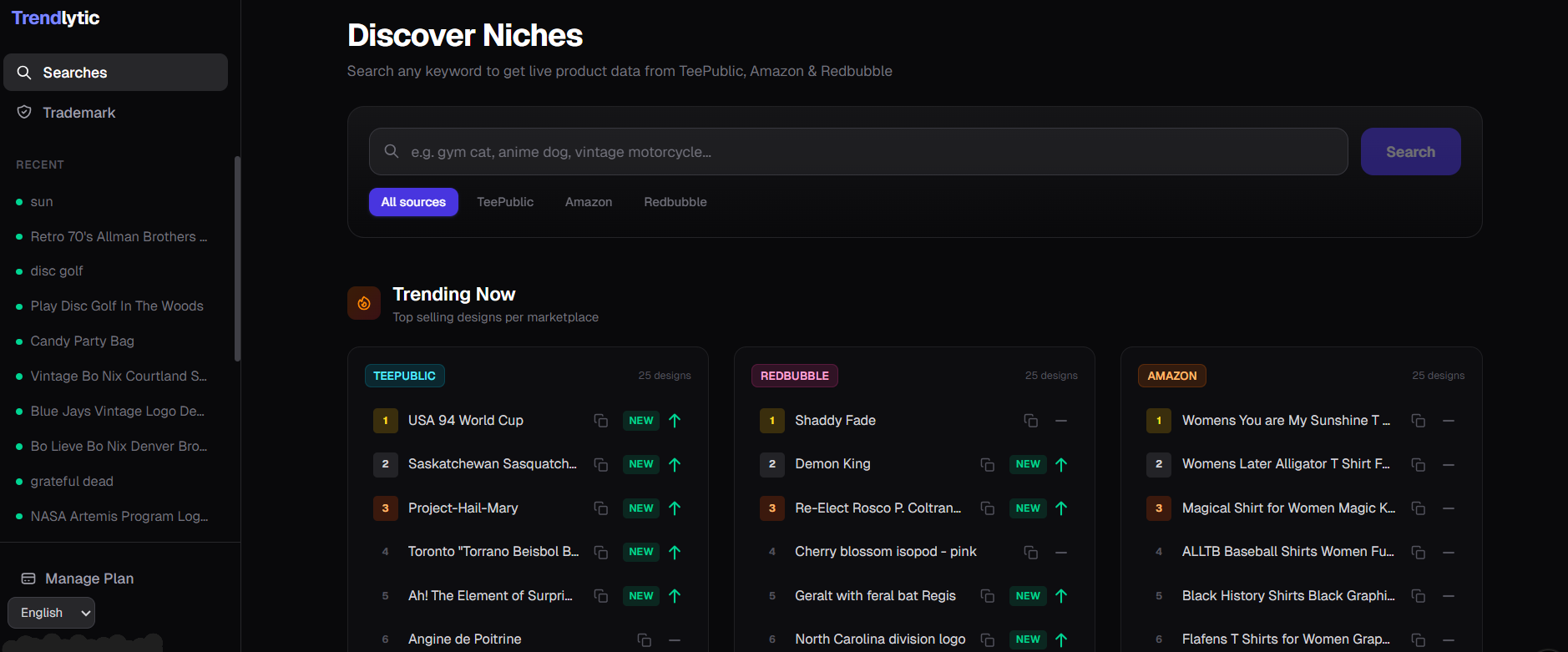
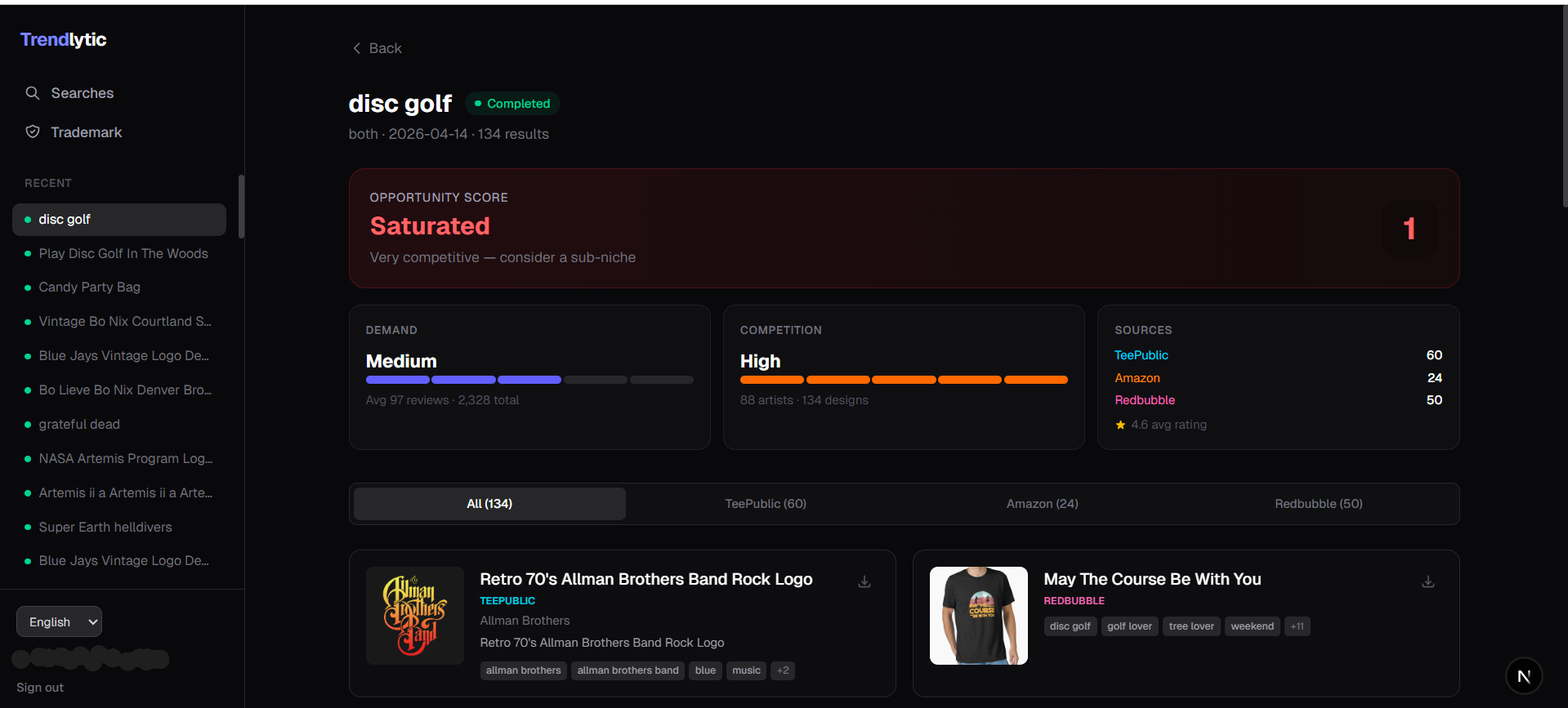
That is the gap Trendlytic fills. It searches Etsy, Redbubble, TeePublic, and Amazon Merch in a single search, scores demand against saturation so you can tell a real opening from a crowded one, and runs a live USPTO check on the keyword. It is $19.99/mo with a free trial, so you can pressure-test a handful of digital-product ideas before you spend a weekend designing any of them.
When a niche is already crowded, you want to know before you build, not after. That saturated verdict is the one that saves you the most time.
To be clear about scope: Trendlytic is not a digital-product-specific tool and it does not make files for you. It is the validation step, the part that answers "is this niche worth my weekend?" You can start with a free trial and run a few of your ideas through it.
There are also free no-login tools that help once you know what to make. The free Etsy tools include an Etsy tag generator, an Etsy title generator, and an Etsy description generator for writing listings that get found. If you are still learning the ropes, my guide on Etsy SEO and the how to sell on Etsy walkthrough are good next reads.
FAQ
What is the best digital product to sell on Etsy? There is no single best type. The best digital product for you is one with proven demand and low competition that you can actually make well. Printable wall art, planners, and Canva templates sell in huge volume, but they are also the most saturated, so a narrow sub-niche inside a category usually beats a generic entry into the biggest one.
Are digital products still worth selling on Etsy in 2026? Yes, but competition is higher than it used to be. The instant delivery and near-100% margin are still excellent, so the model works. What has changed is that you cannot win with a generic product anymore. The sellers doing well are the ones targeting specific low-competition sub-niches with real buyers.
What digital products have low competition on Etsy? Honestly, it changes constantly, so any static "these five are low-competition" list is out of date fast. As a rule, functional products that need some skill (spreadsheets, business templates, ebooks) tend to be less crowded than purely visual ones. But the reliable move is to check current demand against saturation for your specific idea rather than trusting a fixed list.
Do digital products on Etsy make passive income? Partly. You make the file once and can sell it forever, which is the passive part. But listings do not sell themselves. They need decent SEO, good photos or mockups, and often some marketing to get traction. Call it low-maintenance income once it is set up, rather than truly hands-off.
Can I use Canva to make digital products to sell on Etsy? Yes, and many top sellers do. The important thing is to check Canva's licensing for commercial use. You generally cannot resell Canva's stock elements as-is or as editable templates without following their rules, so build with your own design work or content you are licensed to sell, and read Canva's content license before you list.
How do I avoid copyright issues with digital products? Use original work, and avoid trademarked phrases, characters, and logos, which are the most common reason listings get pulled. Before you design around a specific phrase, run it through a trademark check. Trendlytic includes a one-click lookup against the live USPTO register, and the free trademark checker gives you a few checks a day without an account, which is a quick way to catch a problem before you have built anything around it.
Conclusion
The best digital product to sell on Etsy is not the trendiest type, it is the one with proven demand and low competition that you can make well. Every category on this list can work and every category can fail, and the difference is almost always whether you validated the specific sub-niche before you built for it.
So do the boring, valuable thing first: confirm buyers exist and competition is beatable, then design. If you want to skip the hours of manual checking across marketplaces, you can start a Trendlytic trial, and run your ideas through it before you commit. And whether you do or not, the free Etsy tools are there to help you write listings that actually get found.
What digital product are you thinking of making next? If you are torn between two ideas, validating both before you build is the cheapest decision you will make all month.
Like this? Get one like it every Wednesday.
Niche data, trademark alerts, one tactic per week.
Try Trendlytic
Find your next winning POD niche in 40 seconds
Live data from TeePublic, Amazon Merch, Redbubble, and Etsy, with a trademark check built in. Then turn any winner into a listing for a design of your own in that niche. Plans from $19.99/month.
Start researchingKeep reading
- Trendlyticetsy
Etsy Print on Demand: The Complete 2026 Beginner's Guide
The JournalEtsy Print on Demand: The Complete 2026 Beginner's Guide
May 23, 2026 · 17 min read
- Trendlyticcustom calendars
Custom Calendars: A POD Product With an Expiry Date
The JournalCustom Calendars: A POD Product With an Expiry Date
September 23, 2026 · 18 min read
- Trendlyticcanva templates
How to Sell Canva Templates on Etsy, Start to Finish
The JournalHow to Sell Canva Templates on Etsy, Start to Finish
September 22, 2026 · 17 min read