TL;DR: The best selling Redbubble niches in 2026 are aesthetic, fandom-adjacent, humor, and identity micro-niches that fit Redbubble's young, browse-and-discover, sticker-buying audience — cottagecore and dark academia, anime- and gaming-vibe designs, internet and meme humor, mental-health and self-expression, music-adjacent, niche subcultures, animal aesthetics, and activism and identity. But any specific niche on a public list saturates fast, and most fandom and character names are trademarked. So the durable skill is not copying a list — it's validating demand against saturation yourself, and designing the vibe of a community without using a protected name. This post gives you 8 Redbubble-fit niche categories, then the repeatable method to find ones nobody has named yet.
Most "best Redbubble niches" lists are just generic POD niche lists with the word Redbubble pasted on top. That's a mistake, because Redbubble is not a generic POD marketplace. Its audience is younger, more aesthetic-driven, more fandom-adjacent, and far more sticker-happy than the gift-shopper on Amazon Merch — and that changes which niches actually move here.
So this post is Redbubble-specific on purpose. If you want niche categories that work across every platform — profession, milestone, regional pride — I keep a separate print on demand niches guide for that. And if you want the best products to sell on Redbubble, that's a different post too: best selling Redbubble products. This one sits in the middle: the themes and communities that sell specifically because of who shops on Redbubble.
Here's my honest promise. I've tracked POD sellers for about two years across Redbubble, TeePublic, and Amazon Merch, and I'll give you 8 niche categories that genuinely fit Redbubble in 2026, with concrete angles. But they are a starting point and a method, not a copy-paste goldmine. The minute a list like this circulates, its specific examples get crowded — and a lot of the obvious fandom angles are trademarked landmines. The real skill is finding your own. I'll show you both.
Don't miss the next one.
New POD niche analysis every Wednesday.
What makes a niche sell on Redbubble specifically
Before the list, the filter — and on Redbubble the filter is shaped by the audience, which is different enough to change your whole approach.
It's a browse-and-discover marketplace. Redbubble shoppers don't always type a precise phrase the way an Amazon buyer does. They land looking to express an interest, a fandom, or an aesthetic, and they scroll. That rewards visual, vibe-led niches that catch the eye in a grid of thumbnails — and it punishes niches that only work as a precise text search.
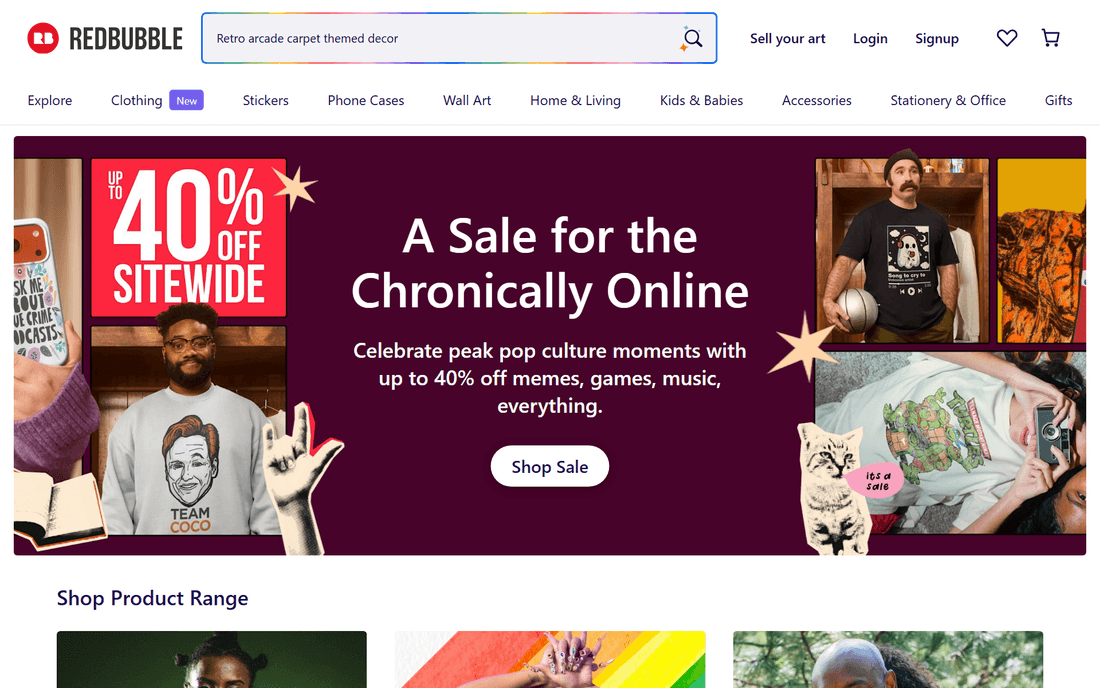
The audience skews young, mobile, and aesthetic-driven. The core Redbubble buyer is closer to a student decorating a laptop, a room, or a tote than a gift-shopper hunting a specific occasion shirt. That's exactly why "aesthetic" — cottagecore, dark academia, Y2K — is a real, sellable niche category here in a way it isn't everywhere. Designs are judged at thumbnail size on a phone, so bold and readable beats intricate every time.
It's sticker culture first. No other major POD platform moves stickers the way Redbubble does — cheap, collectible, bought several at a time. A huge slice of demand is for cheap identity markers, which means the niches that win are ones people want to display as a flag: their fandom vibe, their humor, their cause, their aesthetic.
A huge slice of demand is fandom-adjacent — and that's the trap. Anime, games, music, shows. The audience genuinely wants this, but here is the honest, non-negotiable part: most fandom and character names are trademarked. Use a protected name and your design gets pulled, or your account gets suspended, with no warning. The sellers who win this demand design the vibe of a community — the aesthetic, the in-jokes, the colors — without ever using the protected name. More on that in every section below, because it's the single thing that ends Redbubble accounts.
And the honest thread underneath all of it: a niche being on a list is a warning sign, not a green light. The minute a niche is named publicly, supply spikes. Saturation on Redbubble is per-niche, not platform-wide — specific communities and fresh aesthetics open up every month. So before any niche below matters, the move is to check what's actually selling in that niche right now — real demand you can see, not what a keyword count guesses — and whether there's still room for one more seller. More on that at the end.
The table lists the 8 categories in the order I'd consider them on Redbubble — aesthetic first, because it's the most Redbubble-native of all.
| Niche | Why it sells on Redbubble | Best products | Saturation |
|---|---|---|---|
| Aesthetic (cottagecore / dark academia / Y2K) | Redbubble's signature browse-and-decorate audience buys on vibe | Stickers, wall art, phone cases | Medium–High |
| Anime & gaming fandom-adjacent | Massive fandom demand — won as a trademark-safe vibe, never a name | Stickers, tees, hoodies | High |
| Internet & meme humor | Tag-and-share culture; cheap impulse identity buys | Stickers, tees | Medium–High |
| Mental health & self-expression | Young audience expresses identity and belonging openly | Stickers, tees, totes | Medium |
| Music & band-adjacent | Scene and genre loyalty; vibe-not-logo designs | Tees, stickers, posters | Medium |
| Niche hobbies & subcultures | Quiet broad-search noise, intense insider identity | Stickers, tees, mugs | Low–Medium |
| Animal & pet aesthetics | Emotional + aesthetic; thrives on Redbubble's range | Stickers, wall art, totes | Medium |
| Activism & identity | Values and belonging worn as a public flag | Stickers, tees, totes | Medium |
1. Aesthetic (cottagecore / dark academia / Y2K)
This is the most Redbubble-native niche there is. Aesthetics are visual moods — cottagecore, dark academia, Y2K, coquette, grunge, minimalist line art — and Redbubble's browse-and-decorate audience buys them harder than almost anywhere else.
Why it sells on Redbubble: The audience is young, scrolling, and decorating spaces and devices on a budget. They don't search "cottagecore mushroom sticker" so much as recognize the vibe in a thumbnail and add it to a basket. Aesthetics are also cohesive — a buyer who likes one piece often wants several in the same mood, which rewards a consistent body of work.
Best products: Stickers first (the cheap collectible that suits the vibe), then wall art and phone cases — decoration products where aesthetic genuinely beats text.
Saturation: Medium to high. The big named aesthetics (cottagecore, dark academia) are crowded at the broad level. The opening is in the specific sub-mood and motif — not "cottagecore" but "cottagecore mushroom foraging" in a defined illustration style.
Design / angle tip: Pick one aesthetic and one specific motif, and commit to a consistent style across a small set. Aesthetics are an art-style game, not a text game — make it read at thumbnail size, and let one look carry across sticker, poster, and case. Validate by checking which specific sub-motifs are actually selling for the top aesthetic sellers, not just which ones are searched.
2. Anime & gaming fandom-adjacent
This is where the biggest demand and the biggest danger sit together. Redbubble's audience is deeply into anime and gaming, but the obvious move — putting a character or franchise name on a sticker — is the fastest way to get a design pulled or an account suspended.
Why it sells on Redbubble: Fandom is identity, and Redbubble's young audience wears and displays it constantly. Stickers for laptops, tees and hoodies for being seen in a community. The demand is enormous and evergreen.
Best products: Stickers (the fandom default), then tees and hoodies for stronger statements of belonging.
Saturation: High — and heavily policed. The named-franchise space is both crowded and legally radioactive.
Design / angle tip: This is the trademark trap in its purest form, so the only safe play is fandom-adjacent: design the vibe of a genre or community without any protected name, character, or logo. Think the general aesthetic of "retro JRPG," "soulslike difficulty humor," "cozy farming-sim life," or "speedrunner energy" — recognizable to insiders, owned by no one. Check every phrase against the USPTO trademark database before you design, and when in doubt, abstract further. The vibe sells; the name gets you banned.
3. Internet & meme humor
Internet humor is a Redbubble staple because the audience lives online and buys cheap identity markers that make the right person laugh. The catch is the same as anywhere — generic humor is brutally saturated, so the opening is in hyper-specific, of-the-moment jokes.
Why it sells on Redbubble: Tag-and-share culture. A sticker or tee with a precise in-joke gets recognized, screenshotted, and bought as a cheap impulse. Redbubble's browse feed surfaces visual humor well, and the low sticker price makes it a frictionless yes.
Best products: Stickers first (the perfect cheap joke-carrier), then tees for the jokes worth wearing.
Saturation: Medium to high. Broad "funny" is one of the most flooded spaces on the platform; insider and niche-specific humor is far thinner.
Design / angle tip: The joke has to be genuinely insider and current — meme humor decays fast, so recency matters more here than in any other niche. Two warnings: viral phrases get trademark-registered constantly (check USPTO), and a meme that peaked six months ago is dead weight. Validate that the specific joke isn't already done well across a couple of stores before you design it.
4. Mental health & self-expression
Redbubble's young audience is unusually open about mental health and identity, and they buy designs that say something true about how they feel. This is a genuine, durable niche here in a way it isn't on a gift-first marketplace.
Why it sells on Redbubble: Self-expression is the whole point of the platform for a big slice of its buyers. A sticker or tee about anxiety, burnout, neurodivergence, or quiet self-acceptance is identity worn openly — and it converts because it's personal, not decorative.
Best products: Stickers and tees lead, with totes a strong third as an everyday identity carrier.
Saturation: Medium. The obvious phrasings ("mental health matters") are crowded; specific, original, gently-worded angles still have room.
Design / angle tip: Be specific and sincere rather than cliché — the exact feeling, in original wording, beats the slogan everyone has already done. Tread carefully here: this category is dense with trademarked phrases and copied designs, so trademark-check every line, and write your own rather than borrowing a viral phrase.
5. Music & band-adjacent
Music is identity-deep for Redbubble's audience, but — exactly like anime — band names, logos, album art, and lyrics are protected. The win is genre and scene vibe, not the band itself.
Why it sells on Redbubble: Scene and genre loyalty runs hard in this audience. People wear and display the music they identify with, and Redbubble's browse feed suits visual, vibe-led music designs.
Best products: Tees lead (music as a statement worn out), with stickers and posters strong as cheaper scene markers.
Saturation: Medium. Genre-vibe designs are less crowded than the obvious named-band attempts (which mostly get pulled anyway).
Design / angle tip: Design the feel of a genre or scene — the aesthetic of "90s shoegaze," "underground techno," "sad-girl indie," "old-school punk" — without any band name, logo, lyric, or album-cover reference. Those are all trademarked or copyrighted. Run every phrase through USPTO, and lean on typography and mood rather than anything traceable to a specific artist.
6. Niche hobbies & subcultures
Hobby niches are some of the healthiest on Redbubble because the broad search terms are quiet, so the spaces stay less saturated — yet the people inside them are intensely identity-driven and love a cheap sticker that proves they belong.
Why it sells on Redbubble: Belonging. Hobbyists wear and display their hobby as a flag and recognize insider references instantly. Redbubble's sticker culture is perfect for cheap identity markers on laptops, water bottles, and gear, and the browse audience suits subcultures well.
Best products: Stickers (the gear and laptop identity marker), then tees, with mugs as a low-stakes extension.
Saturation: Low to medium. The well-known hobbies (gym, gaming, yoga) are crowded; specific sub-disciplines — bouldering over hiking, mechanical keyboards, tabletop wargaming, fly tying — are far thinner.
Design / angle tip: Use the real vocabulary of the subculture: the specific move, tool, or gear only an insider would name. Outsider "I love hiking" designs get ignored; insider phrasing gets bought. Validate which sub-hobbies actually have buyers (favorites, sales) before you design into them — and this is one of the few categories where you rarely hit trademark trouble, since you're describing an activity, not a brand.
7. Animal & pet aesthetics
Animals are evergreen and deeply emotional, which is exactly why "cats" and "dogs" are dead ends. On Redbubble specifically, the opening is the aesthetic treatment — breed-plus-vibe, animal-plus-mood — that suits a decorate-and-display audience.
Why it sells on Redbubble: Two forces stack here — emotion and aesthetic. A "black cat cottagecore reading books" or "minimalist line-art corgi" design isn't just a pet design, it's a vibe the audience wants on a sticker, a print, and a tote. Pet people are also among the least price-sensitive buyers in POD.
Best products: Stickers and wall art lead (the aesthetic treatments shine as decoration), with totes a natural identity carrier.
Saturation: Medium. Popular breeds at the broad level are crowded; specific breed-plus-aesthetic combinations and rarer animals (axolotls, reptiles, specific bird species) are far thinner.
Design / angle tip: Stack the animal with an aesthetic and a specific style — "watercolor axolotl," "dark-academia black cat," "cottagecore hen" — and keep the look consistent so it travels across products. This is one of the strongest niches on Redbubble precisely because emotion and aesthetic both work in your favor. Check the breed or animal on the marketplace first; some popular ones are walls while the aesthetic angle around them is wide open.
8. Activism & identity
Values and identity sell on belonging, and Redbubble's audience expresses them openly and proudly. Causes, communities, and identity groups are some of the most loyal, repeat-buying audiences on the platform — they buy a design to display who they are and what they stand for.
Why it sells on Redbubble: Identity plus community. These designs aren't decoration — they're a public flag, which is exactly what stickers and tees are for on Redbubble. The emotional weight drives both self-purchase and gifting within tight-knit communities.
Best products: Stickers (the cheap public statement), tees (the worn one), and totes (the everyday carrier).
Saturation: Medium. The broadest expressions are crowded; specific community sub-identities and original, sincere phrasings still have room.
Design / angle tip: Be specific and genuine rather than generic — borrow the real language of the community, not the obvious cliché everyone has done. This category is dense with trademarked slogans and copied art, so trademark-check every line carefully, and make sure the design is sincere enough that the community recognizes it as theirs.
How to find and validate your own Redbubble niches
Here's the honest part again. Every category above is a starting point, and the specific examples will get crowded as lists like this circulate. The durable skill isn't picking from a list — it's learning to read a niche yourself so you find under-served Redbubble corners before anyone names them. A few principles do most of the work.
Brainstorm vibes, not just topics. On Redbubble you're designing for a mood and a community as much as a subject. Stack an aesthetic or subculture onto a subject until you reach a specific buyer with a specific taste: animal plus aesthetic, hobby plus insider joke, genre vibe plus a defined scene. The output is a list of vibes and communities, not broad topics.
Look at what's actually selling, not just what's searched. A keyword count tells you a phrase is popular; it doesn't tell you anyone buys. Study what the top sellers in a vibe are genuinely moving — the proven designs, not a search-volume guess — and gauge whether there's still room: real demand with competition you can realistically beat. If the front of a niche is wall-to-wall polished work from entrenched sellers, the door is shut; visible gaps mean opportunity.
Make sure the trend is climbing, not fading. A niche that was hot two years ago and is flat now is a trap — and on Redbubble, where meme and aesthetic trends move fast, recency matters more than most places. A niche with fresh designs still breaking through is alive; one that peaked long ago with nothing new landing is closed or fading. The how to find trending POD niches post walks through reading that signal in depth.
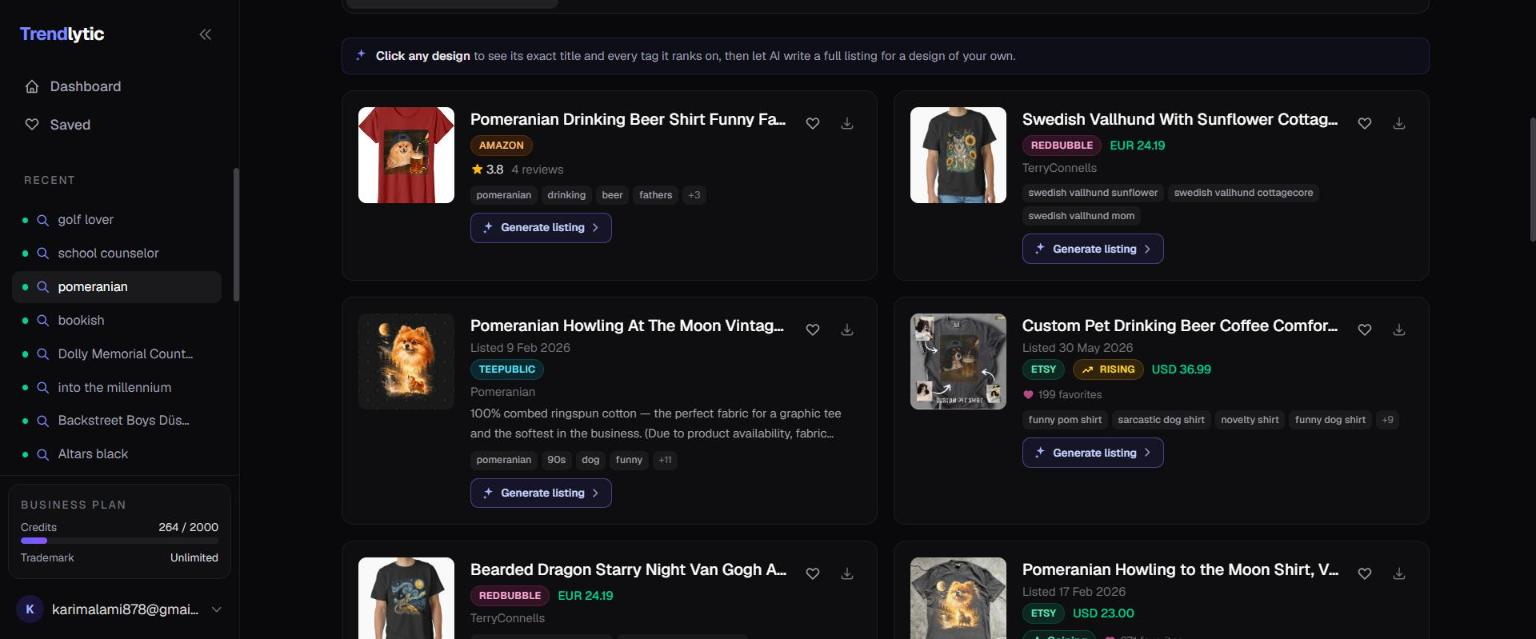
Trendlytic puts a badge on exactly that kind of design. On Redbubble, a design earns Rising when it is between 30 and 180 days old and outranks, on its artist's best-selling page, five or more designs that artist uploaded earlier. The first 30 days are left out on purpose: Redbubble pins brand-new uploads to the top of a shop by itself, so a fresh design ranking high proves nothing yet. A design 30 to 40 days old that already ranks above the artist's established work earns Rising fast. The age comes from Redbubble's upload counter, so it is an estimate rather than an exact date. Here is the All tab of a "pomeranian" search, with Redbubble, Amazon, TeePublic and Etsy designs in one list and a Rising badge on an Etsy card.
Trademark-check every phrase. This is non-negotiable on Redbubble, especially for the fandom, music, meme, and activism niches above. Search the exact phrase in the USPTO trademark database, watch for live marks in relevant classes (apparel is typically Class 25), and if there's a conflict, reword it. Two free minutes prevents an account suspension.
Design only after it all lines up. Real demand plus survivable saturation plus a climbing signal plus a clean trademark plus a vibe-not-name angle. Skip any one and you're either designing into an empty room or building something that gets pulled.
Doing all of that by hand for every niche is slow — it's the boring research most sellers skip, which is exactly why most sellers earn nothing. That's the gap I built Trendlytic to close. It does store-first analysis across TeePublic, Amazon Merch on Demand, Redbubble, and Etsy in a single search, so you see what the top sellers are actually moving instead of trusting a keyword count, and it runs a live USPTO trademark check on every keyword automatically — on every plan. Entry is $9 a month for 100 searches, with a free trial. You can research what's actually selling before you spend a day designing.
I'll be honest about the limits, because honesty over hype is the whole point: it's newer and smaller than something like Merch Informer, and rather than a raw search-volume number it gives you a search-interest curve showing whether a niche is rising or fading, plus proven sellers and trademark safety, not a curiosity score. It does the boring homework well; it is not a money printer.
Two free tools pair with this. Once you've picked a niche and you're ready to list, the Redbubble tag generator turns it into a grouped set of buyer-search tags in one click, no login — pair it with the Redbubble keywords and tags SEO guide for the deeper tagging method.
And because Redbubble's sticker-versus-apparel economics differ so much — cents on a sticker, around $4 on a tee at the default 20% markup — run your idea through the POD profit calculator to sanity-check the margin before you commit a single design.
If you're earlier in the journey, how to sell on Redbubble covers setup end to end, and our complete print on demand guide is the hub that ties every step together.
FAQ
What are the best selling niches on Redbubble? The best selling Redbubble niches are aesthetic moods (cottagecore, dark academia, Y2K), fandom-adjacent anime and gaming vibes, internet and meme humor, mental-health and self-expression, music- and band-adjacent designs, niche hobbies and subcultures, animal and pet aesthetics, and activism and identity. They sell because they fit Redbubble's young, browse-and-discover, sticker-buying audience. But "best selling" by volume also means "most competitive," so the real answer is a tight, fresh, trademark-safe sub-angle within one of these — not the broad category itself.
What sells best on Redbubble in 2026? Aesthetic and identity niches on stickers lead, because stickers are Redbubble's signature impulse buy and its audience buys on vibe. After that, fandom-adjacent and humor designs on tees and hoodies. The honest answer in 2026 is the same as every year: the niche and design decide whether you sell far more than the product does. A fresh, trademark-safe vibe in a community the audience browses for beats a generic design on any product.
Are Redbubble niches saturated? Parts of them are. The broad versions — generic cottagecore, named fandoms, "funny" humor — are heavily saturated, and competing there as a new seller is brutal. But saturation is per-niche, not platform-wide: specific communities and fresh aesthetics open up every month. The move is to take a category from this list and find the specific sub-angle that hasn't been flooded yet, validated against actual store sales — which is exactly what store-first research is for.
Can I use anime or fandom designs on Redbubble? Not the names, characters, logos, or art — those are trademarked and copyrighted, and using them is the fastest way to get a design pulled or an account suspended. What you can do is design fandom-adjacent: the general vibe, aesthetic, and in-jokes of a genre or community without any protected name. "Cozy farming-sim life" or "retro JRPG energy" is safe; a specific character or franchise name is not. Always check the exact phrase against the USPTO trademark database before you design.
What's the best niche for Redbubble stickers? Aesthetic and identity niches, because stickers are cheap collectible identity markers and that's exactly what the audience buys them for — cottagecore and dark-academia motifs, niche subculture flags, hobby insider references, and sincere self-expression. Bold, single-subject designs that read at thumbnail size win. The trick is going specific within the category, since broad sticker themes are the most saturated part of the platform.
How do I find untapped Redbubble niches? Brainstorm vibes and communities (not broad topics), then check each one for a gap — clear demand but thin or beatable competition. Look at what's genuinely selling rather than just what's searched, confirm the trend is climbing not fading, and trademark-check the phrase before designing. An untapped niche has some selling listings (proving demand) but not a wall of entrenched ones.
Do I need a tool to find Redbubble niches? No — you can run the whole method for free with Redbubble itself and a spreadsheet. The trade-off is time: manually reading hundreds of shops is hours of clicking. A tool like Trendlytic automates the reading and the USPTO trademark check across TeePublic, Amazon Merch, Redbubble, and Etsy in one search; it doesn't change the method. The method is what matters, with or without a tool.
Conclusion
Here's the takeaway I want you to keep. The best selling Redbubble niches in 2026 are the ones shaped by its audience — aesthetic, fandom-adjacent, humor, and identity micro-niches for a young, browse-and-discover, sticker-buying crowd. The 8 categories above are a real starting point, but every specific example saturates the moment a list like this spreads, and the obvious fandom angles are trademarked landmines. The durable skill is the method: brainstorm vibes, check saturation on Redbubble, study what's actually selling, check recency, trademark-check, and design the vibe of a community without using a protected name.
That research loop is exactly what Trendlytic does the boring part of — one search across TeePublic, Amazon Merch on Demand, Redbubble, and Etsy showing what's actually selling, with a live USPTO trademark check on every keyword. Start a free trial — and validate a Redbubble niche before you spend a day designing for an empty room.
Which Redbubble niche are you working in right now — and what's the most specific sub-angle you've found that actually sold?
Like this? Get one like it every Wednesday.
Niche data, trademark alerts, one tactic per week.
Try Trendlytic
Find your next winning POD niche in 40 seconds
Live data from TeePublic, Amazon Merch, Redbubble, and Etsy, with a trademark check built in. Then turn any winner into a listing for a design of your own in that niche. Plans from $9/month.
Start researchingKeep reading
- Trendlyticprint on demand
8 Print on Demand Niches That Actually Sell in 2026
The Journal8 Print on Demand Niches That Actually Sell in 2026
June 9, 2026 · 20 min read
- Trendlyticpod niches
How to Find Trending POD Niches in 2026 (Without Guessing)
The JournalHow to Find Trending POD Niches in 2026 (Without Guessing)
May 23, 2026 · 20 min read
- Trendlyticprint on demand
8 Print on Demand Trends for 2026 (What's Actually Selling)
The Journal8 Print on Demand Trends for 2026 (What's Actually Selling)
June 17, 2026 · 22 min read