TL;DR: Etsy SEO is optimizing your listings so Etsy's search surfaces them to buyers. Ranking is driven mainly by relevance — how well your title, tags, attributes, and category match what someone typed — plus listing quality (click-through and conversion), a small recency boost for new listings, and a few market signals like shipping and price. The biggest wins are concrete: write a keyword-led title that front-loads the phrase buyers actually search, fill all 13 tags with multi-word buyer phrases, complete every attribute, pick the most specific category, and back it with strong photos. But SEO only gets you found. It cannot sell a product nobody wants in a niche that's already saturated — so research demand before you optimize anything.
Most Etsy sellers I talk to think their shop is failing because of the artwork, the price, or bad luck. Almost always it's none of those. It's that their listings aren't built for how Etsy actually ranks things.
Here's the thing people miss: Etsy is a search engine first, a marketplace second. Buyers type a phrase into a box, and Etsy returns the listings it judges most relevant and most likely to sell. If your listing isn't written for that box — if you wrote a pretty title instead of a keyword-led one — you don't get found, no matter how good the design is.
This guide covers the whole stack: what Etsy SEO is, how Etsy search actually ranks listings in 2026, how to do real keyword research, and the concrete on-page levers — titles, tags, attributes, categories, and the listing-quality signals that decide who wins. It also covers the honest limit nobody likes to say out loud: SEO can't fix a bad niche. It's a pillar piece, so it runs long. Bookmark it and work through it section by section.
Don't miss the next one.
New POD niche analysis every Wednesday.
What is Etsy SEO?
Etsy SEO is the practice of optimizing your listings so they show up when buyers search on Etsy. It's the same idea as Google SEO, but the search engine is Etsy's own, and the "page" being ranked is your product listing.
In plain terms: when someone types "personalized dog dad mug" into Etsy, Etsy runs that query against millions of listings and returns the ones it thinks best match the search and are most likely to result in a sale. Etsy SEO is everything you do to make your listing one of those — the right keywords in the right fields, complete listing data, and a listing that converts once it's seen.
It breaks into two halves:
- Relevance — does your listing match the query? This is the part you control directly through titles, tags, attributes, and categories.
- Listing quality — once Etsy shows your listing, do people click and buy it? Etsy watches this and promotes listings that convert.
You optimize for the first to get found, and you earn the second by being a genuinely good listing in a niche people want. Get both right and Etsy does the distribution for you. Get the keywords wrong and the best product in the world stays invisible.
How Etsy search actually ranks listings
Etsy publishes a general overview of its ranking factors in the Seller Handbook, but it doesn't release exact weights, and nobody outside Etsy knows the precise formula. What follows is the honest, qualitative picture — the factors that consistently matter, without invented percentages.
1. Relevance (query match). This is the first filter. Etsy matches the buyer's search against your title, tags, attributes, and category. If the exact phrase a buyer typed appears in your title and tags, your listing is eligible to rank for it. If it doesn't appear anywhere, you simply aren't in the running. Relevance is the foundation — everything else only matters once you're relevant.
2. Listing quality score. Once you're eligible, Etsy looks at how your listing performs. A listing that gets shown and then clicked and purchased (a good click-through and conversion rate) earns a higher quality score and climbs. A listing that gets shown but ignored drifts down. This is Etsy saying, in effect, "buyers who saw this liked it, so we'll show it more." It's why a keyword-perfect listing with weak photos still loses — it gets impressions but no clicks.
3. Recency. New listings get a small, temporary boost so Etsy can gather quality data on them. This window doesn't last, and it isn't a reason to constantly relist good performers — but it's real, and it's part of why consistent uploading beats batch-dumping then disappearing.
4. Customer and market experience. Etsy factors in your shop's overall standing — reviews, completeness of your About section and policies, and a history of good service. Shops that deliver well and rack up positive reviews get a quiet tailwind across all their listings.
5. Shipping and price signals. Etsy openly favors listings with free shipping (or shipping under its free-shipping guarantee threshold) in search, and competitive pricing helps conversion, which feeds back into quality score. These aren't the biggest levers, but they're easy ones.
The mental model: relevance gets you into the race, listing quality decides where you place, and recency gives newcomers a brief head start to prove themselves. You control relevance completely through the fields below. You earn quality by being a good listing in a niche people want.
Etsy keyword research
You cannot write a relevant listing if you don't know what buyers actually type. This is the step most sellers skip — they guess. The ones who earn, research.
The goal is to find the real phrases buyers use, lean toward long-tail and buyer-intent terms, and use the full range of how people describe what you're selling.
A few honest principles:
- Long-tail beats broad. "Mug" is searched a lot, but you'll never rank for it and the intent is vague. "Personalized golden retriever dad mug" is searched less, but the person typing it is ready to buy and there are far fewer listings competing. You want the phrases with real intent and beatable competition.
- Use buyer language, not your language. You might call it a "celestial line-art print." A buyer searches "boho moon phase wall art." Tag the buyer's words.
- Cover gift framing. A huge share of Etsy searches include gift intent — "gift for him," "birthday gift idea," "mom gift." If your product is giftable, those phrases are some of your best.
- Mine real search surfaces. Etsy's own search autocomplete is the single most underused tool — type the first few words of your niche and Etsy hands you the queries real buyers enter. Pinterest and Google autocomplete reveal the same buyer language. Reading the tags on top-selling listings in your niche shows you the patterns that already work (borrow the structure, never copy verbatim).
This is also where tools save real time. Trendlytic's Keyword Research pulls the real tags and phrases that best-selling designs already use for a niche, so you're not inventing keywords at a desk and hoping.
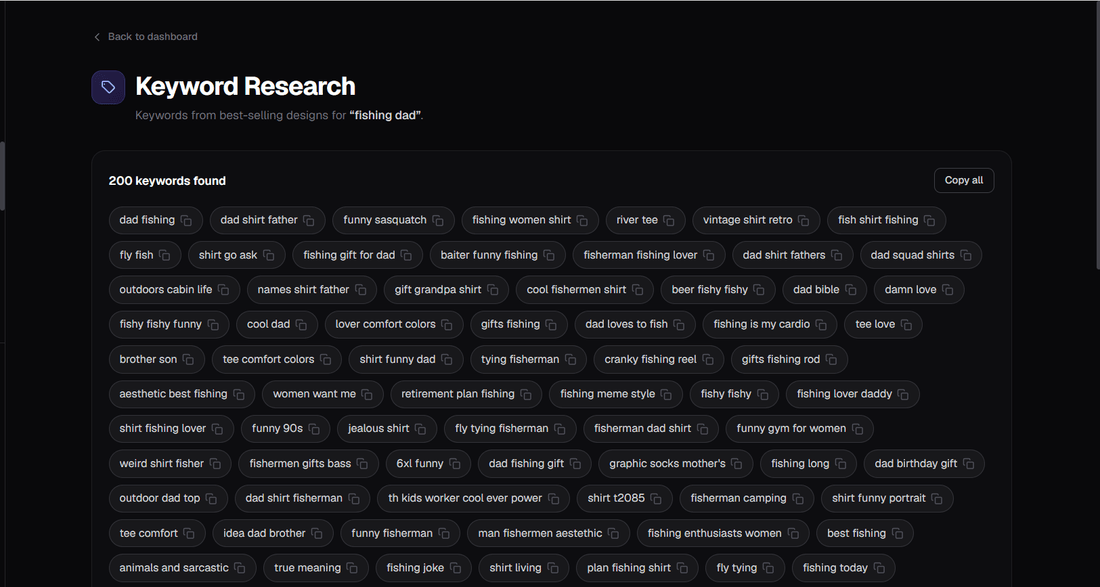 And our free Etsy tag generator expands any seed phrase into a grouped specific-to-broad set in one click, no login — and it keeps every tag within Etsy's 13-tag, 20-character limit, so what you copy is usable as-is.
What does not work as Etsy keyword research: generic Google-volume tools like Ahrefs or SEMrush. Etsy's internal search behaves differently from Google. A term with low Google volume can be busy on Etsy and the reverse. Use buyer-language sources, not Google's keyword planner.
Titles: keyword-led, not pretty
Etsy reads your title strongly, and it's the field most beginners get wrong. They write a name ("Cozy Autumn Mug") instead of a search phrase. Etsy can't rank you for words buyers don't type.
Etsy gives you up to 140 characters. The rules that hold up:
- Front-load your main keyword phrase. The first words carry the most weight and are what shows in truncated views. Whatever phrase you most want to rank for goes first.
- Lead with the buyer phrase, then add supporting descriptors and gift context. Etsy lets you separate phrases with commas — use that to stack several real search phrases in one title.
- Keep it readable for humans. The title also drives click-through from the results page. A title that reads like a keyword salad repels buyers, which hurts your quality score. Aim for a real-sounding phrase that happens to contain your strongest terms.
- Don't keyword-stuff or repeat the same word. "Dog Dog Lover Dog Mom Dog Tee" is a stuffing pattern that helps nobody.
| Weak title | Strong title | Why the strong one ranks |
|---|---|---|
| Cute Dog Shirt | Golden Retriever Dad Shirt, Funny Dog Lover Gift for Him, Retriever Owner Tee | Breed + persona + gift framing + product, multiple real phrases |
| Cozy Autumn Mug | Personalized Fall Coffee Mug, Pumpkin Spice Gift for Her, Autumn Lover Mug | Personalization + season + gift intent + product |
| Boho Wall Print | Moon Phase Wall Art, Boho Celestial Print, Bedroom Decor Gift for Her | Buyer's words for the style + room + recipient |
| Teacher Gift | Personalized Teacher Mug, End of Year Teacher Appreciation Gift, Custom Name Mug | Occasion + recipient + personalization angle |
The title is the one field where SEO and human reading have to coexist. Pure SEO repels buyers; pure marketing repels the algorithm. The sweet spot is a phrase a buyer would actually type and be happy to read.
Tags: all 13, as buyer phrases
Tags are your highest-leverage SEO surface on Etsy. You get 13 tags, each up to 20 characters. Treat every one as a precious slot, not a blank to fill with a single word.
The rules that consistently work:
- Use all 13. An empty tag is a ranking chance thrown away.
- Multi-word phrases, never single words. "dog dad gift" beats "dog." Single broad words are unwinnable — millions of listings compete for them and the intent is weak. Each tag should be a phrase a real buyer would type.
- Don't repeat the same phrase. Etsy already reads each word in a tag, so re-using "dog mom" in three tags wastes slots. Spread across synonyms and adjacent phrasings instead.
- Mirror your strongest tags in the title. Title and tags reinforcing the same phrases is what tells Etsy the listing is coherent and relevant.
- Cover the full range: the core niche, style, recipient, occasion, and gift framing.
Here's a concrete 13-tag set for a personalized golden retriever dad mug:
golden retriever dad
dog dad gift
personalized dog mug
retriever owner gift
gift for dog dad
custom name dog mug
golden retriever mom
dog lover mug
fathers day dog gift
dog dad birthday
retriever dad gift
pet parent mug
funny dog dad gift
Notice what those do: every tag is a phrase, they cover the breed, the persona, personalization, the recipient, and gift occasions, and no phrase is repeated. A buyer searching "personalized dog dad gift" finds it; a buyer searching just "mug" never sees it, and that's fine — you don't want to compete there.
| Do | Don't |
|---|---|
| Use multi-word buyer phrases ("retro bass fishing shirt") | Use single broad words ("fishing," "shirt," "gift") |
| Fill all 13 tag slots | Leave tags empty or duplicate one phrase across slots |
| Match your top tags to your title | Tag things buyers would never type ("nice," "cute," "cool") |
| Include gift and occasion framing | Stuff the same keyword into every field repeatedly |
| Vary tags across your listings | Paste the identical 13 tags onto every product you make |
A useful test for any tag: would a real person type this into Etsy's search bar? If the answer is no, the tag is wasted. "Cute" is not a search. "Cute boho sunflower tote bag" is.
Attributes and categories: the hidden tags
This is the part almost everyone under-uses. Etsy's attributes (color, occasion, recipient, holiday, style, material, and more, depending on the product) function as extra ranking signals — effectively hidden tags. Etsy uses them both for direct relevance and for filtered search, where buyers narrow results by color or occasion.
Two rules:
- Fill every attribute Etsy offers for your product. Each one you skip is a relevance signal and a filter you've opted out of. If a buyer filters to "red" or "for him" and you left those blank, you vanish from that filtered result even if you'd otherwise rank. Because attributes are separate from tags, they also free up your 13 tag slots — you don't need to "spend" a tag on a color Etsy already captures as an attribute.
- Pick the most specific category. Etsy treats the category as a strong relevance signal. Don't stop at "Home & Living" if "Home & Living > Wall Decor > Prints > Digital Prints" applies. The deeper and more accurate the category, the better Etsy understands and ranks your listing.
Attributes and category are quiet wins — no creativity required, just completeness. Sellers leave them half-filled all the time, which means filling them is one of the easiest edges you can take.
Listing quality and conversion
Relevance gets you shown. Listing quality decides whether you stay shown. Once Etsy puts your listing in front of buyers, it watches what happens, and it promotes listings that convert.
The signals that drive quality score:
- Photos. Your first image is your click-through. A clear, well-lit, on-model or in-context photo earns clicks; a flat mockup on a plain background loses them. Use all available photo slots, show scale and use, and make the thumbnail readable at small sizes.
- Click-through rate. If your title and thumbnail match the search and look appealing, people click. Etsy reads clicks as a vote of relevance and rewards it.
- Conversion rate. Clicks that turn into sales are the strongest quality signal. Price, reviews, photos, and a clear description all feed conversion.
- Reviews. Positive reviews build buyer trust and feed the shop-level quality signal. They compound over time.
- Price. Competitive (not necessarily cheapest) pricing helps conversion, and free shipping gets a direct search preference from Etsy.
Here's the full picture of what Etsy weighs and what to do about each:
| Factor | What it is | What to do |
|---|---|---|
| Relevance | How well your title, tags, attributes, and category match the query | Use keyword-led titles and all 13 buyer-phrase tags; fill every attribute; pick the deepest accurate category |
| Listing quality score | Click-through and conversion once Etsy shows you | Strong first photo, clear title, fair price, real reviews |
| Recency | A short boost for new listings | Upload consistently; don't relist good performers just to game it |
| Customer & market experience | Shop reviews, completeness, service history | Complete your About + policies, deliver well, earn reviews |
| Shipping price | Etsy favors free / low-cost shipping in search | Offer free shipping (bake the cost into the price) |
| Listing price | Affects conversion, which feeds quality | Price for your niche, not from fear; don't underprice |
The takeaway: you can win relevance with effort, but you earn quality by being a genuinely good listing. Keyword-perfect listings with bad photos and no reviews stall. The two halves work together.
Common Etsy SEO mistakes
After looking at a lot of underperforming shops, the same mistakes show up again and again:
1. Single-word tags. Spending the 13-tag field on "shirt," "gift," "mug," "cute." These are unwinnable and low-intent. Every tag should be a multi-word buyer phrase.
2. Keyword stuffing. Cramming the same word into the title, every tag, and the description. Etsy reads coherence, not raw repetition, and stuffing hurts the human readability that drives clicks.
3. Ignoring attributes. Leaving color, occasion, and recipient blank. These are hidden ranking signals and filtered-search entries. Filling them is free relevance.
4. Copying titles and tags across listings. Pasting the identical title and 13 tags onto every product. You end up competing with yourself, and Etsy reads it as low-effort. Vary per listing.
5. Chasing saturated keywords. Targeting "dog mom shirt" — a phrase with tens of thousands of established listings — as a brand-new shop. You'll never surface. Go specific instead.
6. Never refreshing. Writing listings once and never revisiting the dead ones. Buyer language and seasons shift. Listings with zero views in a real niche after 60 days usually have a metadata problem worth fixing.
7. Writing pretty titles instead of keyword-led ones. The root mistake behind most of the others. A clever name that contains no search phrase can't rank, full stop.
Etsy SEO tools
You don't need a pile of tools, but a couple of good ones save real time. An honest short list, no strawmen:
- eRank — the most popular Etsy-specific SEO tool. Keyword research, tag suggestions, competitor tracking, and listing audits, with a usable free tier. A solid default for most sellers who want Etsy search-volume data.
- Marmalead — another well-established Etsy SEO tool, strong on keyword analysis, search trends, and "grades" for your listings. Subscription-only but well-regarded by serious sellers.
- Sale Samurai — Etsy keyword and tag research with long-tail suggestions and a Chrome extension that surfaces data while you browse Etsy. A good value option in the same category.
Those three give you Etsy-native search-volume and tag data — that's their lane, and they're good at it.
Trendlytic sits in a different lane. It's not an Etsy-only tool — it's for the step before you write a listing: deciding whether a niche is worth entering at all. One search scans top-selling designs across four marketplaces — TeePublic, Amazon Merch, Redbubble, and Etsy — so you see what's actually selling and how saturated a niche is everywhere, not just on one platform. It also runs a USPTO trademark check on every keyword it surfaces, which matters as much on Etsy as anywhere (a trademark complaint can take a listing or a whole shop down). So the honest framing: use eRank, Marmalead, or Sale Samurai for Etsy-specific keyword data; use Trendlytic for cross-marketplace demand-and-saturation research plus trademark safety. They solve different problems and they work well together.
A few free things that genuinely help and don't cost anything: Etsy's own search autocomplete (your best free keyword tool), our Redbubble tag generator for a starting phrase list, the Etsy fee calculator so you price for real margin, and the Etsy shop name generator when you're setting up.
The honest limit: SEO can't fix a bad niche
Here's the part most Etsy SEO guides won't tell you, because it's not what people want to hear.
SEO gets your listing found. It cannot make people want a product they don't want.
You can write the perfect keyword-led title, fill all 13 tags with flawless buyer phrases, complete every attribute, and shoot beautiful photos — and still earn nothing, if the niche is dead or so saturated that thousands of established sellers already own every search. Relevance puts you in the race. It can't make the race winnable.
This is why niche research is upstream of all the SEO work in this guide. The order that matters is:
- Validate real demand vs saturation before you design anything. Look at what's actually selling in a niche — established shops with real sales — not just what's being searched. A high search count with thousands of competing listings is a saturated market, not an opportunity.
- Go specific. "Dog mom" is a saturated market. "Australian Shepherd agility competitor mom" is a niche you can actually rank in and win. Specific means less competition, higher intent, and easier SEO.
- Then do the on-page SEO from this guide, on a niche you've already confirmed people want.
Doing this by hand is slow — it means looking across four marketplaces, sorting by what sells, and checking trademarks one phrase at a time, which is hours of work per niche. That's exactly the boring step Trendlytic automates: one search shows what's selling across TeePublic, Amazon Merch, Redbubble, and Etsy side by side (store-first, so you see real sales signal, not just search counts), and it runs a USPTO check on every keyword. It's $9/month for 100 searches, with a free trial. It's not a money printer — it's the research step that tells you whether a niche is worth your SEO effort before you spend an evening optimizing a listing nobody will buy.
If you want the full picture of where Etsy fits among POD routes, see Etsy print on demand: the complete guide and is selling on Etsy worth it. For finding the niches themselves, print on demand niches and the broader print on demand pillar go deeper.
FAQ
What is Etsy SEO? Etsy SEO is optimizing your listings so Etsy's search shows them to buyers. It means putting the right keywords in your title, tags, attributes, and category so Etsy reads your listing as relevant to what people search, and building a listing good enough that buyers click and buy it once it's shown.
How do I improve my Etsy SEO? Start with keyword research to find the real phrases buyers type, write a keyword-led title that front-loads your main phrase, fill all 13 tags with multi-word buyer phrases, complete every attribute, pick the most specific category, and back it with strong photos and a fair price. Then make sure the niche actually has demand — SEO only works on a product people want.
How many tags should I use on Etsy? All 13. Use each as a multi-word buyer phrase (up to 20 characters), not a single broad word, and don't repeat the same phrase across slots. Empty tags are wasted ranking chances.
Do Etsy tags still matter in 2026? Yes. Tags remain one of the strongest relevance signals in Etsy search, alongside your title, attributes, and category. The change over the years is that single broad words are useless — Etsy and the competition have made long-tail multi-word phrases the only tags worth using.
What are the best keywords for Etsy? The best keywords are long-tail, buyer-intent phrases specific to your niche — things like "personalized golden retriever dad mug" rather than "mug." They have less competition and far higher purchase intent. Find them with Etsy's search autocomplete, by reading top-seller listing patterns, and with keyword tools; lean toward specific phrases and gift framing.
Does Etsy SEO work? Yes, but with a caveat. Good SEO reliably gets a listing found in Etsy search — that part works. What it can't do is sell a product nobody wants or rank you in a hopelessly saturated niche. SEO is the distribution step; demand and a beatable niche are the prerequisites. Get the niche right first, then SEO does its job.
How long does Etsy SEO take to work? New listings get a short recency boost, then Etsy spends a few weeks gathering quality data. Most well-built listings in a real niche start settling into a stable ranking over the first one to three months, and a shop reaching consistent sales usually takes several months of steady, well-optimized listings. It rewards patience over batch-dumping.
Where to go from here
Etsy SEO isn't a trick or a secret. It's a discipline: research the phrases real buyers type, write keyword-led titles, fill all 13 tags with buyer phrases, complete your attributes and category, and back it with photos good enough to earn the click. Do that consistently on niches that actually have demand, and Etsy's search does the distribution for you.
The two halves to keep straight: on-page SEO gets you found, niche demand decides whether being found is worth anything. Most sellers obsess over the first and skip the second, then blame the algorithm. Get the niche right first.
If you want the keyword-and-tag mechanics in even more depth, the Redbubble keywords, tags, and SEO guide breaks down the same phrase logic in detail and most of it transfers straight to Etsy. And the boring upstream step — checking demand vs saturation across four marketplaces and screening trademarks before you optimize anything — is exactly what I built Trendlytic to handle: one search across TeePublic, Amazon Merch, Redbubble, and Etsy, a USPTO check on every keyword, $9/month, free trial. It won't write your tags for you, but it'll tell you whether the niche is worth tagging at all.
What's the niche you're trying to rank in on Etsy right now, and which of the SEO levers above do you think you've been leaving on the table?
Like this? Get one like it every Wednesday.
Niche data, trademark alerts, one tactic per week.
Try Trendlytic
Find your next winning POD niche in 40 seconds
Live data from TeePublic, Amazon Merch, Redbubble, and Etsy, with a trademark check built in. Then turn any winner into a listing for a design of your own in that niche. Plans from $9/month.
Start researchingKeep reading
- Trendlyticetsy printables
Etsy Printables: How to Sell Them Properly
The JournalEtsy Printables: How to Sell Them Properly
September 12, 2026 · 17 min read
- Trendlyticetsy shop ideas
Etsy Shop Ideas: 20 Concepts That Actually Sell
The JournalEtsy Shop Ideas: 20 Concepts That Actually Sell
September 8, 2026 · 23 min read
- Trendlyticlow competition keywords
How to Find Low-Competition Keywords (Without Guessing)
The JournalHow to Find Low-Competition Keywords (Without Guessing)
July 25, 2026 · 13 min read