TL;DR: Yes, selling on Etsy is worth it in 2026 — but only for the right person and the right product. Etsy gives you real built-in buyer traffic, which is a genuine advantage over launching a store from scratch. The catch is that it's crowded, the fees stack up (about 9.5% + $0.45 per order, plus 12–15% on Offsite Ads sales), and you compete on listing SEO and product differentiation. It's worth it if you have a differentiated handmade item or a researched POD niche and treat it like a real shop. It's not worth it if you expect to list generic products and have them sell themselves.
If you're trying to decide whether to open an Etsy shop, this is the page I'd want you to read before you commit a weekend to it. Not the "easy passive income from home" version — the version with the actual fees in it.
I've spent the last two years tracking sellers across TeePublic, Amazon Merch, Redbubble — and now Etsy too. I've watched people build steady monthly income on Etsy, and I've watched far more open a shop, list a dozen generic items, earn nothing, and conclude that "Etsy is dead." It isn't dead. But it also isn't the free-money button the get-started videos imply. The honest answer lives in the middle, and that middle depends entirely on what you sell and how you treat it.
So let me give you the one-line answer, then show you the reasoning.
Don't miss the next one.
New POD niche analysis every Wednesday.
The honest one-line answer
Yes — selling on Etsy is worth it, but only if you have a differentiated or researched product and treat the shop like a real business. It is not worth it if you expect generic listings to sell themselves.
That's the whole article in a sentence. Everything below is the proof: where Etsy genuinely helps you, where it quietly takes your margin, the real fee math, and the honest "good fit / bad fit" test so you can decide for yourself.
If you wanted to hear "yes, just open a shop and the sales will come," this isn't that page. If you want to know what you're actually signing up for, keep reading.
The case FOR Etsy
Let me start with what's genuinely good, because Etsy has real advantages that a brand-new Shopify or standalone store does not.
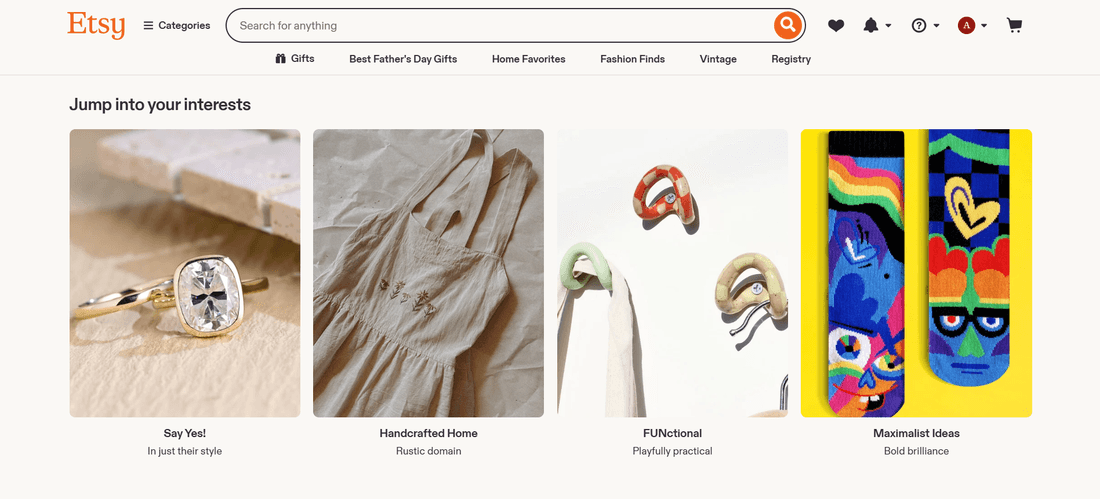
- Built-in buyer traffic. This is the big one. Etsy is a marketplace people browse and search with their wallets out. Someone typing "personalized dog dad mug" into Etsy is already in buying mode. Compare that to a fresh Shopify store, where you get zero visitors until you pay for ads or build an audience. On Etsy, the audience already exists — you're competing for a slice of existing demand, not creating demand from nothing.
- Trusted checkout. Buyers already trust Etsy with their card. You inherit that trust on day one. A new independent store has to earn it, and "I've never heard of this site" kills a lot of first sales.
- It fits handmade, vintage, personalized, and POD well. Etsy buyers actively want products that feel specific — handmade goods, vintage finds, personalized gifts, niche print-on-demand designs. If your product is differentiated, Etsy's audience rewards it more than a generic marketplace would.
- Low barrier to open. You can have a shop live the same day. There's a small per-listing fee, but no upfront inventory if you go the POD route, and no monthly storefront subscription required to start.
That built-in traffic is the single best reason to choose Etsy over a from-scratch store. You're not buying your way to your first visitor — you're showing up where the buyers already are. The question is whether you can get found among everyone else doing the same thing, which brings us to the other side.
The case AGAINST Etsy
Now the honest downsides, because pretending they don't exist is how people lose money.
- Saturation and competition. The obvious niches are flooded. "Mama" scripts, funny cat shirts, generic motivational mugs — there are thousands of near-identical listings, and a new shop in those spaces lands on page 30 where nobody scrolls. The built-in traffic is real, but so is the crowd standing between you and it.
- The fee stack. Etsy doesn't take one clean fee — it takes several small ones that add up. Roughly: a 6.5% transaction fee, plus payment processing of about 3% + $0.25, plus a $0.20 listing fee. That works out to about 9.5% + $0.45 per order before anything else. (More on the exact math below.)
- Offsite Ads. If a sale comes through Etsy's Offsite Ads, Etsy takes an extra 12–15% of that order. Once your shop crosses a revenue threshold, this is mandatory — you can't opt out. Budget for it, because pricing as if it never fires is how sellers lose money on their best days.
- Listings expire. Etsy listings renew every 4 months (or each time an item sells), and each renewal costs another $0.20. Small, but real, and it means dead listings quietly cost you.
- Price pressure. Because buyers can compare dozens of similar listings side by side, there's constant downward pressure on price. Differentiation is what lets you escape it; generic items get squeezed.
- You still do the work. Etsy's traffic doesn't find your listing automatically. You have to do listing SEO (title, tags, photos), write descriptions, and often market on top. The traffic exists; getting your share of it is on you.
- Policy and account risk. Etsy can suspend a shop, usually over an intellectual-property complaint. One trademarked phrase on a product can take down a listing or the whole shop, often with little warning.
None of this makes Etsy a bad choice. It makes Etsy a real business choice. The fees and competition are the price of admission to that built-in audience.
The real fee and profit math
Vague talk about fees helps nobody, so let me work a concrete print-on-demand example, because POD is the route most people reading this are weighing.
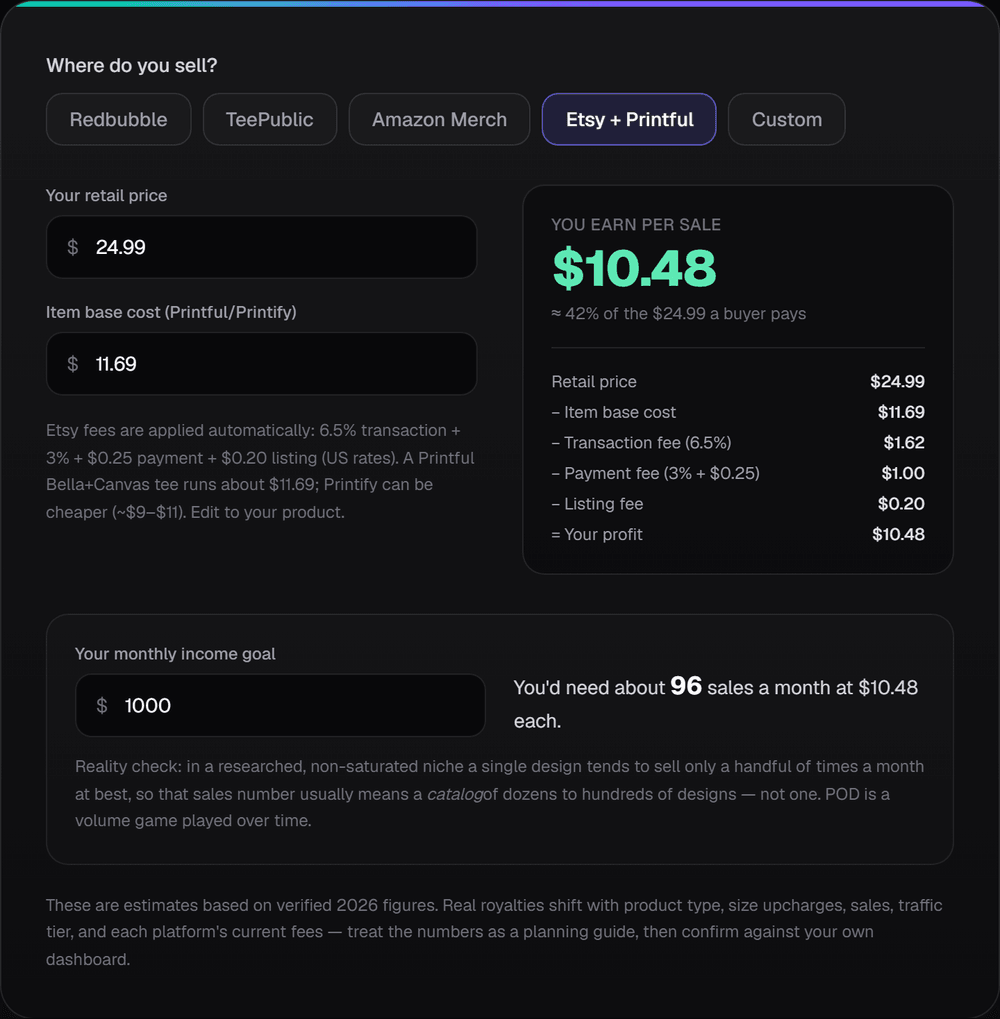
Say you sell a print-on-demand t-shirt through Printful. The Printful base cost for a standard tee is about $11.69. You list it on Etsy for $24.99. Here's roughly what you keep:
| Line item | Amount |
|---|---|
| Sale price | $24.99 |
| Printful base cost | −$11.69 |
| Etsy fees (~9.5% of $24.99) | −$2.37 |
| Etsy per-order fees ($0.25 payment + $0.20 listing) | −$0.45 |
| Your profit | ≈ $10.48 |
So at $24.99 you keep about $10.48 per shirt — a healthy margin for POD, and roughly double what you'd earn as a Redbubble royalty on a similar tee.
Now watch what careless pricing does. Suppose that same shirt feels "too expensive" at $24.99, so you drop it to $16.99 to look affordable:
| Line item | Amount |
|---|---|
| Sale price | $16.99 |
| Printful base cost | −$11.69 |
| Etsy fees (~9.5% of $16.99) | −$1.61 |
| Etsy per-order fees ($0.25 + $0.20) | −$0.45 |
| Your profit | ≈ $3.24 |
Same shirt, same effort, and your margin nearly evaporates — from about $10.48 down to about $3.24. And if an Offsite Ad fires on that $16.99 sale, the 12–15% cut can leave you working for nearly nothing. This is the single most common way Etsy POD sellers quietly lose money: they price for their own fear of looking expensive instead of pricing for the fee stack.
Run your own numbers before you list anything. The free POD Profit Calculator has an Etsy + Printful mode — pick the platform, plug in your base cost and retail price, and it shows your real take-home after all the fees. Seeing that number honestly, before you commit, is the best expectation-reset I can offer.
Who Etsy is worth it for — and who it isn't
Here's the honest "it depends" test. Etsy is worth it, or not, almost entirely based on what you bring to it.
Etsy is worth it if:
- You have a differentiated product — handmade, vintage, genuinely personalized, or a researched POD niche that isn't already flooded.
- You're willing to do listing SEO: keyword-led titles, all 13 tags, good photos, real descriptions.
- You'll price for the fees instead of underpricing out of nerves.
- You treat it as a business you build over months, not a lottery ticket you check next week.
Etsy is not worth it if:
- You plan to list generic, dropship-style items that a thousand other shops already sell identically.
- You expect passive sales with no ongoing work.
- You won't do niche research to find a space you can actually win.
- You'll skip the SEO and then blame Etsy when nobody finds your listings.
If you read the first list and thought "fine, I can do that," Etsy is one of the better places to build a small product business — the audience is already there waiting. If you read the second list and felt a flicker of recognition, that's useful information: it means the "passive income" framing got to you, and you'd likely be one of the sellers who lists ten things and quits. Better to know now than after three quiet months.
The differentiation point is worth dwelling on. Generic loses on Etsy because buyers can compare you against everyone. A researched, specific niche — "Australian Shepherd agility competitor mom," not "dog mom" — faces less competition, ranks more easily, and commands a price that survives the fees. Finding that specific angle is the upstream work that decides everything downstream.
Etsy vs the POD marketplaces
If you're weighing Etsy specifically against Redbubble, TeePublic, or Amazon Merch, here's the honest trade-off. They're different shapes of the same business.
| Etsy | Redbubble / TeePublic / Amazon Merch | |
|---|---|---|
| What you run | Your own branded shop | A contributor account |
| Who fulfills | Your POD provider (Printful, Printify) | The platform does everything |
| Traffic | Some built-in search + you drive more | More built-in marketplace traffic |
| Your cut per sale | Higher (~$10 on a $24.99 tee) | Lower (~$2–$5 royalty) |
| Control & branding | High — it's your shop | Low — you're one of many contributors |
| Setup effort | Higher (shop + provider + SEO) | Near-zero |
The short version: Etsy gives you a branded shop with higher margin and some search traffic, but you drive more of your own success. Redbubble, TeePublic, and Amazon Merch hand you more built-in traffic and take a bigger cut, with far less control and almost no setup.
Neither is "better" in the abstract — they fit different people. If you want the lowest-effort entry to test whether you even like POD, the marketplaces win. If you want to build a real brand and keep more of each sale, Etsy wins. I broke down the marketplace side in Printful vs Redbubble and compared two of the big marketplaces directly in TeePublic vs Redbubble if you want to weigh those routes too.
The smart move for a lot of people is to validate niches on the marketplaces with the most public signal, then build your branded shop on Etsy where the margin lives. You don't have to pick one forever.
How to make Etsy actually worth it
If you've decided Etsy fits you, here's where the "worth it" actually gets decided. These are the levers, in order of importance:
- Pick a researched, non-saturated niche. This is upstream of everything else. A great listing in a flooded niche still earns nothing. Go specific enough that you can realistically rank, and validate that real buyers exist before you design anything. I wrote the full method in how to find trending POD niches, and there's a curated set of starting points in print on demand niches.
- Differentiate the product. Personalization, a specific angle, a real point of view — anything that makes a buyer pick you over the near-identical listing next to you. Generic competes on price and loses.
- Nail listing SEO. Front-load your strongest keyword in the title, use all 13 tags with multi-word buyer phrases (not single broad words), and use real photos. Etsy is a search engine; titles and tags are the whole game.
- Price for the fees. Use the POD Profit Calculator to set a price that survives the ~9.5% + $0.45 and a possible Offsite Ads cut. Don't underprice out of fear.
- Trademark-check every phrase. Before you list, run the wording through the free USPTO trademark database and check for live marks in apparel (Class 25). This one habit prevents most avoidable shop suspensions.
Worth a small note: naming the shop itself matters less than people think, but a clean, memorable name helps trust. If you're stuck, the free POD shop name generator spits out brandable options in a few seconds so you can stop agonizing and get to the real work.
The niche research and trademark steps are exactly where I built Trendlytic to help. Trendlytic now covers all four marketplaces — TeePublic, Amazon Merch, Redbubble, and Etsy — so one search shows you what's actually selling across them, including real Etsy listings with favorite-count demand data, and it runs a live USPTO trademark check on every keyword at the same time. $9/month for 100 searches, free trial. I'll be honest about what it is: it does the boring research step so you don't dig through marketplaces by hand. It is not a money printer, and plenty of sellers do this manually with a spreadsheet, like I did at first. It just makes the part that decides everything faster.
If you want the full step-by-step for the Etsy POD workflow specifically — providers, setup, listing SEO in depth — that's the companion guide: Etsy print on demand: the complete beginner's guide. And for the honest take on whether POD itself pays, is print on demand profitable runs the per-sale math across every platform.
FAQ
Is selling on Etsy worth it in 2026? Yes, selling on Etsy is worth it in 2026 for the right person and product. Etsy gives you real built-in buyer traffic, which beats launching a store from scratch, but it's crowded and the fees stack up to about 9.5% + $0.45 per order. It's worth it if you have a differentiated or researched product and treat it as a business; it's not worth it for generic listings you expect to sell themselves.
Is Etsy profitable for small sellers? Yes, Etsy can be profitable for small sellers, but margins depend on pricing and niche. On a print-on-demand tee sold at $24.99 with an ~$11.69 Printful base, you keep about $10.48 after fees — a solid margin. Underprice the same shirt and that profit can drop to a few dollars. Small sellers who research niches and price for the fees do well; those who list generic items at low prices often net almost nothing.
How much does Etsy take per sale? Etsy takes about 9.5% + $0.45 per order: a 6.5% transaction fee, about 3% + $0.25 in payment processing, and a $0.20 listing fee. If a sale comes through Etsy's Offsite Ads, Etsy takes an additional 12–15% of that order, which is mandatory once your shop passes a revenue threshold.
Is Etsy worth it for print on demand? Yes, Etsy is one of the better POD routes because you keep a higher margin than marketplace royalties — roughly $10 on a $24.99 tee versus $2–$5 on Redbubble. The trade-off is more setup and you drive more of your own traffic. It's worth it if you research niches, do listing SEO, and price for the fees; it's not worth it if you expect royalties for showing up.
Is it too late to start an Etsy shop? No, it's not too late, but the easy niches are gone. The obvious markets are saturated, so a new shop has to go specific — a researched, differentiated niche where it can actually rank — rather than competing in flooded spaces. People starting today still build steady income; they just can't win on generic products the way early sellers could.
Do Etsy shops actually make money? Yes, Etsy shops make real money, but it's earned, not passive. The shops that earn pick specific niches, differentiate their products, write proper listing SEO, and price above the fee stack. The ones that make nothing list generic items, underprice, skip SEO, and quit early. The difference is almost always process, not luck.
Where to go from here
So, is selling on Etsy worth it? Yes — but now you know what that actually means: real built-in traffic on one side, a stacked fee structure and a crowded marketplace on the other, and a product that has to be differentiated or researched enough to earn its place. It's a genuine business with genuine margin, not a passive jackpot. The sellers who win are the ones who accepted that and did the upstream work.
If you're in, the next move is to run your own numbers honestly. Use the free POD Profit Calculator in Etsy mode to see your real take-home, then read the Etsy print on demand guide for the full setup-and-SEO walkthrough. For the big-picture map of how Etsy fits with every other route, see the complete guide to print on demand.
And when you're ready for the research step — seeing what's actually selling and how saturated a niche is before you commit, with a USPTO trademark check on every search — that's exactly what I built Trendlytic for. It now covers TeePublic, Amazon Merch, Redbubble, and Etsy in one search. $9/month, 100 searches, free trial. It does the tedious part. It won't make you money on its own, but it'll stop you from building into a flooded niche or a trademarked phrase.
One honest question before you decide: after seeing the fee math, does Etsy still feel worth it to you — or did the numbers change your mind? Tell me which figure surprised you most, and I'll point you to the right next step.
Like this? Get one like it every Wednesday.
Niche data, trademark alerts, one tactic per week.
Try Trendlytic
Find your next winning POD niche in 40 seconds
Live data from TeePublic, Amazon Merch, Redbubble, and Etsy, with a trademark check built in. Then turn any winner into a listing for a design of your own in that niche. Plans from $9/month.
Start researchingKeep reading
- Trendlyticmost profitable etsy shops
Most Successful Etsy Shops: What They Have in Common
The JournalMost Successful Etsy Shops: What They Have in Common
September 12, 2026 · 17 min read
- Trendlyticetsy printables
Etsy Printables: How to Sell Them Properly
The JournalEtsy Printables: How to Sell Them Properly
September 12, 2026 · 17 min read
- Trendlyticetsy shop ideas
Etsy Shop Ideas: 20 Concepts That Actually Sell
The JournalEtsy Shop Ideas: 20 Concepts That Actually Sell
September 8, 2026 · 23 min read