TL;DR: Print on demand and dropshipping are both "no inventory" models, which is exactly why people confuse them — but they're different businesses. With print on demand you sell your own designs on blank products (tees, mugs, stickers) and a supplier prints each item per order; you compete on creativity and niche fit, lean very little on ads, and accept small margins. With dropshipping you resell existing generic products (gadgets, home goods) from a third-party supplier who ships them; you compete on marketing and price, can earn bigger order values, but you live or die by ad spend and supplier reliability. Beginners who can design — or who want low ad risk — lean print on demand. People comfortable funding and running ads, and testing products, lean dropshipping.
Most "print on demand vs dropshipping" articles treat them as two flavors of the same thing because both let you start without buying inventory. That surface similarity is real, and it's also where the confusion ends. Underneath, they're two different businesses that reward two different skills.
I've spent the last two years tracking print-on-demand sellers across Redbubble, TeePublic, Amazon Merch, and Etsy — watching what sells, what stalls, and where people quietly lose money. This exact comparison comes up constantly, usually phrased as "which one makes more money." That's the wrong question, and answering it the wrong way is how people pick the model that doesn't fit them and quit three months in.
So this is the honest version. Not "both are great," not a pitch for one side. By the end you'll know the real difference, what each one actually costs and risks, and which one fits where you are right now.
Don't miss the next one.
New POD niche analysis every Wednesday.
The core difference: your designs vs existing products
This is the whole article in one section, so I'll say it plainly and then come back to it where it matters.
Print on demand means you sell your own designs on blank products. You create artwork or text — a phrase for night-shift nurses, a graphic for disc-golf dads — and a POD supplier prints it onto a blank tee, mug, hoodie, or sticker only after someone orders it. The product itself is generic; the thing you're selling is your design and the niche it speaks to. You compete on creativity and on picking a niche that has demand without being flooded.
Dropshipping means you resell existing generic products. You don't make anything. You find a product that already exists — a posture corrector, a LED strip, a kitchen gadget — list it on your own store at a markup, and when someone buys, a third-party supplier ships it to them directly. You never design, never hold stock, and never touch the package. You compete on marketing: finding a product people will impulse-buy and running ads that sell it profitably.
So the honest reframing is this: the real question isn't "which is better," it's "do you want to build a business around your own designs, or around marketing existing products?" Print on demand is the design path. Dropshipping is the marketing path. They're answers to two different questions, and the right one depends on which skill you have or want to build.
Hold onto that, because every difference below comes back to it.
How each one works
Print on demand — design, list, supplier prints per order
The POD flow is built around your design:
- You research a niche, then create a design for it (text or graphic).
- You upload it either to a marketplace (Redbubble, TeePublic, Amazon Merch, Etsy) or to your own store connected to a POD supplier like Printful.
- On a marketplace, the platform's own buyers find your listing through search. On your own store, you drive the traffic.
- When someone orders, the supplier prints the item, ships it, and you earn a royalty or your margin.
The key line: you make the design once and it can sell for years, with the platform or supplier doing the printing. On marketplaces you often don't need ads at all — the built-in search traffic does discovery. I broke down the full beginner path in how to start a print on demand business.
Dropshipping — find a winning product, run ads, supplier ships
The dropshipping flow is built around the product and the ad:
- You research products and pick a "winner" — something with impulse appeal and room for markup.
- You build a store (almost always Shopify) and list that product, often as a one-product or few-product store.
- You run paid ads — Facebook, Instagram, TikTok — to drive cold traffic to the listing.
- When someone buys, you order from the supplier (often AliExpress or a sourcing agent), who ships directly to your customer.
The key line: dropshipping has no built-in traffic — your ads are the entire engine. No ads, no visitors, no sales. Finding a product that converts at a profit on paid traffic is the whole skill, and it's the part that takes a budget and a tolerance for losing some of it while you test.
Cost, margin & risk
Here's where the two models split hardest. Both have $0 inventory cost, but almost everything else differs. Let me use honest, realistic numbers rather than invented ones.
| Print on demand | Dropshipping | |
|---|---|---|
| Upfront cost | ~$0 on a marketplace; small store fees if you run your own | Store subscription + an ad budget (commonly a few hundred dollars to test) |
| Who holds inventory | Nobody — printed per order | Nobody — supplier ships per order |
| Main expense | Your time (design + research) | Ad spend |
| Typical margin | Small but clean: ~$2–$5 per tee on marketplaces | Higher order value, but ad cost eats much of it |
| Main risk | Saturation — designing into a flooded niche and earning $0 | Ad spend can wipe out margin; supplier delays and quality issues |
| Where traffic comes from | Built-in marketplace search (mostly free) | Paid ads you fund yourself |
A few honest details behind that table.
On the POD side, marketplace royalties really are small. A standard tee on Redbubble at the default 20% markup earns you around $4. Amazon Merch's lower royalty tiers can be closer to $2.44 on a basic tee. If you run your own store with a supplier like Printful, the base cost of a quality tee is around $11.69, so a $24.99 retail price leaves you roughly $10 before store fees. Small per sale — but on a marketplace, the traffic that produces that sale was free.
On the dropshipping side, the order value is usually higher — a $30–$50 product instead of a $4 royalty — but you paid to acquire that customer. If your ad spend to make one sale is $15–$25 (normal for cold traffic), a big chunk of that bigger order value is gone before you count the product cost. The margin can still be good, but it's variable and tied to ad performance in a way POD margins aren't.
The risk profiles differ too. In POD, the main way you lose is quiet: you design into a saturated niche and simply earn nothing — you've lost time, not money. In dropshipping, you can lose actual cash fast when an ad set doesn't convert, and you carry supplier risk on top: long shipping times, quality complaints, and refunds you have to honor for a product you never saw. To pressure-test the margin side, the free POD profit calculator lets you plug in base cost, price, and fees for the POD path.
Traffic & marketing: the biggest practical difference
If you remember one section, make it this one. For most beginners, traffic — not margin — is the entire decision.
Print on demand gives you traffic (on marketplaces). Redbubble, TeePublic, Amazon Merch, and Etsy already have millions of people searching and buying. Upload a well-tagged design and the platform's existing audience can find it with zero marketing from you. A complete beginner with no ad budget and no audience can still make a first sale, because the buyers were already there searching. (Run your own store instead and that free traffic disappears — then you're driving visitors yourself, which is closer to the dropshipping reality.)
Dropshipping gives you zero traffic. None. A fresh Shopify store with a product on it gets exactly zero visitors until you pay to send them. Your job is to run ads — write the creative, target the audience, manage the budget, and keep the cost per sale below your margin. That's a real, learnable skill, but it costs money to learn, and it never stops: stop spending and the sales stop the same day.
This is the most practical fork in the road. POD marketplaces hand you the hardest, most expensive part of any business — getting a qualified buyer in front of your product — for free. Dropshipping makes that part your full-time job and your main expense. If you don't yet know how to run profitable ads, that difference is enormous.
Which is easier to start / lower risk
Bluntly: print on demand is the gentler on-ramp.
To start POD on a marketplace, you sign up, research a niche, make a design, and list it. No store to build, no ad account, no budget at risk. Your worst-case outcome is that a design earns nothing — you're out time, not cash. That's why I steer most first-timers here.
To start dropshipping, you need a store (a monthly Shopify subscription), a product, and — critically — an ad budget you're prepared to partly lose while you test. There's no real version of dropshipping without paid traffic, and there's no version of paid traffic where your first attempts all work. The model isn't "risky" in a reckless sense, but it does put real money on the table from day one, and it asks you to be comfortable testing and losing.
So on the pure "easier and lower-risk to start" axis, POD wins cleanly. Dropshipping asks more of you up front — money, ad skill, and a tolerance for testing — in exchange for a higher ceiling.
Which makes more money?
Here's the honest answer most articles dodge: it depends, and neither is passive.
Dropshipping has the higher ceiling. A winning product on profitable ads can scale fast — you can pour more ad spend into something that's converting and grow revenue in weeks, not years. But that ceiling comes with high variance. Most products tested don't win, ad costs rise, and a profitable campaign can turn unprofitable when the platform's auction shifts. The people making real money dropshipping are good at product research and ad math, and they got there by funding a lot of tests that didn't work.
Print on demand has a lower ceiling but steadier, compounding income. Each listing is a small, cheap lottery ticket; you win by holding a lot of well-researched ones. A catalog of hundreds of good designs keeps earning quietly in the background, and older listings keep selling while new ones gain traction — without ongoing ad spend. It builds slower and tops out lower for most people, but it's far less volatile and doesn't evaporate when you stop paying for traffic. I went deeper on the realistic numbers in is print on demand profitable.
Neither is passive. POD is a research-and-consistency grind; dropshipping is a testing-and-ad-spend grind. Treat any "make $10k in 30 days" claim about either one as a red flag.
Which should you choose?
Here's the honest framework. Be real with yourself about which list you're actually in.
| Lean print on demand | Lean dropshipping | |
|---|---|---|
| Your strength | Design, or willingness to learn it | Marketing, ads, product research |
| Budget | Little to none | Have a few hundred to test ads |
| Risk tolerance | Want low/no cash risk | Comfortable spending to test |
| Income style | Steady, compounding, slower | Higher ceiling, higher variance |
| Day-to-day work | Research niches, make designs, list | Find products, run and tune ads |
Choose print on demand if you can make designs (or want to learn), want low or no ad risk, like the idea of building a catalog that compounds, and want to lean on free marketplace traffic instead of funding ads.
Choose dropshipping if you are comfortable running and funding ads, enjoy product research and testing, want higher order values, and accept that your ad spend is the engine — and the main risk.
And you don't have to pick a side forever. The models can even overlap: you can sell your own POD products through your own store (Printful plus Shopify or Etsy), which is a design business run with a store owner's tools. Some sellers run a POD catalog on marketplaces for steady baseline income while testing a dropshipping product on the side. They're different skills, but they're not enemies.
Where research fits (for the POD path)
If you lean print on demand, here's the part that decides everything: before you design anything, you have to know what's actually selling. A great design in a flooded niche earns exactly $0, because it ranks on page 40 where no buyer ever scrolls. The model decision is downstream of the niche decision — pick a researched, non-saturated niche first, then design.
You can do this by hand: search your keyword across Redbubble, TeePublic, Amazon Merch, and Etsy, see how crowded it is, and study what's genuinely selling rather than just how many results exist. That's how I started — a spreadsheet and a browser. It works; it's just hours of manual digging across four marketplaces, and you still have to check each phrase for trademarks separately.
That tedious step is exactly what I built Trendlytic to handle. One search shows what's actually selling across Redbubble, TeePublic, Amazon Merch, and Etsy at once, with a live USPTO trademark check on every keyword so you don't design something you'll get taken down for. $9/month, 100 searches, free trial. Honest about what it is: it does the research, it is not a money printer, and you don't need it to succeed — it just makes the "find a niche that isn't saturated" part faster. Honest about its limits too: it's newer and smaller than tools like Merch Informer, and instead of raw search-volume numbers it shows a search-interest curve of whether a niche is rising or fading, alongside real selling signals across the marketplaces.
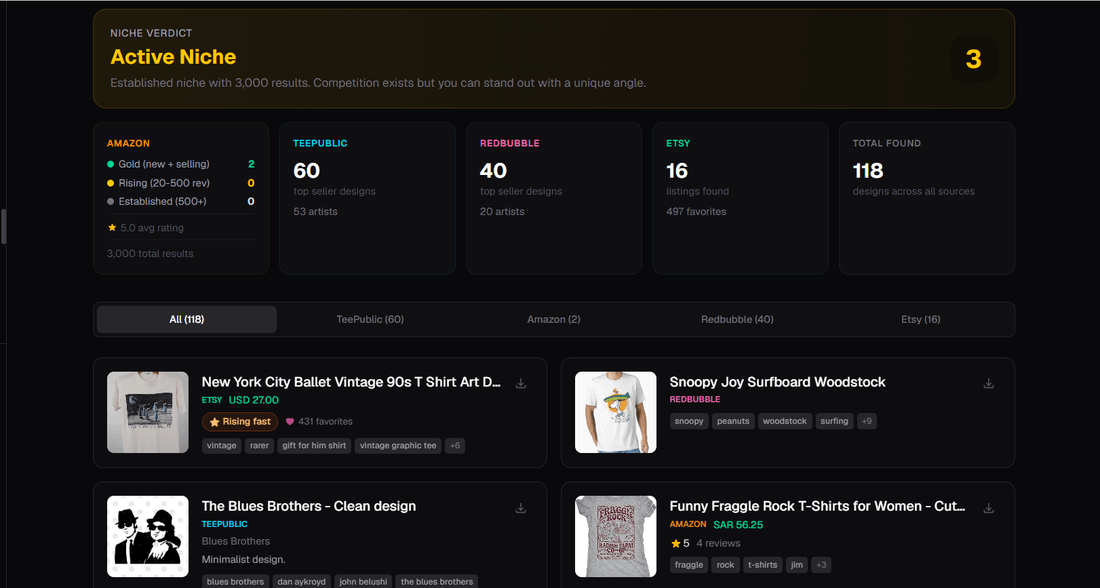
To go deeper on the POD side once you've chosen it, print on demand niches covers how to find ones with real demand, and best print on demand products covers what to actually put your designs on.
FAQ
Is print on demand the same as dropshipping? No. They share one feature — no inventory — but they're different businesses. Print on demand sells your own designs printed on blank products, and you compete on creativity and niche fit. Dropshipping resells existing generic products from a supplier, and you compete on marketing and ads. POD usually leans on free marketplace traffic; dropshipping runs on paid ads you fund yourself.
Is print on demand or dropshipping more profitable? It depends on your skills, and neither is passive. Dropshipping has a higher ceiling — a winning product on profitable ads can scale fast — but high variance and ad dependency, and most tested products lose money first. Print on demand earns less per sale and grows slower, but it's steadier, compounds over time, and doesn't collapse when you stop paying for traffic. Marketers with a budget often do better with dropshipping; designers or budget-tight beginners often do better with POD.
Which is better for beginners — print on demand or dropshipping? For most true beginners, print on demand. You can start on a marketplace for free, with no store to build and no ad budget at risk, and the platform's own traffic finds your listing. Dropshipping needs a store subscription, an ad budget, and the willingness to lose some of it while you learn to run profitable ads. POD's worst case is wasted time; dropshipping's worst case is wasted cash.
Is print on demand a type of dropshipping? Not exactly, though they're cousins. Both are "fulfilled by a third party, no inventory" models, so some people lump POD under the dropshipping umbrella. The distinction that matters: in dropshipping you resell a product that already exists, while in print on demand the supplier creates a custom-printed product from your design per order. POD is design-led; classic dropshipping is product-and-ads-led.
Can you do both print on demand and dropshipping? Yes, and some sellers do. They draw on different skills, so they're not exclusive. A common combination is running a POD catalog on marketplaces for steady, low-risk baseline income while testing a dropshipping product with ads on the side. You can also sell your own POD designs through your own store, which blends a design business with a store owner's toolkit.
Which has the lower startup cost — print on demand or dropshipping? Print on demand, clearly. On a marketplace you can start for effectively $0 — sign up, design, list, no store and no ads. Dropshipping is never truly free: you need a store subscription plus an ad budget to drive any traffic at all, and you should expect to spend some of that budget testing products that don't work. Both have $0 inventory, but POD is the cheaper, lower-risk start.
Where to go from here
Print on demand vs dropshipping isn't a contest between two similar tools — it's a choice between two kinds of business. Print on demand is the design path: your own art, free marketplace traffic, small but steady compounding income, very little ad risk. Dropshipping is the marketing path: existing products, paid ads as the engine, higher order values and a higher ceiling, but real cash on the line and supplier risk to manage. The honest decision is about which skill you have or want to build, not which model is "better."
If you're leaning toward the POD path, the design decision sits underneath everything — and getting the niche right first is the boring step worth doing well. Trendlytic shows what's actually selling across Redbubble, TeePublic, Amazon Merch, and Etsy with a live USPTO trademark check on every keyword, $9/month for 100 searches, free trial — it does the research so you're not digging by hand for hours. It's not a money printer; it just points you at niches that aren't already flooded. From there, run your real numbers with the free POD profit calculator, and if you want to compare a marketplace against your own store, Printful vs Redbubble walks that decision. For the big-picture map of how this all fits, our complete print on demand guide is the hub that pulls it together.
One question before you decide: are you someone who'd rather make something people want (designs) or market something people already want (products)? Tell me which one sounds more like you, and I'll point you to the path that actually fits.
Like this? Get one like it every Wednesday.
Niche data, trademark alerts, one tactic per week.
Try Trendlytic
Find your next winning POD niche in 40 seconds
Live data from TeePublic, Amazon Merch, Redbubble, and Etsy, with a trademark check built in. Then turn any winner into a listing for a design of your own in that niche. Plans from $9/month.
Start researchingKeep reading
- Trendlytichigh demand products to sell
High-Demand Products to Sell Online in 2026
The JournalHigh-Demand Products to Sell Online in 2026
July 23, 2026 · 15 min read
- Trendlyticetsy vs redbubble
Etsy vs Redbubble: Which Is Better for Print on Demand?
The JournalEtsy vs Redbubble: Which Is Better for Print on Demand?
June 25, 2026 · 15 min read
- Trendlyticetsy
Is Selling on Etsy Worth It in 2026? An Honest Breakdown
The JournalIs Selling on Etsy Worth It in 2026? An Honest Breakdown
June 14, 2026 · 16 min read