TL;DR: The best places to sell AI art are Redbubble and Etsy for reach and buyer intent, plus your own store (Shopify or Gumroad) if you want to keep the margin. Redbubble is the easiest start and prints on demand. Etsy has the strongest buyers but requires you to disclose that you used AI. Every one of these marketplaces permits AI-assisted art as long as the work is genuinely yours, not a resold pack of someone else's generated images. The thing that actually gets accounts suspended is not the AI. It is trademark and IP infringement, a logo or character or real person the generator slipped in, so screen every design and phrase before you list it.
If you're searching "where to sell AI art," you've probably already generated a batch of pieces you're proud of, and now you want to know which platform will actually turn them into sales without getting your account banned.
I'll give you the straight version. There isn't one perfect marketplace. There's a handful of good ones, and the right pick depends on whether you want passive print-on-demand income, digital downloads, or your own brand. What they all share is that they allow AI art when it's your own work, and they all suspend sellers for the same thing: intellectual property trouble, not the generator.
I build a niche-research tool for print-on-demand sellers, so I read these platforms' policies for a living and talk to people whose designs got pulled. Below is a fair look at six places to sell AI art: what each is best for, how it makes money, and the catch nobody mentions in the excited YouTube videos.
Don't miss the next one.
New POD niche analysis every Wednesday.
How we picked these (and how to not waste your time)
I didn't rank these by how loud their marketing is. I picked marketplaces that are genuinely open to AI-assisted work, that have real buyers, and that pay out in a way a solo seller can actually use. A few of them print your art on physical products on demand, so you carry no inventory. Others sell digital files or let you run your own shop. I've tried to be honest about who each one suits and where it falls short.
Here's the part most "where to sell AI art" lists skip. The marketplace matters less than the niche you sell into. AI made producing a design nearly free, which means an enormous amount of it is being made, and the obvious categories are flooded. Being one more generated sticker in a saturated niche means being invisible, no matter how good the art looks. So the real skill is not picking a platform. It's validating that people actually want the thing you're about to make before you make it.
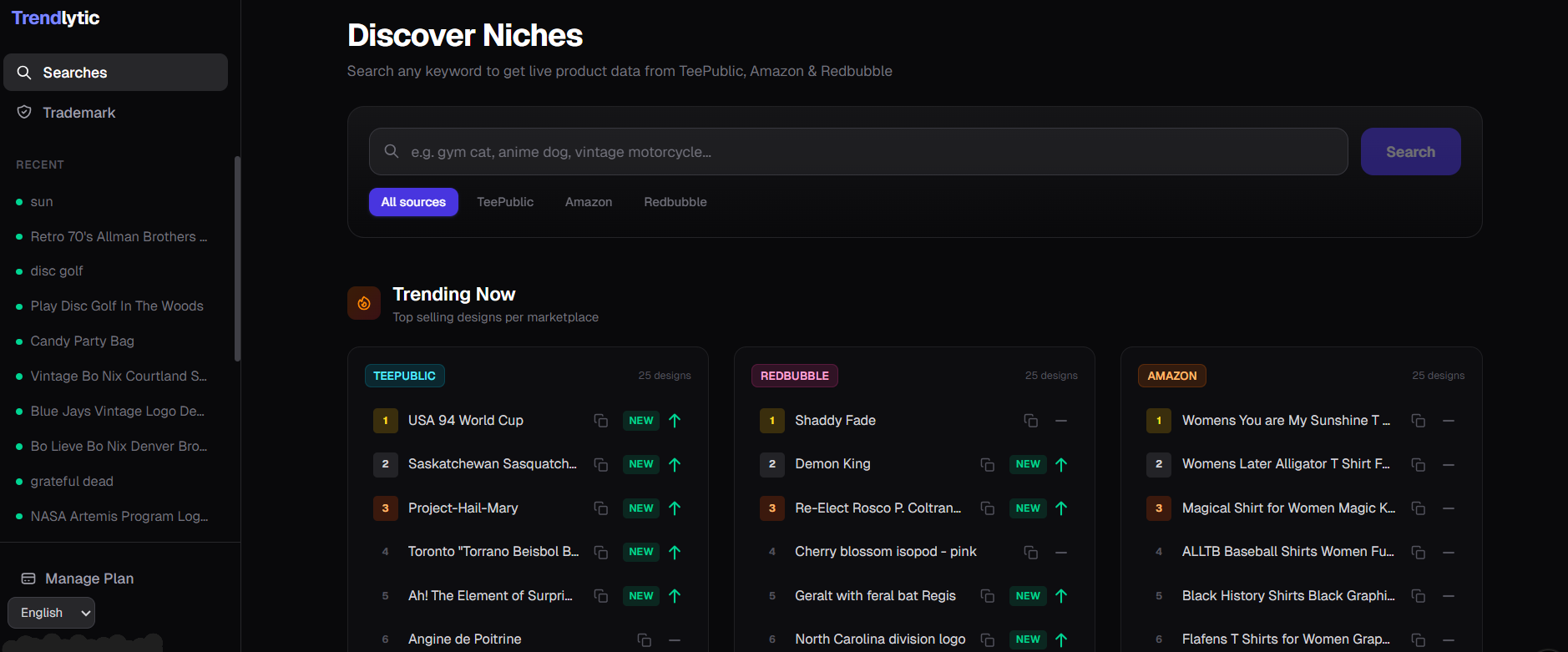
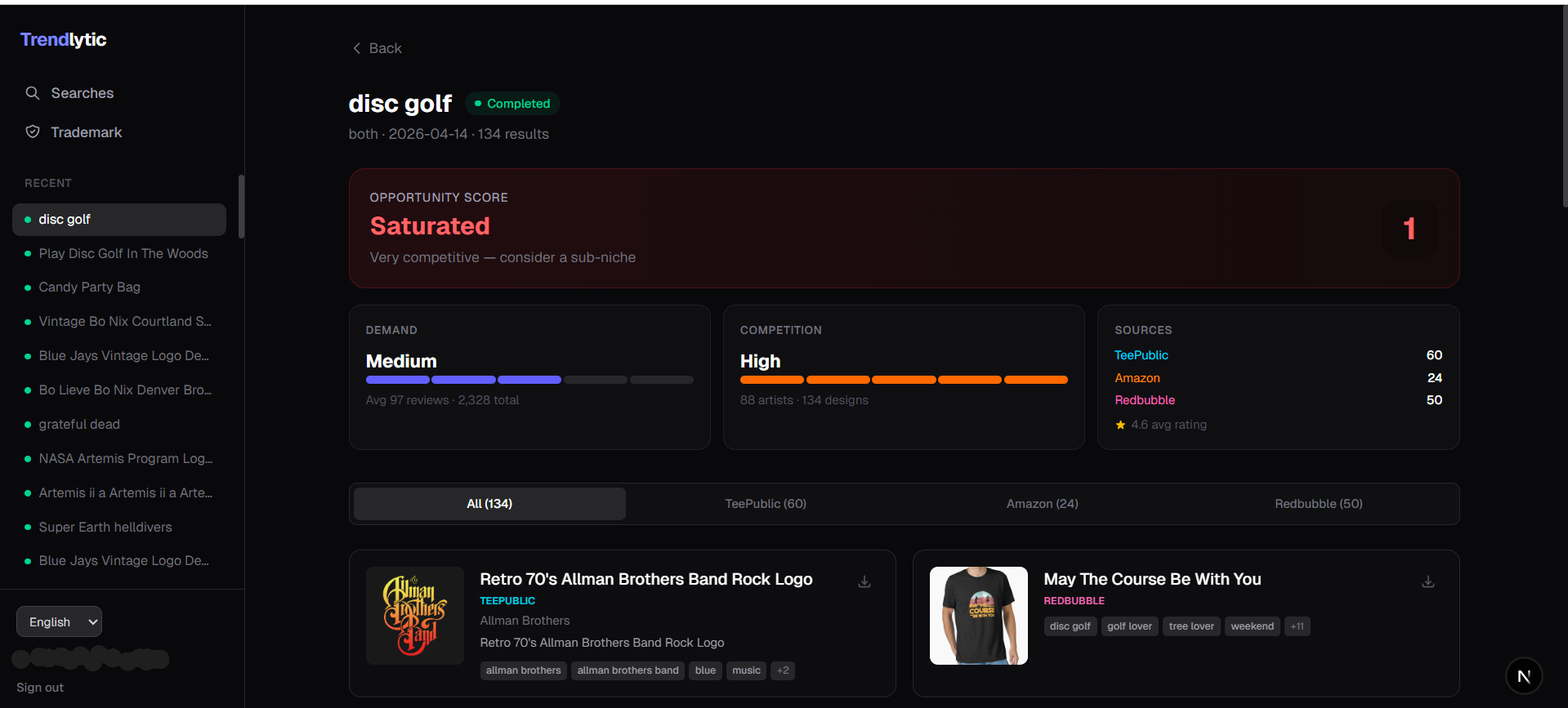
The principle is short: judge a niche by what's genuinely selling, not by how many people search for it. A phrase with heavy search volume and a wall of existing listings is a crowded market, not an opening. The openings are the corners where real sales are happening but only a handful of shops have moved in yet. Doing that read by hand means combing several marketplaces and checking each idea for trademark trouble, which is hours of work per niche. That upstream research is exactly what I built Trendlytic to automate, along with a live USPTO trademark lookup on any phrase. I'll come back to it, but the point stands even if you never use a tool: validate demand first, and the marketplace choice gets much easier.
| Marketplace | Best for | Model | AI art? |
|---|---|---|---|
| Redbubble | Easiest start, widest product range | Print on demand, you set markup | Allowed if it's your own work |
| Etsy | Highest buyer intent, digital + physical | Listing fees + commission | Allowed, must disclose AI use |
| TeePublic | Apparel, cross-listing with Redbubble | Print on demand, tiered royalties | Allowed if it's your own work |
| Amazon Merch on Demand | Enormous reach | Print on demand, royalty per sale | Allowed, strict content policy |
| Your own store (Shopify / Gumroad) | Keeping the margin, building a brand | You keep the sale minus fees | Allowed, your rules |
| Society6 / Displate | Wall art and home decor | Print on demand, set royalty | Allowed if it's your own work |
1. Redbubble
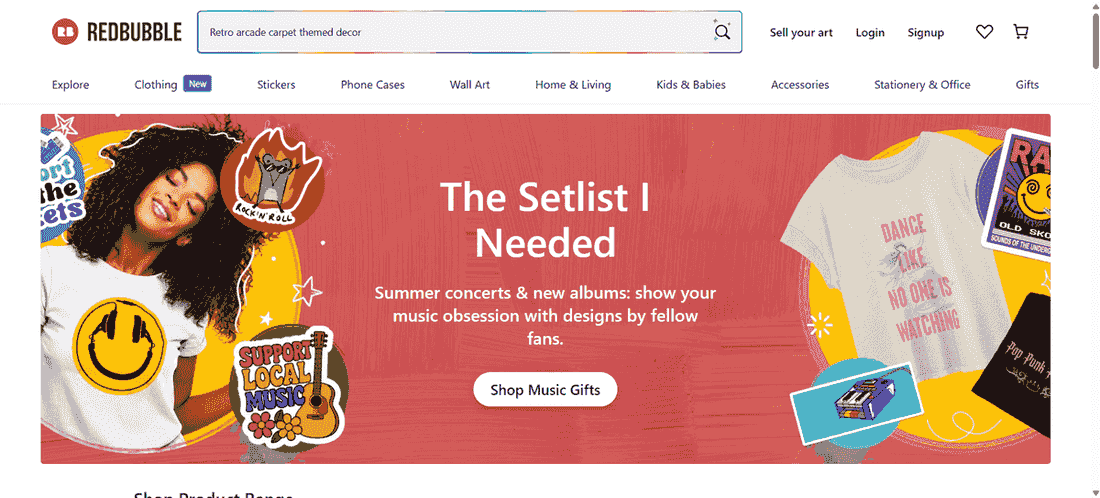
Redbubble is where I'd tell most people to start, and it's our lead marketplace for a reason. You upload a design once, and it gets applied to a huge catalog of products automatically: stickers, t-shirts, hoodies, wall art, phone cases, mugs, totes. No inventory, no upfront cost, and the sticker culture here is unmatched by any other platform.
Why it fits AI art: The barrier to entry is basically zero, so it's the friendliest place to test whether your generated designs land with real buyers. Redbubble permits AI-assisted art as long as the work is genuinely yours, made with your own prompts and creative direction, not a bought pack of someone else's images re-uploaded as originals. I wrote a full breakdown of the rules in can you sell AI art on Redbubble if you want the detail.
How it makes money: You set a markup on each product's base price. Redbubble handles printing, shipping, and payment, and pays you the markup. Stickers earn cents to about a dollar; a tee earns a few dollars. It's a volume game.
The catch: Redbubble runs an aggressive automated IP scanner. It hunts for registered names, brand marks, familiar characters, and famous faces. When it flags a design, the design comes down, you take a strike, and strikes stack toward suspension. AI generators are unusually good at slipping infringing content into your image without warning, so this is the real risk here, not the AI itself. Redbubble is also a search engine before it's a gallery, and it gives you up to 15 tags per work, so tagging honestly with the phrases buyers actually type is most of what decides whether anyone sees your design.
Best for: Beginners, anyone testing a lot of designs cheaply, and sticker or apparel niches. If you're new, how to sell on Redbubble covers setup end to end, and is Redbubble legit covers how it treats sellers in general.
2. Etsy
Etsy is the marketplace with the strongest buyer intent on this list. People land on Etsy ready to spend money, which is a different animal from browse-and-discover platforms. And Etsy is flexible: you can sell AI art as instant digital downloads (a printable file the buyer prints themselves) or as physical print-on-demand products through an integration like Printful or Printify.
Why it fits AI art: Digital downloads are a genuinely good match for generated art. You make the file once and sell it repeatedly with no printing involved, which suits wall-art prints, patterns, and clip-art style work. Etsy allows AI-assisted art, but with a firm condition that sets it apart: you have to disclose that AI was involved and describe honestly how the item was made. Etsy treats a generated design as your work only when the creative input is yours, and it expects that told plainly in the listing. My can you sell AI art on Etsy post digs into the disclosure rules.
How it makes money: Etsy charges a small per-listing fee plus a commission and payment processing on each sale. The buyer intent is high enough that the fees are usually worth it, but they do eat into thin-margin digital products.
The catch: Etsy leans more handmade than the print-on-demand platforms, and a slice of its audience is wary of anything that reads as mass-produced or low-effort AI. Disclosure is not optional here, and getting it wrong is a policy problem. On top of that, the same trademark risk applies: a generated design that reproduces a protected character or brand will get you a takedown or worse.
Best for: Digital downloads, wall art, and anyone who'd rather sell to buyers with their wallets already out. How to sell on Etsy walks through opening a shop.
3. TeePublic
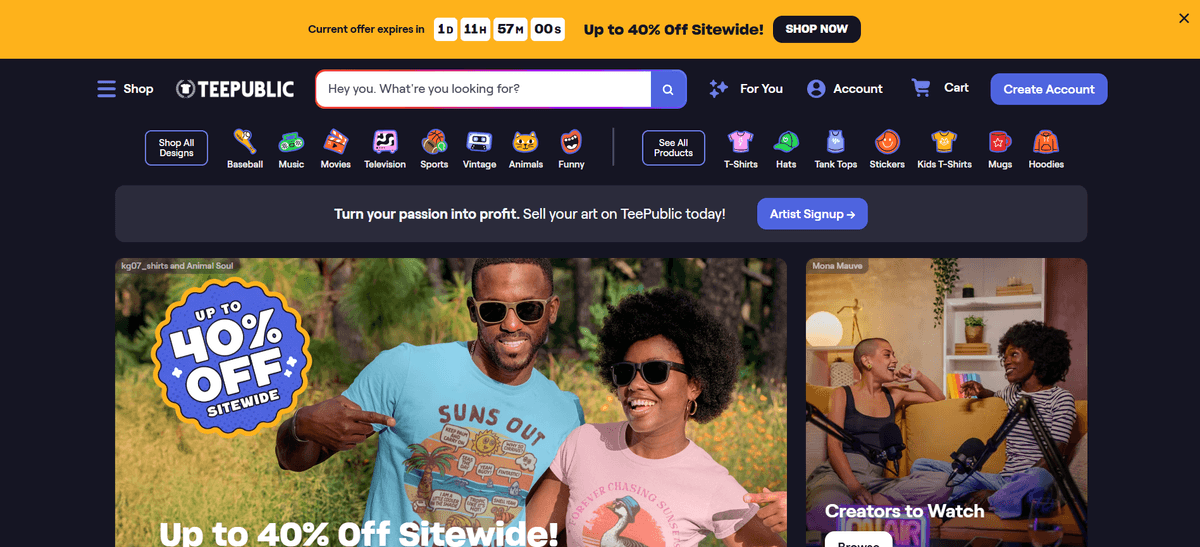
TeePublic is Redbubble's apparel-focused sibling. It's owned by the same parent company, and the two are the classic cross-listing pair: sellers upload the same designs to both to double their reach for almost no extra effort. TeePublic leans harder into t-shirts and apparel than Redbubble's broad catalog.
Why it fits AI art: Same permission as Redbubble. Your own AI-assisted designs are allowed as long as they're genuinely yours and don't infringe. Because TeePublic is apparel-first, it rewards bold, readable, statement-led designs, which is a style AI tools handle well when you direct them.
How it makes money: Print on demand with a tiered royalty structure that's weighted toward sales. TeePublic's algorithm favors designs that are already selling, so early traction compounds. Its regular sitewide sales drive a lot of volume, and your royalty adjusts accordingly.
The catch: The sales-weighted algorithm cuts both ways. New designs with no sales history start cold and can stay buried, so it's less of an even playing field than Redbubble for a brand-new listing. And the same IP rules and takedown risk apply. If you're deciding between the two, TeePublic vs Redbubble compares them head to head.
Best for: Apparel-focused sellers and anyone already on Redbubble who wants a second storefront with near-zero extra work.
4. Amazon Merch on Demand
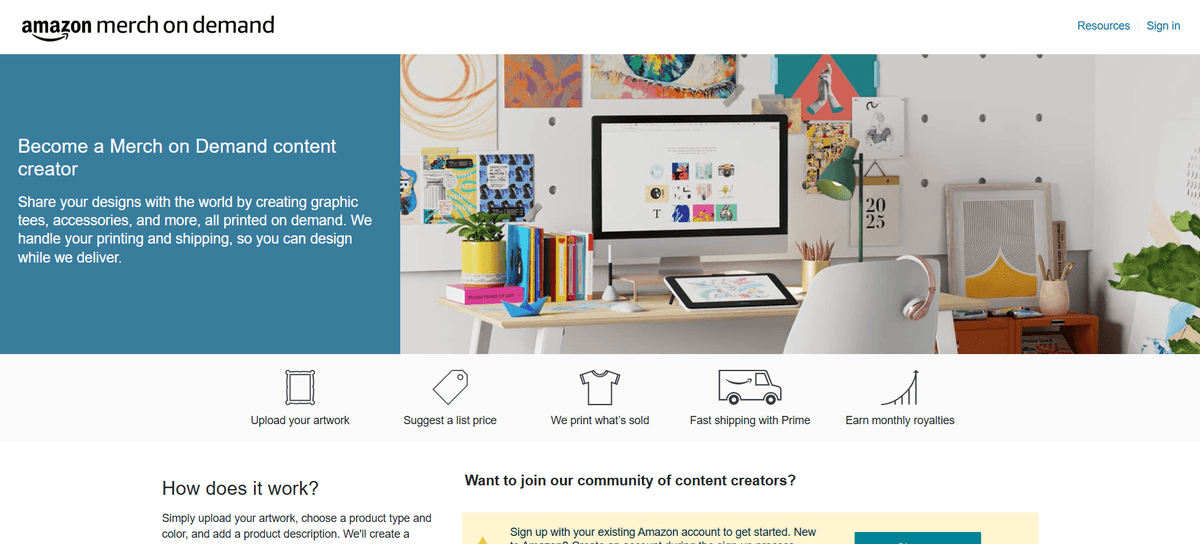
Amazon Merch on Demand puts your designs in front of the largest shopping audience on the planet. When a design sells, Amazon prints it, ships it, handles support, and pays you a royalty. The reach is unmatched, and a design that catches on can move serious volume through Amazon's own search traffic.
Why it fits AI art: Merch allows AI-assisted designs that are your own original work. The enormous built-in demand means a well-targeted design doesn't need you to bring any traffic. Amazon does that part.
The catch: Merch is invite and tier-gated. You apply for an account, acceptance isn't guaranteed, and you start at a low tier with a small number of design slots. You climb tiers by making sales, which unlocks more slots. The content policy is strict, and Amazon removes designs and can close accounts for IP violations without much ceremony. Generated art that carries a hidden trademark is exactly the kind of thing that gets caught. The application barrier and slow tier climb make this a slower start than Redbubble.
How it makes money: You set a list price, Amazon subtracts its costs, and you keep a royalty on each sale. Higher-priced products and higher tiers improve your economics.
Best for: Sellers who want maximum reach and are willing to work through the application and tier system. Not the place to start on day one if you want instant listings.
5. Your own store (Shopify, Gumroad, and similar)
Selling from your own store flips the whole model. Instead of listing on a marketplace and accepting its cut and its rules, you sell directly, keep most of the margin, and own the customer relationship. You can sell physical prints (paired with a print-on-demand fulfiller) or digital downloads. Gumroad is the low-friction option for digital files; Shopify is the fuller storefront if you want a brand.
Why it fits AI art: There's no marketplace policy layer deciding what you can list, so within the law you set your own rules. Margins are the best on this list because no marketplace commission takes a slice of every sale. For high-quality generated art with a clear audience, this is where the money actually stays with you.
The catch: On a marketplace, the platform brings the buyers. On your own store, you bring the traffic, all of it. No audience means no sales, however good the art is, so you're now doing marketing on top of making the work. Shopify also has a monthly subscription cost, and both charge payment processing fees. It's the highest-margin option and the highest-effort one.
How it makes money: You keep the full sale price minus your fulfillment cost (for physical) and payment processing. On digital downloads through Gumroad, that's most of the price.
Best for: Sellers building a real brand, anyone with an existing audience to sell to, and higher-priced digital products where the margin justifies bringing your own traffic. Not the first move for someone with no audience yet.
6. Society6 or Displate (the wall-art angle)
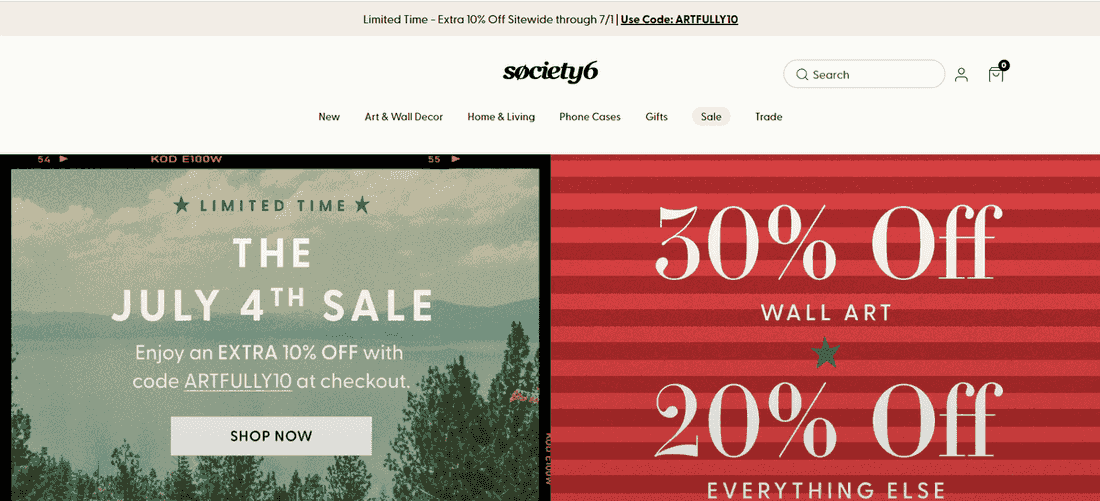
If your AI art leans toward wall pieces, home decor, or collectible prints rather than apparel and stickers, a dedicated art-print marketplace fits better than a general POD platform. Society6 specializes in art prints, canvases, and home decor. Displate is built around magnet-mounted metal posters, popular with the gaming and pop-culture-adjacent crowd.
Why it fits AI art: Both are print-on-demand and permit your own original AI-assisted work. Their audiences come specifically to decorate spaces, so illustration-heavy and aesthetic generated art, the kind AI tools are strong at, has a natural home here in a way it doesn't on an apparel-first platform.
How it makes money: Print on demand. You set a royalty or markup on top of the base product cost, and the platform handles printing, shipping, and payment. Metal prints and larger canvases carry higher per-unit value than a sticker or tee.
The catch: These are narrower, lower-traffic marketplaces than Redbubble or Amazon, so the ceiling on volume is lower. And the same IP rules apply. A generated wall print that reproduces a copyrighted character or a real person's likeness is a takedown waiting to happen.
Best for: Wall art, home decor, and collectible-print niches where the physical product quality is the selling point, ideally as an additional storefront alongside a broader platform.
Where to actually start (and how to not get struck)
Six options is enough to stall on. So pick by your goal, not by the longest feature list.
If you want the easiest passive start with no inventory and no traffic to bring, start on Redbubble, then cross-list the same designs to TeePublic. That's the lowest-friction way to find out whether your art sells at all, and it costs you nothing but upload time.
If you want the strongest buyers and you're comfortable with digital downloads, go to Etsy. Just disclose the AI use honestly in every listing, because on Etsy that's a rule, not a nicety.
If you want to keep the margin and you already have (or will build) an audience, run your own store on Shopify or Gumroad. Accept that you're signing up to do the marketing, because nobody arrives on their own.
If your art is wall pieces and home decor, add Society6 or Displate as a specialized storefront on top of one of the above.
Two rules hold no matter which door you pick.
Validate demand before you generate. The design is the cheap part now. What decides whether you sell is picking a niche people actually buy in, with competition you can realistically beat, before you make anything. Look at what's genuinely selling, not just what's being searched.
Screen every design and phrase for trademarks. This is the single thing that suspends print-on-demand accounts, across all of these marketplaces, and AI generators produce infringing content by accident constantly. A brand name, a slogan, or a character that's registered in your product class is a landmine however you made the art. Our free POD trademark checker runs a name or phrase against the USPTO database so you can catch the obvious ones before you invest in a design. It won't spot a stray logo hiding inside your generated image, so you still have to look at what you made with your own eyes, but it kills the easy mistakes that end shops.
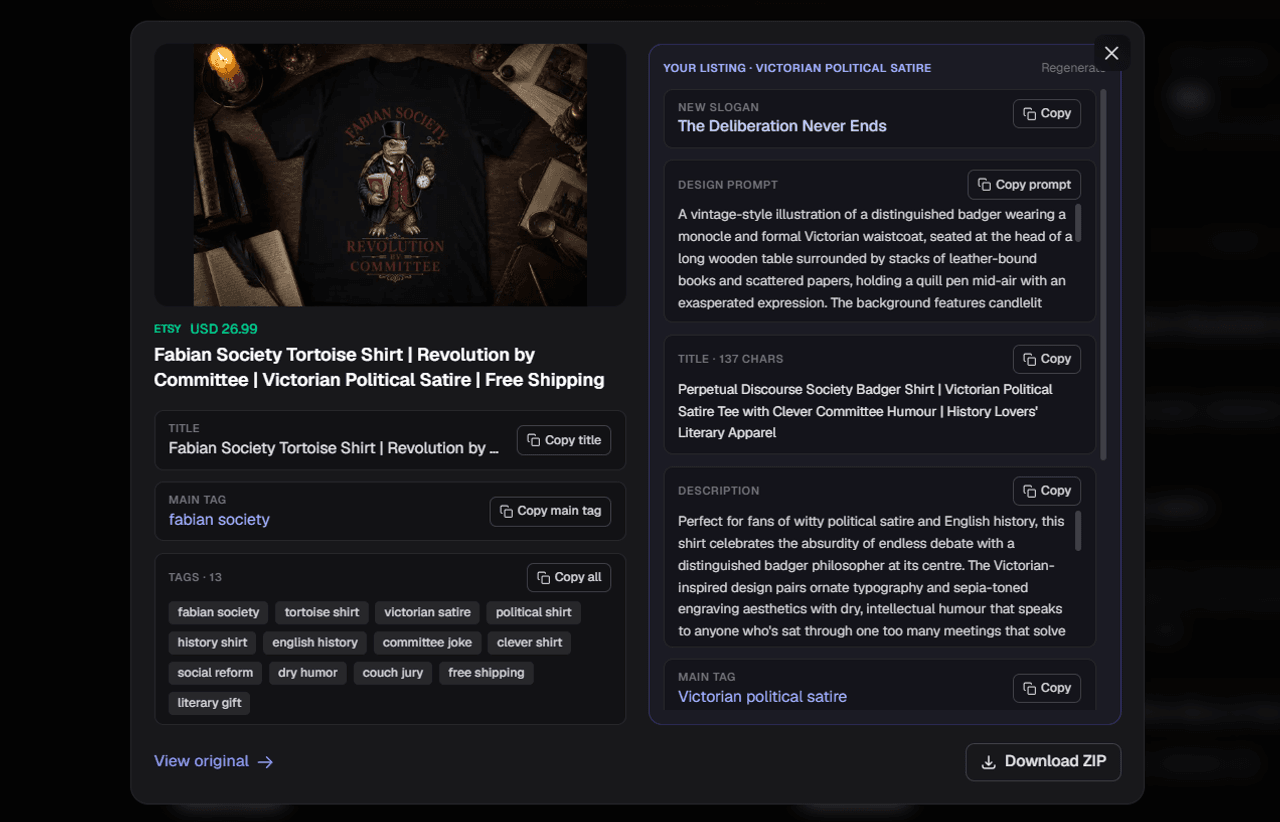
Those two habits matter more than which of the six marketplaces you choose. Getting them right is why I built Trendlytic: one search shows what's actually selling across Redbubble, TeePublic, Amazon Merch, and Etsy side by side, with a live USPTO lookup for the phrases you mean to use. There's also an AI Listing Generator, and I want to be exact about it because it's not what people assume. It does not make artwork. It takes a validated niche and outputs a listing for a new design of your own: a design prompt you paste into whatever image generator you prefer, plus a slogan, a title, a description, and per-marketplace keywords. What it carries over from a proven niche is the keywords, never the artwork. The design itself is still yours to make, which is exactly what these platforms require.
FAQ
Where is the best place to sell AI art?
For most people, Redbubble is the best place to start, because listing is free, there's no inventory, and your design gets applied to a wide range of products automatically. Etsy is the best for buyer intent, especially for digital downloads, as long as you disclose the AI use. Your own store on Shopify or Gumroad keeps the most margin but requires you to bring your own traffic. The best choice depends on whether you want passive print-on-demand income, digital sales, or a brand you own.
Can you sell AI art on Redbubble and Etsy?
Yes, both allow it. Redbubble permits AI-assisted art as long as it's genuinely your own work and follows its content and IP rules. Etsy also allows it, with the added requirement that you disclose the use of AI and describe honestly how the item was made. On both platforms the account risk is trademark and IP infringement, not the fact that you used a generator.
Is it legal to sell AI-generated art?
Generally yes. Selling AI-generated art that you made with your own prompts breaks no law, as long as it doesn't infringe someone else's intellectual property. The complication isn't legality, it's ownership. In the US a purely AI-generated image usually can't be copyrighted because copyright requires human authorship, so you can sell it but may not be able to stop others from copying it. Reselling a pack of someone else's generated images as your own, or a design that reproduces a protected brand or character, is where you cross a line.
Can you make money selling AI art?
Yes, but the money is in picking the right niche, not in making the art. Because AI made producing designs nearly free, the popular categories are saturated, and being one more generated listing in a flooded niche means no sales. The sellers who earn are the ones who validate real demand against saturation before they generate anything, and who spread proven designs across multiple marketplaces. Treat the design as the easy part and the research as the real work.
Do you have to disclose AI art?
On Etsy, yes. Etsy requires you to disclose that AI was involved and to describe honestly how the item was made. Other marketplaces don't all demand an explicit AI label, but every one of them requires that the work be genuinely yours, so being honest about how you made something is the safe default everywhere. Where a platform asks for disclosure, treat it as a rule, not a suggestion.
Can you copyright AI art?
Usually not, if the image is purely AI-generated, because US copyright protection requires human authorship that raw machine output lacks. You can still legally sell the image, but you may not hold an enforceable copyright, which means a competitor could copy your design with little you can do about it. Meaningful human input, editing the output, arranging elements, or combining generated pieces with your own creative work, can add protectable authorship. It's the untouched, straight-from-the-generator file that leaves you exposed.
Conclusion
Where to sell AI art comes down to your goal. Redbubble and TeePublic for the easiest passive start, Etsy for the strongest buyers and digital downloads, your own store to keep the margin, and an art-print marketplace like Society6 or Displate for wall decor. Every one of them allows your own AI-assisted work, and every one of them suspends sellers for the same thing: trademark and IP infringement, not the AI.
So put your effort where it actually pays. Validate that a niche is genuinely selling before you generate anything, and screen every design and phrase for trademarks so one flag doesn't cost you an account. That's what Trendlytic does in one search across Redbubble, TeePublic, Amazon Merch, and Etsy, with a live USPTO check available on any phrase. You can start a free trial, from $19.99 a month for 100 searches, and research what's actually selling before you spend a day making art.
Which marketplace are you leaning toward, and have you checked yet whether your niche is selling or just crowded?
Like this? Get one like it every Wednesday.
Niche data, trademark alerts, one tactic per week.
Try Trendlytic
Find your next winning POD niche in 40 seconds
Live data from TeePublic, Amazon Merch, Redbubble, and Etsy, with a trademark check built in. Then turn any winner into a listing for a design of your own in that niche. Plans from $19.99/month.
Start researchingKeep reading
- Trendlyticcan you sell ai art on redbubble
Can You Sell AI Art on Redbubble? What's Allowed
The JournalCan You Sell AI Art on Redbubble? What's Allowed
July 17, 2026 · 15 min read
- Trendlyticcan you sell ai art on etsy
Can You Sell AI Art on Etsy? What's Actually Allowed
The JournalCan You Sell AI Art on Etsy? What's Actually Allowed
July 17, 2026 · 15 min read
- Trendlyticprintify alternatives
8 Best Printify Alternatives in 2026 (Faster & More Reliable)
The Journal8 Best Printify Alternatives in 2026 (Faster & More Reliable)
July 6, 2026 · 14 min read