TL;DR: Yes, Zazzle is legit. It's an established, US-based print-on-demand marketplace and customization platform founded in 2005, with millions of orders fulfilled, real customer support, and a buyer satisfaction guarantee. It's safe to buy from, with the usual large-marketplace caveats: shipping times and print quality can vary by product and by third-party designer. For sellers it's a real platform with genuine royalties, but it's competitive and getting discovered is hard. Below: what Zazzle is, whether it's safe to buy, the common complaints (and how to avoid them), and whether it's worth selling on.
If you searched "is Zazzle legit," you're probably one of two people. Either you're about to place an order (a custom invitation, a mug, a gift) and want to know it's not a scam, or you're a designer weighing whether it's worth selling there. The honest answers are a little different for each, so this article covers both.
I've spent two years tracking print-on-demand (POD) marketplaces and the sellers who work them. Zazzle isn't one of the platforms my own tool covers, so I have no reason to oversell it. I'll give you the buyer answer fast and clearly, then go deeper on the seller side, where most of the real nuance lives.
No hype, no scare tactics. Just a balanced read.
Don't miss the next one.
New POD niche analysis every Wednesday.
What is Zazzle?
Zazzle is a print-on-demand marketplace and customization platform founded in 2005 and based in the United States (Redwood City, California). It's one of the older players in the space, which on its own says something: scam sites don't usually survive twenty years.
Here's how it works depending on who you are:
For buyers, Zazzle is two things at once. It's a marketplace where you can browse millions of ready-made designs from independent creators, and it's a customization engine where you can personalize almost anything yourself, adding names, dates, photos, and text before you order. That second part is what Zazzle is best known for. Where Redbubble is mostly "pick a finished design," Zazzle leans into "make it your own."
For designers, Zazzle lets you upload artwork, apply it across a huge catalog of products, set your royalty rate, and earn when people buy. There's no upfront cost to open a store.
The product range is genuinely wide, and wider than most POD sites. Alongside the usual apparel and stickers, Zazzle is strong in:
- Invitations, announcements, and stationery (a real specialty, especially weddings)
- Business cards and office supplies
- Mugs, drinkware, and home goods
- Gifts and personalized keepsakes
- Postage stamps (a long-running, distinctive Zazzle product)
So when people ask "what is Zazzle," the short answer is: an established US print-on-demand site that's part marketplace, part custom-product builder, with an unusually deep catalog and a strong lean toward personalized and event products.
Is Zazzle legit and safe to buy from?
Yes. Zazzle is a legitimate, established company, and it's safe to buy from in the ways that matter most.
The reasons buyers can order with confidence:
- It's a real, long-running company. Founded in 2005, US-based, with millions of orders fulfilled over nearly two decades. This is not an anonymous dropshipping front that appeared last month.
- Payment is secure. Zazzle uses standard encrypted checkout and major processors (credit and debit cards, PayPal, and others). You're paying Zazzle the company, not handing card details to an individual seller.
- There's a satisfaction guarantee. Zazzle publicly backs orders with a satisfaction guarantee, meaning if your product arrives wrong, damaged, or doesn't meet a reasonable expectation, you can pursue a refund or replacement.
- There's real customer support and a return process. Support exists, it's reachable, and the return and refund process is real. As with any large marketplace, the experience of using it varies, but the process is there.
So for the core fear ("will I get scammed, lose my money, receive nothing?"), the answer is no. That's not what Zazzle is. The legitimate concerns buyers have are about experience quality, not fraud, and that's what the next sections cover.
Zazzle reviews: what customers actually say
Pulling together the recurring themes from buyer reviews across the usual places (Trustpilot, the BBB, Reddit threads, and general consumer feedback), the honest read is that sentiment is mixed but leans positive. Plenty of buyers are happy repeat customers; a meaningful minority have had a frustrating experience. That's a normal profile for a large print-on-demand marketplace, not a red flag.
I'm not going to invent a star rating or quote a specific score, because those numbers move around and any single figure would be misleading. What's more useful is the pattern of what people praise and what they complain about.
What people praise:
- The customization tools are genuinely good. The ability to personalize products with names, photos, and text is the standout, and it's why Zazzle is a go-to for events.
- The product range is huge, especially invitations, stationery, and gifts.
- Print quality on its core products (especially paper goods like invitations and business cards) gets consistently solid marks.
- Frequent promotions and discount codes make orders cheaper than the sticker price suggests.
What people criticize:
- Shipping times can be longer than expected, especially with the cheaper shipping tiers.
- Print quality can vary on some products and from some third-party designers.
- Resolving a problem through support can take patience.
The honest summary: Zazzle reviews skew positive-to-mixed, and the negative reviews are overwhelmingly about experience (shipping speed, occasional quality variance, support friction) rather than about Zazzle being fraudulent. That is exactly the signal of a legit-but-imperfect marketplace, which is what it is.
Common Zazzle complaints (and how to avoid them)
If you read the critical reviews, the same handful of issues come up. None of them make Zazzle a scam. They're the normal trade-offs of print-on-demand, and most are avoidable with a little care before you click buy.
1. Shipping can be slow. Because items are made to order, production time stacks on top of shipping time. The cheapest shipping option, in particular, can run longer than people expect. Tip: read the estimated delivery window at checkout, and if you have a hard deadline (a wedding, a birthday), pay for a faster tier or order well ahead. Don't order for a deadline three days out.
2. Print quality varies by product and designer. Zazzle's core paper goods are consistent, but apparel and some specialty items can vary, partly down to the product line and partly down to whether the third-party designer uploaded a high-resolution file. Tip: check the product reviews and zoom into the design preview before buying, and prefer products and stores with visible review history.
3. Returns and refunds can take patience. The satisfaction guarantee is real, but custom and personalized products have stricter return rules (understandably, since a mug with a stranger's name can't be resold). Tip: double-check your personalization (spelling, dates, photo placement) before ordering, since errors you introduce yourself are harder to get refunded than a genuine defect. Keep your order confirmation and include photos when you contact support about a defect.
4. Designer quality varies. Zazzle is a marketplace of independent creators, so quality isn't uniform across every store. Tip: treat it like any marketplace. Favor designs with reviews, and read the product details rather than assuming every listing is equal.
Here's the buyer-vs-seller view at a glance:
| Concern | Buyers | Sellers |
|---|---|---|
| Is the company legit? | Yes, US-based since 2005 | Yes, US-based since 2005 |
| Will I lose money to a scam? | No, secure checkout, real products | No, real royalties paid out |
| Main real risk | Shipping speed, quality variance | Competition, hard discovery |
| Customer service | Real support, can be slow | Help center and seller support |
| Worst-case outcome | Defect, then refund or replacement | Designs that never get found |
Is Zazzle worth it for sellers and designers?
Yes, Zazzle is a legitimate platform to sell on, and it genuinely pays its designers. But "legit" and "worth it" are two different questions, and the honest answer to the second is: it depends on your designs and your patience.
What's good about the seller side:
- No upfront cost. Opening a store and uploading designs is free.
- You set your own royalty rate. Zazzle lets designers choose their royalty percentage on top of the base price, which gives you more control than some platforms.
- A massive product catalog. One design can be applied across a huge range of products, including high-value items like invitations and stationery where margins can be healthier than a basic tee.
- A referral and associate program. You can earn additional commission by driving traffic to Zazzle, including to your own products.
What's hard about it:
- It's competitive. Like every established POD marketplace, the popular categories are crowded. A generic design dropped into a saturated category may never get seen.
- Discovery is the real bottleneck. Getting your products found, both inside Zazzle's search and from outside traffic, is the difference between earning and not. Many beginners upload a handful of designs, get no sales, and conclude the platform is broken. It isn't. The designs just weren't surfaced or weren't differentiated.
That last point is where the whole game lives, and it's the same on Zazzle as it is on Redbubble, TeePublic, Amazon Merch, or Etsy: the sellers who earn are the ones who figure out what people are actually buying before they design, instead of guessing. Validating real demand against saturation, and trademark-checking your text before you upload, is what separates earning stores from dead listings.
Doing that research by hand is slow. It means digging through what's actually selling across several marketplaces and cross-referencing the USPTO trademark database, which is hours of work per niche. That cross-marketplace research is exactly what I built Trendlytic to automate, though to be straight with you, Zazzle isn't one of the four marketplaces it covers (it's TeePublic, Amazon Merch, Redbubble, and Etsy). So I won't pretend it researches Zazzle for you. The principle it's built on (validate demand vs saturation, check trademarks first) applies wherever you sell, Zazzle included. If you mainly sell on the four it does cover, it'll save you the manual digging.
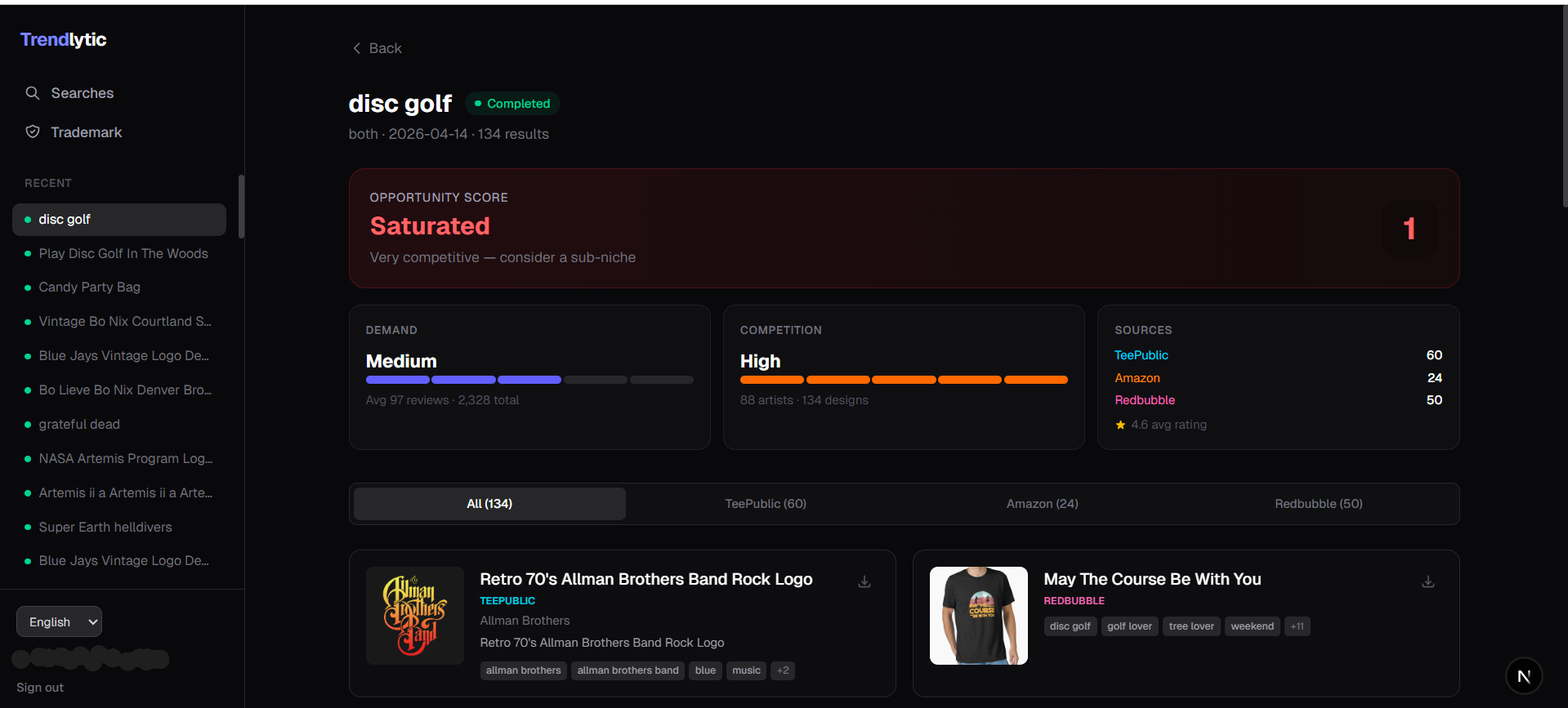
That "is this niche saturated or open" read is the check that decides whether a design is worth your time, on Zazzle or anywhere else.
If you want the research method itself, separate from any tool, I've written it up here: how to find trending POD niches and the most profitable print-on-demand niches.
Zazzle vs other print-on-demand platforms
If you're choosing where to buy or sell, here's an honest one-line-each comparison against the platforms people usually weigh Zazzle against.
- Zazzle is the customization and event specialist, with the deepest product catalog and the best personalization tools, strong on invitations, stationery, and gifts.
- Redbubble is more art-and-design focused, big on stickers and apparel from independent artists, with less emphasis on personalization.
- Etsy is a broader handmade-and-vintage marketplace where POD is allowed but you handle more of the shop and listing work yourself.
- Amazon Merch is invite-only with the largest built-in audience, but it's apparel-led and tightly controlled.
A rough at-a-glance comparison:
| Platform | Best for | Customization | Product range | Discovery difficulty |
|---|---|---|---|---|
| Zazzle | Events, gifts, personalized items | Excellent | Very wide | Hard |
| Redbubble | Art, stickers, apparel | Limited | Wide | Hard |
| Etsy | Handmade feel, broad buyer base | Varies by shop | Wide | Medium-hard |
| Amazon Merch | Apparel at scale | None | Narrow (apparel-led) | Hard, plus invite-only |
There's no single "best" here. For buyers wanting a personalized gift or event stationery, Zazzle is often the strongest pick. For sellers, the right platform depends on your art style and where your audience already is, and many designers cross-list across several rather than betting on one.
FAQ
Is Zazzle legit? Yes. Zazzle is a legitimate, established US-based print-on-demand company founded in 2005, with millions of orders fulfilled, secure checkout, real customer support, and a satisfaction guarantee. Complaints exist, but they're about service quality, not fraud.
Is Zazzle safe to buy from? Yes. Payments go through Zazzle's secure, encrypted checkout, you receive a real physical product, and there's a satisfaction guarantee plus a return and refund process if something arrives wrong or damaged. You're paying the company, not an individual seller.
Is Zazzle a legit website? Yes. Zazzle.com is the official site of a real company that has operated since 2005. As always, only order through the official zazzle.com domain and ignore any email asking for your password or payment outside the site.
Are Zazzle reviews good? Reviews are mixed but lean positive. Buyers praise the customization tools, product range, and core print quality; the common complaints are about shipping speed, occasional print-quality variance, and support friction. That's a normal profile for a large print-on-demand marketplace.
Is Zazzle good for sellers? It's a legitimate platform that pays real royalties, lets you set your own royalty rate, and has a huge product catalog. The catch is competition and discovery, getting your designs found is hard, so research and differentiation matter more than upload volume.
How long does Zazzle take to ship? It varies. Because products are made to order, production time is added on top of shipping time, and the cheapest shipping tiers can take longer than expected. Read the estimated delivery window at checkout and order ahead for any hard deadline.
Is Zazzle better than Redbubble or Etsy? It depends on what you want. Zazzle is the strongest for personalized and event products with the best customization tools. Redbubble is more art-and-sticker focused. Etsy is a broader marketplace with more shop control. Many sellers use more than one.
Conclusion
So, is Zazzle legit?
- For buyers: Yes. It's a real, established, US-based company with secure payment, a satisfaction guarantee, and an unusually deep catalog of customizable products. The genuine downsides are shipping speed and occasional quality variance, normal print-on-demand trade-offs, not scams. Check reviews, read the delivery estimate, double-check your personalization, and you'll likely be happy.
- For sellers: Yes, it's legit and it pays. But "legit" doesn't mean "easy." The platform is competitive and discovery is the real hurdle, so the designers who earn are the ones who research demand and differentiate before they design.
Zazzle isn't broken. What's usually broken is the expectation, on the buyer side, that a made-to-order product ships like an Amazon Prime item, or, on the seller side, that any design will sell itself. Go in with realistic expectations on both and it's a solid, legitimate platform.
If you're selling, on Zazzle or anywhere, the whole game is figuring out what people actually buy before you design, and not getting tripped up by trademarks. You can do that by hand with marketplace browsing and the USPTO database in a browser tab. That's how I started. If you sell on TeePublic, Redbubble, Amazon Merch, or Etsy, Trendlytic automates that cross-marketplace research for $9/month, with a free trial. It won't research Zazzle for you, but the habit it's built on applies wherever you list.
Further reading:
- Is Redbubble legit and safe? — the buyer-and-seller verdict
- Is TeePublic legit and safe? — Redbubble's sister site
- The most profitable print-on-demand niches — where the demand is
- How to find trending POD niches — the research method
One question for you: Are you here as a buyer checking that your order is safe, or as a designer weighing whether to sell on Zazzle? If you're thinking about selling, what's holding you back, the competition or not knowing what to design? That answer usually tells you exactly what to research first.
Like this? Get one like it every Wednesday.
Niche data, trademark alerts, one tactic per week.
Try Trendlytic
Find your next winning POD niche in 40 seconds
Live data from TeePublic, Amazon Merch, Redbubble, and Etsy, with a trademark check built in. Then turn any winner into a listing for a design of your own in that niche. Plans from $9/month.
Start researchingKeep reading
- Trendlyticcustom yard signs
Custom Yard Signs: What Print on Demand Really Does
The JournalCustom Yard Signs: What Print on Demand Really Does
September 27, 2026 · 17 min read
- Trendlyticcustom mouse pads
Custom Mouse Pads: What Sells and What Does Not
The JournalCustom Mouse Pads: What Sells and What Does Not
September 25, 2026 · 18 min read
- Trendlyticcustom coasters
Custom Coasters: What Sells, and Why It Is Sets
The JournalCustom Coasters: What Sells, and Why It Is Sets
September 25, 2026 · 18 min read